
Isn’t it a little late in the day for a hot take on Apple’s Vision Pro AR headset? The thing was announced all of two weeks ago. The news cycle has cast the Eye of Sauron upon it, made pronouncements and swept on in search of the next headline. No time for a thoughtful examination. Everyone else is bloviating, you need to get your voice heard too, quickly. 99 percent of the articles feel the same—a quick spin through the tech specs and an opinion based on, for those with privileged access, a short period of time spent with the device. This would have been a carefully curated, heavily stewarded experience. The last thing Apple want is commentary outside their interests.
Fine, that’s the way the news cycle works. But none of it told us anything about what it would be like to live and work with the bloody thing. And no-one will know until it launches ‘sometime in 2024’. All we have is lightly informed speculation on a beta product which was rolled out to garner research on the Vision Pro, its potential market and what needs to change before it finally hits the Apple Store.
Fine, ok, there was an outlier. Joanna Stern in the WSJ gave a less fanboy take on the device which actually addressed real-world use.
But in my experience, that was about yer lot. One article out of thousands with a different perspective.* So it made sense for me to step back, take a breath and figure out where the immediate, visceral reaction I had to the announcement and presentation of the Vision Pro came from.
Which is why you’re getting this instead of Chapter 21 of The Swipe. I just couldn’t let it lie. Sorry. If you’re already sick of the discourse around a device you probably don’t want and almost certainly can’t afford, please enjoy instead this pick from the archive where I share the story of the two Straight 8 films I never made, and the one I did.
Right. For those of you left, I’ll try to keep this as ungeeky as possible. No point in banging on about chips or cameras or comfort straps. You can get all that on other sites. I have two subjects in mind.
Identity and interaction.
Here’s Exhibit A—Apple’s presentation film on the Vision Pro. It’s worth taking ten minutes to watch the whole thing. I’d be interested to know how many of you had the same instant queasy reaction as me.
This is the moment that really struck me. Apple flag it as two people happily chatting, as if the lady in white isn’t wearing a set of ski goggles.
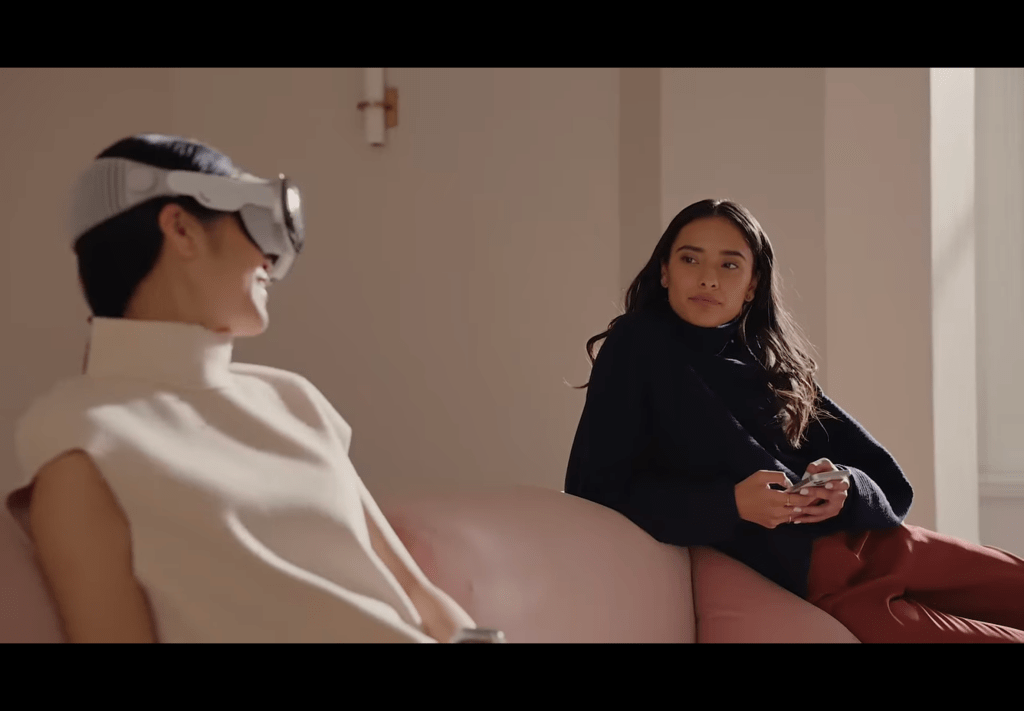
It’s not a normal interaction. Goggle-girl is looking at her friend through a set of cameras. Even though they’re called pass-through, it’s as if she’s holding a phone up to her face and viewing the girl in black that way.
Then there’s this.

You can just see goggle-girl’s eyes through the mask, right? Nope. You’re looking at an OLED screen with a projection of her eyes, taken using more of the Vision Pro’s internal cameras. Both women, sitting a couple of feet apart in the same room, are interacting with screens, digital approximations of each other. The only way for them to chat like normal people would be if goggle-girl took the damn mask off. And what would be the point to that?
Let’s look a little deeper into the way Apple takes charge of the way we present to the world at large using the Vision Pro. For FaceTime and virtual conferencing, you’ll show up as an avatar, presumably scanned by LIDAR when you buy the device. That avatar should map your facial expressions and accurately lip-sync your speech. But it won’t be you. It’ll be a version. A CGI puppet, and who knows what it’ll look like when it glitches?
I mean, yeah, sure, I understand how slippery identity is in the digital realm. We are not ourselves on the internet. Very few of you know who I am, what I look like (unless you’ve seen that terrible photo of me I posted a couple of weeks back in which case I apologise and hope I didn’t put you off your breakfast), how I speak. What you get on the blog is a representation of me. Again, a digital approximation. But, importantly, it’s an approximation I control. I present to you in the way I want. You don’t get that with the Vision Pro. Apple takes it out of your hands.
There’s already been discussion about whether you’ll be able to tweak the avatar, make it shinier, younger, more cartoony—basically slapping an Instagram filter onto yourself. It’s just as feasible to turn the eyes on the front-facing screen into, say, anime-wide peepers. Which could be fun when you’re trying to engage with your goggled-in kid and all you can see is Naruto’s eyes staring back at you.
In the world of Vision Pro, though, it’s rare to be in a room with other people. In the ten minutes of presentation, there are only two moments where human beings share a space—the aforementioned chat between goggle-girl and her pal in black, and two shots of a guy making videos of his kids which he then, slightly creepily, plays back to himself. Other than that, every actor in the clip is on their own or interacting virtually.
Which, horribly, is sort of the point. Vision Pro is a single-user interface. You can’t share it in any meaningful way. TLC and I will often show each other funny videos and pics on our phones or tablets. It’s a common activity. It’s what people do to humanise their relationship to technology. This has been designed out of the Vision Pro experience. Apple justify its high price by considering it a replacement for a big-screen telly, high-end stereo and laptop. But what if you want to watch Avatar: The Way Of Water with your partner or kids? Will they all have to splash out (sorry) for their own headsets? Would you be able to link them so everyone is watching the same thing and not just slightly time-slipped streams? Amazon and Spotify enable folks around the world to watch or listen in parties no matter how geographically separate. There’s no sign, yet, of whether Vision Pro will be able to do the same. And even if it can, we’re back to the same lonely paradigm. People in different countries, sitting in rooms on their own.
I often see folks walking down the street, headphones on, eyes on their screen and not on the road ahead. We have trouble breaking away from the shiny window in our pocket. It’s the reason for all the guidelines which insist you take regular breaks. Easy enough with a phone or laptop—a simple physical movement while you close a lid or stow it in a pocket. We often talk abut being ‘glued’ to our devices. With Vision Pro we are physically attached. The thing is strapped onto our heads, with the battery in a pocket. It makes accessing screen breaks that bit more difficult, which means people are more likely to skip it. Don’t forget, it’s not just about swiping away from a home page. When you have Vision Pro on your face, you are behind a screen. The cameras are always on.
How quickly would it take all-day use of the Vision Pro to become the norm? Research is scarce into the possible physical side-effects of long-term immersion into virtual spaces, but I can imagine headaches, dizziness, nausea have to be expected. You probably know how bad it feels to be at work all day in front of a computer, even allowing for breaks. Sure, Apple have designed apps which simulate natural environments, and studies have shown in the short term there can be some limited cognitive benefits. But all day every day? No-one’s mapped that. Because they don’t have access to the Vision Pro. The only way we’re going to find out is with the device in the marketplace, and consumers as test subjects.
Ok, I know I sound bleak, and I’m as guilty as every other commentator who has written about the new headset. I have no clue what it’s like in use, or how it will or will not transform the work and home environment.
However, despite everything I’ve just said, I believe there is a place for AR and the Vision Pro is a big step towards a world where the virtual and the real blend in surprising and exciting ways. But the form factor, for now, clearly isn’t right and there has to be a way to easily take a break. We need to ensure we can still interact with the world and each other in simple, straightforward and non-creepy ways.
When a device with the Vision Pro functionality and the looks of a chunky pair of Ray-Bans that you can just take off and sit on a table hits the market, you could be hearing something very different from me. We’ll have to see what happens a year or so down the line.
For now, I’m going to take a wander down the garden and take a screen-break in a green space. Feel free to do the same.
Thanks for listening. See you next Saturday.
*There were probably others. I don’t pretend to be a thorough researcher. Feel free to share anything I may have missed.

 EXCUSES AND HALF TRUTHS