
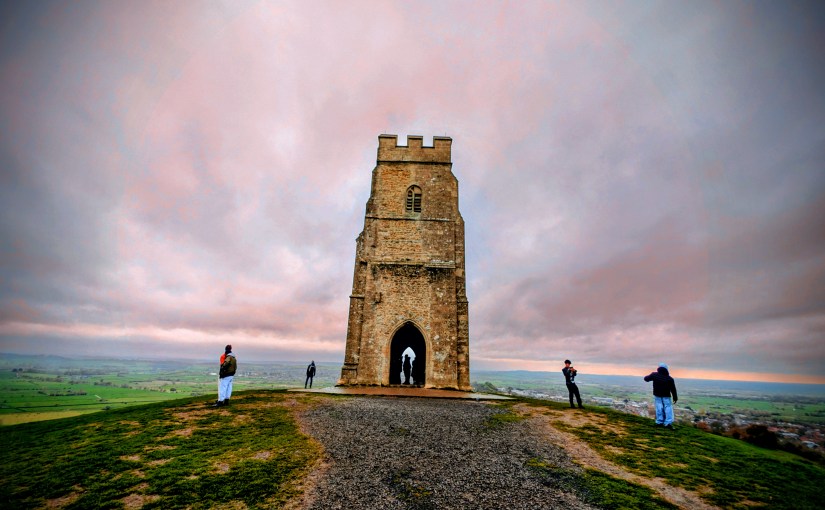
From Glastonbury Tor, you can find a kind of perspective. Below you, the lines of the earth are clear and sharp—both the natural contours of the land, and the hedges, fields and roads carved onto the face of Mother Earth by her violent offspring. Even on a cloudy, blustery day, the horizon is a long way in the distance. Petty concerns and worries slip off your shoulders, whisked away into the wild beyond, and for that moment you can breathe again.
As your head clears, you feel as if you’ve found something sacred.
C and I heard that word a lot on our long weekend in Somerset. The area around Wells and Glastonbury is one of those places in England where the skin between the mundane and the sublime is a little thinner, a shade more translucent. Here, it’s easy to believe in magic. Or at least, in a world beyond the everyday.
Here’s an example. We had booked a glamping pod, which you would reasonably expect to be in the middle of a field in the middle of nowhere. Imagine my surprise when the satnav guided us into a maze of back streets near the centre of Wells, passing industrial units, garages, the entrance to a branch of Morrison’s. We were lost, surely. Had I read the booking guide wrong?

We took one last turn, found ourselves in a farmyard, thence to a wide field with hills rolling away behind. Our pod awaited, in a place which in a logical world should not have existed. We could still see the supermarket.
We could also see Wells Cathedral.
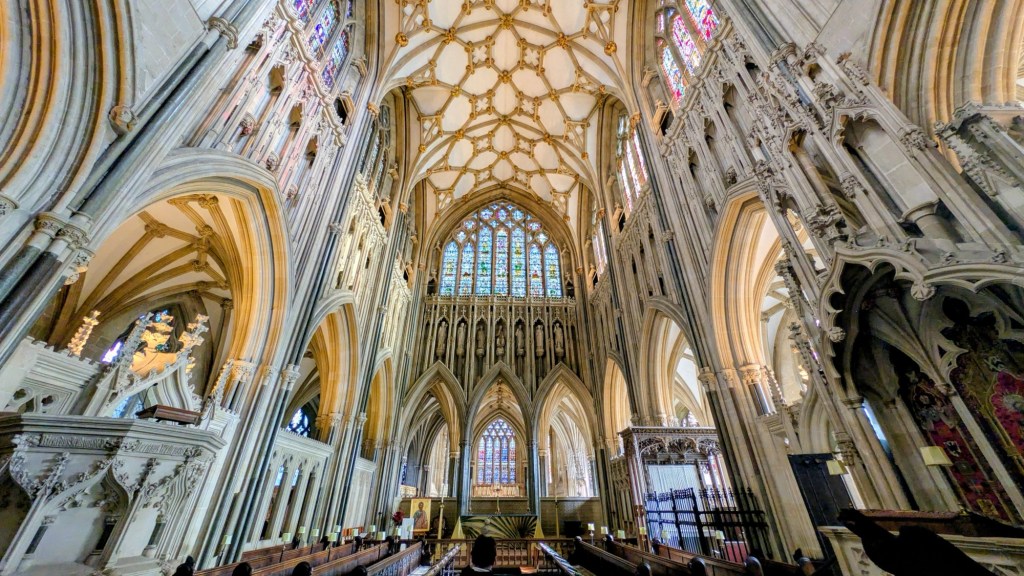
Imagine a hymn in stone, a symphony in granite, marble and brass. A dream of glory made manifest in soaring arches and spires, geometry made manifest, architecture wrought into being as an article of faith. A building like Wells Cathedral should not exist in a small Somerset town, tucked behind the market place through a humble archway. It is otherworldly, extraordinary in the purest sense of the world. A house fit for a god.

I’m always amused by the theories of certain credulence-stretching ancient historians that the remarkable buildings of the ancient past were constructed with such skill, to such fine tolerances, that mere humans must have had a helping hand, perhaps from aliens or time travellers. Side-barring the obviously racist undertones of the argument (it’s always the ancient Egyptians who need the help, never the Romans) it ignores the simplest explanation. Artifacts like Wells Cathedral and Glastonbury Abbey—of which more in a minute—were built with simple tools and techniques, but under the hands of craftsmen who would have honed their art over decades. They knew the stone, the metal, the glass. They knew how to form it, how to fit it. There would have been hundreds of men working on the building. And they would have taken their time. Wells Cathedral took three hundred years to rise from foundation to capstone. Over a long enough timeframe, with a sufficient workforce, any dream can be made real. That, I think is the most wonderful thing about Wells Cathedral. A house for a god, sure. But only here thanks to all too human virtues—hard work, skill, talent, tenacity.
Glastonbury rivals Wells in the weight of the history inside its walls, but the vibe is very different. We had expected a hippy feel. We were not quite ready for the sheer number of shops selling the alternative experience—arcane emporia, tarot card-slingers, all the supplies your coven or church-not-made-with-hands could possibly need. If you’re in the market for crystals or unicorn-themed ephemera, than by The Great God Pan, are you ever in luck. To the inhabitants of Glastonbury, this is Sacred Avalon. The last resting place of Arthur and Guinevere, (at least according to the monks of Glastonbury Abbey, who claimed to have discovered the grave in 1191, a declaration which had the entirely unsurprising effect of boosting the place into a major destination for pilgrims) the site of Chalice Well, a source of healing water, and of course the towering hump of the Tor overlooking everything. If you go in with the right attitude, Glastonbury is a lot of fun. The townsfolk are uniformly gentle and sweet, and there’s a calming air to the place. Arthur or no, it’s a nice place to pilgrimage to.
We visited on Remembrance Sunday. The Main Street was closed to traffic as wreathes were laid and the Last Post sounded. It’s always an eerie feeling to hear the sounds of a town ebb to silence at 11am, the small knot of supplicants round the memorial standing sombre and still.
I have a little ambivalence towards the ritual though—and let’s be clear, the performance which takes place on the Sunday nearest the 11th November has all the aspects of a rite, its phases proscribed, inviolable. There are unwritten laws, and trouble ahead should you choose to ignore them. You shall wear a poppy, you shall stop what you are doing. Never mind if you have your own way to remember the fallen which doesn’t include a donation to the British Legion.
And of course, we choose to remember without learning a thing. The War To End All Wars could not have been more ironically named. It’s argued that as the last participants in the Big World Wars die, we move our attention to veterans of more recent conflicts. The same mistakes made over and over again. Surely, our focus should be on building a world where this increasingly empty ritual has no place, no point. Where the fallen are remembered not because of how they died, but because of how they lived. My grandad Wal fought in Africa in World War 2. He never spoke about his time there, and we could never get war stories out of him. I think, given the choice, he would want to forget about it all.
But then I’m reminded of Kurt Vonnegut’s view on the subject, and realise a quiet moment on a single Sunday morning in November isn’t such a sacrifice.
After the bells had rung and the crowd around St. John The Baptists Church wandered off to do a bit of early Christmas shopping, C and I readied ourselves for a tiny pilgrimage of our own. It made sense to start at Glastonbury Abbey, through which so many penitents have passed. The building is bones now, high walls stark and clean against a scumble-grey sky. In the 12th century it was painted in bright colours, a joyous hallelujah with the added advantage of showing off the wealth and power of the monks. It still has the power to bring you to pause, even just as high walls and archways.
Curiously, the one structure which has had the most attention, restored to a condition close to the one in which it would have been used, is the kitchen. The most complete medieval building in Europe, you can clearly see how food was prepared, with dedicated fires for roasting and pots, and a blackened bread oven in one corner. A logical, practical layout. If they’d let me light the fires, I could probably cook a meal in there.
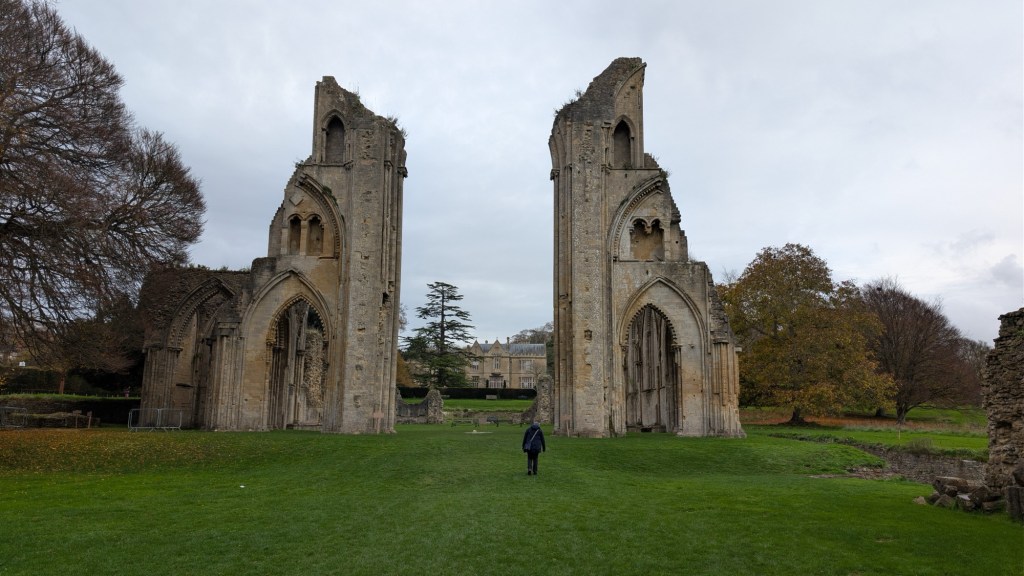
The tomb of Arthur and Guinevere is less impressive. Once you pass through the tall entrance (still surprisingly symmetrical) the grave itself is a simple slab with a plaque. A traveller had placed a single rose on the stone, which was starting to wilt. There has been no attempt to fancy this part of the Abbey up, as if it’s shamefully accepted that, like many of the purported sites of Arthur’s last resting place, its claim is subject to — shall we say, questions of authenticity.
Onwards, heading steadily uphill now to the site of Glastonbury’s holy spring, Chalice Well. This has been in use for hundreds of years, fed by an aquifer which delivers thousands of gallons daily, even in drought. It’s said to be the site where Joseph of Aramathea buried the Holy Grail, and the iron-tinged waters of the Red Spring remind the faithful of the nails of the Crucifixion.
Nowadays, it’s a place of spirituality and contemplation. You can sip of the healing waters (pleasingly cool and minerally, I can report) pace in the sacred pool, or simply sit and meditate for a while. The founder of the Chalice Well Trust, Wellesley Tudor Pole (yep, Eddie’s granddad) advocated for a Silent Minute twice a day at 12 and 3pm, as ‘a united and harmonious channel through which can pass strength and guidance.’ A quiet contemplative moment shared by all at a set time. Sound familiar?
Chalice Well is at the foot of Glastonbury Tor, our last steps on the path of pilgrimage. A high point on the flat expanse of The Somerset Levels, it has been a site of worship since Saxon times, and more than one building has been built at the summit. The current tenant is St. Micheal’s Church. You have to wonder why M&S don’t set up a small concession up there for hungry pilgrims.
At a snidge over 500ft it’s a steep climb to the top, but not a deal-breaker. There is a clearly defined stone path and plenty of places to rest. Pace yourself. Enjoy the way the view of the town and Levels gradually reveal themselves.
At the top, your reward—England, mapped out at your feet. You cannot help but be transported, if only thanks to the euphoria that comes with completing the climb. It was a windy, rainy day for us, all the better to feel my cares blow away like so much sawdust, whirling for a second over my head before the gusts took them. Ahead of us, a thigh-shuddering walk back down, and a celebratory pint as the rain settled in—try Becket’s on the High Street for the true Glastonbury experience—friendly, free-thinking and joyfully eccentric.
We ached, we were damp, we were a little emotional. But we knew how the pilgrims felt now. How walking a path in a mindful manner can be its own kind of worship, a sacred place to hold inside yourself.
One last thing. Our first night at the pod, full of pasta and a little boozed, and we decided to check out the wood-heated hot tub. Now, you may remember my struggles with fire from our Spring break. This was a little more successful, and we floated happily in the warm water, glass in hand. C finally decided she had wrinkled enough, and left me alone.
It was dark, and the rain began to fall. In the distance, the bell ringers at Wells Cathedral were practising, a carillon of chimes spiralling through the air. I floated, watching the fine needles of water droplets ping and pop on the surface of the water, listening to the bells, feeling myself blur and merge a little with the soft expanse of the universe. I was, at that moment, utterly content, totally at peace. It was—now, what’s the word?

 EXCUSES AND HALF TRUTHS