Fodderblog: A New Way With Salmon And Broccoli

It’s one of those classic combinations. I love salmon and broccoli in fishcakes and as part of a quiche filling. But sometimes it’s nice to separate the ingredients out, and give them a chance to compliment each other in a different way.

I’ll admit, this is a slightly odd mix, with Italian playing against Chinese flavours. But it works well, and it’s a lively and springtimey meal.

Start off with a couple of decent-sized salmon fillets. Coat them in a goodly dollop of pesto, and then roll each fillet in breadcrumbs. (There is no reason not to have breadcrumbs in the freezer. It’s the best way of using up stale bread. Blitz or grate the end bits that would just go in the bin otherwise, and bag ’em up. Easys.) You won’t get an even coating, but you need enough to give a light crunch. Alternatively, splodge pesto on top and press on a palmful of crumbs for a denser, more crispy finish.

Pop the fillets onto a baking sheet lined with greaseproof paper, and into a hot oven (200C, Gas 6) for 20 mins.

While they’re doing, steam some purple sprouting or tenderstem broccoli, for about ten minutes. The greens should take the point of a knife without any resistance, but should still be, you know, green. Once done, let the broccoli cool slightly, before mixing it with something salady – pea tops would be ideal, or some young watercress. The salad will soften slightly in the heat from the broccoli. That’s the plan, and why you need a robust salad leaf.

Then dress the greenery. Make up a basic vinegrette (three parts oil, one part vinegar. I used cider vinegar, because it was to hand. Lemon juice would be nice, I think). Then a little soy sauce for salty umaminess, which you might need to balance with a bit more acid. Taste, and taste again until you’ve got a flavour that works. This goes over the broccoli and salad, enough to add a shine. Don’t go nuts.

Pile the greens onto two plates, and top with the sizzling fish from the oven. Any spare dressing can go on the side.

It’s light, but fresh-tasting and full of flavour. You can bulk it out if you like with some new potatoes or rice, but I think it’s perfect as is. Save room for some cake afterwards, instead.

A Saturday Chicken and Sunday Sausages

(As promised, here’s yesterday’s post, which has been lying dormant in a sleeping netbook. I have taken steps to ensure that powerouts will not happen again. Thank you for your patience and consideration in this difficult time.)


We had rellies over this weekend, which always puts me in a nurturing, big-food mood. I love to gather people around our big round table and give them something good to eat. We lunched out heartily, so I was a little worried that my dinner would be picked over and poked about the plate without much interest. I was wrong.

I’ve always been a fan of the simple roast chicken, which takes so little effort and gives so much. The trick is not to ponce about, but allow the pure, clean flavours of the main attraction to shine through, with just a couple of accompaniments. On occasion we’ve simply had chicken with fresh warm bread and lots of aioli, but that’s a TLC and I treat that I don’t do for anyone else.

My way with chicken? A lemon up the backpipe (jabbed all over with a knife so that it squirts hot juice into the flesh as it cooks), olive oil massaged over the whole of the creature (think of how you would put suntan lotion on the one you love. Massage it in. Don’t be shy. You’re cooking with love), lots of Maldon salt and fresh ground pepper. That’s all. The chicken gives out enough fat to either baste your spuds or to make a thin, intense gravy. This time around I did neither, choosing to go a little French with a potato boulangerie (finely sliced potato and onion layered in a deep dish, covered with stock and baked) and a green salad of lamb’s lettuce and, in a trendy touch, pea tops, which look a bit like watercress and taste a bit like Bird’s Eye’s finest. The boulangerie was sloppy enough to create the lubrication the dish needed. It was great, and five empty plates told me all I needed to know. Then we had chocolate cake. Clearly, lunch had worn off.

The carcass was dealt with after we’d waved our guests goodbye the following day. It was stripped of any remaining meat (not much) then dumped in a pan, covered with water, and joined by peppercorns, the lemon (after I’d squeezed the sweet, tart juice over the leftovers) and a bay leaf. That bubbled away quietly to itself for a bit, maybe an hour or so, until I had a straw-coloured broth.

I’d done an emergency run to the shops the previous morning, and spotted Toulouse sausages on special, and a clever pack of beans and veg designed for a casserole. Sunday dinner fell into place in an instant.

The sausages were quickly fried off in a big pan after a dust with flour, which instantly gave them a tasty crust. Then the bean mix, and everything was tossed together to make friends. Once they were singing away happily, the remnants of a bottle of red from the night before went in, reduced down to cook off the booze and enrich the flavours. Then some of the stock from the chicken, enough to cover, and a squirt of tomato puree. I tipped the whole lot into my little red casserole dish with the lid, and into an oven at 200c/Gas 6 for an hour. The resultant stew was rich, unctuous, rib-sticking. There were whole cloves of garlic in the bean mix, which had softened enough to squish to a paste. The whole shebang was served with the remains of the Saturday loaf, and the leftover spuds from the boulangerie, pan-fried with leeks and mushrooms until a crust formed.

There’s enough stock left over to make a risottoish thing with the lemony chicken leftovers. One cheap chook has supplied enough to help out three meals. You don’t get that with a tray of pieces.


A Big, Fat Fish Pie For The Weekend

A busy day in the kitchen yesterday. A fresh loaf, a blueberry cake, and hell, I’m in the kitchen anyway, I might as well go the whole hog and make a fish pie.

This is more or less Nigel Slater’s famous recipe, and I’ve been making it for long enough that I can quote it from memory. It’s a messy job, there’s no doubt about it, but I’ve tweaked it enough that it’s reasonably straightforward. Even if it wasn’t, fish pie would be worth the fuss.

I start with about half a pound of fish in my big saute pan. Enough milk to cover goes in, with a bay leaf if you’ve got one and some peppercorns. Bring it to a simmer, and cook until the fish is about done. Should take about ten minutes. While that’s bubbling, chop a couple of big leeks and some mushrooms (enough to give you a couple of big handfuls of dice) and a stick of celery. I also put four fist sized potatoes in the steamer to cook, as they are, in their skins.

Fish done. Fish comes out of pan, and put somewhere to stay warm. If you’re a big ole cheaty-head like me, you’ve used a fish pie mix that’s skinless, boneless and already chunked up. If not, the skin and bones will come away easily from the cooked fish, which you should keep in chunky pieces. No mince here. Pour the fishy milk into a jug through a strainer. Keep this with the fish.

Wipe out the pan. Back on the heat with a little oil and butter, and cook the leeks and celery over a lowish heat with the lid on until the leeks are soft and bright green. Whip those out, reheat the pan and do the mushrooms, letting them soak up the oil and butter. You can do these in two pans if you like, but do them separately to stop the mushrooms going wet and sloppy, rather than flavoursome and slightly caramelised.

Once the mushrooms are nice and brown, add the leeks back in, and sprinkle over a couple of tablespoons of flour. Let this cook for a minute of so until you can’t smell the flour any more, then throw in the milk. Let this bubble until the sauce you suddenly have in the pan thickens a bit to a nice creamy texture. A big spoonful of creme fraiche, lots of salt and pepper, then stir the fish back in. If you fancy chucking in any fresh herbs, flat leaf parsley, maybe some celery leaves, hell, even basil, now’s the time. Give this another five minute love in. The sauce should be creamy and rich, not at all runny or sloppy.

While that’s doing, check your spuds. They should be done. Do what you have to do to turn them into mash. I’m not going to tell you how to do it. You’re a grown up. Be comfortable with your mash-making technique.

Pile the mixture into a baking dish. Now the spuds. I use a ricer, and squish cooked unpeeled potato straight on top. Saves on peeling, and gives a nice light result. Then cheese. People say you shouldn’t put cheese on a fish pie. Screw them. I like cheese. I used a nice strong Wyke Farm cheddar with horseradish for a little doink of heat. If you’re going to be all huffy about it, just dot some butter over your mash.

Hot oven (about 200C, Gas 6) for 15 minutes or until there are nice brown toasty peaks on your mash.

Serve to someone you love (you’re not gonna go to all that effort for someone you don’t at least fancy) with some peas and a little soft music.

Worry about the washing up later.

Mine’s A Half: The Battersea Beer Festival

I think we're in there somewhere...

Blimey, it comes round quick. It’s year three for the Beeranauts at the Battersea Beer Festival, a hastily assembled crew gathered for an evening session, as we weren’t organised enough to pull it together for a full day.

The South West train service from Reading is slow, but direct to Clapham Junction (un-nervingly, the station announcements were running backwards in my carriage. If I were to believe them I was heading further away from Clapham with every stop). From there, a short hike up Lavender Hill brings me to the Battersea Arts Centre, brutish in concrete cladding.

In the Great Hall, it’s a different matter. A huge oaken hall with a pipe organ at one end, the very best of Victorian municipal architecture, and improved no end by two long counters housing hundreds of beer barrels. I walk straight in, but it’s already busy, roaringly so, barrel-belly tight, and I was lucky to dodge the queue that must have started forming immediately behind me. Charmer Ciaran wasn’t so lucky. He was in a one-in, one-out shuffle forward that took him and The Lovely Chloe an hour to negotiate.

Joining the Beeranauts (for the purposes of this gathering the rollcall is Rev Sherlock, Cranford Sam and new addition John The Oilman) I was informed of the first problem. Some popular and interesting ales had already vanished, a victim of the tickers on the first night. Tickers are the twitchers of the beer world. They will come to a festival with a list to try, and will drain a popular barrel like piranhas on a cow carcass. This is not good. Tellingly, the one beer I really wanted to try, Entire Stout, which had just won Champion Ale at a big CAMRA show in Manchester, was the only one of the five Hopback beers in the catalogue that wasn’t on offer.

This makes it sound like there was a crisis in supply, which is errant nonsense, of course. There was, as ever, an embarrassment of choice. All it meant was that we abandoned all pretence of discernment in our picks, and went for the beers with the waggiest tails.

I’ve found that I tend to drink in the same way at festivals. I start light and hoppy, before moving onto juicy IPAs, building up towards dark, rich stouts and porters. A palate cleanser of hoppiness at the end, perhaps a cider or perry, and I am replete.

I must make mention of the food at the BBF, run by a small concern that serve up proper grub for a small lay out. Their Hunter’s Stew, a thick concoction of sauerkraut and all the finest smoked meats that Eastern Europe has to offer is particularly good, although their meatballs with olives over rice also do the job nicely. I bought a plateful just to be polite. I didn’t think I was hungry. I scarfed the lot in land speed record time. A godsend for the hungry drinker.

We had a wander round the cider room, which seemed a lot friendlier and fuller than last year. No twats in hats, but the demographic was noticably younger and more female. The Lovely Chloe recommended a Welsh cider, which was delish. Uncharacteristically, I forgot to note it down. Forget I mentioned it.

Beer of the night? I’m going to go for Powerhouse Porter, a rich, dark, fruit-and-nut bar confection from Sambrooks, who are local to Battersea. It divided the Beeranauts. Cranford Sam and I loved it. John couldn’t finish his half. I was a gent, and helped him out.

As ever, the Battersea Beer Festival was a buzzy, beery treat, well-organised, friendly and well-stocked. It’s worth getting there a little early if you’re planning to go, because it does fill up fast for the evening session. I always find it worth the trip, and always come home with a new beer to rave about.

Chin chin!

(The pic illustrating today’s post is from the Battersea Beer Festival Flickr pool, and is by streatham mike. The Battersea Beer Festival is at The BAC on Lavender Hill, London SW11, and is on today. Try the meatballs.)

Pumpkin Soup, Eventually

So this pumpkin’s been in the food cupboard, getting in the way. It’s been there for a while. At least since before Christmas. I have a nasty feeling it was snagged as a post-Halloween bargain. Which makes the darn thing at least three months old. It’s not soft or sagging, but it’s also significantly past the seriously over-zealous use-by date on the sticker on the side of the thing. The sticker telling me it’s a pumpkin as opposed to, I dunno, a mutant carrot or a novelty DVD player. Nonetheless, there it sits, accusingly in the food cupboard, daring me to make use of it.

It goes in the oven for an hour, after I chop it in half longitudinally, scoop out all the seeds and fibres, glug in some olive oil and, as a last thought, a head of garlic split into cloves and split evenly over the two halves. Once the flesh offers no resistance to the point of a knife, I set it aside and let it cool, while I cook off a couple of big shallots in a big pan. The spongy pumpkin soaks up all the garlic-scented oil. I pop the garlic out of it’s skin, and squish it into a rough pulp with my fingers.

When it’s cool enough to handle, I turn the pumpkin halves inside out, whch is the quickest way of getting the flesh away from the skin. A quick chop, then the pumpkin and garlic join the shallots in the hot pan.

It needs stock, and as I can’t be arsed to defrost any from the freezer, I make do with one of those strange gelatinous things that an angry TV chef endorses. It’s ok, but I know that the soup won’t need any extra salt. 500mls, a Pyrex jug full of stock go into the pan. After a five minute bubble, I chuck in a couple of tablespoons of a curry paste that’s kicking around in the fridge, and half a can of coconut milk. Then it bubbles gently for half an hour.

When we’re ready for it, I blitz the soup with my trusty blending wand until it’s silky smooth and unctuous. It’s sweet, warmingly spicy and moreish. We eat it with a toasted muffin apiece, and some nutty sheep’s cheese grated over. We like Issou D’Iraty, but most Dutch cheeses will do nicely. Nothing too cheddary with this one. It needs sweet mildness.

A pumpkin the size of a volleyball gave us enough soup for a light Sunday supper, with enough left for TLC’s tea tomorrow. It was nice to get there, even if it took a while.

So This Cake Happened

IMG_1000000821.JPG

I have no explanation for the fact that I have started baking cakes, other than the fact that I like baking, and I fancied a challenge that moved me away from bread. It’s very much a weekend thing, and fills me with a certain pride to be able to offer tea and homemade cake to TLC in the afternoon.

It also appeals to my economical nature. I can use ingredients that would otherwise be binned. Old, hard lemons and limes left over from Christmas are no good in your G&T. But they still have plenty of juice and useful zest for a lemon lime syrup cake.

The cake I’m going to tell you about came about because I had made a pot of coffee that we didn’t really drink. I fancied a coffee and walnut cake. But most of the recipes out there seemed to be as much about the filling and frosting as the cake. That seemed like a shame.

So, with guidance from this source, I struck out on my own. Is it any good. Well, let’s put it like this. There was more cake than the photo above when I put it away last night, so someone likes it…

Nutty Coffee Cake

Preheat your oven to 180C/Gas5, and grease a springform baking tin. Springform’s great. I love the solidity of unclamping your cake when it’s done. You might want to put some baking parchment in the bottom too. If you’re really flash, you can make a cartouche.

Chop some nuts. About 75g. I like almonds and pistachios, largely because that’s what I had at the time. Macadamias and pecans would be good too. The almonds might need toasting, if they’re blanched. Give ’em five minutes in a hot dry pan, and watch ’em. They burn in a second if you’re not careful. They just need to be golden.

Get a big bowl. Your biggest. Into it goes 175g of butter, 100g of caster sugar and 100g of brown sugar. Mash ’em together until they turn into a light, fluffy mousse-type thing. I started trying to use a fork and whisk for this, then remembered we own one of those food mixers with the interlocking whisks. Brilliant. Job done in moments.

Using your magic whippy machine, beat two eggs into the mixture. Now it looks like cake batter. Then add 100mls of hot coffee. That’s about two espressos. Now it looks like something that came out of a drain.

Now put in 200g of self-raising flour, and beat until it looks like a batter again. Throw in all but a palmful of the nuts, and beat again. Lot of beating going on. Baking is violent.

Now the whole gloopy mess goes into your baking tin, and into the oven. Give it 25 minutes, then poke it with a skewer or toothpick. You’re not taunting it, you’re seeing if it’s cooked through. If your implement of torture comes out clean, you’re done.

It’s fine like that, but this is Sunday, so make some damn effort. Throw together an icing.

200g of icing sugar in yet another bowl (your kitchen should look like a dirty bowl store by now). Add 3 tablespoons of coffee to that, then enough boiling water to make a runny icing. Think the sort of thing that goes on a doughnut. If you have lemon zest, half a teaspoon would be good here. Drizzle your icing over the top of the warm cake. It’s gonna go everywhere, so don’t try and be fancy. Scatter the nuts you held back from earlier (snicker) over the top. Let it cool a little more. Just a bit. Just to torture yourself.

Serve with fresh coffee, or if you’re a total heathen like me, the remains of the morning’s pot reheated with some milk. Sorry about that. Waste not want not.

Done To A Turn: The Things TV Cookery Shows Get Right

Cookery shows are entertainment gussied up as having some educational value – which for the most part they do not have. Important steps in the preparation of a delicious meal are either skipped, glossed over or mangled. I speak from bitter experience. There’ve been too many times when I’ve served TLC something barely edible that I’ve taken from a cooking sketch. The expensive hardbacked books that these shows are designed to hawk have the same problem. As Nigel Slater says, recipes don’t take your kitchen into account. Your oven might be calibrated differently. You might not have been able to get hold of all of the ingredients. The more precise the recipe, the greater the chance that it’s going to go wrong somewhere down the line. If you’re trying something from Heston Blumenthal, you’re SOL unless you’ve got a laboratory and a tame hunchback to hand.

A real annoyance is the moment when, when in the interests of entertainment, a cook will take a stone classic and needlessly muck about with it. TLC doesn’t cook much, but her specialties have a purity and forthrightness of purpose that shines through. When a TV chef starts throwing bacon, double cream and breadcrumbs into a mac and cheese, her disdain is palpable. She’s right, of course. There’s no need for it. Better to teach the viewers how to make food properly. Here’s TLC’s tip for perfect mac: “When in doubt – MORE CHEESE.”

Frankly, a philosophy to live by.

You can get valuable tips and tricks out of cookery shows, though, if you’re prepared to watch out for the telling details. The way a TV cook handles a knife, for example. Compare the cack-handed way Nigella chops an onion to the way Gordon Ramsay renders it down to fine dice in instants. Watch the pro chefs at work, and you get some inkling of the short cuts they use to make their lives simpler.

I always get something useful out of Jamie Oliver. He grew up in a professional kitchen, cooking for punters. And it really shows. He’s a natural around a rolling pin. I’m embarrased to say that it was Jamie that showed me the right way to crush a clove of garlic (twat it with the flat of a big knife, while still in it’s skin. Peeled and chopped in one easy move, without the un-necessary investment in presses, rollers or those funny neoprene sleeves. Yes, ok, you have to pick the garlic out of the skin and maybe chop it about a little more. If you have a problem with touching garlic, then maybe you shouldn’t be using it.) Watching him and others like him at work has moulded the way I operate in a kitchen environment, taught me the importance of sharp knives, solid implements and a worktop that can take a beating.

Every so often the shows will come up with a recipe that you just know is going to hit big. in that case, it’s going to be everywhere. Both Nigel Slater and new girl on the block Lorraine Pascale (the perpetrator of the criminal mac and cheese) have featured a no-knead quick soda bread made without yeast. It’s the reappearance of a great idea (it’s in Mrs Beeton, donchaknow), and means you have a warm loaf on the table 40 minutes after putting flour in a bowl. I’m not accusing anyone of plagiarism. In the culinary world, as in fashion, ideas are there to be taken and tweaked. But this one is going to run. Betcha the Hairy Bikers grab it next.

In fact, sod it, here’s my take on it.


Rob’s Sody Bread

Half and half measures of strong wholemeal and plain flour to make up 500g or 18oz go in a bowl.

Throw in a teaspoon of sea salt, another of sugar, the browner the better, and one more of bicarb of soda, and mix the dry ingredients together.

Throw in 350ml or 12 fl oz buttermilk, and scoosh it into a soft dough. Don’t got buttermilk? Add a tablespoon of lemon juice to ordinary milk before it goes in, and leave for five minutes. Now you got buttermilk.

Tip the dough onto a floured surface, and shape it into a ball. It’ll be sticky. Flour your hands too.

Score the top in a cross with a knife. Go deep. Imagine your enemies while you’re doing it.

Place your slashed dough on a baking tray, then into a hot oven 200C/400F/Gas6 on the top shelf. Give it half an hour.

When it’s nice and brown and risen and filling the kitchen with that bread smell, you know the one, the one they use in supermarkets only this is real, this is YOU making that smell you delicious creature, take the bread out  and let it cool slightly, before rending it asunder and using it to scoop up the juices of the casserole I didn’t tell you how to make. It’ll last a day or so, so you have my permission to be greedy and wolf the lot in one go. You’re worth it.


Undercooked: the three types of food TV

Cookery shows have very little to do with the fine art of gastronomy. They’re aspirational, set in the kitchens that we want, in the houses we dream about. If you try making a dish out of the recipes shown on these shows, you’re pretty much guaranteed to come a cropper. Either that, or the washing up afterwards will be of biblical proportions.

I reckon there are three different kinds of cookery shows. First, there’s the celebrity chef show, which is as close as you get to a standard cooking sketch these days. They take all their cues from the master of the form, dear old Keith Floyd. Four or five dishes will be prepped in a modicum of detail. If there is shopping to be done beforehand, the chef will go to a picturesque deli in an upmarket street, and definitely not Asda.

There will be very little chopping. Some of the ingredients will be in bowls, in tiny dice. Everything will be impeccable. There will be no limp mushrooms or half open packs of bacon here. The kitchen will be spotless, and the size of an aircraft hanger. The chef will waft through it all, airily informing you what a simple mid-week supper a samphire and duck liver souffle can make. Oh, and the word supper gets used a lot. The only supper I’ve ever been interested in is the one that comes out of a chippy.

Then we have the travelogue, where the chef goes on holiday and cooks a few meals along the way. Wacky transport will be involved here – giant RVs, motorbikes, barges, specially adapted VW campers. Inevitably, the cooking sketches are either on a beach, a harbour or in a town square. The food will be cooked on a tinpot gas range, and there will be tame locals on hand to taste whatever comes off that grill and mildly insult it. There will be lots of shots of very pretty scenery. it will be very nice, but faintly dull.

At the bottom of the barrel there are the reality shows. These attempt to redefine cookery as combat, pitting one chef against another in an orgy of ego, tantrum and spilt dairy. There will be lots of fast cutting and sweaty closeups. The host will frown a lot.
The music will be better suited to an action movie, and there will be a pause before the winner of the show is announced that lasts for the length of the last ice age. They have as much to do with cookery as The Weakest Link, and are about as entertaining. Except Iron Chef. That’s so lunatic that it’s crossed over into genius.

Delia is the exception to the rule, but she’s more of a national institution than a cook these days.

Come back tomorrow, when I’ll discuss whether it is actually possible to get decent cooking tips from a TV show. Now, if you’ll excuse me, all this talk of grub has made me a bit peckish. I’m off for a zebra carpaccio with smoked green tea foam on rye. So easy to make, you know.

New Culinary Definitions: SMOZZ

Smozz is the stuff added to food to make it extra perfect. Vinegar on chips. Parmesan. Ketchup. Sweet chili sauce. It’s an embellishment. A grace note, but one without which a meal can be perfectly fine, yet not …quite …there.

Smozz is dependent on the tastes and proclivities of the individual. Most people like a dollop of ketchup with their chips, which to me is a culinary crime. Mayo, on the other hand, is a must. Those crazy Dutch really hit on something there.
Smozz is not just a savoury addition. Sweet smozz can include marshmallows on hot chocolate, or a snappy, plasticy Flake shoved at a jaunty angle into an ice cream. A grating of chocolate on your cappuccino is the very essence of smozz.

Origin: the word was first seen on a bill at an Italian restaurant, where TLC and I had ordered a small garlic bread with extra mozzarella. Garlic bread does not need a blanket of sizzling, string-melty cheese on top, but it certainly doesn’t hurt. The bread was itemised on the bill as s.mozz. A new culinary term was born.

Love And The Pot

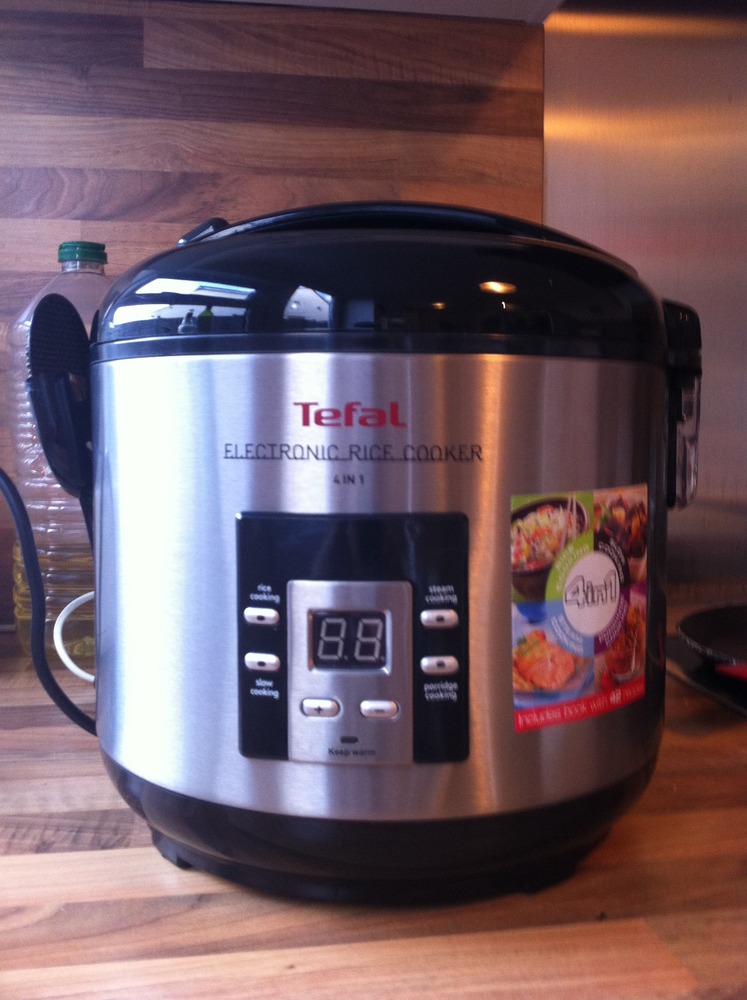
Film critic Roger Ebert has one, and loves it so much that he wrote a book about it. My friend Rev Sherlock has one, and claims it’s the heart of his kitchen. After months of whining and pewling from yours truly, TLC caved in and bought me one for Christmas.

I’m talking about rice cookers, Readership. And I think it’s going to radicalise the way I do things in the kitchen.

My proudest new possession is a Tefal, with four functions. (Ebert frowns on this, but I don’t really care). It’s a steamer and slow cooker as well as a rice cooker. It also has a porridge function, which made for the creamiest, most unctuous podge I’ve ever made.

So far, I have steamed broccoli for Xmas lunch and spuds for a fish pie in it. I have made blueberry and cream porridge. I have cooked a full chilli beef stew in it, and the meat was softly giving under light pressure from a spoon. I have even cooked rice in it.

This process has something of the magical about it. Rinsed rice and volume-and-a-half of liquid go into The Pot (after a while, you can’t help but go for the Ebert-style capitalisation). Press the cook rice button. It sits quietly on the counter, venting the occasional polite puff of fragrant steam. After about 15 minutes, it beeps gently. Your rice, sir. It will stay warm in the pot for an hour or so. Fluff it up and get stuck in. No muss, no fuss. The non-stick bowl washes clean in an instant. The simplicity and efficiency of the device has me filled with a profound, calm joy. I want to use this machine every day.

Something of a recipe, as spelled out to me by one of my work oppoes. It’s the perfect restorative after a night out, or indeed a long work day, and will withstand any manner of tweaking.

Tobias Clayton’s Back-From-The-Brink Rice.

Put the rice in The Pot and get it started. While it’s puttering away, finely chop a chili and a green onion. Once the rice has clicked over to stay warm, fluff it up, then throw in a glug of oil and the veg, and clap the lid back on. Give it five minutes. The veg will soften slightly in the heat. When you can’t stand it any more, throw in more soy sauce than you think you’re going to need, lob the whole lot in a bowl and bury your face in it.

If you want to gild the lily, some briefly cooked mushrooms, prawns or chicken would work well. Try flavoured oil stirred through the rice, or cook it in some stock. I’m going to try popping some fish in the steaming basket that comes with the pot next time, just to see how that’ll cook.

All of which sort of jibes with the elegant simplicity of the dish. The salty tang of the soy mixed with the crunch and zap of the chili, all bound with the nutty comforting rice. It’s pure cooking, all about flavour.

Look, I’m sorry, I know I’m gushing here. But this is a transformative moment for me. I’m spending more time than I ought thinking about what to cook in The Pot, and using it makes me grin like a gibbon. As my adventures in domesticity continue, this becomes yet another reason to get home, get comfy and cook.

Now, have I told you about my new pair of slippers?