
Sometimes you just have to take the opportunities that are offered to you. Thus, I found myself escorting TLC and MadamWDW to the Sheldonian Theatre in Oxford, to hear Lord Rees of Ludlow deliver the annual Romanes Lecture. I am, apparently, cultured.
Category: ramblin’
ramblin’
Joy Unconfined
I love a wedding. Any excuse to get dressed up and drink too much and dance like a fool. Friday saw us at a lovely hotel in the heartlands of the country, at the nuptials of TLC’s mum and her long-time beau.
It was one of the most joyful occasions I’ve ever been to, and I’ve not laughed so hard or so freely at a social occasion in a long time. The bride was consumed in fits of giggles through the ceremony, and I’m still not convinced that she repeated all the vows. Once the papers were signed, the bride and groom danced back down the aisle (I’m taking the blame for that; I did, after all, show them the JK Wedding Dance). The first dance was livened up by the bride going a-over-t during an attempt at a pirhouette. And I don’t even think she’d been drinking that much up to that point.
And yes we danced and yes we drank and yes we laughed. And yes we chased off a bunch of wedding crashers and yes we all had headaches the next morning. But oh my word, you want something like that to be memorable, and this is a wedding that will live on for quite some time. You sometimes forget that a solemn occasion doesn’t have to be without joy.
Pam, Joe, the future is yours. That’s one hell of a way to kick it off.
Paint Under Skin: On Becoming A Graffiti Artist
Making graffiti is like playing the guitar. It’s very easy to pick up and do very, very badly. Getting it right and creating something that people might find pleasant to the eye takes a lot of skill and practice. I discovered this for myself when that damned elusive DocoBanksy lured me down to the free-spray zone at Leake Street, near Waterloo, to do a bit of promo work for his film.
Turns out he had a much more realistic idea of his skill level and the likely end result than I did.
Continue reading Paint Under Skin: On Becoming A Graffiti Artist
Tales Of The Beeranauts: Very Merry Men
The Beeranauts have been pretty quiet this year. The Great British Beer Festival had to manage without us, and it was a minor contingent that made it to the London Drinker gathering back in the spring. Apart from that, nish since Battersea. A bit of a poor show, frankly.
We made up for that on Friday, with a trip up to Nottingham for the Robin Hood Festival. Held in the grounds of lovely Nottingham Castle, it’s perhaps the biggest British Beer Festival after the Earl’s Court spectacular. And it’s far and away the best.
Legacy
I’m really not sure how I should be feeling today. I’m sad, of course, as anyone should be where they hear of a life cut too short, when there was still so much left to do. But at the same time, I have to say the sadness is tinged with admiration. The legacy that he has left is one of the most influential on the planet. Even if you don’t own one of the products that made the company that he founded, left and then resurrected, you’re pretty likely to have used devices that he had a major hand in popularising. He didn’t invent the Graphical User Interface, the mouse, or the tablet computer, or the hard drive music player. All he did was make them easier and more intuitive to use. And in doing so, he changed the technological landscape of the late 20th and early 21st century.
His influence is everywhere – in the design, colours and finish of hundreds and thousands of products that he had nothing to do with. In the way we consume music, TV and films. He is the driving force behind one of the most innovative and consistently surprising film studios on the planet. His company could make headlines not just by launching a product, but by allowing rumours of those products to circulate.
I find it impossible to write about him in the past tense, because he’s still around – when I lift the lid of my laptop, when I pick up my phone. He’s part of the technological, social and artistic landscape, and always will be. That’s a legacy that we should all wish for.
The point is, I can write this piece without mentioning his name once, and you all know who I’m talking about.
From Here To Hilversum
I try not to talk about work on X&HT, which is in general a solid rule for most bloggers. But this is too cool not to share.

That cool chunk of Lego is the Beeld & Geluid (Sound and Vision) building, in a leafy town called Hilversum about a twenty minute train ride from Amsterdam. It’s the home of Dutch radio and television, and contains all the archives of getting on for 100 years of broadcast history.

The building is just as remarkable on the inside – five stories high and five deep. As well as the archive, it’s home to a huge multimedia museum. The glass wall here has imprinted pictures of Dutch stars of stage and both big and small screen.

These pods contain the contestants of Last Man Watching, a competition where you watch TV until your brains leak out of your ears. It had been running for about 30 hours when I visited. Loads of people had dropped out at the 24 hour mark. Not a sign of the limits of human endurance – if you make it that far you get a free TV.
It’s a fascinating place, and well worth a trip out if only to marvel at a building that’s like a supervillain’s lair if only they were really into Dutch film and TV.
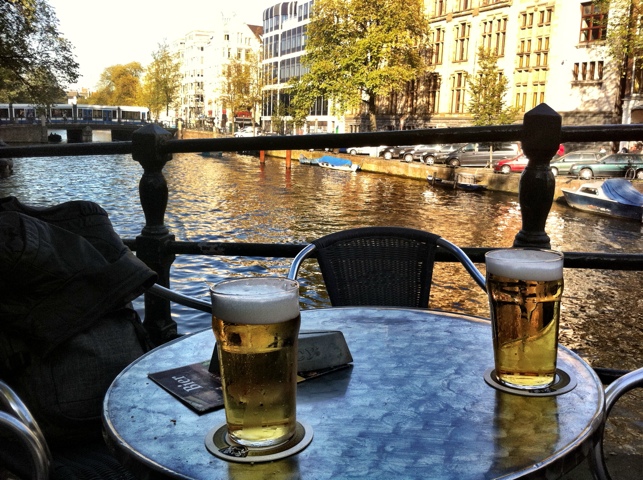
Of course, it was important to find time for a spot of refreshment before we headed back…
Two Mornings
In the South of France, docoDomsy sets up a time-lapse shot before a day on his promo project for Mas De Calage, a local winery.

Meanwhile, I take my place amongst the flood of people pouring through London Paddington, facing another day at work.
 </
</The Women: Genre And Gender

Horror, SF and fantasy, according to common knowledge, are not female friendly genres. Bad enough that the prototypical image of the genre fan is the sweaty overweight dysfunctional geek – that’s hardly representative. By making that image male, the picture is distorted even further away from the true. As a regular visitor to Frightfest, I’m happy to confirm the large number of women that attend that are just as vocal in their enjoyment of the movies as the men. The authors of the two biggest fantasy franchises on the planet are women – JK Rowling and Stephenie Meyer. Common knowledge is, as is usually the case, bass ackwards from the truth.
However, the depiction of women in SF, fantasy and horror needs a refresh. There are still far too many victims out there, female analogues waiting to be rescued or assaulted. When kickass women do appear, they’re frequently Buffy clones or, in the case of Hitgirl, children. It’s either that or the avenging angel of I Spit On Your Grave or Ms. 45. The wronged as killing machine, using their femininity as a weapon or a cloak from which to strike out at their abusers. It’s an old, tired tale.
I’ve seen a couple of movies lately that change that sorry state of affairs. Both films feature strong, uncompromising central performances from their lead actors, and both explicitly reject the myth of the female as victim in genre films.
Pedro Almadovar’s The Skin I Live In has a cool, controlled surface. Underneath that, lunacy boils and writhes. I need to be careful here. The central conceit on which the plot pivots is not one that should be easily spoiled, and it’s one that threatens to derail my whole argument before I even get started (feel free to give me a kicking in the comments).The film is part Pygmalion, part Frankenstein, part Eyes Without A Face. It tells a common genre tale – the mad scientist attempting to cheat God and death by resurrecting a lost love. Antonio Banderas is suitably driven and remorseless as the plastic surgeon, rebuilding a burn victim in the image of his dead wife. But all is not as it seems with the beautiful Vera. Played by Elena Amaya (pictured left) with a mix of vulnerability and shocking power, she seems at first barely human. A mannequin, meek before her master’s demands. As we discover her past, and all she has lost at the hands of Banderas, Vera shrugs off the weakness, becoming something fierce and strong. Her own creation, transcending the scientist’s plans, remade by sheer force of will. She ends the film as her own woman.
Lucky Mckee’s The Woman, which had it’s UK premiere at Frightfest, tells a similar tale, then rebuilds it from the bones up. A feral woman is discovered and captured by a suburban lawyer, who plans to “civilise” her. He locks her in an outhouse, hoses her off and dresses her in clothes with easy release fastenings. It’s clear what his intentions are from the beginning. Yet the Woman of the title, played with ferocious magnetism by Pollyanna Mackintosh, is no victim. She will never succumb to him, and is content to wait as the lawyer’s family collapses under the weight of revelation that her arrival sparks. Her release, and her revenge, are inevitable. Part monster, part hero, the Woman is never less than the mistress of her own destiny.
Frightfest was a bit of a showcase for this cliche-busting approach this year, with films like Susan Jacobson’s The Holding (with yet another fine central performance from Keirston Wareing) showing how genre doesn’t have to mean generic when it comes to gender. This is a good start, but we shouldn’t be complacent. Although I started this post in a bullish mood about equality in the realm of the fantastick, we’ve had a summer where DC Comics’ big relaunch was marred by the realisation that there were hardly any female creators on board, and a call from author Juliet Mckenna to promote equality in genre writing. There’s a way to go before we can get the balance right, but as Juliet points out, SF, fantasy and horror have always questioned unthinking prejudice and the status quo. Films like The Woman and The Holding are encouraging indeed, pointing the way to new, strong voices and bold, uncompromising stories.
The Real World: Film Vs. Animation
As CGI becomes more prevalent in the film realm, we’re seeing a shift, or at least a blurring, of the boundaries between live action and animation. Hateful as they are, filmed retreads of cartoon classics like Yogi Bear, Alvin and the Chipmunks and The Smurfs are paving the way for the science fiction idea of the synthespian. Motion capture is a sort of halfway house towards this goal, as blokes in leotards covered in ping pong balls create the base movement for the characters that will eventually end up on screen. Andy Serkis has made something of a career of this, which is a shame. It’s always a pity to see one of our most mobile and expressive actors peeking out from behind a monkey mask.
Yes, I know Disney have been doing this sort of stuff ever since Bedknobs and Broomsticks. If you were to really track the idea back, interaction between live action and animated characters goes back to Winsor McKay’s Gertie the Dinosaur in the early 1900s. Yes, ok, Who Framed Roger Rabbit. For gods sake, let’s not mention Cool World. The conceit now is that the characters are supposed to look photorealistic, as if they belong in the mise en scene. The fact that they don’t, and that we are ushered even more quickly into the uncanny valley when they appear, shows that this technique still has a way to go.
The fluid state of the boundary becomes even more pliant when live action directors move into animation. Tim Burton has always moved easily between the two disciplines, but then he started as an animator in the first place. Now other directors are trying out the medium, and the results are, to my mind, the purest distillation of their obsessions and tropes.
For example, Gore Verbinsky’s CV shows a restless and fertile imagination, trying all kinds of genre work before making the film that I think is his most complete and successful work: this year’s animation epic Rango. Here, his dark imagination is allowed full rein, and he gives us a film that is equal parts hilarious, horrific and lysergically surreal. It feels as if it sprang fully-formed from his brow and simply materialised on the screen – which would of course be an insult to the hundreds of talented people that worked on the film. But somehow it feels complete, free from studio interference. A pure, cool shot of water in a desert of mediocrity.
Similarly, Wes Anderson’s Fantastic Mr Fox has all his retro hipsterisms in full effect, creating a world that owes more than a little to Nick Park’s chunky steampunky look. His decision to animate in stop-motion is another cue to the analogue aesthetic. It doesn’t matter that the fur of Fox and his friends ripples under the skilled fingers of the animators. That’s kind of the point. The film looks hand-crafted, because that’s exactly how it was brought onto the screen. A world built in miniature, down to cotton-wool smoke and cellophane water. For all that, though, it’s the Andersonisms that shine through. It’s a coolly urbane film, despite being set in a rural world of farms, fields and tunnels.
Of course, the idea works both ways. Andrew Stanton, director of the upcoming John Carter, made his name at Pixar, notably on Wall-E. He points out one of the advantages of working with actors instead of animated characters. Making a note on performance and then seeing it in action is a matter of moments, rather than weeks. His story-oriented approach, where most details are solidly locked down before a frame is shot, is a positive advantage in an effects-heavy movie like John Carter, and shows that the skills and philosophies learned in one film-making realm can have surprising effects in another.
Sunday Spiritual: Age
Today is my Nan Gwen’s 90th birthday. Her branch of the family tree is famously long-lived. Her mum, my great-nan Jen, lived to the ripe old age of 104. Some might say that’s over-ripe, and Jen certainly spent the last 15 years of her life growling at the world like a mean old moggie with a bad case of the scurf. Nan Gwen is, I’m pleased to note, generally pretty cheerful, especially with a couple of sherries in her.
It’s bad enough when you hit your own landmarks, but when a parent or grandparent hits a big number, it can come as a bit of a shock. You’re confronted with the past, often in quite direct ways. Mum had put up a frame full of old pictures. There was one of me with Nan and my uncle Doug. I look thin as a rake, and a bit dazed, but grinning like a loon. It was taken the day after I got married.
The skinny kid in the baggy Equinox T-shirt smiling out of the frame is me, but not. He’s got a long road ahead of him, a good few bumps that he’s going to hit hard, and some amazing sights and brilliant moments. If I had the chance to go back and give him any advice, I don’t think I would. That would change the man that he would become. The me with the beer in a sunny Chingford kitchen, smiling fondly at a memory.
A long way down the road, maybe I will be standing in front of another photo, taken by my mum as I turned away from the frame. I hope then, as now, that I will be surrounded by people that I love, and that love me in return. That, after all is the one true signifier of a journey not taken in vain. The kind of journey my Nan has taken. It’s good to be reminded of that. Sometimes, you need to glimpse in the driving mirror at the road behind you. Sometimes, you need to look back to see how far you’ve come.
 EXCUSES AND HALF TRUTHS