
Art Stories at Reading Museum has been, after an admittedly bumpy start, a roaring success. A collaboration between that big red-brick building facing off against Queen Victoria on Market Place, artists like Cornelia Parker and Gerald Scarfe and local creative types, the exhibition has shown how visual and literary disciplines can interact, inform and enhance each other. The public have thoroughly embraced the experience, writing their own responses to the paintings, sculpture, textiles and photography on display.
All good things must, sadly come to an end. The John Majeski Gallery hosts an ever-changing feast of new exhibits. At the end of the month, this story will have to finish. But there’s one last chapter that’s worth talking about.
On February 2nd, the contributors who were able to attend were invited to an afternoon soirée. It was a chance to meet the other writers and artists who had helped make the show such a success, and to present their works to each other and any members of the public who happened to be passing. A thank you and a farewell.
My pals at Reading Writers and I were especially well represented at the show. Six of us (seven if you count the magnificently ubiquitous Claire Dyer, who shall forever remain one of our cohort) had writing on show, and all but one turned up on the day. Nerves were high. The group WhatsApp vibrated with jitters. Perhaps we could read each other’s pieces. Perhaps Rob could don a false moustache and recite Haro’s. Look, we’re mostly introverts. Performance does not come naturally.
Nevertheless we were there. Greeted by Elaine Blake from the museum and local writer Robin Thomas, the team who had cooked up the whole scheme, we were lured out of our huddle with the promise of affordable cava. A toast was raised. To art. To writing. To another glass of booze if you’re expecting me to read in front of actual people.
My piece had been inspired by a gouache painting by Palestinian artist Hadil Tamim, who fused the traditions and disciplines of Islamic art with depictions of British flowers. When I first saw Blue Square, I instantly thought of the kind of formal planting common in grand estate gardens which C and I see regularly on our trips around the country. It was instantly evocative, and a response came easily.
Too easily, it turned out. I presented 600 words, before being gently pointed to an email I’d missed during the acquisition stage of the process where a strict 200 word limit was in force. Yikes. Time to kill some darlings.
The swiftly trimmed version has been accompanying Blue Square since September. As I wandered around the space, cava in hand, I saw a slim woman in a hajib hovering around the painting. It couldn’t be—could it?
It could. Hadil Tamim was in attendance. After a slightly awkward introduction (pro tip: don’t start the conversation with ‘hello, you’re my artist which means I must be your writer’. It sounded better in my head. I could see the panic in her eyes before I clarified who I was) we got along swimmingly—we had plenty to talk about, after all.
After the dreaded and obligatory ‘networking opportunity’ we got down to business. The artists in the room went round first, introducing their work, talking about what inspired them and the routes they took creatively to bring them into the world. Everyone seemed erudite, practiced and professional, Hadil especially. My heart dropped a little. I’m terrible at public speaking and I hadn’t thought to bring notes. Oh well. Take a deep breath. Go slow.
After the artists, the writers had their turn. A couple of minutes to talk about the artwork and how we came up with our responses to it. Sounds suspiciously familiar to Manuscript Night at Reading Writers. We have to apportion time for reading and feedback with a firm hand.
Everyone obeyed the directive—if anything, a little too enthusiastically. All too quickly, I was up. All eyes, including Hadil’s, were upon me.
Deep breath. Go slow.
Readership, I did not stumble, stutter or fumble. I kept my chin up, my voice clear, my annunciation—annunciative. I even managed to sketch a half-bow to Hadil at the end of it. There was applause and everything. I’ll call that a win.
Suddenly it was quarter to five, and the tannoy was urging us to clutter up some other joint. Outside was cold and damp, but for a while we’d conjured up some sunshine in the heart of Reading. Down the road, the Blagrave Arms was about to open, unaware of the sudden afternoon rush as a roomful of thirsty scribes descended on them. Was there karaoke and dancing later?
Ah, that’s a story for another day.
The preamble above has all been an Excuse to post the original, long version of Blue Square. I think it’s a more honest response to Hadil’s beautiful work, and has never been seen in public before. You still have a chance to see our collaboration if you’re quick—Art Stories closes on February 22nd.
One last thing. Cora from the charity AFFECT, which helps families with a loved one in prison, reached out to ask if I would let her publish A Garden in their quarterly newsletter. I was happy to do so, and it was included in the January edition. You can read it here.
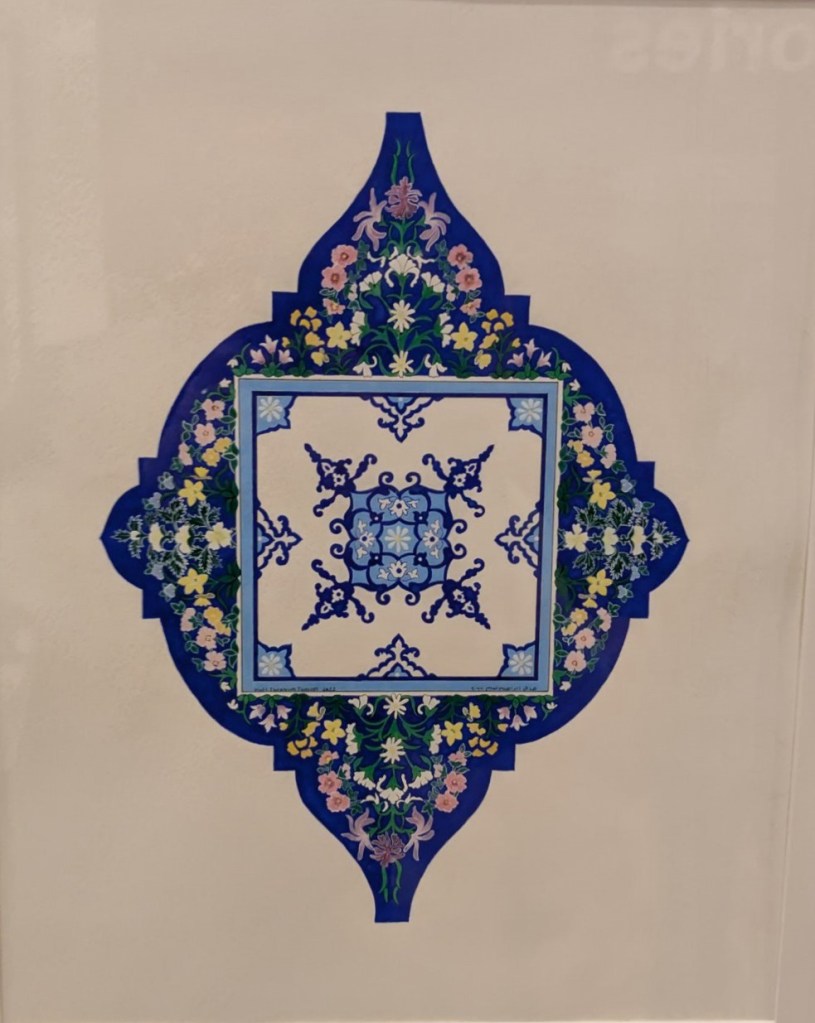
A Garden (Blue Square)
There is a garden. It is a place of calm, where care and worry cannot root and grow. Perhaps it is somewhere you played as a child, running barefoot across a lawn, grass cool under your bare feet. Maybe it is the carefully tended space where your grandparents grew sweet-peas and roses. You may be thinking of a grand garden cared for by a staff of hundreds, a lavish display of colour and form, exquisitely manicured, around every corner a new source of wonder and delight. Or it is somewhere more humble, a simple square of concrete and gravel dotted with pots, fragrant with herbs for the kitchen, alive with splashes of paint-bright blooms.
There is a garden, and I cannot accurately describe it. For it lives within you, tucked into a warm corner of your heart, waiting in your mind for the moment when you need it the most. It may no longer exist. It may never have existed, living instead as a dream, an idea, a plan, a fantasy.
Think on your garden now, as you look at the picture in front of you. See the greens and blues of foliage and flower, the white and gold of the ox-eye daisy at the very centre of the composition. Perhaps it is sunny in your garden today, warm rays of low afternoon light setting leaf-edge and petal-heart glimmering. Perhaps it is raining, and the plant-life nods and dances under the deluge, grateful for the water, the tiny engines of life at their core refuelling, rekindling the energy they will use to push up towards the sky.
Your garden is a clock, a reflection of the seasons, bare and still as bone in the winter, trembling with new life in the spring. A firework display in the summer, a larder come autumn. An endless cycle, never ending, always changing.
Look at the picture again, notice how your eyes track around it. Although it is a square, you look at it in a circular manner, a sort of spiral, the way the hands of a clock move around the face. And, like a spiral, your gaze moves towards a central point—the daisy, the eye, the heart.
Leave a garden alone and it will still grow, although not in ways you expect. Tend to it, a little every day, and it will be a truer reflection of you, your hopes and dreams and passions. In that way, as you care for your garden it will care for you, blessing you with tiny rewards. A butterfly soft-landing on a flower next to you, the plant gently moving under the tiniest of pressures. Or the moment when you unearth the first potatoes of the season, each perfect oval warm against your palm, the promise of dinner fulfilled.
Perhaps it is an ox-eye daisy, peeking up through a crack in the concrete at your feet, a reminder that there is always beauty and hope in this world, if you only slow down and take the time to see it.
There is a garden, and it is yours to wander through as you choose. Here, in this quiet gallery, I hope you have found a doorway in which to reach it.
See you next Saturday, arthounds.

 EXCUSES AND HALF TRUTHS