
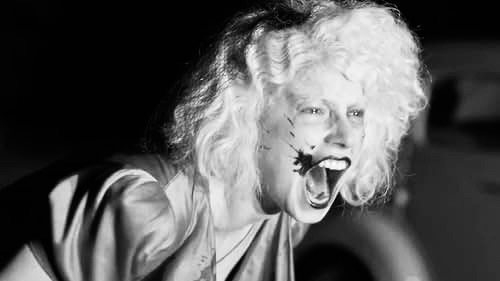
There is a moment towards the end of Maggie Gyllenhaal’s daring, divisive movie The Bride! which completely recontextualised everything I’d seen up to that point. Don’t get me wrong, I was enjoying the ride. The Bride! delights in wild swerves in tone and style, deliberately wrong-footing the audience at every turn. I’d expected that, so came in prepared.
Then Doctor Euphronious upended the whole darn hayride.
***SPOILERS AFTER THE FOLD. TREAD CAREFUL***
My moment of clarity came moments before the bullet-ballet finale of the movie. It flips from horror film to wild jazz-age cabaresque (made-up word, I’m sure you get the gist) to Bonnie & Clyde-style psycho-killer lovers on the run pastiche. Frank, Victor Frankenstein’s troubled first-born, has been shot and his Bride has dragged him back to the one person she thinks can help—the scientist who resurrected her, Doctor Euphronius. Desperate, pleading, she begs for aid. Instead, Euphronius relates the story of her past.
Here’s the turning point. Although the good doctor is skilled beyond measure in the dark art of raising the dead, she and her late husband had another speciality. They were working on a theory of quantum universes. And it seems, with the creation of The Bride, Euphronius had a breakthrough.
She describes her work as a search for ‘disobedient geometry’, a vector of space-time which doesn’t comply with the agreed rules or patterns.
‘Yeah?’ says The Bride. ‘So what does that look like?’
Euphronius smiles. ‘Like you.’
This simple exchange spun my head sideways and fired up an engine which just kept revving.
What if the mad scientist’s apparatus wasn’t just a resurrection machine?
What if it was a mechanism for tapping into or creating alternate realities?
What if, in hooking her device into the corpse of The Bride, Euphronius had opened and transported us to a world governed by rules pivoting around that wild girl’s skewed, manic version of the truth?
It would naturally be a universe of dream logic, one where laws of time and space become fluid. Where dancers can be taken over by The Bride’s internal soundtrack and forced into jerky, robotic action. Where the visions of a patchwork man could suddenly manifest on the big screen. Order becomes chaos, fantasy becomes reality. Any complaints about shonky pacing or handbrake-turns in tone and mood become irrelevant. It’s simply how this little corner of space-time works.
Let’s talk about Mary Shelley, whose presence in the narrative looms like a predatory animal. At face value, she finds a path out of limbo/the bardo/purgatory by possessing Ida, the girl who would be The Bride. She sees ‘a crack’ through which she can enter our world. Or, if you’ll bear with my increasingly deranged logic strand, she becomes aware of a version which has already been overwritten by Euphronius’ machine. The mad scientist has poked a hole in the veil, and the cackling, free-associating Shelley takes full advantage.
Back to the end of the film, and Euphronius is talking about her marriage, the life of the mind she led with her genius husband. He died, and she brought him back to life. It did not go well, and she shruggingly confesses she had to get rid of him.
But look at her maid, Greta. Look at the black smudge on her face. Familiar? The Bride wears her stigmata with pride. It’s a clear marker of Euphronius’ process. Greta has been resurrected. The device triggered, the veil pulled aside, the first domino toppled. If we’re really going to stretch things to the far bounds of possibility, it could be that the maid is the husband, mind-erased and reconfigured.
If we allow that the quantum device has been used at least once before, then who’s to say the universe it created isn’t one in which meta-fiction is a law? If you’ll excuse my inevitable swerve into Ninth Art discourse, I’m thinking of the Fictionverse, a conceit invented by Alan Moore to populate his League Of Extraordinary Gentlemen. Simply put, any character which has ever been imagined has a place there. Prospero can enter into combat with James Bond and Lord Voldemort. Mary Poppins can descend from the skies as a god-figure to restore order. If you’re unfamiliar with the story, perhaps Ready Player One will get you closer to a level of understanding. A realm where racing a time-travelling DeLorean while King Kong throws punches at you is just another day at the office.
To summarise. In the world of The Bride!, I propose Euphronius and her room full of magical lightning has mapped out a new set of quantum universes, in which it’s entirely likely that Frankenstein’s Monster can walk the earth, in which the ghost of the greatest horror writer of all time can break the fourth wall, find flesh and spirit, a new chance for agency, identity and even love. A place where the rules of conventional narrative have no place.
Was any of this intended by Maggie Gyllenhaal when she wrote the script? I like to hope so, but honestly it wouldn’t matter that much. Because the joy of The Bride! is its open-ended nature, the way the story doesn’t really conclude or answer anything. Which gives me the excuse to map my own theories onto the framework. This isn’t a matter of right or wrong. It’s a world of ‘what if?’
Take the white-out we see at the end of the movie immediately before the credits (total chef’s kiss for that choice of needle-drop, by the way), when Euphronius throws the switch one last time—does it signal the opening of a whole new stack of realities? What marvels and horrors might we see there? I for one hope to see more, although poor early box-office leads me to the inevitable conclusion of a long half-life for the film, as Brides pop up in cosplays and it starts to regenerate into a cult classic, a late-night staple.
One last awful thought strikes me. If we accept my (admittedly unlikely) proposition of the fluid, fictional nature of the sandbox Maggie has created, we also need to consider the feminist rage she ferments, as young women embrace the splat of black face paint and shock of white hair as the uniform of a ferocious rebellion. Is she saying that the only way women can turn the tables freely on abusive, murderous men, to gleefully indulge in violent retribution, is in a land of make-believe? Does Maggie have to distance her characters far enough away from the world we have to live in to achieve a sense of equality?
I hope I’ve overthought this now. Because the logical conclusion of that train of thought is just too bleak to bear.

 EXCUSES AND HALF TRUTHS
I went to the theater to rewatch this a second time tonight, in part, because like you I wondered if Greta had been reanimated as well. I wanted to watch more closely and see if I had missed a plot point or an inference that Greta had died. (But mostly because I was so in love with the film and wanted to feel it again.) I came to the conclusion that Greta was not reanimated. It is only after the Bride leaves and comes back that Greta adopts the makeup of all the other Disruptors. I really did wonder again, as I had during the first watch through, the significance of the tuxedo cat Greta holds in the discussion of the lost love, because that is the only time we see the cat in the movie. I wondered if Euphronius had transferred her husband’s consciousness to the mustachioed cat.
Good spot, and an interesting theory!
I really loved your reading of the film and am going to watch the movie again with it in mind because the interpretation of Dr. E and The Bride’s final conversation through the lens of the multiverse has totally changed my understanding for the better. W/r/t the impasse at the end of your essay, I think the feminist potential of the film lies beyond the depictions of feminist rage with the Brain Attack movement. It’s actually in the film’s depiction of The Bride’s relationship with Frank. I would say The Bride attains a kind of freedom in the end, giving herself her own name, despite the unideal conditions (on the run, Frank lied to her, etc), and choosing Frank *again,* from a position of knowledge and, well, freedom. Frank is a genuinely equal partner to her, reveling in her wildness and unpredictability, not seeking to subordinate or contain her. He also defends her from violence, instead of remaining complicit in upholding other men’s power (I’m thinking when he shoots the cop, in particular). He is, after all, an outcast himself and a startling contrast to every other man in the movie.
Hi, Kaelie! Yes, totally agree with your thoughts on the feminist through line in the film. I love that Frank is able to fess up to his deception, something we see less and less of now – doubling down on a lie in defence of the fragile male ego seems to be the fashion. A shame that the only male figure capable of mature behaviour is the patchwork monster! Just another skein in Maggie’s clever tapestry, I guess.
So glad you enjoyed the piece, and thanks for commenting!