
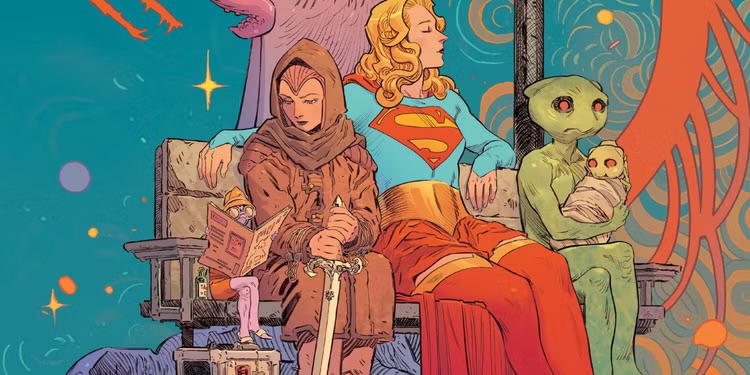
We have always told stories about beings more powerful than ourselves. Myths and legends of heavenly hosts and mountain-dwelling deities, offering promises of eternal bliss if you do as they say, unending punishment if you don’t. The gods are capricious, fickle, ultimately unknowable. We are, perhaps, pawns in a great cosmic game, or merely playthings, good for an eye blink of entertainment before being cruelly cast aside.
If you believe, as I do, that all gods are fictional, made up as a warning or an enticement to stay in line and keep paying the dues, then they become a twisted mirror image of humanity, their mercurial nature simply a byproduct of the heavy semantic lifting they have to do. Your god may be merciful or vengeful depending on the context or the moment they are being called upon to arbitrate over.
I have an example, one which springs easily to mind as she’s in the public consciousness at the moment.
Let’s talk about Supergirl.
That may seem like a bit of a swerve, but stay with me. I subscribe to the opinion (posited by experts such as Grant Morrison) that the fictional nature of gods means we have a modern pantheon right there in the pages of all your favourite funny books. Stronger, faster, more powerful than your average Joan, and due to the nature of comics publishing, functionally immortal. Sure, you may see the occasional excursion into worlds where a particular cape has aged, but it never really sticks.
The month by month journal of a superhero portrays them as young, fresh-faced, lithe and lacking in visible body fat. It’s how the business works. The image remains stable, unchanging, ready for the next escapade. The daddy of them all, The Last Son Of Krypton, ol’ blue britches himself, has been around since the thirties, and unless he’s a heavy user of Just For Men, there’s no grey hair in that ever-stylish pompadour.
Which pivots us back towards The Last Daughter Of Krypton, Kara Jor-El. Forever twenty-one, forever the junior partner of her cousin and, until the creative team of Tom King, Bilquis Evely and Matheus Lopes got to work in 2021, frankly a little uninteresting. Sure, there had been a film, a TV show or two, but until then Kara was never really given a task to show what she was capable of.
To show that she was a god, just like all her pals in comics land.
OK, I guess from here I should issue a SPOILER ALERT for the 2021 limited series Supergirl: Woman of Tomorrow (henceforth italicised as S:WOT) by the aforementioned Kind, Evely and Lopes and therefore by osmosis the feature film based on that work directed by Craig Gillespie, written by Ann Nogueira. Consider yerselves heads-upped.
Right. A bit of a plot synopsis is probably wise at this juncture. Our story centres around a young girl, Ruthye, who sees her father killed by a ruthless criminal, and takes it upon herself to track him down and seek revenge. She is assisted in her endeavour by a hard-bitten, troubled warrior with the kind of combat skills Ruthye lacks. On their quest, they come to understand and respect each other, realising how alike they actually are.
Yeah, sure, ok, that’s True Grit. Tom King pitched it as such to DC (Ruthye originally teamed up with Lobo, which explains the appearance of the Main Man in the movie adaptation), and S:WOT matches a lot of the elements of the Charles Portis classic, down to the florid language and inciting incident happening within the first page. Those similarities have been written about at length, so I won’t get into it too much here. But, by using a familiar mythic framework and going full-on space opera with it, KIng and co are able to expand on Supergirl’s powers, tweak her origin story, in doing so helping explore the godlike nature of the superhero.
Let’s dig into it. Why does Kara help Ruthye in the first place? There is talk of ‘hiring’, but there’s never any mention of payment—indeed, there’s little sense that the girl has much to offer apart from the sword which the killer, Krem of the Yellow Hills, left in her father’s body. The obstensible objective—the quest for an antidote to the poisoned arrow he fires into Kara’s dog Krypton is revealed at the end of the story to be a fake-out. There is no good reason for Supergirl to drag Ruthye halfway across the universe with her.
It turns out she’s doing it to teach Ruthye a lesson—about compassion, about forgiveness, about letting go of the things you can’t control. To save her from a life consumed by anger and the need for revenge. Well, that’s all very sweet and all. But frankly, what gives Kara the right to do that? Sure, Supergirl is better than anyone else at crushing coal into diamonds with her bare hands and flying across the galaxy in a single bound, but that in no way translates into any high ethical standpoint. It’s a motive grounded in an unearned sense of moral superiority, that she knows better than Ruthye what’s good for Ruthye, that she has an obligation to turn her father’s murder into a teachable moment.
All this, by the way, from someone who was only on Ruthye’s world in the first place because its red sun dampens her powers, so she can get drunk and booze her troubles away. Not the most suitable person to offer up lessons in how to live your best life.
Look, Supergirl is damaged goods in this story. She’s a long way from the bright-eyed girl of the Silver Age comics who only had to deal with magical horses having crushes on her (yes, really. And Comet The Super-Horse does turn up as a deus ex machina in S: WOT, saving her bacon on a couple of occasions). She, unlike Cousin Kal, lived through the collapse of Krypton, part of the desperate effort to keep a rapidly shrinking fraction of the population alive as the atmosphere failed and cosmic radiation poured from the merciless skies. She has every right to be bitter and guilt-ridden. But that does not give her the right to make life choices for anyone else. She’s clearly sublimating her need for redemption onto Ruthye. If she can fix this little girl, maybe she can fix herself.
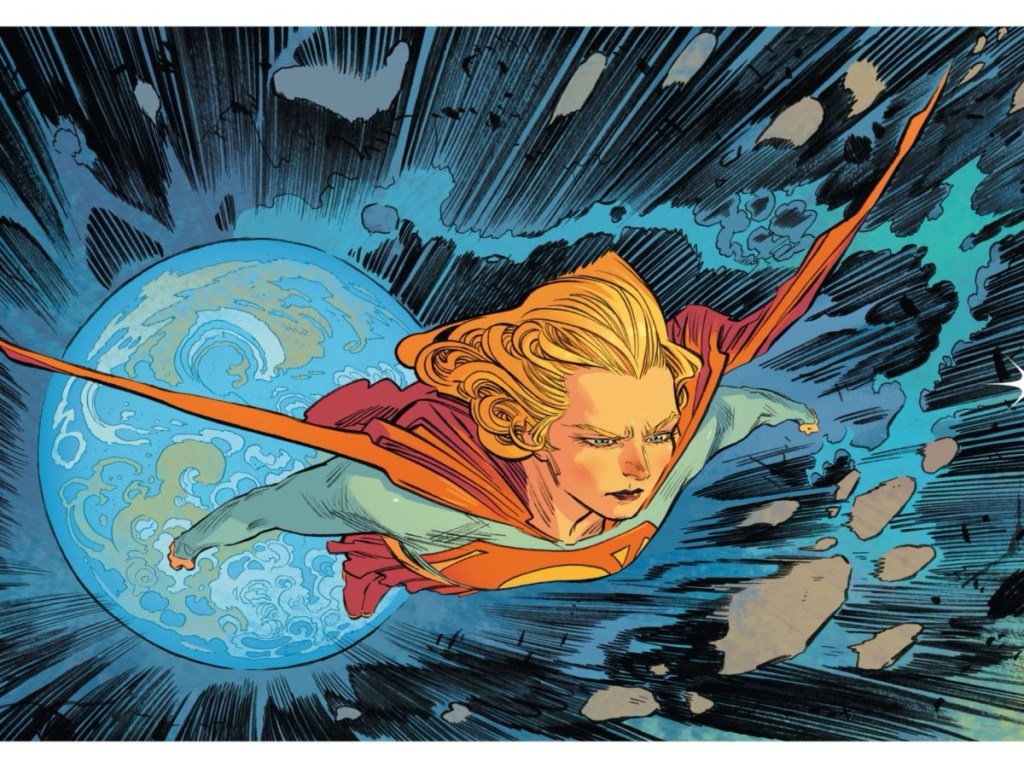
But there’s another aspect to all this that’s worth exploring. One that ties back to my thoughts around superheroes and godhood. This is probably all personal headcanon, but do me a favour and roll with it.
I do not believe Kara was celebrating her 21st birthday when she first met Ruthye. I think that was just a story she told herself as an excuse. Because I think Kara is much, much older than her physical appearance lets on. This is a fine example of superhero immortality in play. It’s explicitly alluded to at the end of S: WOT when our two main characters meet one last time to dispense their final judgement on villainous Krem. Ruthye is an old woman, small and bent. Kara hasn’t changed at all. Discounting the flippy bob she’s adopted, she is as flawless and golden-haired as the moment we met her. Krypto, at her side, bounds about with the same puppyish energy as ever.
Let’s make an assumption, then, that she is very long-lived. Taking that as a given, let’s step further down the path. You have been around for a very long time. You have seen it all, done it all. Nothing is new or exciting. You’re wracked by memories of tragedy, of a lost world, of a lineage which effectively stops with you. You’re the end of the line. The last daughter.
So any chance at distraction, for example just plucking an idea out of nowhere, a chance to go chasing off across the galaxy to show off your superiority in all things, well, you’re going to jump at that, aren’t you? It has to be better than getting maudlin drunk in a shitty tavern on a backwater world, right?
And there’s something else, a question which has nibbled at the fringes of my brain for quite a while. I guess exploring it is the reason I started this piece in the first place, so thank you for following along with me while I work through my particular thought exercise. It goes like this—why are these eternal, all-powerful creatures bothered with us at all? Surely we should be beyond their focus, ants underfoot. Or, if we do strike their attention, why treat us with respect and compassion, instead of doing what we do to ants—stomp, squish, douse in boiling water? That would be the simple, obvious thing to do, wouldn’t it?
Yes, it would. And therein lies the point. It’s harder to be kind. It’s more difficult to forgive, to show empathy, to do a favour for no recompense. It takes effort, and often it may not seem worth it. But it is. Always. Kara and Kal and Thor and Peter and all the members of the modern pantheon do not get kindness handed to them as part of their power set. They have to work at it. They have to struggle to keep it. And sometimes, it’s the one thing that saves the day.
Two panels from the book to bolster my point.
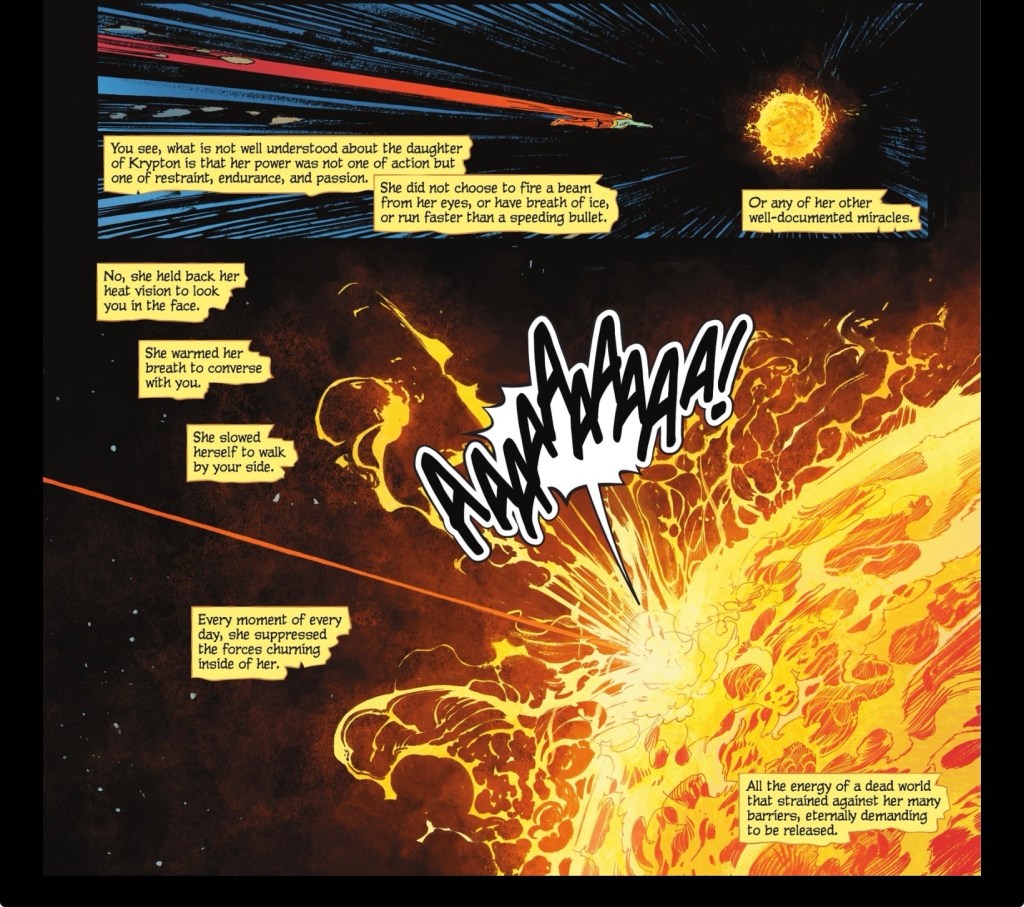
I believe kindness is a superpower. It builds and creates and coheres and unites. It makes us all better, faster, stronger. And the example set by the colourful folks in the funny pages shows us how we can achieve it.
As I said right at the beginning, I think we make our own gods, to serve as lessons on how to behave. Sure, those can be weaponised, turned into coercive or repressive propaganda. But it doesn’t have to be like that, and most of the mainstream cape comics choose a brighter path. That’s something to hold onto, something to learn from.
S:WOT may seem bleak in places, despite the gorgeous art and humour. But the heart of it, of Kara deciding she is going to help this wounded girl at her lowest point, gives the dark moments context. I hated the book on first reading, because I couldn’t see that. It’s only now I understand.
That we can all fly, in our way, if we allow ourselves to do so.
Supergirl: Woman Of Tomorrow is available in all good Ninth Art retailers and digitally.
Supergirl the movie is in theatres now.


Re the relationship of gods and men, see also Hera to Zeus in Harryhausen’s Jason and the Argonauts (1963): ‘You are the god of many men. Yet when those men no longer believe in you, then you will return to nothing.’
In fact the whole film is Harryhausen’s meditation on the meaning of the gods. Can ping you my chapter on this if you’re interested. (Just have to find it first.)
I’d love to read it, thank you!