Food Hell

Let’s start with a song, shall we?

Amanda Palmer has, I think, nailed the experience of food hate. We all have one. That foodstuff that you don’t just dislike (sprouts), or refuse to have on your plate (sprouts) but will actively force you out of the room. Marmite have built an entire advertising strategy out of this, positioning their product as one that neatly divides the nation. I fall into the hater camp, I’m afraid. I will, on occasion, use it in a stew or casserole to give some of the deep, rich umami tang for which it’s rightly known. But spreading it on toast seems such a ridiculous concept to me. You may as well dollop gravy browning on your morning slice. Or a turd.

Marmite are now trying it on a bit, I think, by launching the Marmite Bar. This is a cereal bar, one of those sticky, oaty slabs that can sometimes do the job if you’re up late and don’t have time to put milk onto a bowl of cereal in the morning. Most cereal bars have some manner of fruit in them to lighten the mix. Marmite Bars, and my gorge is actively rising as I write this, remove the fruit, and replace it it with Marmite. It’s a savoury cereal bar. Just what you need to smack your tonsils awake on a Tuesday morning. It’s a product that Marmite are actually pitching as a dare. “Have we gone too far?”, the posters cry. It’s a bold move, but I can see it backfiring. I know I’m not the target market (probably the opposite, in fact) but I can’t see anyone wanting to buy the horrid things. I have trouble conjuring up a more revolting prospect.

Oh, who am I kidding? Let’s talk about my own personal food hell.

(Digression. I’m a fan of the BBC cookery show Saturday Kitchen Live, which shows archive food shows alongside live cookery skits and a spectacularly pointless omelette race. One silly feature is Food Heaven, Food Hell, in which the token celebrity of the day is quizzed on their favourite and least favourite food, and then subjected to a vote in which they will eat a dish based on either. No-one yet has dared to pull the bullshit alarm on this trite concept:

“So, (B-list celebrity with something to plug) , what is your Food Hell?”
“Well, (avuncular host) , my Food Hell is prawns.”
“Oh, really? (initiate flirt/banter mode, dependent on gender of guest) And why, pray tell, is that?”
“Because I’m violently allergic to them, and if I eat one I will go into toxic shock and die.”

It’d be nice to see that once. Don’t you think?)

Aaaanyway. My food hell. The humble egg is a cornerstone of world cuisine, a foodstuff as versatile as it is loved. Millions of people go to work on one every morning. They are cheap, nutritious and the foundation of the Great British Full English Breakfast.

Put a fried or lightly scrambled egg in front of me, and I will run out of the door. My lovely wife, my deary darling, will sometimes indulge in a breakfast of scrambled eggs soused in ketchup, which will send me to the bottom of the garden with my hand clamped firmly over my mouth. I have a friend that will send me photos of any particularly runny fried egg sandwiches he manages to get hold of. I’m not kidding here, the thought of it is making me feel a bit sick.

It’s partially a texture thing, partially a smell thing. I do have a problem with gelid foods, which I think is a common problem with Food Hell in general. Many people I know will cite tomatoes or mushrooms in their spit list, because of the squishy, half-set texture. It’s notable, I think, that I don’t have a problem with eggs per se. I’ll happily cook with them. I make a mean pancake, will happily eat a quiche or even a Spanish omelette, and will even whip a just cracked egg into fried rice. But the concept of runny yolk does not fit well in my gut. And I honestly have no idea where it’s come from. As far as I know, I have always hated eggs. There must be a memory I’ve blanked out somewhere, of a particularly runny soft-boiled egg and soldiers that just flipped a switch in my tiny head. In his memoir Toast, Nigel Slater writes of how his mother’s insistence of forcing him to eat runny egg put him off them for life. I think I’m the same.

This made me a particularly miserable vegetarian, of course. In fact, it was eggs that turned me away from the righteous path. On a driving holiday through France, it soon became clear that the only thing that was available for salad-huggers like me and TLC was omelettes. Even the salads had hard-boiled egg in them, which tainted them completely. I tried to man up, and ordered a cheese omelette one night. I managed one bite, and that tiny morsel ended up back on the plate. I spent a week eating bread and cheese, and the occasional bowl of frites. It was horrible.

Finally, on the last night of the trip, I cracked. We went to a seafood restaurant in Le Havre, and I ate cod with puy lentils. It was a magnificent, Proustian moment. I can still taste the meal now. It was back down the slippery slope for me from there. I lasted barely a year as a vegequarian, and am now a rabid, unapologetic carnivore.

Some years after that trip TLC and I went to Paris, and found a decent vegetarian restaurant. it was fantastic. The food was simple, pure and delicious. If there had been more places like that in Brittany in the spring of 1992, I’d probably still be a courgette-muncher today. (I still am, but not exclusively.)

So, let me know, Readership. I’m intrigued. What foods really don’t do it for you? Are you a Marmite lover or a hater? More to the point: would you eat a Marmite Bar?

In Defence Of The Thong Song

I am here to celebrate one of the more extraordinary moments in modern music of the last 10 years. A moment that marries head-wreckingly crass lyrics to music of astonishing grace and power. A moment that would redefine the way young men and women comported themselves on the dance floor. A moment that, for a fleeting instant, made platinum hair dye the thing.

You’ve got it. I’m talking about The Thong Song.

Monday night’s Glee (fantastic show. Are you watching it? Why aren’t you watching it? What are you, some kind of idiot? It’s got hotties of all kinds, musical numbers and Jane Goddamn Lynch. Go, hit a catch up service. This’ll wait.) featured an attempt to mash up My Fair Lady’s I could Have Danced All Night with the aforementioned Sisqo classic. The project was doomed to failure. Well, of course it was. The My Fair Lady song is trite, by the numbers Lerner/Loewe songcraft, designed to shunt the story of Eliza and Professor Higgins forward. The Thong Song is much, much more than that. Musically and lyrically, it’s on a completely different plane.

The dynamic way in which The Thong Song changes and mutates through it’s agreeably short running time means that you’re never more than a minute away from a new surprise, another revelation. The song starts simply, with a pretty string filigree. This is soon superseded (although never overwhelmed. This simple figure is the sinuous backbone of the track) by a lithe, bouncing backbeat, the
perfect accompaniment for Sisqo’s sing-rapping.

This in itself is a wonder, veering from clever wordplay and neat quotes from other songs (the “Living La Vida Loca” moment springs to mind strongly here) to sheer grunting neanderthal monosyllably. The prime example is the moment leading up to the chorus.

“She had dumps like a truck, truck, truck,
Thighs like whut, whut, whut,
Baby move your butt, butt, butt…”

Which would be bad enough, but he’s so pleased with that clanging chunk of proto-rhyme and rotten imagery that he repeats it. After telling us he’s going to repeat it.

“I think I’ll sing it again.”

Please don’t. Or if you do, at least, find something to compare your subject’s thighs to.

But even here, there’s a purpose. The delivery and repitition are entirely deliberate. Sisqo sounds breathless here, literally panting with lust. Of course he’s gonna sing it again. He wants to make sure we get it. By acting dumb, he’s playing clever.

The chorus is a different entity, taking our hero’s grunts and pants and transforming them in an instant into a thing of beauty. Two harmonies wind around and about each other like a pair of dancers. Sisqo is hollering at the top of the stack, giving the mix some fire.

The third verse is the point where I would argue that the video improves on the original mix of the song. Note here how during the dance on the beach Sisqo and his back-up dancers do a pronounced stomp that kicks up a little CGI shockwave. This shock is echoed with a heavy bass thud that hits on the offbeat and is perfectly in time every time. It’s a lovely addition, and one that means I find the standard mix of the Thong Song ever so slightly lacking.

(Caveat: the video is otherwise dreadful. You’re best bet is to run it in Youtube and tuck that tab away. Unless you like watching oiled-up girls in thongs, of course.)

After all this, the best is still to come. There has been a steady but stealthy build in the intensity of the track, but the gorgeous key change at (3:17) just kicks things up into orbit. Sisqo is in a state of glory here, transported to the point where he can barely string a coherent line together. It’s an orgiastic, euphonious peak to a song that interweaves the sacred and the profane in a way that only the best pop music, hell, the best music full stop, can do.

It’s poor and lazy of the Glee writers, who are normally spot on with their musical choices, to make the blunt assertion that the show tune is in any way superior to Sisqo’s masterpiece. Making it the favourite song of the brutish football coach Tanaka merely compounds the error, painting The Thong Song as a track that only jocks and lowbrows could love.

Well, sorry, I’m neither, and I think it’s the nuts. It’s a track that rewards repeated listens with new treats and flourishes. Also. it’s a hell of a lot more fun to dance to than anything from My Fair Lady.

Who’s with me? Let me see your booty go.

Coming up: Will Smith’s Boom! Shake The Room.

A (Quiet) Word In Your Ear


In the process of wandering the great and echoing halls of the interwebs over the past few days, I’ve come across several posts and a whole site dedicated to the subject of the introvert. You know the type. Shy, retiring. Doesn’t talk much. Bit of a downer. Clumsy in social settings. Keeps himself to himself.

Well, that’s the common conception, anyway. My reading on the subject have brought up a very different conclusion. One that had me bookmarking pages in delighted relief, as I recognised myself more and more in what was being said, and the discussions afterwards.

The epiphany came at the end of this post in The Atlantic by Johnathon Rauch. I realised that being an introvert was not a choice, but an orientation. This was simply who I was.

So, Readership, the time has come to out myself.

My name is Rob Wickings, and I am an introvert.

Let me explain myself. I came across the Atlantic post, and the astonishing reaction to it while I was at work. (ahem. On a lunch break, of course.) My job ensures that I spend large portions of the day alone, and in relative quiet. Visitors often wonder whether I have been driven mad by the isolated nature of the work. Not so. In fact, it’s very much the opposite. I’ve always been completely comfortable in my own company. I can think, perhaps play a little music. Mostly, though, I’m just happy to sit quietly and watch the images flow across my screen.

The good part of the job is it’s shift-based nature. I get time off in the week. This is a rare delight, padding around the house on my own, cooking, writing, maybe wandering into town to browse bookshops or catch a movie. I’ll chat amicably to shop assistants or passers-by if approached, but otherwise I’m fine just to be quiet and do my own thing.

This is starting to make me sound like a bit of a hermit, which could not be further from the truth. On a day off, I’m happiest at the moment that I hear the key in the door that tells me TLC is home. I have a tight circle of good friends, who I see regularly. I’ve even done karaoke, furfuxache. The one thing I am not, is shy. (OR entirely conversant with sentence construction, it would appear. Hi ho.)

But I’m not especially gregarious. Large parties bother and worry me. I’m terrible at small talk, lousy at gossip and a little bit deaf. This makes clubs and pubs with loud music a bit of a nightmare, unless I’m with a core of people I know and trust. I’ll do them, and can have a good time, but you’ll find I want to go sooner rather than later. Dinner parties, smaller gatherings, barbeques – yeah, fine, no problem. I love people … in small doses. Big gatherings just fluster and exhaust me.

My main bugbear is the telephone. I want to apologise to everyone I know who have ever felt that I have rushed or needlessly cut short a phone conversation. It’s not you. It’s the vector of communication. It cuts off at least half of my chatting skills. If I’m on the phone to you I can’t pull faces, flap my hands about, sketch in the air, shrug, flinch or mime. I tend to think before I speak, which means there’s usually quite a bit of dead air. I just can’t chat on the phone the way I can face-to-face, and it drives me nuts. It should not, then, be a surprise that my choice of phone is one that puts texting and email capabilities front and centre. In fact, the argument that the iPhone’s telephony is it’s weakest feature was just another plus for me.

And yes, I am embarrassed to say, I do screen my calls, and if I’m not in the mood to talk I will let that call drop to voicemail until I’m feeling more chatty. It’s nothing personal. Honestly, it’s not. I’d just rather talk to YOU, not some ghostly approximation. (There are exceptions, of course. Get me on the phone to my best mate from school, and I will happily yak for hours. I think that’s mostly because this is the only way we’re able to talk at length is on the phone. On the rare occasions we DO meet face-to-face, well, then it is kind of difficult to shut us up. And I don’t let calls from TLC purposefully ring out. That’s one voice I don’t tire of, ever.)

The internet has liberated the introvert. It shouldn’t be a surprise that I spend so much time on it. I can express myself in subtle, rich and expansive ways. I CAN SHOUT or whisper. You can always tell when I don’t really mean that insult ;-). Plus, I love to read, and I’m insatiably curious. Frequently I will have a laptop and a book open at the same time, and often the telly will be on as well. My headspace is the place where I feel most comfortable, and the web has given me access to the world and lots of new friends, meeting socially when I feel ready, and on my own terms. It’s a win-win for me, and for a lot of people out there just like me who have absolutely blossomed without all that tedious mucking about in clubs, bars and cafés. Does this make the introvert socially inept? No, of course not, and screw you if you think that. We simply socialise in a slightly different way.

So, what have we learnt? Well, we’ve learnt that I can’t shut up when I get the bit between my teeth, certainly. I’ve discovered that I’m not quite so much of a weirdo as I thought I was, and that’s incredibly liberating.

Your required reading for the day is The Introvert’s Corner, in which Sophia Dembling talks wittily and insightfully about living a quiet life in a noisy world. I can recommend the comments thread on each post, by the way. Typically for a site full of introverts, they tend to be erudite, clever and funny. Features of the persuasion in general, I have to say. We may not be loud, but we’re as sharp and bright as a box of new pins.

And the mailbox for Johnathon Rauch’s original article is well worth a look, too.

Thank you for listening. Now, if you’ll excuse me, I need a little quiet time.

A Liddle Bit Of Good News

An image search for "Rod Liddle" brings up macros with a much more robust choice of language than this...

Columnist Rod Liddle now looks unlikely to be offered the position of editor at the Independent, following a groundswell of disapproval from staff and readers. This should universally be considered A Good Thing. Liddle would be a rotten fit for the paper. His views on women and minorities are well-known, thoroughly documented and utterly reprehensible. However, because the reader response was organised through Facebook and the campaign site 38 Degrees, some opinionistas in the press have taken the opportunity to tag public disapproval of the potential appointment as mob rule.
This is disingenuous, to put it mildly. So I won’t. It’s flipping ridiculous. Mob rule is a loaded and highly evocative phrase, which leads the reader to imagine that Liddle had been dragged out of town after being tarred and feathered (pause for a moment just to savour that image…) What actually happened was somewhat less dramatic. A highly paid journalist has not been ushered into an even more highly paid job, thanks in part to the efforts of concerned readers of the paper concerned. That’s it. It’s hardly bloody Salem, is it?
I will immediately state my interest in the affair. I joined the Facebook group, and signed the 38 Degrees petition. I don’t want an unmitigated shit like Liddle running a newspaper for which I have some measure of respect and affection. It is my right to inform the potential owner of that paper of my opinion. Did I gather with hundreds of other worried readers at the doors of the Independent’s offices, flaming torch in hand? Did I help to string up a gibbet at the door to Liddle’s flat? Have I in any way affected Liddle’s future earnings or his professional reputation?
No. No, I did not. I put my name to an internet petition and fired off an email to Simon Kelner and Alexander Lebedev. That’s all I have done. The fact that I was not alone in doing this seems to be the problem, and something that opinionistas are finding increasingly difficult to cope with. The idea that people can respond in their thousands to an article or story that they find objectionable, that somehow they can be held accountable for the things they write must scare them stool-less.
The angry letter to the editor is no longer the only option. The readership of our daily papers are more and more aware of their power, and ready to exercise it. If the chattering loudmouths that clog the opinion pages don’t like it, well, la-di-tough-shit. Guess what, passive consumption is a thing of the past, and about time. It’s easy now to show our disapproval of the badly-thought out, quickly dashed-off, lazily executed rubbish that passes as opinion in every paper on the news-stand.
In the face of public disapproval, all they can do, it seems, is call us either the thoughtless automatons of a liberal elite orchestrating our every move on Twitter (the Indie campaign was started by a reader, by the way, not a celebrity) or at worst a howling mob. Neither portrayal is likely to endear us to the writers that spawn this bollocks.
Liddle, as a columnist for the Times and The New Statesman, is just the latest and most obnoxious example of the problem. It’s interesting to note that as the campaign has unfolded, his complaints about social networking have become more hysterical. While trying not to paint himself as a victim, he has resorted to using ever more tenuous links to other, unrelated or outdated news stories to have a pop. It would be funny if it wasn’t so… oh, who am I kidding? It’s HILARIOUS.
To sum up, then. It would seem that public opinion becomes mob rule only when it isn’t working in your favour. And we are watching, opinionistas. Watching, and ready to call you out on your bullshit.

Hail To The Ale

E6D6B53D-CDD1-4FD5-9290-3E41E14433C4.jpg

Ah, beer. Stuff of life. One of the first foods. Made from pretty much the same simple ingredients as bread, and it’s been with us for just as long. Grains, yeast, flavourings and time. That’s all there is to it. There is an argument in ecumenical circles that if Jesus Christ truly was of the working-class, then he would never have touched wine, and the Blood of Christ at Holy Communion should be a nice drop of IPA instead.

My enthusiasm for the holy brew knows no boundaries. A decent beer is one of life’s finest ingredients. It speaks to me of community, of friendship, of good times. Too much will give you problems, but that is an argument that can be levelled at … well, anything. If I was forced to choose, I mean, really gun-to-the-head-of-a-loved-one choose, I believe I would rather drink beer than anything else. OK, it’s not going to replace the first cup of tea in the morning, or the flat white served with a smile from one of the AMT girls at Reading station, but on the whole… Well, let’s just say I look at historical records that tell us that everyone drank beer instead of water up until the mid-nineteenth century because it was safer, and wish vaguely that I was a time-traveller.

Before this turns into the confessions of an alcoholic, a little bit of focus. My love of the saintly sup has turned me into an activist. I am a member of CAMRA, and have signed petitions and written to my local MP regarding the perilous state of Britain’s pubs. The pub should be a cornerstone of British society, up there with the red phone box and the double-decker bus.

Of course, both of those are extinct, and the humble British boozer is going the same way. A pub a day is closing. These are terrible times for a vital part of English culture, and I try in my little way to support and encourage the public house and everything about it.

Which leads to my arrival at Clapham Junction yesterday, to meet some friends and enjoy the Battersea Beer Festival. This was our second attempt. Last year we were unable to gain admittance, faced with massive queues that refused to subside even in the face of a vicious snowstorm blasting down Lavender Hill. That night we ended up in The Falcon on St John’s Hill, just down the way from the station. This is a beautiful pub-in-the-round, with a lovely long bar, a couple of snugs, pretty decent food and a fabulous selection of beers. We had our own mini-festival that night, and The Falcon seemed the ideal place for our little group to form before heading up to the BAC, home of the festival.

This was a very wise move. There was a CAMRA stall, and kegs had been set up in the back room to entice punters into trying some slightly more esoteric brews. That, along with the food that Nicholson’s pubs like the Falcon specialise in (very good pies and sausages, ideal for soaking up booze) meant that we headed up Lavender Hill in high spirits, and in the mood for more.

We got into the venue without problems, issues or any kind of a wait. A token entry fee and £2 dropped for a commemorative beer glass, and we were in.

Now, a word on the beer glasses. You buy one at the door, and hang onto it through the session. You can buy half and pint glasses, and these are oversized and lined in third, half and pint measures. We always drink halves in beer festivals. It seems pointless to bloat out with a full pint of something you might not like. Plus with halves, you get to try more over the course of a session. One trick is to order halves in a pint glass. Inevitably, you will get more than the measure, especially as the day wears on and the worthies behind the bar, volunteers and enthusiasts all, become more and more tipsy and loose-wristed at the kegs. For the most part, we were getting tooths (two-thirds of a pint) for the price of a half. At £1.50ish a shot, this represents VERY GOOD VALUE FOR MONEY.

57EA20A9-5682-43B8-BDF2-62FD14289309.jpg

The venue is pretty impressive. The Great Hall at the BAC is a big old woody church hall, complete with high stained glass windows, and the booming echo of a decently crafted acoustic. That room, which must have been fifty feet long, is filled with a central, double-sided bar stacked high with kegs. By 6pm, that room will be stuffed to the gills with drinkers of all shapes, sizes and levels of beardiness. And that’s just the girls, kathudTISH.

I’m always surprised by how many females of the lady-type persuasion turn up to these gigs. Although the day is normally heavy on rotund hairy gentlemen of a certain age and the occasional dashing handsome interloper such as me and my crew, come hometime and whoops look out, it’s like a Boots advert in the Great Hall. Here come the girls, and they’re all after a half of insanely strong Belgian lambic, or a decent porter. They go for the strong dark stuff, ales with flavour, body and character. None of your cheap lager here. These are classy birds. Although they’d whop you one for telling them that. I am far too much of a gent/coward to try.

Eventually, we felt the urge for something different, and ventured downstairs to the cider and perry hall. This, we decide later, was a Big Mistake. The room is dingy and airless, and entirely populated by twats in stupid hats, urging each other on to ever more foolish feats of stunt alcoholism to the strains of (this is the godshonest truth) the refrain of Gary Glitter’s You Wanna Be In My Gang. We have a glass of something (Newton’s Hereford Perry, very nice) and do a runner before things turn nasty. C’mon, C’mon? No, f’anks.

After that, we took the advice of the marvellous Ciaran, who lives just round the corner from the BAC, and headed to another pub, The Eagle. This regularly wins awards, and no wonder. It’s a warm, cosy place, filled with locals, and the beer is clearly sourced, stored and served with care and pride. It’s a perfect place to finish the evening before the long drag home, and the pint of Loddon Hoppit that I sip is a clarion call back to the West. But I shall return.

So, recommendations. The Twitter stream I generated through the day is here. Yes, I tweeted the beer I drank. I’m 21st century, me. The hit of the fest for me was Black Hole Brewery’s RED DWARF, an unbelievably moreish toffee-flavoured treat. I was generally in the mood for milds, porters, stouts and other dark beers, so the list is by definition skewed that way. The Falcon is here. I’m not telling you where the Eagle is. I’d like to keep that one a little bit secret.

Windows In SF

No, not the Microsoft version, and you’d like to hope that the systems on board the Enterprise and the like are not based on an underpinning that’s liable to blue-screen on you halfway through a transporter cycle, or need to download an important security update before you can fire those photon torpedoes.

I'm not sure that's the best way to clean windows...

Windows in SF tend towards the panoramic. They are great floor to window room-width panes, around which your crew can gather to goggle in wonder at each new wonder they encounter on their impossible mission to the gates of forever. More recent iterations of The Big Window have embedded graphics. Just in case you weren’t sure about the exact designation of the Klingon Warbirds moving into battle configuration in front of you, handy pop-up windows, scrolling text boxes and spinning wire-frame models tell you more than you needed to know.

In reality, of course, the sort of panoramic window that you’d see on the bridge of the Enterprise or the command deck of an Imperial Destroyer could never happen. That much glass, under atmospheric pressure on the inside and the constant risk of micrometeorite impact from the outside, would be far too dangerous to install. On the International Space Station and the Shuttle, windows are tiny, quadruple-glazed portholes of thick crystal. You want a peek outside? That’s what video cameras are for.

The guy in red doesn't realise he's up for window-cleaning duty yet...

Which is why most “windows” in SF are actually really big projectors. They have zoom functions. They can hook into communication circuits, so that looming close-up of the approaching enemy warlord demanding your immediate surrender and the handover of fifty of your most fragrant ensigns can be really threatening. You can even show that things have gone really badly wrong by having the screen just show that fuzzy analogue static that is somehow still a signifier of lost signal even after ten years of fizz-free digital telly.

I’m a fan of The Big Window in Danny Boyle’s Sunshine, which started this whole SF decor riff in the first place. That window is a way for the crew to have a look at the approaching sun in all it’s fearful magnificence, and it’s tunable to filter out all but 3% of the light. This, for once, does just seem to be a portal, albeit one with some really smart sunblock. But it fulfills all of the rules I outlined earlier – it’s a Really Big Window, probably twenty feet square, and at one point the whole crew do gather around it to gawp in wonderment at Mercury passing across the surface of the sun. It’s a lovely moment, and sums up for me the important thing about SF set design. It should always be there to help the story along. Let’s face it, that bit of the film wouldn’t have had the emotional impact if the crew of the Icarus II had been crowded around a foot-square porthole.

We're gonna need a bigger tube of Factor 50.

One word you should never hear in an SF movie? “Budge up a bit, let me have a look.”

The Man Who Draws The Movies

As I think we’ve seen, set design in science fiction follows particular rules and tends towards particular looks. It does not, in general, have the jury-rigged aesthetic that you’d see on actual spacecraft, or long term habitations like the ISS. Which is fair enough. No-one really wants to see high drama carried out in the sort of cramped compartments astronauts have to survive in for months at a time. No, spacecraft in Hollywood are roomy affairs, filled with high-ceilinged, dramatically lit rooms that bizarrely are connected by low, dark corridors.

I put the blame for the look of Hollywood spacecraft squarely onto one man’s shoulders. He’s been a seminal influence on fantastic (as in cinema of the…, although his work is never less than brilliant) set design since the seventies, and was pivotal in creating the look of some of the greatest films of the genre.

I’m talking about Ron Cobb, of course.

His career began at UCLA in the early seventies. Working alongside a fledgeling director by the name of John Carpenter, Ron’s first piece of design was on Carpenter’s first film, Dark Star. Although the clean lines of Star Trek were still in evidence in the ship design, the tiny bridge room he put together was a clever way of working within a budget that was not so much tight as gonad-squeezing. All three astronauts are crammed into a tiny set, but by placing them face-to-face and stacked along the frame, he allowed Carpenter to build in long dialogue takes without needing to intercut. His work on Dark Star is smart and sharp, and makes a student film look much, much more expensive.

The work for which he’s best known would come with his collaboration with Ridley Scott on Alien. Taking a cue from Jodorowsky’s aborted Dune project, Scott assembled some of the best known SF illustrators of the day for their takes on the gigantic space tug Nostromo, the alien craft they discover, and the creature they bring back with them.

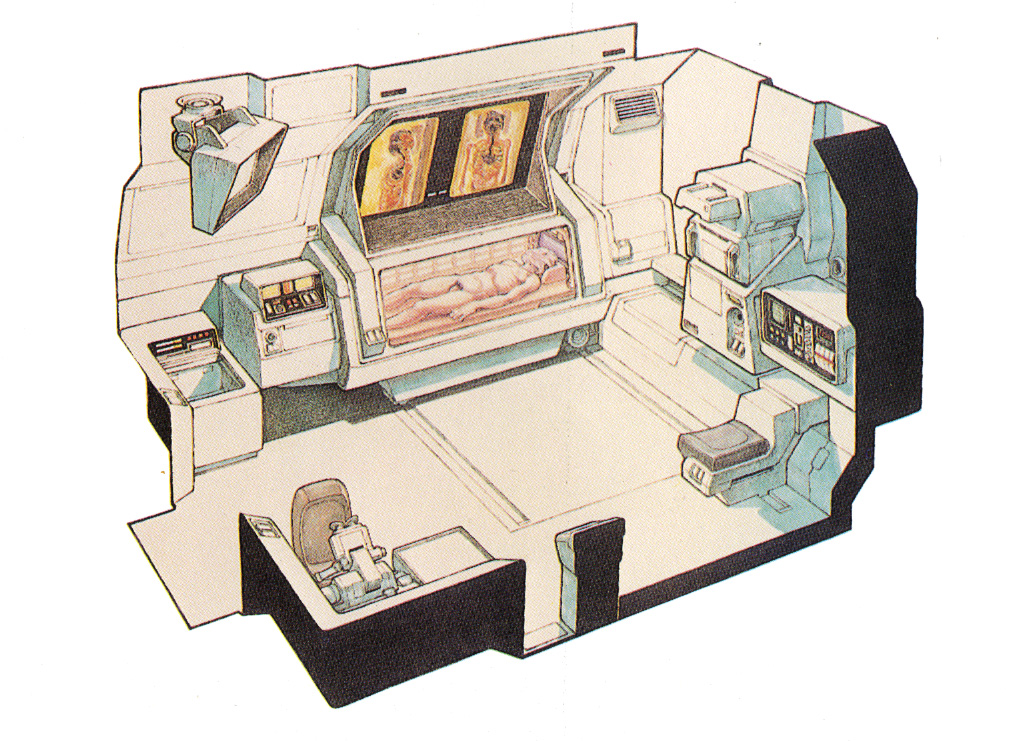
Cobb interiors. The second image is from Walt Simonson's fantastic adaptation of the film. Equally influential.

Cobb’s drawings of the interior of the Nostromo were a part of my childhood. One of my most prized possessions as a boy was a book on the making of Alien. This had a wealth of pre-production drawings from the likes of Cobb, Chris Foss and of course HR Giger. I wish I could tell you what happened to that book. It somehow managed to disappear during one of the many moves my family made while I was a teenager. I was drawn especially to Cobb’s boxy, solid interiors, and used to pore over the details, obsessing for hours over how he had managed to do so much with such apparent ease.

It was thanks to him that I started to draw, filling notebooks with carefully drafted approximations of his work. He helped me figure out perspective, shading and modelling. Even now, my choice of art materials skews towards the technical. Sharpies, Rotrings and markers rather than pastels, oils and charcoal. Tie that into my enduring love of comics, and the discovery that actually I’m not a bad cartoonist, and my path has been set artistically ever since. I’m a black line boy.

Ron is still working, of course, and it’s great to see his mantle taken up by other, equally talented film designers like Nigel Phelps. But I see his influence in comics and graphic work of all hues and persuasions as well. His boxy vehicle designs are very much echoed in current production line models like the Kia Soul, the Scion and most obviously to my mind, the Nissan Cube with it’s asymmetrical wrap-around window. The modern MRI scanner owes more than a tip of the hat to his medbay drawings for the Nostromo. It seems we all live in Ron Cobb’s world now.

If only I could remember what I’d done with that Alien artbook…

(once again, a tip of the hat to John Eaves and his excellent website, from whence a lot of these images have been ganked.)

The Chair In SF

The humble chair. A little spot designed for rest and relaxation, right? An item of furniture for you to take the weight off your feet, to switch off a bit.
Not in SF, it isn’t. In our favourite genre, the chair becomes a place of action.

Consider The Captain’s Chair in Star Trek. In The Original Series, it is a slab-sided, poorly padded lump of alloy on a swivel. Kirk spends a minuscule amount of time on it, and for the most part he perches on the edge of the seat cushion. Mainly because if he tried sitting back the rotten thing would dig a hole in his lower back. It wasn’t surprising he couldn’t wait to get out of it. It seemed to be a focal point for James T. to bark at Scotty through the communicator whilst leering at leggy ensigns.

It’s interesting to note that The Captain’s Chair becomes more comfortable the less outwardly aggressive it’s occupant. In the later seasons of Star Trek – The Next Generation, The Chair is better described as The Recliner. I swear, the thing has a footstool. I’m also certain there are opening shots in some of the later episodes where Picard can be spotted having a sneaky snooze.

Standards are slipping at Starfleet

SF chairs are not static objects. They do things. They move about. They are multi-purpose. They are dramatic objects. They are not designed for settling into with a mug of cocoa and a thick paperback.

A lot of them are on gimbals or tracks and whizz backwards and forwards with exciting whines and buzzes. They frequently incorporate communication devices, video equipment or in some cases, something more destructive.

pewpewpewneeeowwwkaboooom

Let’s do the Star Wars thing. I’m thinking specifically of the gun emplacements on the Millenium Falcon. These are fantastic. They’re ceiling-mounted. They have headsets, cool video screens and OH DID I MENTION THE GUNS?? I wanted one of these so badly when I was a kid. Oh, who am I kidding? I want one now.

Clearly I’m not alone. The gun emplacement bit in The End Of Time, the last Tennant Doctor Who episode, is a clear homage to the Falcon gunfight. Behind the scenes footage shows Bernard Cribbins having a whale of a time behind the sights of the lasers. I want to see the out-takes where he goes “pewpewpew” and makes exploding noises through his cheeks.

To confuse matters even further, let’s look to The Matrix. The gateways to the virtual world on the Nebuchennezar are accessed through couch-mounted plugs and circuits. You take a seat to dial into the Matrix. Let me just reiterate that. In the Matrix, chairs can be doors.

In Iain M. Bank’s Use Of Weapons the chair becomes something more potent. I would argue that the events of the book revolve around the sourcing of materials and construction of a simple white chair. This might seem a bit of a strange thing to say when talking about a novel that chronicles the adventures of an interplanetary mercenary. And it’s a difficult thing to properly talk about without ruining the big wallop at the end of the story. I recommend reading the book, but if you must, there’s a spoiler below.

The chair is made out of the bones of the main character’s sister, complete with a cushion fashioned from her skin. Iain Banks’ SF is not cheerful. Although it is somewhat chairful. Sorry.

After all that, I need a sit down. Someone send me over an armchair…

The Door in SF

You thought I was kidding, didn’t you?

Ron Cobb does the business. That’s the kind of door we’re talking about…

image courtesy of John Eaves. Check out his chunk of posts on Ron Cobb here.

Let’s consider the humble doorway, and how it has become a character in and of itself in SF. In every other genre I can think of, they are simple objects. They open. They close, occasionally with a slam. In a prison context, they are symbols of incarceration, although to be frank characters tend to talk about the walls more, and they are the object that will have the graffiti and the gate-bar scratches, counting off the days until freedom comes.

SF doors are infinitely more complex. They are desperately over-engineered for the job at hand. And at the same time they barely fulfil the essential design requisites that you and I would consider the door would need. They rarely have handles, for example. You have to punch a code or say a password or, memorably in Jeunet’s Alien:Resurrection, huff your cheesy breath into a detector.

And that’s before the darn things will even open for you. Then you get the best efforts of a team of props men as they slide back on tracks or drop through the floor or iris open like a lens. In Star Trek: DS9 the doors were built like cogs, and they rolled out of the way in a way that was far too complex for the end result. Lights will frequently blink and flash. In Peter Hyam’s Outland, they had useful red or green fluorescents to let you know if they were locked or not.

And then of course, they always make noise. Helpful bleeps and chimes to let you know that they’re about to do that fancy three-way split. The hiss of hydraulics. The unzipping sound that accompanied Captain Kirk as he marched down the corridors of the Enterprise (those corridors were always too fancy for my liking, although I’ve always had a thing for the Jeffries Tube). And I have to mention the doors on the Heart Of Gold in the Hitch-hiker’s Guide To The Galaxy, that were programmed to take pleasure in opening and closing, and did so with an almost orgasmic sigh.

Of course, there are always exceptions. The doors in the reboot of Battlestar Galactica are heavy, unwieldy things, but at least they have a handle and they are pulled open and closed. However, as they’re all designed to isolate an area in the event of a leak, they still have valves and wheels and an excess of handles and cranks. Opening a door still takes up a disproportionate amount of screen time and effort.

I’ve not really talked about the more esoteric kind of SF door yet. The Stargates, for one, have devolved over the years from being a 2001-esque gateway across galactic space, complete with warp effects and the wailings of a heavenly choir, to the kind of thing that O’Neill and crew hop through when they fancy a walk in the Canadian woods. Then we have the organic portals of the living craft of Lexx and Farscape. These worry me. I’m not sure a door should drip and ooze. Or to that point, just vanish on you just at the point when you need them the most.

But of course, my all-time favourite SF door? Well, there’s no contest, really.

And don’t tell me you wouldn’t do the same with a door that did that. I want one for my garage.