A Tangled Web, or some random thoughts on animation

I noted yesterday that Tangled is likely to be the last of the “Disney Princess” films. This still seems like a bit of an odd decision, considering how popular the girls are as a brand. They have their own clothing, doll and even comic ranges, and new direct-to-disc movies seem to roll out on a regular basis. It’s funny to see how Tinkerbell seems to have been folded into the gang. She’s an uncomfortable fit. A bit too feisty for the rest of the girls. It’s apparently to do with appealing to boys. Note that Disney didn’t say anything about quitting the fairy-tale genre. That Jack fella’s got some stories to tell.

When pictured together, the Princesses have a disturbing similarity. As their images are tweaked and refined, they are slowly nudged into templates that look very familiar. The eyes get bigger, the mouth smaller, the head shape more overtly heart-shaped. Granted, Mulan and Jasmine don’t quite fit the mould, but it’s starting to become difficult to tell Cinderella apart from Sleeping Beauty, Belle from Ariel*.

NewImage.jpg

Rapunzel’s the most extreme version thus far of the look. It’s a very anime approach. Her eyes take up half her head and her mouth almost disappears to compensate. There’s a lot of the japanimation heroine in Rapunzel. Her hair becomes prop, weapon and maguffin. Anime is full of characters with ridiculously long hair, that seems to have a life of its own (and also seems to randomly change length based on what the character is up to at the time).

NewImage.jpg

The thing is, of course, that the influence goes both ways. The father of modern manga, Osamu Tezuka, was famously influenced by early Disney, with characters like Astro Boy given the big eyes and childish features that he found so appealing in Mickey Mouse and his friends. We could say that by making Rapunzel look so anime, the designers are simply acknowledging, however subconsciously, the history and influences that have placed The House Of Mouse at the heart of world animation.

We can look to Europe too. It fascinates me how we are happy to have cartoony characters as long as the backgrounds and settings are rendered realistically. Tangled again is a prime example of this idea, with gorgeously rendered scenery playing up against massively stylised heroes and villains. It’s an example of the style that French bande desinee artists have made their own. Think of Tintin, with all those beautiful, exquisitely researched landscapes backing our blank-eyed hero. Or Asterix, if you want to go more cartoony. There’s nothing to say that Disney was at all influenced by the French school, but the comparisons are there to be had.

NewImage.jpg

The Europeans are also big on their anthropomorphic animals. The biggest selling comic album in France right now is Blacksad, a noirish detective tale. The main character just happens to be a panther, with a snappy line in suits. Again, Disney made their name with animals that wear clothes, walk on two legs and talk. Which came first – the mouse or the marsupilami? It’s a knotted mess of influence and cross-fertilisation. And it’s not helped by the fact that, contrary to common practice in modern animation, the two animal sidekicks in Tangled don’t talk. They react in human ways, but in dumbshow. Even more messily, the horse Maximus is presented as half cop, half jock and half dog. He chases down Flynn by smell, and reacts very favourably to Rapunzel scratching him behind the ears. It’s yet another knot in the net.
NewImage.jpg

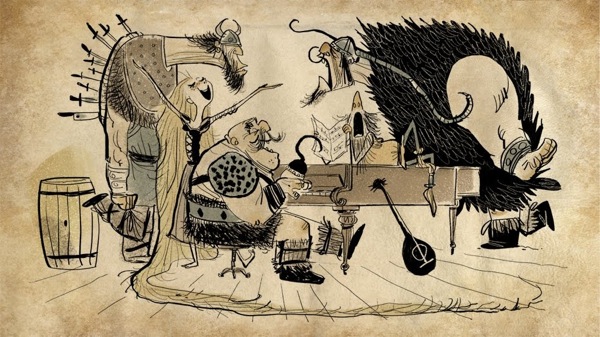
It’s worth sticking around to watch the end credits, which are illustrated with character designs (by the brilliant Shiyoon Kim) in a lovely, scratchy inky style that has more than a nodding relationship to the work of one of my favourites, St. Trinian’s creator Ronald Searle. I’ve always seen nods to Searle’s style in some of my favourite Disney’s, and the linework in the Tangled end credits hearkens back to some of those classic mid-60s films. 101 Dalmations and The Aristocats are prime examples of this looser, freer form. It’s great to see this little tribute to past triumphs, and I was quietly amused to see how much more busty Rapunzel is in these early sketches. I didn’t think Disney did cleavage.

Dammit, this film has got me thinking about cartooning again in a big way. In a kind of unfocussed, scattershot manner, for which I apologise (how else could it be when talking around a film with a title like that?). But the fun in watching a film as rich this rich reference and tribute comes from seeing the images spark and fire off connections, however randomly. Tangled provides a dense web in which it’s a pleasure to get tied up.


*yes, alright, apart from the tail…

A Very Good Hair Day: X&HT Watched “Tangled”

Tangled is something of a landmark for Disney. It’s their fiftieth animated movie. It’s also, according to reports, most likely to be their last “princess” film. I’m still not sure if that’s a shame or not. Mind you, I’m not sure how many other princesses of legend are left to chronicle.

The film also marks a return to the core values and tropes that make your classic Disney films so satisfying. By going back to its roots, the House Of Mouse has made their most successful movie since 2007’s Enchanted; a film which took delight in extracting the Mickey out of the story beats that Tangled embraces and celebrates.

We all know the tale. A girl, imprisoned in a tower by an evil witch, whose only means of entry is by means of her long golden hair, is rescued by a handsome prince. It ties into the myth of the lost princess, one of the main building blocks of yer average fairy tale. Sleeping Beauty. Beauty And The Beast. Cinderella, stuck in near-slavery. Snow White, in exile with a bunch of vertically-challenged miners. It’s a base to build a story on, a solid foundation of myth and legend.

Tangled’s screenwriter, Dan Fogelman (sweetly, IMDB also lists Jacob and Wilhelm Grimm as co-writers) takes that core idea and answers the simple question that everyone asks. What happens if Rapunzel lets down her golden hair and breaks herself out of her prison, rather than waiting for a prince? By making her story a quest, a love story, a rite of passage and a return home, Fogelman does a great job of not just answering the question, but telling a story that bears retelling at bedtime. More importantly, by giving Rapunzel’s ‘do a point and a purpose, the story has an impetus, becoming the engine that drives the tale on.

It’s traditional enough, sure. There’s a happy ending (ok, fine SPOILER ALERT, Disney film has happy ending. In other news, water is wet, the sky is blue, yo’ mama wears an afro with a chinstrap) and cute animal sidekicks. It’s all set in that pleasingly ill-defined land of mittel-European castles, forests and jolly, clean, well-fed peasants that we may as well call HistoryLand. But there are subtle trims to the formula. The animals are unvoiced, letting the character animation do all the talking. Maximus the horse is bold and brave. Pascal the chameleon is loyal and sassy. We get it, and we don’t need a comedy voice to put a wig on it and make it do a shuck and jive. There’s plenty of slapstick and broad humour, but the jokes work on the grown-ups in the audience too. The main characters aren’t limp and lifeless. They’re sharply drawn and inhabit the screen with flair and verve.

And I mean sharply-drawn in all senses of the word. The animation is, as you’d expect, stunning. But it’s not just the vistas, set pieces and special effects that make it special (although yeah, the lantern sequence, something in my eye, I’ll be fine). The character animation is beautifully nuanced. Every little flit of emotion on Rapunzel and Flynn’s faces is exquisitely done. This isn’t performance capture or any of the other cheats in which Zemekis, Cameron and Jackson have decided to base their careers. This is proper, honest to goodness cartooning, showing the magic that happens when talented animators use the best tools the 21st century can offer.

It’s bolstered with great voice work too. Thank goodness, for Tangled the directors plumped for actors with Broadway experience, who know how to project a line and make it sing. I’m so sick of animated films with all-star casts that don’t understand how to act for cartoons. You have to be larger than life. Instead, you so often get a flat, cold delivery that’s not so much “will this do?” as “screw you, pay me.” Mandy Moore, Zachary Levi and the amazing Donna Murphy get it so right that I’m astonished there isn’t a Best Voice category at the Oscars. They bring the gold, the final grace notes of wit and charm, menace and wickedness that make the characters shine. You get to believe in, and root for them.

By bringing back Alan Menken, the talent behind most of the Disney songs you know since The Little Mermaid, Tangled gets another boost. I’d gone off songs in Disney films, (and towards the end of Menken’s run they were kind of jammed on and lacquered into place) but here they do the perfect job – commenting on the inner life of Rapunzel, the relationship between her and Mother Gothel and in the riotous Snuggy Duckling sequence, showing that even hardened brigands and ruffians have dreams. They’re neatly done, don’t overstay their welcome, and move the story forward in graceful ways to which the writers of Glee should be paying note.

The fiftieth Disney animated film shows how far the studio has come since Snow White, and how much they’ve learned. It’s a company that has always been prepared to take risks with their movies, and to learn from them. After the major mis-step of Home On The Range (Don’t. Seriously. Just … don’t.) Disney retrenched, learning with the brilliant Enchanted how to laugh at themselves, and with The Princess And The Frog that it’s the story rather than the CGI that makes the film. Under the watchful eye of Pixar’s John Lasseter I feel quietly hopeful that rather than marking the end of an era, Tangled takes the best of the past and zshuzzes it up into something new and fresh.

Maybe I’m overthinking it. Tangled is one of those films that works as entertainment and history lesson, but ultimately, it’s a fun, smart and extremely pretty family movie. You can just let your hair down and enjoy it.

The Chain Of Life

I gave my bike a little dose of love yesterday. A good dose of lube, a bit of a wash down and de-rust, a fresh tube on the back tyre. The poor old thing gets dreadfully neglected for the amount of abuse it gets, and it’s quarterly wash and brush up is quite literally the least that I can do*.

I try not to make it look too shiny though. I lock up at Reading Station when I’m at work, and a bit of protective colouration goes a long way to making sure that the thieves keep their mitts off my wheels. Hence, although I often swoon over the gorgeous machines at AW Cycles on the Henley Road, I know in my heart that I couldn’t use them. I’m not a competitive or leisure cyclist. My four-year-old Ridgeback Motion is a mode of transport, simple as that.

You notice things on a bike that simply pass most other people by. The state of the roads, for example. Last year’s brutal cold snap took place not long after a fairly major resurfacing project in Reading – a surface that simply hasn’t held up. The side roads, in particular are drastically potholed and cracked. My Ridgy has no suspension. You feel everything. I bounce around on the saddle so much that it makes the bell on my handlebar ring*.

IMG 1000000824
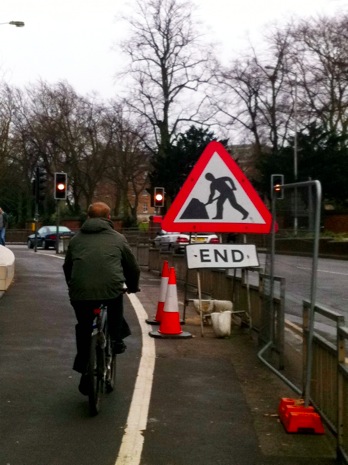
Our friend here is not in the bike lane. For obvious reasons.

Which wouldn’t be so much of a problem if we had a decent and consistent cycle lane policy. The bike lanes around here are badly-thought out, and have a tendency to merge you into traffic or simply disappear just when you least expect it. Or, in the case of the lanes around the Vastern Road rail bridge, they abruptly cut off with whacking great stop signs. Pedestrians grumble about cyclists on the pavement – in this case I simply have no option.

Ah, pedestrians. They walk in your bike lane. They wander out in front of you. They run out in front of you. They never look where they’re going. I’ve noticed this more and more over the past couple of years. I suspect, with absolutely no evidence whatsoever, that it’s connected to the fact that so many people are plugged into iPods and other devices when they’re out and about. With a soundtrack in your head, you become invulnerable.

They’ll still look out for cars. The mass displacement of half a ton of steel bering down on you must trigger some latent impulse to at least look around before you step out on to the road. If you’re on a bike, you’ve got no chance. If they’re texting while they’re walking, the temptation would be to plow into them anyway. I know riders that do that just to prove a point.

The problem is that when I’m off my bike, I’m guilty of exactly the same crimes that I’ve just bitched about. I dreamily amble around, letting stories and characters flit through my head, barely hearing the scream of brakes and curses from behind me. In Amsterdam, a true cyclists city, TLC and I both nearly ended up in someone’s front forks. I really thought I knew better, but it seems that as soon as I’m off the saddle, my spatial awareness goes to pot. I’m as bad as everyone else, bitching at cyclists on the pavement when I’m on foot, at pedestrians in my way when I’m on two wheels.

Some things never change. Pedestrians hate cyclists. Cyclists hate drivers. Drivers hate cyclists. Cyclists hate pedestrians. The chain of life continues, unending as the loop round my deraillieurs.

*The more waggish members of the Readership who might postulate that I’m not talking about my bicycle here are filthy minded reprobates – and that’s probably why you’re here. Fair do’s. Carry on.

.

So This Cake Happened

IMG_1000000821.JPG

I have no explanation for the fact that I have started baking cakes, other than the fact that I like baking, and I fancied a challenge that moved me away from bread. It’s very much a weekend thing, and fills me with a certain pride to be able to offer tea and homemade cake to TLC in the afternoon.

It also appeals to my economical nature. I can use ingredients that would otherwise be binned. Old, hard lemons and limes left over from Christmas are no good in your G&T. But they still have plenty of juice and useful zest for a lemon lime syrup cake.

The cake I’m going to tell you about came about because I had made a pot of coffee that we didn’t really drink. I fancied a coffee and walnut cake. But most of the recipes out there seemed to be as much about the filling and frosting as the cake. That seemed like a shame.

So, with guidance from this source, I struck out on my own. Is it any good. Well, let’s put it like this. There was more cake than the photo above when I put it away last night, so someone likes it…

Nutty Coffee Cake

Preheat your oven to 180C/Gas5, and grease a springform baking tin. Springform’s great. I love the solidity of unclamping your cake when it’s done. You might want to put some baking parchment in the bottom too. If you’re really flash, you can make a cartouche.

Chop some nuts. About 75g. I like almonds and pistachios, largely because that’s what I had at the time. Macadamias and pecans would be good too. The almonds might need toasting, if they’re blanched. Give ’em five minutes in a hot dry pan, and watch ’em. They burn in a second if you’re not careful. They just need to be golden.

Get a big bowl. Your biggest. Into it goes 175g of butter, 100g of caster sugar and 100g of brown sugar. Mash ’em together until they turn into a light, fluffy mousse-type thing. I started trying to use a fork and whisk for this, then remembered we own one of those food mixers with the interlocking whisks. Brilliant. Job done in moments.

Using your magic whippy machine, beat two eggs into the mixture. Now it looks like cake batter. Then add 100mls of hot coffee. That’s about two espressos. Now it looks like something that came out of a drain.

Now put in 200g of self-raising flour, and beat until it looks like a batter again. Throw in all but a palmful of the nuts, and beat again. Lot of beating going on. Baking is violent.

Now the whole gloopy mess goes into your baking tin, and into the oven. Give it 25 minutes, then poke it with a skewer or toothpick. You’re not taunting it, you’re seeing if it’s cooked through. If your implement of torture comes out clean, you’re done.

It’s fine like that, but this is Sunday, so make some damn effort. Throw together an icing.

200g of icing sugar in yet another bowl (your kitchen should look like a dirty bowl store by now). Add 3 tablespoons of coffee to that, then enough boiling water to make a runny icing. Think the sort of thing that goes on a doughnut. If you have lemon zest, half a teaspoon would be good here. Drizzle your icing over the top of the warm cake. It’s gonna go everywhere, so don’t try and be fancy. Scatter the nuts you held back from earlier (snicker) over the top. Let it cool a little more. Just a bit. Just to torture yourself.

Serve with fresh coffee, or if you’re a total heathen like me, the remains of the morning’s pot reheated with some milk. Sorry about that. Waste not want not.

The Sunday Lao Tzu: Little Wonders

“From wonder into wonder existence opens.”

As a writer, as an artist, the most important thing for me is to keep hold of my sense of wonder. I never want to feel like I know everything, and that I can no longer be surprised or amazed. I want to start every day with the expectation of learning something new, to be astonished or uplifted by an event, a piece of music, a film, a picture, a sunrise, a night sky. Even a simple act of kindness, an unexpected smile or laugh can be the tiny spark that lights up my day.

I’m open to all and every experience, and still have the capacity to be mesmerised or moved by the simplest thing. Some call the ability to hang on to your sense of wonder child-like, and from there it’s a simple step to call it childish, to sneer as if the ability to find the extraordinary in the ordinary is something to put away once we are grown. I couldn’t disagree more. Finding wonder in the everyday, in the sights and sounds that surround us is the first step in making and remaking our world into a better, more magical place.

The Mirror Crack’d From Side To Side: X&HT Watched BLACK SWAN

NewImage.jpg

Black Swan is the first great horror movie of 2011. Darren Aronofsky has taken the beloved movie trope of the doomed ballerina, and created something new, sumptuous and berserk out of it. It references Polanski’s Repulsion, the moody, lush quality of Dario Argento’s Suspiria, and most boldly, the work of David Cronenberg. The body horror may be going on in her head, but for poor Nina Sayers, the changes that happen as she struggles with the dual roles of the White and Black Swan are all too real.

It’s a simple story. Nina is a ballerina plucked from obscurity in the corps to dance a career-defining role as the Swan Queen in Swan Lake. She is precise, technically perfect. But passionless, controlled. Her quest to embrace the sensuality and darkness at the heart of the role, the evil twin, the Black Swan, leads her down the path to madness.

It’s a film about duality, and Aronovsky makes that clear from the start. The film is jammed full with mirrors, obscured windows, and all sorts of other reflective surfaces that offer up warped views of the world. We often see two or more versions of Nina in the frame. As her sanity starts to fray, those mirror images start to show something other than reality. Her reflection no longer maps to her, taking on it’s own life. When that happens, she is free to release herself from her old existence, taking on the mantle of the Black Swan both mentally and physically.

Like the tortured, driven characters in much of Cronenberg’s work, and indeed in Aronovsky’s own extraordinary debut Pi, Natalie Portman plays Nina as fragile, unworldly yet driven to succeed at all costs, even if that cost is mental and physical transformation. When Thomas, the exploitative and abusive head of the corps (played with sleazy physicality by Vincent Cassel), demands that she become the Black Swan, that is exactly what she does. It’s a tour de force, and Portman is on record as throwing herself into the role, training for ten months before shooting started. She makes a convincing prima ballerina, and worryingly, an even more convincing psychotic.

The film works beautifully at blurring the boundaries between the real and Nina’s mirror world, undoing murders and seductions in the blink of an eye, showing us flashes and warped reflections of her unravelling mind. The atmosphere throughout is unsettling. There are a few shockhits, but for the most part Aronofsky keeps the mood low-key, and his audience on edge. It’s a brave, bold and scary film. For once, I’m behind the Oscar hype. This one deserves to fly.


(WDW isn’t so much of a fan, for reasons that I can totally get behind. Her contrasting review is up on MovieBrit.)

Friday Fotos: A Day Among Ghosts

I took a day to plot and scheme with the mysterious docoBanksy yesterday. Usually we meet and cavort in Soho, but I fancied a change, so we met in Islington, before heading to Spitalfields and Brick Lane. It was a cold, cold day. Fun was had. Beer was drunk, including a pint of crude in the infamous Ten Bells. It’s been tidied up a lot, but there’s still a strange air about the place. An edge, sharp as a butcher’s blade. Or maybe I was just letting my imagination get away with me.

Anyway, here are some photos of the day. The area’s renowned for the street art which graces many of its walls and dead spaces, which will always get me pulling out a camera.

(edited, to include the fact that I was actually in Spitalfields, not Shoreditch. Maybe it’s because I’m no longer a London-errrr…)

Interesting Times For Tax Dodgers

NewImage.jpg

The end of January is tax return time, and businesses up and down the country are working hard to make sure their numbers get in on time. For those businesses and individuals that choose to find morally dubious methods to avoid paying those taxes, the end of the month is going to be more interesting than usual.

UKUncut’s Big Society Revenue And Customs have called for the day before the deadline, this coming Sunday, to be the moment for their biggest high street action yet. As well as the usual targets, new dodgers have come to light and are in the frame. This time around, Boots, whose move to Switzerland in 2008 lost the UK around £100m in tax profits per year, will see the sort of action that has already shut down Top Shop and Vodafone stores across the country. Week on week, more friendly UK high street names are being shown up to be sharp practitioners, using armies of lawyers to exploit legal loopholes that are costing us billions of pounds in lost revenue every year.

Kraft, who recently bought Cadbury’s, have shown the direction of their moral compass by moving part of their business to …guess where? Switzerland, depriving the Exchequer of an estimated £60million a year. Even Tesco do it. A company that turns over profits of 3.4billion will go through extreme contortions in the courtroom to avoid land tax and stamp duty. And yes, they also have a presence in Switzerland.

The fact that these numbers are out there, can be easily shared and discussed, and allow us to ask questions that Boots and Philip Green would really rather prefer we didn’t, is a direct result of action and data-sharing from organisations like UKUncut and bloggers like the excellent Richard Murphy. Better yet, by motivating ordinary people up and down the country to make it plain that we don’t approve of the shenanigans of big business (and let’s never forget, financial shenanigans from large corporate structures that considered themselves to be above the law are what got us into the current mess in the first place), the regulators are now taking an interest. The National Audit Office will be looking into how deals were struck with HMRC by Vodafone and others. It’s also going to assess how HMRC can do it’s job properly as hundreds of tax inspectors are laid off following the latest round of public sector layoffs. This is brilliant news, and a real sign that direct action has genuine and palpable results.

I can’t wait to see what the documents WikiLeaks are releasing from Swiss banking whistleblower Rudolf Elmer have to say. I think those corporations and super-rich individuals who think they can shirk their obligations are in for a very interesting few months.


Done To A Turn: The Things TV Cookery Shows Get Right

Cookery shows are entertainment gussied up as having some educational value – which for the most part they do not have. Important steps in the preparation of a delicious meal are either skipped, glossed over or mangled. I speak from bitter experience. There’ve been too many times when I’ve served TLC something barely edible that I’ve taken from a cooking sketch. The expensive hardbacked books that these shows are designed to hawk have the same problem. As Nigel Slater says, recipes don’t take your kitchen into account. Your oven might be calibrated differently. You might not have been able to get hold of all of the ingredients. The more precise the recipe, the greater the chance that it’s going to go wrong somewhere down the line. If you’re trying something from Heston Blumenthal, you’re SOL unless you’ve got a laboratory and a tame hunchback to hand.

A real annoyance is the moment when, when in the interests of entertainment, a cook will take a stone classic and needlessly muck about with it. TLC doesn’t cook much, but her specialties have a purity and forthrightness of purpose that shines through. When a TV chef starts throwing bacon, double cream and breadcrumbs into a mac and cheese, her disdain is palpable. She’s right, of course. There’s no need for it. Better to teach the viewers how to make food properly. Here’s TLC’s tip for perfect mac: “When in doubt – MORE CHEESE.”

Frankly, a philosophy to live by.

You can get valuable tips and tricks out of cookery shows, though, if you’re prepared to watch out for the telling details. The way a TV cook handles a knife, for example. Compare the cack-handed way Nigella chops an onion to the way Gordon Ramsay renders it down to fine dice in instants. Watch the pro chefs at work, and you get some inkling of the short cuts they use to make their lives simpler.

I always get something useful out of Jamie Oliver. He grew up in a professional kitchen, cooking for punters. And it really shows. He’s a natural around a rolling pin. I’m embarrased to say that it was Jamie that showed me the right way to crush a clove of garlic (twat it with the flat of a big knife, while still in it’s skin. Peeled and chopped in one easy move, without the un-necessary investment in presses, rollers or those funny neoprene sleeves. Yes, ok, you have to pick the garlic out of the skin and maybe chop it about a little more. If you have a problem with touching garlic, then maybe you shouldn’t be using it.) Watching him and others like him at work has moulded the way I operate in a kitchen environment, taught me the importance of sharp knives, solid implements and a worktop that can take a beating.

Every so often the shows will come up with a recipe that you just know is going to hit big. in that case, it’s going to be everywhere. Both Nigel Slater and new girl on the block Lorraine Pascale (the perpetrator of the criminal mac and cheese) have featured a no-knead quick soda bread made without yeast. It’s the reappearance of a great idea (it’s in Mrs Beeton, donchaknow), and means you have a warm loaf on the table 40 minutes after putting flour in a bowl. I’m not accusing anyone of plagiarism. In the culinary world, as in fashion, ideas are there to be taken and tweaked. But this one is going to run. Betcha the Hairy Bikers grab it next.

In fact, sod it, here’s my take on it.


Rob’s Sody Bread

Half and half measures of strong wholemeal and plain flour to make up 500g or 18oz go in a bowl.

Throw in a teaspoon of sea salt, another of sugar, the browner the better, and one more of bicarb of soda, and mix the dry ingredients together.

Throw in 350ml or 12 fl oz buttermilk, and scoosh it into a soft dough. Don’t got buttermilk? Add a tablespoon of lemon juice to ordinary milk before it goes in, and leave for five minutes. Now you got buttermilk.

Tip the dough onto a floured surface, and shape it into a ball. It’ll be sticky. Flour your hands too.

Score the top in a cross with a knife. Go deep. Imagine your enemies while you’re doing it.

Place your slashed dough on a baking tray, then into a hot oven 200C/400F/Gas6 on the top shelf. Give it half an hour.

When it’s nice and brown and risen and filling the kitchen with that bread smell, you know the one, the one they use in supermarkets only this is real, this is YOU making that smell you delicious creature, take the bread out  and let it cool slightly, before rending it asunder and using it to scoop up the juices of the casserole I didn’t tell you how to make. It’ll last a day or so, so you have my permission to be greedy and wolf the lot in one go. You’re worth it.


Undercooked: the three types of food TV

Cookery shows have very little to do with the fine art of gastronomy. They’re aspirational, set in the kitchens that we want, in the houses we dream about. If you try making a dish out of the recipes shown on these shows, you’re pretty much guaranteed to come a cropper. Either that, or the washing up afterwards will be of biblical proportions.

I reckon there are three different kinds of cookery shows. First, there’s the celebrity chef show, which is as close as you get to a standard cooking sketch these days. They take all their cues from the master of the form, dear old Keith Floyd. Four or five dishes will be prepped in a modicum of detail. If there is shopping to be done beforehand, the chef will go to a picturesque deli in an upmarket street, and definitely not Asda.

There will be very little chopping. Some of the ingredients will be in bowls, in tiny dice. Everything will be impeccable. There will be no limp mushrooms or half open packs of bacon here. The kitchen will be spotless, and the size of an aircraft hanger. The chef will waft through it all, airily informing you what a simple mid-week supper a samphire and duck liver souffle can make. Oh, and the word supper gets used a lot. The only supper I’ve ever been interested in is the one that comes out of a chippy.

Then we have the travelogue, where the chef goes on holiday and cooks a few meals along the way. Wacky transport will be involved here – giant RVs, motorbikes, barges, specially adapted VW campers. Inevitably, the cooking sketches are either on a beach, a harbour or in a town square. The food will be cooked on a tinpot gas range, and there will be tame locals on hand to taste whatever comes off that grill and mildly insult it. There will be lots of shots of very pretty scenery. it will be very nice, but faintly dull.

At the bottom of the barrel there are the reality shows. These attempt to redefine cookery as combat, pitting one chef against another in an orgy of ego, tantrum and spilt dairy. There will be lots of fast cutting and sweaty closeups. The host will frown a lot.
The music will be better suited to an action movie, and there will be a pause before the winner of the show is announced that lasts for the length of the last ice age. They have as much to do with cookery as The Weakest Link, and are about as entertaining. Except Iron Chef. That’s so lunatic that it’s crossed over into genius.

Delia is the exception to the rule, but she’s more of a national institution than a cook these days.

Come back tomorrow, when I’ll discuss whether it is actually possible to get decent cooking tips from a TV show. Now, if you’ll excuse me, all this talk of grub has made me a bit peckish. I’m off for a zebra carpaccio with smoked green tea foam on rye. So easy to make, you know.