
Everyone has an opinion on Christopher Nolan’s version of The Odyssey. It’s become the great talking point for these few weeks of summer before the next cultural controversy comes rolling in.
Me? Yes, I’ve seen it. I thought it was a highly impressive visual achievement and a massive slog all at once. A film to admire rather than love. That is my opinion. Others are available. But there’s an interesting exchange of ideas going on around The Odyssey regarding a particular niche interest of mine. In fact, it’s something I get paid to have a good working knowledge about, so it amuses me no end to see folks chatting about it.
If you’ll forgive a guy for using his personal space to yatter on at length on a pet subject —let’s talk about aspects ratios and framing.
Blank looks all round. OK, let’s define our terms. Aspect ratio is the name given to the shape of the box a film is shown in, usually some manner of rectangle. Framing simply refers to the bits of any given image which fit within that box. Let’s give you a couple of examples you have readily to hand—your phone and your telly.
Now, unless you’re one of those slightly annoying types going back to flip phones, your phone is a rectangle just over two times as long as it is tall, referred to as having a ratio of 20:9. That’s if you’re looking at it in landscape, which you should always be doing when you’re taking a photo or video. Social media be damned. Twenty units high by 9 wide. Your telly is slightly shorter than that, sitting at 16:9. Sixteen units across by well you get the idea. Why use 9 as a unit of measurement instead of the more logical number of fingers and thumbs? We’ll come back to that.*
Back in the days, tellys were a different shape, much squarer. The aspect ratio for domestic sets up until the turn of the twenty-first century was 4:3 — 12:9 if that makes more sense. This was due to the shape of the cathode ray tube which gave you the pictures. This worked very well for decades, for everything from soaps to football.
But it wasn’t so great for films. And the reason for that was all done to the shape of the box.
Up until the early fifties, most movies were shot and projected in much the same aspect ratio as TV. It’s a workable, comfortable frame. But as TV became more and more popular in the post-war years, movie execs started to worry about the threat to their business model. In order to bring people back to the theatres, they needed to innovate. And the best, easiest way to do that was to offer something TV could not.
A bigger, wider screen.
The advantage cinema as a projected medium over TV as a fixed display medium is exactly that — you can fill a big long back wall with picture. In the fifties and sixties there were all sorts of exciting new film formats which vied to entice viewers into witnessing the biggest show in town. From Techniscope to CinemaScope to VistaVision to Cinerama, with all kinds of other wild experiments, the argument was clear — if you wanted vast spectacle, the movies were the only place to go. Why settle for that piddly little square screen when you could have pictures running past your range of perception?
Which brings us to the biggest, most immersive film format of them all — IMAX.
Short for Image MAXimum, duh.
Initially this huge film format was a curate’s egg. You could shoot with it, but stock was ridiculously expensive, the cameras were comically unwieldy and you could only shoot three minutes of footage on a single roll. Early use was contained to short scientific films shown in museums (there’s a reason the Science Museum has one of London’s two accredited IMAX screens) and, bizarrely, fairground attractions. I still remember seeing a rollercoaster ride projected onto the interior of a dome-shaped tent, the image so large that it fooled the viewer into thinking they were actually on the track. It was disorientating and overwhelming, which was the point. There were safety rails and grab handles on hand, as people would actually lean as if they were in the rollercoaster car.
IMAX isn’t just big, it’s tall too. In fact, its native aspect ratio is pretty close to that of yer gran’s old telly—13:9. That square frame, projected on a large enough backdrop, fills your field of vision in much the same way as VR goggles, immersing you fully in the action.
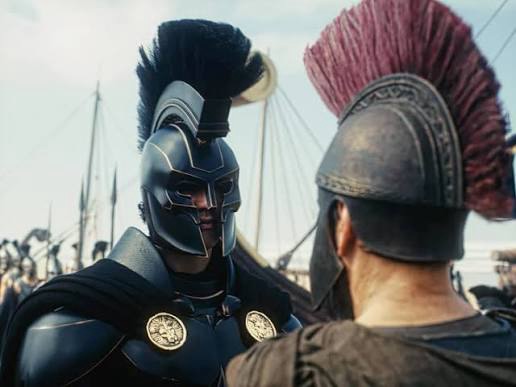
With all that in mind then, let’s return to The Odyssey and take a look at Agamemnon’s big helmet.
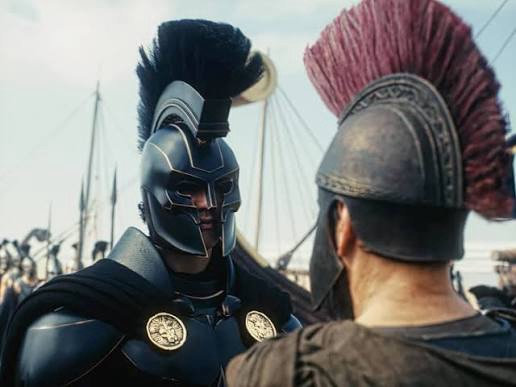
Here’s an image you probably recognise from trailers and think pieces and hot takes and so on and what not. It’s director Benny Safdie in a very impressive piece of costuming as the proud and wicked King Agamemnon. He seems to fill the frame, even though he only really takes up half of it. This shot is carefully and intentionally framed for that big, square IMAX frame, making it clear that Agamemnon is in charge.
Now, Christopher Nolan has always advocated passionately for using IMAX cameras. He recalls the same sorts of immersive experiences with the format as I, how it has the ability to draw you into the story. His dream was to shoot an entire IMAX feature and he’s spent decades of research and millions of dollars in making that happen. Good for him, you have to admire a guy with ambition.
But most cinema audiences around the world won’t see that vision. The theatres don’t have back walls big enough to show the full height of Agamemnon’s massive plume. Projectionists have no choice but to crop the top and bottom of frame, giving us something which looks more like this…
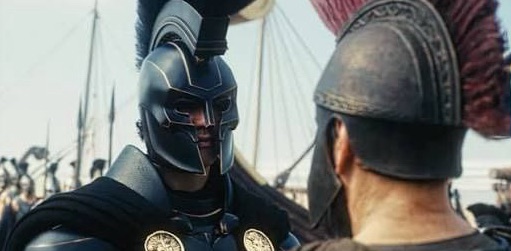
There’s an element of guesswork applied but this is pretty close to the 19:9 cutout which non-IMAX cinemas have to apply to Nolan’s frame. See how everything becomes flatter, how Agamemnon no longer seems to loom over Odysseus? It’s a compromise, one which cheerfully bins the original composition in favour of an image which serves the purpose but nothing more. It becomes more obvious as you watch the film that Nolan is framing for height, not width, and the widescreen frame loses a lot of the original intent.
I have questions, then. We know that Christopher Nolan is a precise and exacting film-maker, obsessed with doing things the hard way in the pursuit of a kind of cinematic truth. He barely uses green screen, preferring to shoot on location, using puppets, props and all manner of tricks to keep things real on screen. He puts in an incredible amount of hard work towards the quest for the perfect image.
But then, at the last step, at the moment he shows the results of all that labour to a paying audience, he just—stops caring. Unless you have the money to pay for an IMAX screening (either digital or in his absolutely preferred format, 70mm print which, as The Readership should already be aware thanks to my banging on about it in an earlier episode of The Swipe, is only available in 41 venues across the entire planet), or indeed an appropriately equipped cinema near you, you’ll just have to settle for an inferior experience.
I could let go of that if the marketing of The Odyssey hadn’t yelled so loudly and at such length that IMAX is the only way to see the film. Folks have started noticing this two-tier approach and frankly, they don’t like it. I don’t either. It soured me on the whole experience and, although I am one of the lucky ones to have relatively easy access to IMAX and the money to pay for it, I won’t.
There’s something else. When The Odyssey comes to streaming and Blu-Ray, which framing will be used? Will the distributors settle for the 16:9 screen-filling version? The square-ish IMAX frame will look pretty unimpressive sat in the middle of our wide screens with black bars around it. Will anyone apart from the Nolan fanbase care at that point?
This all depresses and saddens me a little. I feel as if a great artistic statement has somehow been blunted and diluted, a great dream made to look less glorious in the harsh light of commercial reality. Christoper Nolan wanted to do something wonderful and take us along with him. Instead, I question all his creative choices, because I cannot get one last question out of my mind.
Just how much of Agamemnon’s hat does he want us to see?
*there’s no single answer for that, and it’s confused as you can also refer to a format’s aspect ratio in values related to 1–16:9 can also be defined as 1.78:1, the old TV sizing of 12:9 as 1.33 — or indeed 4:3. Using 10 as a base ratio tends to muck up the numbers and put too many figures after the decimal point.
Really, it comes down to whatever works best, although as a rule of thumb cinemas use the something-by-one, while monitors are something-by-nine. If you work with aspect ratios at all, you will end up at some point sketching boxes in the air with your palms out like you’re at a rave. Trust me, I’ve done it more times than I can count.


