
The Face Of Dredd

NewImage
Clicky for more piccy

The release yesterday of the first real look at Karl Urban as Judge Dredd sent a certain portion of the nerdiverse, myself included, into geekgasm. It’s great to finally see the character up close. Every still we’ve seen up to now, coupled with Alex Garland’s taut, claustrophobic script, shows that Dredd The Movie is going to be a grim and gritty affair. The man in his scuffed bike leathers and stubble owes as much to Mad Max as the version we see every week in 2000AD.

I still think the helmet’s too big. But then, in the comic it has to serve as the top half of his head. Some artists have drawn it as so close-fitting that it would be impossible to get off. Either that, or Joe Dredd has made the ultimate sacrifice, and shaved off his ears. Urban’s hat is as close as dammit to the one that I have been drawing since I was 9, with the obvious exception of having to serve a real world purpose.

Of course, we’re now a world away from the Stallone version with the spandex and gold-plated plastic and the talking gun and flying bike. I cannot in all honesty defend the 1995 movie, although the first ten minutes is a very fine adaptation of the “Block War!” story. And goddamn, Stallone has the chin for the job. But I’m a purist, and the moment the hat came off was the moment that I lost interest.

Of course, you could argue that Dredd has taken his helmet off and we have indeed seen his face. At which point I’d note that you can’t fool a fanboy, because it’s clear you’re talking about The Dead Man. This was a spin-off strip set in The Cursed Earth that followed a drifter, burnt beyond all recognition, who is taken in by a friendly family of mutants. But the man has a past, and it hasn’t finished with him. The big reveal, that few readers saw coming was that The Dead Man was an amnesiac Dredd, left for dead by The Dark Sisters Of The Apocalypse.

This story is a major milestone in the Judge’s long history, and I’d argue it ties him much more explicitly to the fictional exploits of another iconic loner, Clint Eastwood. If Dredd in MegaCity is Dirty Harry, then in The Dead Man he has become, quite literally, The Man With No Name. Scarred and haunted, he becomes a clear analogue to the ghostly avengers of westerns like Pale Rider and High Plains Drifter. The look, though, is clearly based on William Munny in Unforgiven. His return to Megacity and Judgehood is marked by reconstructive surgery. The glimpse at Dredd’s face that we get in The Dead Man is fleeting and illusory. For the most part, we are left with the early legend that he is simply too ugly to be looked at directly.

NewImage

The fact that we never see Dredd’s face is kind of the point. He was imagined as an avatar of justice, soul-less, almost machinelike in his single minded dedication to The Law (always capitalised, as much an abstract concept as a set of rules). Through the last 34 years and thousands of progs, he has become much more, while still staying true to the core idea. He’s a cipher, on which any number of stories can be hung.

I’m pleased that the makers of the movie have embraced the unwritten rule of the character, and the helmet will be staying firmly on Karl Urban’s head. besides, as any fan knows, the face of Dredd is not the most important part…

NewImage

Six Thousand Days

To be accurate, six thousand, two hundred and six. There’s probably some flexibility in there to allow for leap years and other temporal shenanigans. Let’s stick to my back-of-an-envelope calculations for simplicity’s sake, then do a little division to come up with a rounder figure.

Seventeen years and a day ago, I stood up in front of a friendly looking registrar and a bunch of friends and family, and made a promise. I’ve broken many pledges since that day, whether by accident, spite or sheer laziness, but this one has been kept.

I’ve been incredibly lucky to have someone beside me to help do that, and I would no more let her down than I would choose to stick my right arm into a wood chipper.

It all seems so mind-bogglingly simple to me that I find it hard to write it down without relying on mush and platitudes. I made a pledge. I kept and continue to keep it. in that simple act, I have found contentment.

I won’t dispute that I have been lucky, that I married my best friend, muse and lover. I do not consider the alternatives, all the choices and decisions that had to fall the right way to lead us to a bright room in the West Midlands six thousand and some days ago. I simply remain grateful that they happened in the way they did.

Seventeen years can seem like a long time. A lot of things have happened. A lot of things have changed. But the promise, and everything we have built using it as a foundation, remains unbroken. I intend to keep that promise, in the same way I always have. Day by day.

Whatever Happened To The World Of Tomorrow?

NewImage

A short Twitter conversation the other night about Richard Hammond’s tv show Journey to The Centre Of The Planet had me musing on the state of science programming. It’s not great, to be blunt. Hammond’s show was damned by knowledgeable observers like X&HTeam-mate MadameWDW…

She echoed the consensus.

Science shows seem to fall into camps nowadays. You have the big specials, filled with expensive CGI and hosted by a housewives’ favourite, full of sound and fury and very little content. I’d roll the James May show where he plays with oversized Lego into this camp, too. You have shows like Spring/Autumnwatch, cosy and cute, slipping in odd bits of science amidst all the cute wittle chickywickies and a disturbingly gleeful focus on hedgehog poo.

Then you have Bang Goes The Theory, a more polite version of Discovery’s Mythbusters and a direct descendent of Hammond-hosted shows like Blast Lab and Brainiac. You could maybe parse two minutes of interest out of these shows. They’re light entertainment disguised with a white coat and protective goggles. Not that I have a problem with blowing things up on camera in the name of science, but the shows are painfully thin on actual content. Finally, god help us, the hipster Top Gear that is The Gadget Show. It’s thin gruel, but on occasion rolls out an innovation or two amidst the endless competitions and tests of the top five waterproof cameras.

There’s a hole in the schedule.

I mourn, Readership, for a memory. I mourn for a show that combined raffish charm with excitement and enthusiasm for the science of the day. I mourn for a show forged in the era of the white heat of technology, that is ever more needed in this most sciencefictional of centuries.

I miss Tomorrow’s World.

In the 60s, 70s and 80s, TW had the sort of sway, impact and viewership that was only topped by shows like Top Of The Pops. It was slick and glamourous, and not afraid to talk to it’s audience like grown-ups. It was wide-ranging, yet capable of bringing depth and focus to a subject when it was needed. It roamed the world, from the science parks and boffins of rural England to the rocket jockeys of the California deserts. In William Woollard it had a genuine, frequently shirtless sex symbol. In Raymond Baxter, a Chairman Of The Board, a smooth-talking master at the tricky job of making science approachable. You never felt you were being talked down to. Tomorrow’s World was pacy, newsy and in the right place at the right time. It was at the forefront of the computer boom of the early eighties, showed us the first home video cameras and recorders, and was all over the launch of the shuttle Enterprise. As Atlantis touched down for the last time, I couldn’t help but feel a twinge that the Tomorrow’s World team weren’t there to welcome it home.

As science becomes increasingly under threat from swivel-eyed fundamentalists and swingeing budget cuts, I think the time is right for a revival. A weekly science-based magazine show would be a great way to spark interest in the field. We need the legacy of Baxter, Woollard, Michael Rodd and the others more than ever. Let’s celebrate the world of tomorrow, with a show that will give us up-to-the-minute updates in the fast-moving field of science and technology. Boing Boing TV, anyone?

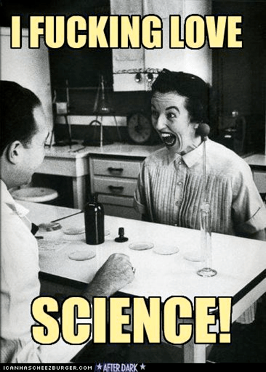
(Speaking of Boing Boing, they’ve posted some background to the picture that heads up this post. Short version: the lady, Jane Root, was a test subject into early prenatal gender screening in the 1950s. She’s just been told she’s having a girl.

I suggest that you show that picture to the next person that tries to tell you that science is a soul-less, uncaring endeavour, and then tell them to go gruff in a hat. I love this picture. And I fucking LOVE science.)

A Portrait

TLC is famously camera-shy, especially when it comes to whacking photos of her up on the interwebs.

Who can blame her. I hide behind a cartoon rabbit avatar, after all. There’s a lot of discussion around about privacy on the net, and how far that extends into how we present ourselves online. Should we be compelled into an internet profile that consists of our own faces, our real names? For the kids growing up with Facebook, privacy seems to be a thing of the past. Everything about you is shared, without a second thought. All your indiscretions, your saddest, silliest moments, those face-pulling pics, the whole shebang. Your life in all it’s wobbly-eyed, crazed magnificence.

If you want to do that, fine. Not my bag. I cringe and run for my privacy settings whenever Facebook roll out a new feature. I know a few people that are moving to Google+ for that very reason, one because Facebook would not allow him to post under an pseudonym. The point is, freedom of expression also means freedom to express yourself as much or as little as you want, and the presentation of your online self is a vital part of that. Identity can be currency in the 21st century, and I think it’s good to be careful.

Your pseudonymous life doesn’t have to be completely fictional, of course. That way can lead to disaster. A carefully chosen avatar, a handle to which you’ve given a little thought, can give a flavour of your character. It’s up to you how much, or how little, you choose to show to the world.

With that in mind, then, here’s a pic which sums up TLC and her sweet, gentle nature perfectly – to me, at least.

IMG 1000001292


A Sorry Excuse

The thing about apologies is that you have to mean them. Or at the very least, make a decent effort at looking like you mean them. I don’t think anyone’s convinced by the half-hearted mumbless that Rupes, Red and the rest of the crew have made about the ongoing debacle/funniest story of the year that threatens to engulf News International, in the same way that a hungry squid will go at a bag of doughnuts.

To me, the full-page apology and the press statements we’ve had up to now read like the sort of thing you’d get from a ten-year old that’s been dragged up to your front door by his dad after being caught scrumping apples.

“Say you’re sorry, Rupert.”

“msrry.”

“I don’t think the nice man heard that, Rupert.”

“I SAID I’M SORRY, ALRIGHT? I’M SOOOREEEEEE. Cuh, you deaf, or what?”

That Murdoch kid needs a good clip round the ear.

Anyway, the problem is that we now see anything coming out of the News International Eye of Sauron as inherently untrustworthy. Even if the apology published yesterday was heartfelt, that’s not the way most of us perceived it. Tied in with a self-aggrandising interview Rupes did with one of his own papers, the Wall Street Journal, in which softball questions were gently lobbed and batted away, and you have the prime example of Journalistic Crime Numero Uno.

The whole situation isn’t helped by the Murdoch’s magnanimously agreeing to give evidence at the upcoming Select Committee – after receiving a parliamentary summons which meant they couldn’t really say no. That’s going to be an absolutely prime moment of comedy television. I’m thinking about setting up a drinking game. Take a shot every time Rupes, Red or Spud say “I don’t recall…” or “I have no knowledge of…” I think we’ll all be very drunk, very quickly.


To sum up the whole sorry state of affairs, I can’t really put it any better than this.

caption


Big Society Blues

With all the hoopla, furore and general whoop-te-doo surrounding the Murdochs, Sky and a newspaper industry that’s looking more like a badly run spy network everyday, it’s important to keep your eyes open for the other news announcements. The ones that get sneaked out while everyone’s looking somewhere else. Even if they’re not bad news, you have to wonder why the story has to come out at that moment.

The latest example of this has been David Cameron’s renewal of the Big Society pledge. This is the coalition’s attempt to bring public services up to speed by allowing volunteer, charity and business interests to compete for their provision. Competition is, after all, a good thing, leading to more choice and value for money.

Well, yes and no. I agree wholeheartedly that the volunteer and charity sector is vital to the well-being of the country. I’m completely behind the notion that communities should help each other out, that local knowledge trumps diktats from a remote central office. And I also believe that we can see when there is a need for community action, and are able to quickly unite to solve problems. We Brits are also a charitable bunch – look at what we do every year for Comic Relief, for urgent DEC fundraising efforts in places like the Sudan. Frankly, we already get The Big Society.

The thing is, I’m not sure that Cameron and the coalition government do. Savage cuts to council funding have already started to bite the very groups on which this new strategy is supposed to depend. Across the country, these groups are scaling back services or are forced to close just at the point when they are being asked to take on a more frontline role.

And that’s the thing that worries me most. Charities and volunteer groups should enhance and complement, not replace existing local services. When councils decide to displace, for example, trained professional librarians with a squad of volunteers, there’s clearly no understanding that it’s a complex and labour-intensive job. It’s not simply shelf-stacking, and you can’t pick it up in an afternoon. Worse, what is supposed to happen in deprived areas where people simply can’t afford the time to help out?

I’m not alone in thinking this either. Oxfam’s trading director David McCullough has already spoken out on the issue after the charity was approached by other councils for advice on using volunteers. He says:

“A vibrant, engaged community starts from an investment in infrastructure and skills, which can then be supplemented with a willing volunteer base. Cutting jobs for trained staff and hoping to fill the space with volunteers will not deliver a stable, long-term solution.”

I think that while there is nothing wrong in principle with The Big Society idea, there are big problems in the way it’s being implemented and managed. And I also can’t help but agree with critics who suspect at a time when local councils are having to cut budgets by 27% over four years, placing responsibility on local residents is just cover for cutting council services. When the budgets for the groups who are supposed to take up the slack are being cut as well, you have to wonder who’s in charge, and what they think they’re playing at.

The Green Stuff

Many people extol the virtues of red sauce. Others prefer their sauces brown. I’ve always been partial to a spot of green.

This is the stuff that you can’t get in bottles. The best name for it is the Spanish shorthand – salsa verde. Unlike your red or brown condiments, this sauce doesn’t have a secret recipe handed down from father to son, locked in a safe somewhere. It’s an open source, open to interpretation kind of a deal. It also doesn’t last that long – certainly never long enough to form a crust round the top of the bottle. But as it takes so little time to whip up, that’s not such a big deal.

In basic terms, salsa verde is a herb and oil suspension, livened up with lemon juice and salt. You need a blender or mixer with a bit of grunt to it, unless you’re feeling prehistoric and prefer pounding your food into submission in a mortar and pestle. Which’ll work fine, but you know, 21st century and all that, the machines are our friends.

Green, leafy herbs are the order of the day. My preference is for lots of parsley, mint, basil and fennel or dill. My salsas are heavy on the fennel nowadays as I have a monster of a plant in the herb patch and I have to tame the bugger somehow.

Get yourself a decent handful of fennel and flat-leaf parsley, and about half as much basil and mint. Blitz, along with a few cloves of garlic, then pour in olive oil until you have something with a decently sloppy but spoonable consistency. Add the juice of a lemon, and some salt. You’ll probably need more than you think of each. I’ve taken to throwing in a couple of preserved lemons instead, which do the job in one hit. Taste, and taste again. You want something loud, tart and green, sharp and bright and grassy as the first sip of a gin and tonic on a hot summer day.

Fish and chicken are perfect for this stuff, although I’ve dolloped it on a burger with good effect. In fact, most barbecued meats will snuggle up happily to the salsa. It’ll keep in the fridge for a few days, although it will thicken up. Once it’s at that stage, stir it into mayo, yoghurt or sour cream to keep the salsa useful as a chippy dip, or a creamy side for lamb chops. In short, this is my go-to accompaniment for the warm months, and one of my principal reasons for growing herbs. A spoonful of summer.

A Fiendishly Good War Comic

Wartime horror is one of those subgenres that’s never really taken off. War itself is horrific enough. You don’t need to overegg the pudding with something supernatural.
SF can get away with the setting, as it’s an excuse for cool dieselpunk gadgets and Nazi robots and that.
There’s been a bit of an upsurge in films about Nazi zombies lately, but really they’re just the walking dead in an emotive costume.

I’m kind of disappointed that there’s been so little material on Nazi vampires. I can’t think of anything in the realms of film apart from Michael Mann’s discodelic The Keep (oh, those lasers…). Angel and True Blood have both had WW2 vignettes.*

But it’s comics that have brought us the best examples of an admittedly niche trope. Some fine recent examples include the current run of American Vampire, and a lovely, creepy Captain America strip by Ed Brubaker and the sorely missed Gene Colan, that you can read in full here.
But for the definitive WW2 vampire story, look no further than my beloved 2000AD, and Fiends Of The Eastern Front. Drawn by one of the most celebrated artists on the British scene, Carlos Ezquerra, and written by one of it’s most under-rated scribes, Gerry Finley-Day, FOTEF is a stark, uncompromising and gloriously pulpy bit of horror.
The comic is set during the Russian campaign of 1942, and takes the form of a diary written by a German trooper, Hans Schmitt. His regiment becomes host to a group of Romanian partisans led by the charismatic Captain Constanta. They seem unstoppable in battle, and fight by night, spending the day asleep.
You’ve guessed it. They’re Transylvanian, and Schmitt discovers their bloody secret. Of course, none of his comrades believe him, and Constanta gives him a not-so-friendly warning. When the tide of the war turns, and Romania changes sides, Schmitt and his regiment face a new and remorseless enemy who are quite literally after their blood.
2000AD is unfairly tagged as the Judge Dredd comic, when it has published a wide range of solid genre work over the years. Their horror is particularly good (and probably worth a post all to itself), and I would hold up FOTEF as one of the AD’s finest hours.

Ezquerra’s stark black and white art is dripping with atmosphere and a sweaty, febrile dread. Findley-Day’s script is stripped to the bone, as tight and inevitable as a hangman’s noose. Bookended with a scene set in a Berlin bunker twenty years later that provides a neat final twist, FOTEF is a deeply satisfying read that motors along breathlessly. As a treatise on the way allegiances can all too quickly shift, and how trust be be so easily compromised, it has few equals in the comics field.
Finley-Day is best known as Tharg’s future war specialist, creating both Rogue Trooper and The VC’s. But FOTEF’s roots can be traced to his work with Battle and Action in the mid-70s. He was already known for creating sympathetic German heroes, and his work had a sharply political and cinematic edge. Rat Pack, an earlier collaboration with Ezquerra, is a neat take on The Dirty Dozen, and I can’t help but be reminded of Peckinpah’s Cross Of Iron when reading Hermann Of Hammer Force. Not least because Ezquerra’s heroes look a bit like James Coburn…
Fiends Of The Eastern Front was revamped (sorry) for modern audiences in the early norties by David Bishop, and those stories, dropping Constanta and his bloodsucking crew into real life battles, are a lot of fun. But the original is the best, and Gerry Finley-Day deserves recognition for a solidly original work of horror fiction. War, with Constanta at your heels, can indeed be hell.

Revolution Books have a nice new edition of Fiends Of The Eastern Front for your viewing pleasure, which include the original tale and David Bishop and Colin MacNeil’s reboot. Highly recommended.

*As expected, I has UPDATES from X&HTeam-mates. Ben Woodiwiss issues a Uwe Boll warning, and reminds me of Bloodrayne 3, which features more vampNazis than you can shake a stake at! Trailer here. Caution: not safe for anyone.

Meanwhile, Leading Man Clive has pointed me at this:

http://www.youtube.com/watch?v=cEI9BLZ6460

Looks like you have to go to the Germans for your Nazi Vampires…

Unclehood

I love being an uncle. I can highly recommend it. It’s all the fun of parenting with little of the tedious admin.

An example. TLC and I spent a chunk of the weekend at Pier 32, the codename I have decided to give to her brother’s gaff (a little more on Pier 32 later). We are guideparents to the son of the family, a bright bit of ball lightning called AJ. Guideparents? AJ’s mum and dad don’t stand for any of that religious nonsense, and he was named with all due ceremony in their local pub by a humanist minister. Does this mean I take my guidepaternal responsibilities any less seriously than if AJ had been christened?

Of course not. A vow is a vow no matter what kind of house you take it in. Our visits together may be infrequent, but we make sure AJ gets quality time when we’re around. As I am an unreconstructed big kid, this means lots of time with Lego, and time on the computer helping him out with homework projects. As AJ’s mum and dad have recently invested in a 27 inch iMac, this is not the grind it could be. Yesterday I helped him make a 12-page newspaper. I only grabbed the mouse off him once or thrice.

I’m not great with kids – they have a tendency to un-nerve me with awkward questions and unwarranted meltdowns. However, all the kids that I am uncle and god/guidefather to are exceptions to the rule, and I delight in spending time with all of them. Being able to sneak away and leave them to their parents after getting them sugared up and over-excited is, of course, just the cherry on the cake.