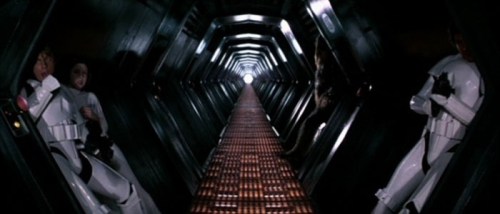
As I think we’ve seen, set design in science fiction follows particular rules and tends towards particular looks. It does not, in general, have the jury-rigged aesthetic that you’d see on actual spacecraft, or long term habitations like the ISS. Which is fair enough. No-one really wants to see high drama carried out in the sort of cramped compartments astronauts have to survive in for months at a time. No, spacecraft in Hollywood are roomy affairs, filled with high-ceilinged, dramatically lit rooms that bizarrely are connected by low, dark corridors.
I put the blame for the look of Hollywood spacecraft squarely onto one man’s shoulders. He’s been a seminal influence on fantastic (as in cinema of the…, although his work is never less than brilliant) set design since the seventies, and was pivotal in creating the look of some of the greatest films of the genre.
I’m talking about Ron Cobb, of course.
His career began at UCLA in the early seventies. Working alongside a fledgeling director by the name of John Carpenter, Ron’s first piece of design was on Carpenter’s first film, Dark Star. Although the clean lines of Star Trek were still in evidence in the ship design, the tiny bridge room he put together was a clever way of working within a budget that was not so much tight as gonad-squeezing. All three astronauts are crammed into a tiny set, but by placing them face-to-face and stacked along the frame, he allowed Carpenter to build in long dialogue takes without needing to intercut. His work on Dark Star is smart and sharp, and makes a student film look much, much more expensive.
The work for which he’s best known would come with his collaboration with Ridley Scott on Alien. Taking a cue from Jodorowsky’s aborted Dune project, Scott assembled some of the best known SF illustrators of the day for their takes on the gigantic space tug Nostromo, the alien craft they discover, and the creature they bring back with them.
Cobb’s drawings of the interior of the Nostromo were a part of my childhood. One of my most prized possessions as a boy was a book on the making of Alien. This had a wealth of pre-production drawings from the likes of Cobb, Chris Foss and of course HR Giger. I wish I could tell you what happened to that book. It somehow managed to disappear during one of the many moves my family made while I was a teenager. I was drawn especially to Cobb’s boxy, solid interiors, and used to pore over the details, obsessing for hours over how he had managed to do so much with such apparent ease.
It was thanks to him that I started to draw, filling notebooks with carefully drafted approximations of his work. He helped me figure out perspective, shading and modelling. Even now, my choice of art materials skews towards the technical. Sharpies, Rotrings and markers rather than pastels, oils and charcoal. Tie that into my enduring love of comics, and the discovery that actually I’m not a bad cartoonist, and my path has been set artistically ever since. I’m a black line boy.
Ron is still working, of course, and it’s great to see his mantle taken up by other, equally talented film designers like Nigel Phelps. But I see his influence in comics and graphic work of all hues and persuasions as well. His boxy vehicle designs are very much echoed in current production line models like the Kia Soul, the Scion and most obviously to my mind, the Nissan Cube with it’s asymmetrical wrap-around window. The modern MRI scanner owes more than a tip of the hat to his medbay drawings for the Nostromo. It seems we all live in Ron Cobb’s world now.
If only I could remember what I’d done with that Alien artbook…
The humble chair. A little spot designed for rest and relaxation, right? An item of furniture for you to take the weight off your feet, to switch off a bit.
Not in SF, it isn’t. In our favourite genre, the chair becomes a place of action.
Consider The Captain’s Chair in Star Trek. In The Original Series, it is a slab-sided, poorly padded lump of alloy on a swivel. Kirk spends a minuscule amount of time on it, and for the most part he perches on the edge of the seat cushion. Mainly because if he tried sitting back the rotten thing would dig a hole in his lower back. It wasn’t surprising he couldn’t wait to get out of it. It seemed to be a focal point for James T. to bark at Scotty through the communicator whilst leering at leggy ensigns.
It’s interesting to note that The Captain’s Chair becomes more comfortable the less outwardly aggressive it’s occupant. In the later seasons of Star Trek – The Next Generation, The Chair is better described as The Recliner. I swear, the thing has a footstool. I’m also certain there are opening shots in some of the later episodes where Picard can be spotted having a sneaky snooze.
Standards are slipping at Starfleet
SF chairs are not static objects. They do things. They move about. They are multi-purpose. They are dramatic objects. They are not designed for settling into with a mug of cocoa and a thick paperback.
A lot of them are on gimbals or tracks and whizz backwards and forwards with exciting whines and buzzes. They frequently incorporate communication devices, video equipment or in some cases, something more destructive.
pewpewpewneeeowwwkaboooom
Let’s do the Star Wars thing. I’m thinking specifically of the gun emplacements on the Millenium Falcon. These are fantastic. They’re ceiling-mounted. They have headsets, cool video screens and OH DID I MENTION THE GUNS?? I wanted one of these so badly when I was a kid. Oh, who am I kidding? I want one now.
Clearly I’m not alone. The gun emplacement bit in The End Of Time, the last Tennant Doctor Who episode, is a clear homage to the Falcon gunfight. Behind the scenes footage shows Bernard Cribbins having a whale of a time behind the sights of the lasers. I want to see the out-takes where he goes “pewpewpew” and makes exploding noises through his cheeks.
To confuse matters even further, let’s look to The Matrix. The gateways to the virtual world on the Nebuchennezar are accessed through couch-mounted plugs and circuits. You take a seat to dial into the Matrix. Let me just reiterate that. In the Matrix, chairs can be doors.
In Iain M. Bank’s Use Of Weapons the chair becomes something more potent. I would argue that the events of the book revolve around the sourcing of materials and construction of a simple white chair. This might seem a bit of a strange thing to say when talking about a novel that chronicles the adventures of an interplanetary mercenary. And it’s a difficult thing to properly talk about without ruining the big wallop at the end of the story. I recommend reading the book, but if you must, there’s a spoiler below.
The chair is made out of the bones of the main character’s sister, complete with a cushion fashioned from her skin. Iain Banks’ SF is not cheerful. Although it is somewhat chairful. Sorry.
After all that, I need a sit down. Someone send me over an armchair…
Ron Cobb does the business. That’s the kind of door we’re talking about…
image courtesy of John Eaves. Check out his chunk of posts on Ron Cobb here.
Let’s consider the humble doorway, and how it has become a character in and of itself in SF. In every other genre I can think of, they are simple objects. They open. They close, occasionally with a slam. In a prison context, they are symbols of incarceration, although to be frank characters tend to talk about the walls more, and they are the object that will have the graffiti and the gate-bar scratches, counting off the days until freedom comes.
SF doors are infinitely more complex. They are desperately over-engineered for the job at hand. And at the same time they barely fulfil the essential design requisites that you and I would consider the door would need. They rarely have handles, for example. You have to punch a code or say a password or, memorably in Jeunet’s Alien:Resurrection, huff your cheesy breath into a detector.
And that’s before the darn things will even open for you. Then you get the best efforts of a team of props men as they slide back on tracks or drop through the floor or iris open like a lens. In Star Trek: DS9 the doors were built like cogs, and they rolled out of the way in a way that was far too complex for the end result. Lights will frequently blink and flash. In Peter Hyam’s Outland, they had useful red or green fluorescents to let you know if they were locked or not.
And then of course, they always make noise. Helpful bleeps and chimes to let you know that they’re about to do that fancy three-way split. The hiss of hydraulics. The unzipping sound that accompanied Captain Kirk as he marched down the corridors of the Enterprise (those corridors were always too fancy for my liking, although I’ve always had a thing for the Jeffries Tube). And I have to mention the doors on the Heart Of Gold in the Hitch-hiker’s Guide To The Galaxy, that were programmed to take pleasure in opening and closing, and did so with an almost orgasmic sigh.
Of course, there are always exceptions. The doors in the reboot of Battlestar Galactica are heavy, unwieldy things, but at least they have a handle and they are pulled open and closed. However, as they’re all designed to isolate an area in the event of a leak, they still have valves and wheels and an excess of handles and cranks. Opening a door still takes up a disproportionate amount of screen time and effort.
I’ve not really talked about the more esoteric kind of SF door yet. The Stargates, for one, have devolved over the years from being a 2001-esque gateway across galactic space, complete with warp effects and the wailings of a heavenly choir, to the kind of thing that O’Neill and crew hop through when they fancy a walk in the Canadian woods. Then we have the organic portals of the living craft of Lexx and Farscape. These worry me. I’m not sure a door should drip and ooze. Or to that point, just vanish on you just at the point when you need them the most.
But of course, my all-time favourite SF door? Well, there’s no contest, really.
And don’t tell me you wouldn’t do the same with a door that did that. I want one for my garage.
Like most things in my life, it all boils down to Star Wars.
There are certain kinds of films that I really go for, and will happily sit and watch again and again. Danny Boyle’s Sunshine is one of them, and in a short introduction before it’s screening last night on FilmFour, he nailed one reason why. They all seem to be of a particular type, a genre with a history and a meme-set that is easily tracked. I love films of the genre sub-species he described as “A Ship. A Crew. A Signal.”
These are the horror-tinged bottle films, where most of the action takes place on a dark, monolithic spacecraft, within the confines of which BAD THINGS HAPPEN once The Crew pick up and foolishly answer The Signal. This Signal is usually a misinterpreted message to STAY THE FRAK AWAY. From then on in there will be running and screaming and dying and mostly a single survivor.
But mostly, there will be corridors. Hundreds of them, stretching for miles. They will be encrusted in vents, ducts, computery bits, extraneous ribbing, tons of stencilling and detailing in a limited palette of sans-serif fonts. There will be steam. Oh my word, there will be steam. I often wonder whether ships like the Nostromo and the Event Horizon are powered by a coal-fired boiler rather than a nuclear reactor.
The camera will start the film drifting in a dreamy manner down these corridors, and end it whizzing down them as the final character either has to get to a door before a timer runs out, or because something insectoid with too many teeth is chasing them. Frequently, both of these things are happening at once. There will be a whooping alert sound. It’s the same one in all of these films. There will also be a calm female voice doing the countdown. I think Winona Ryder has the monopoly on that one.
Sunshine has some great corridors. The set took over the entirety of Three Mills Studio in East London when the film was shot in 2006, and the detailing is exquisite. I’m happy to report that there’s also little attempt to score points off the meme. Although the ship is on it’s way to the sun, the corridors are dark and claustrophobic. The feel is heavy and industrial. Like most of these ships, the Icarus II is a submarine in space, a tiny metal bubble of life in an environment that’s almost instantly lethal.
I spent years in my youth drawing corridors like the ones you see in films like Sunshine and Alien. Once the technical drawing classes I took in junior high school taught me the rudiments of perspective, I was away. I can still draft a pretty good blocky spaceship in three-point, or an infinitely expansive throughway liberally coated in technological cruft. I love them. They are places where adventure happens, where there is high drama, monsters coming out of the walls and lots of those spinning orange lights they have on the roofs of ambulances.
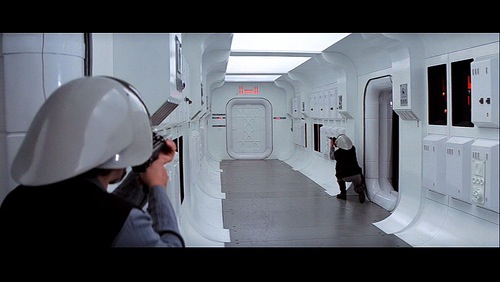
I said at the beginning that I blamed this on Star Wars. Think about it. Two minutes into the film, after all that tedious nonsense with the yellow letters and the big triangle that goes on for miles, we are inside the Tantive IV, and we see… well, THIS.
This, and the later scenes in the Death Star are something that should not be shown to an impressionable ten-year-old who’s already a little too lost in his own imagination for his own good. Especially the bits in the prison block.
It’s time, I think, to start talking about a project that I’ve been tangentially involved in for a while. This is a short documentary that Dom, one of my best friends and filming partners, has been working on. It’s about the art and public perception of the graffiti artist Banksy. It’s an unusual project, in that Dom is claiming that he has nothing to do with it. He’s telling people that it was simply something he came across, a DVD that he found behind a lamp-post somewhere, and that all he’s doing is bringing it to the public’s attention. To the point where the working title is now “I Found A Film About Banksy”.
Fair enough then. I too have fallen down the rabbit hole, and can only tell you what I know about this film. Last Thursday, for reasons I am not at liberty to go into, I was on a slow-running train into London on my day off, with my trusty MiniDV camcorder. Dom and I were off to The Courthouse, a hotel that used to be the Great Marlborough St Magistrates Court, to interview entrepreneur Ivan Massow.
I’ve discussed the film that he’s made, “Banksy’s Coming To Dinner”, here. Dom had been keen to talk to him since he’d seen the film, and Ivan had agreed to an interview after a surprisingly short amount of nagging from my most tenacious friend. We arranged for a 10:30 meet with Ivan at the bar of The Courthouse, which has kept the holding cells it was built around and converted them into snugs. A great place for an interview about an artist whose relationship to the law is at best skewed.
As we headed in, it became clear that we were going to be late. My train was painfully slow-running, and traffic for Dom was the usual London nightmare. Also, Ivan had pulled the interview forward half an hour. We were now in danger of pissing off our interviewee with a late arrival – the most unprofessional thing to do when someone is doing you a favour. I arrived at the Courthouse at 10:15, got the bar open and quickly settled on a decent cell for a chat. Dom was five minutes after me, looking intensely harried, but with good news. Ivan was also running late.
We ran the quickest rig-up in the history of film-making ever, and were just about ready to go when Ivan finally arrived, 25 minutes late and already looking at his watch. Great. This would not be the leisurely chat we were expecting. However, we had no cause to grumble.
Ivan was great. Erudite, funny and insightful, and fully up for playing the Banksy game. In short, not admitting to anything. You might say that, but I couldn’t possibly comment. It wasn’t me, nobody saw me, you can’t prove anything. Plausible deniability. We managed 25 minutes with Ivan before he had to run, and we’re both very grateful to him for giving us that much. There is some very good stuff in that interview, and he’s added a chunk of value to the already rich mix that allegedly has been put together by someone. See, the game is addictive.
The remainder of the day was a solid chunk of decompression in various pubs, chats with friends and plotting our next move. This was a great way to relax after an incredibly panicky morning. We’d pulled victory out of the jaws of humiliating defeat, and it felt good.
So. Next. Dom will be giving Sheffield the love at the documentary film festival, and we are in prep mode for the reshoots on Time Out, which should be happening in the next week or so. Then it’s a simple case of finishing the cut on that and getting it distributed, hopefully to a slightly more interesting platform than YouTube. More news on that as it happens, obviously.
And then it’s November, and Nanowrimo again. I have a great idea, which is going to be a manic romp around some of the influences that shaped my reading as a kid. I’m really excited about this one, as is everyone that I’ve pitched it to, purely on the strength of the title, which came out of a misheard phrase when I was talking about last year’s Nano.
Ladies and gents. My novel for 2009 will be based on a very simple concept.
Dom discovers YouTube. That's it for work today, I guess...
Looking back over the past few posts, it’s painfully obvious that I am turning into a curmudgeonous old whiner, griping and complaining about the state of the country, signing petitions in lieu of doing something useful.
So, for a change, let’s be positive and constructive and look at how the film projects are coming along.
Time Out is taking shape nicely. We’ve closed up gaps, tweaked the edit ever so slightly, and laid in a sound bed that’s suitably overwhelming. We’ve storyboarded up the shots we need to get in a comparatively simple reshoot day, and are now getting that day together, in conjunction with our brilliant cast and crew. The plan is to complete Time Out in the next couple of months. Let’s call it a Christmas Present to the world.
Meanwhile, Decks Dance And Videotape continues on it’s glacially slow path to realisation. Dom had one of his busiest weeks ever, squeezing in interviews with Richard, promoter of the renowned Raindance night and Pez, the guy who defined the iconography of thee Acid House aera with his use of The Smiley Face. But that’s not all, dance fans. He also snagged an interview with house pioneer and legend, Marshall Jefferson. He can now brag that Marshall bought him a Chinese takeout. There aren’t too many people who can say that. All three came across as wise, insightful and funny. And they can all talk the hind legs off a kangaroo.
Logging work will commence on this prime chunk of footage, and next order of business will be a new trailer to drum up some interest, reflecting the wealth of interviewee goodness we now have on board.
And of course, how surreal the whole thing can be…
L-R, Richard, Pez. Or is it the other way round?
Over the past week, Dom and I have really made some progress on two very solid projects, and there’s more to come. We’re interviewing next Thursday, working on yet another film that I’ve been keeping shtum about on this blog for the time being. That may well have to change soon. Keep it locked to X&HT. News is approaching.
Reviews should be objective. It’s never a good sign for a pundit to write a piece on a film when it’s known that he or she was involved in it’s creation. There’s no sense of distance, and every chance of bias.
Here is my review of Blood + Roses, a film which gives me a prominent colourist credit, and for which I put together an EPK.
Blood + Roses is a film about a girl who cannot help but get involved with bad boys.
At the beginning of the film we meet Jane, who is stuck in a loveless relationship with Martin, a cold, controlling bastard played with misogynistic glee by Kane John Scott. Jane, frail and wounded, has nightmares of something awful that has happened to her in the recent past. Something that she can’t quite remember, and that Martin is in no hurry to help her recall. Something that they have driven to an isolated cottage in the country to try and put behind them.
Once there, things don’t seem to be improving for Jane. Martin is unsympathetic, selfish. Then she meets, and is seduced by the ultimate tall, dark stranger – Seth, a vampire. As Jane begins to change, her memories of what has happened begin to return, and her frailty is shed in favour of something more primal. Physically and mentally, her strength returns. As it does so, Jane begins to thirst. Not just for blood, but for revenge.
Blood + Roses is an attempt to tweak some of the more romantic aspects of the vampire mythos, to tease out some dark truths about the nature of attraction and desire. Jane may be stuck in a loveless marriage, but she knows what she’s getting into with Seth. She embraces her new life with relish, and an almost unseemly haste, considering the consequences.
Jane is played by Marysia Kay with a touching fragility in the early stages of film, before her transformation. After, she becomes stronger, sleeker, more feline, graceful yet deadly. She portrays this change nicely, and as a vet of the BritHorror scene, I would have been surprised if she hadn’t. This is, after all, an actress who specialises in portraying strong women – sometimes strong enough to pull their hapless victims in two!
Seth, the third point in the triangle, is played with louche charm by Benjamin Green. Seth appears worldly and urbane, but at the same time he is very much the predator of the piece. He simply walks into Martin and Jane’s life and takes what he wants, without a wasted thought to the consequences. Jane is quick to embrace his attitude – any escape from the airless trap that her life has become with Martin would seem to be acceptable, even the loss of her soul.
Blood + Roses is a film to muse over, something that needs a little time to sink in and percolate. It’s careful to play with the mythos just enough – the “v word” is never mentioned, and in this film they can be seen in mirrors. An interesting move, perhaps to bring home the point that the life Seth offers is a dark mirror of the one Jane is so keen to leave. The life of a vampire is, in it’s way, as constrained as her marriage to Martin. She will never see the sun again, eat real food be able to have children. Her time with Martin may have stripped away most of her humanity, but accepting Seth’s bloody bargain means turning her back on what’s left of it.
The isolated location of Blood + Roses works in it’s favour. Most of the action takes place in the confines of the small cottage Martin and Jane have rented. The camera stays tightly framed on the actors, trapping them in dark corners, unable to escape their fate. The cinematography is lush and rich, though, and colour is used to surreal effect in a couple of dream sequences. Kudos to DoP Richard J. Wood and director Simon Aitken for resisting the temptation to desaturate the colour palette and give the pictures a mud wash. This is a good-looking film, even if it was shot in nasty HD video.
The film really comes to life when it’s focussed in on the vampires. The chemistry between Seth and Jane comes across beautifully, to the point where I was disappointed when they weren’t on screen. By contrast, I felt too much time was spent on the plot cooked up by Martin and his doctor friend Ted, and their crime against Jane. This wasn’t helped by the dry reading given by Adam Bambrough, which made the pair come across as buffoonish rather than truly evil. A shame, because on the whole I thought the script, by Simon’s long-time writing partner Ben Woodiwiss, worked well. And the guy can write a mean vampire.
On the whole, then, I found Blood + Roses an entertaining take on a couple of standard horror tropes. It doesn’t wallow in grue or histrionic performances, preferring instead a low-key approach that builds slowly towards the finale. Here, at last, my gorehound tendency was satisfied in an ending that riffed nicely on classical and Elizabethan revenge tragedy. It’s something a bit different, and I wish it well.
It’s a big day for UK indie film-maker Simon Aitken. Blood + Roses, his first feature, has it’s cast, crew and press screenings tonight. I’m really excited, and can’t wait to see it on the big screen at last. It’s been a long, hard two year fight to get the film to this position, and it shows the sort of tenacity and single-minded drive that Simon has in spades that he’s done it with no money, and certainly no help from government or lottery-funded grants. It’s a tremendous achievement, and I’m proud to be associated with it.
Saturday dawned, sunny with clear blue skies. A blessing, after three twelve hour days at work in the dark, staring at a screen.
No sun for me. I would be spending the day voluntarily sitting in a dark room, staring at a screen. Saturday was Frightfest day.
I met Leading Man Clive and Blood ‘n’ Roses Aitken in the one decent pub in Leicester Square. They were breakfasting. I had already eaten, so fortified myself with a pint of crude. It’s good for you, right? Besides, I didn’t want any more coffee. Twitchy in a horror movie crowd is not a good look.
To the Empire, the big new venue for Frightfest. We grabbed wrist bands, perused the retail opportunities around the main concourse (The Cinema Store had a decent selection of goodies, but I contented myself with a Frightfest teeshirt) and all too soon it was time to go in for the first movie.
SMASH CUT is a loving tribute to the work of Hershell Gordon Lewis, The Wizard Of Gore. It wears it’s influences lightly and isn’t afraid to make fun of itself. The story of a director who starts harvesting murder victims for props for his movie, it’s light on it’s feet, funny, sharp and impassioned about the state of the industry. It features a lot of genre names in cameo and supporting roles, including Hershell himself, who was clearly having a ball. It was a great casting move to include porn star Sasha Grey, who gives a fairly solid performance as the investigative journalist tracking down the psycho director. There’s a fine horror tradition of giving strong female roles to porn actresses, and it’s carried off with aplomb here.
I loved it. It will never win any Oscars, but for fans of the genre it’s well worth the time. Director Lee Demarbre and star David Hess introduced the film and gave a hilarious Q&A afterwards, which also addressed the central dilemma at the heart of the film. A love story to cheap and cheesy 16mm film-making, it’s shot on video. I’m never convinced by the arguments given for shooting on HD versus film, and just think it always looks a bit cheap. I’m biased, I know, but I simply don’t see HD as the only choice for the lo-to-no budget film-maker.
Aaaaanyway. Twenty minutes later, we were back in our seats for HIERRO, a Spanish horror that’s clearly going for the same creepy ghost child feel as The Orpanage and The Devil’s Backbone. It doesn’t, sadly, feeling leaden and plodding. Rather than building a mood and putting us on edge, director Gabe Ibáñez seems content to make a good looking frame, and ensure that his lead actress, the lovely Elena Anaya, always looks stunning even at the height of her despair.
Elena plays Maria, who lost her son on a ferry trip to the island of La Hierro, on the southernmost tip of the Spanish territories. Crazed with grief, she returns to the island when a child’s body is found, only to then believe that the child is still alive.
It’s a shame that it doesn’t work. The performances are fine, the last plot twist is clever, and Gabe Ibáñez can compose a beautiful looking shot. But the funereal pace and lack of shocks just do for it, in the end, and I found myself unable to care for Maria or her plight.
Another short break, which led Aitken to indulge in the Pick ‘n’ Mix counter as we didn’t have time to get anything proper to eat, and back in for MILLENIUM, aka THE GIRL WITH THE DRAGON TATTOO. This, we were told, was something of a departure. Not strictly speaking a horror film at all, it contains enough horror tropes to make it suitable for we merry band of hardcore Frighters. “Trust us on this one,” we were urged. “It’s great.”
And it is. I can’t say I’m a huge fan of detective stories, but this was utterly absorbing. A twisty, clever tale of the decades-spanning work of a serial killer and the journalist and hacker who team up to stop him, it features one of the best new characters of the decade, and if there’s any justice, Bizarre magazine’s new muse, the heavily tattooed and pierced Lisbeth Salander. Vicious, antisocial, but stridently moral and incorruptible, she is no victim despite her harsh upbringing. Her revenge on the guardian who abuses her is jaw-droppingly cruel – but he deserves everything that happens to him, and she had the whole cinema cheering.
Already a massive hit in Europe, you need to search this one out when it hits the UK early next year. There are two other films in the trilogy, which are out in Scandinavia in September and November. Time for me to start brushing up on my Swedish…
Yet another short break (you can see where I’m going with this, can’t you?) which gave us just enough time to dash out and inhale a Burger King. It was getting on for seven o’clock at this point, and we’d all had to skip lunch. Pick ‘n’ Mix, Simon opined, is no substitute.
I was excited now, as the next film up was the new one from one of my horror heroes, Dario Argento. A return to his slasher roots, to the point where it was simply named after the genre: GIALLO.
These days, it’s unusual for me to watch a film through my fingers. I like to think I’m pretty hardcore. Giallo was a rare exception. I was in a knot throughout.
It’s utterly, mind-buggeringly, squirm-inducingly awful. It would be laughable without the name of a master attached. The dialouge is rotten. The performances veer from flat to scenery-chewing without ever hitting decent. The effects are no better than the ones in Smash Cut, and they were supposed to be laughable. I spent the first reel hoping against hope that it would improve, and realised by the end of the second that there was no hope for it. I very nearly walked out, but I was so utterly mesmerised by the slow-motion car-crash unspooling in front of me that I was rooted to my seat.
It’s interesting to note that Argento’s most recent mainstream interview, a three-page spread in this month’s Bizarre, fails to mention Giallo at all. There are strong rumours that he has completely disassociated himself from it, that it was taken out of his hands, even that Emmanuelle Seigner, the lead actress, was on drugs throughout. Can’t properly comment on that one as it’s pure speculation, but it would explain the dreadfully flat performance. I’m not a believer in the so-bad-it’s-good school of film appreciation, but it honestly has laugh-out-loud moments. If it’s a spoof, it’s a work of utter genius. If it’s not, then I’ve just witnessed one of my favourite directors piss what’s left of his reputation away.
After that we all needed a drink, so I got them in while we waited for the next film of the night. I had tried and failed to get tix for Pontypool, a clever spin on infection horror, but I was assured that I would not be disappointed by my second choice.
And so it proved to be. TRICK ‘R TREAT is a loving tribute to the horror anthologies of the eighties. It’s chock full of invention, wit, charm, proper scares and features the most genuinely inventive new horror character in years, the Halloween sprite Sam. It’s being hailed as the highlight of the festival, and rightly so, as it’s genuinely, properly entertaining. Quite honestly, it’s a film I could take Clare to, feeling sure she’d enjoy it.
So, it’s a shoo in for Halloween screenings, right? Warner Bros must be all over this one like a rash, right? A proper, honest horror hit in the making, right?
Wrong. Trick ‘R Treat was made in 2007, and has been shelved ever since. It’s finally getting a DVD release this year, which is totally bogus for a film that really comes to life in front of a cinema audience. For this film to be sat on, when formulaic retreads and remakes get the nod is frankly sickening. Michael Dougherty, the director, was there, and made an impassioned plea for people to get behind this film and push for it. He has support from none other than John Landis, at Frightfest for the re-release of An American Werewolf in London, and who made his feelings about Warner’s actions very clear indeed, with a bellowed “Fuck ’em!”
Supporting this criminally overlooked film is the least I can do. It’s available for pre-order now – go snag a copy. Better, if you get the chance to see this film on the big screen, do it. It’s brilliant. It’s just the most deeply satisfying horror I’ve seen in a long time.
The last film of the night, Vampire Girl vs. Frankenstein Girl, started late, and was shaping up to be good, sugared-up gory fun, but something made me check the train schedules, which was just as well. The 3:30am train I was counting on wasn’t running, which meant an abrupt exit, hasty apologetic texts to Simon and Clive, and a dash across town to catch the last train home. A shame, as I enjoy the anime-brought-to-life of films like Tokyo Gore Police. The twenty minutes I saw came across like Grange Hill on meth. This is not necessarily a bad thing.
(The clip below is NOT SAFE FOR ANYBODY)
And that was me done. I was drained after just one day, so Gods know how Clive does it year after year. I can see why he does it though. It’s a great way to get a real snapshot of what’s going on in the horror and fantasy field, as well as seeing rare and interesting movies that you simply wouldn’t see otherwise.
My one problem was with the density of programming. It’s great that they cram so many films into the day, but it does mean if you want to network or kick back with your mates, you’ll probably have to miss something, and if you’re on a day pass that’s just not the best use of your time.
Still, that’s a minor grumble against a day that was otherwise well worth the money.
Frightfest – very nearly the best fun you can have with lots of people in the dark.
August Bank Holiday is rolling around, in the same sort of way as a rhino that’s about to run you down. It’s big, it’s slow-moving, but somehow it’s on you before you realise it.
Normally at this time of year I would be getting ready to wallow in the mud at the Reading Festival. Due to circumstances both beyond (tickets sold out in 15 nanoseconds flat) and within my control (laziness) Radiohead will just have to manage without me. No, this year I shall be at Leicester Square, for a day of Frightfest.
The UK’s premier horror and fantasy film festival hits it’s tenth anniversary this year, and it’s ringing the changes in a big way. A move to the Empire, one of the bigger cinemas in The Square, and the opening of a second Discovery Screen for new talent. Which means more films, of course, and with that the chance to miss something you really want to see because something you want to see more is screening at the same time. So it goes.
I’m easing in gently, by just doing the Saturday, which has the highest concentration of must-sees for me. Unlike hardcore Festers like Leading Man Clive, who regularly do the whole thing, which can’t be good for you.
The real pick of the crop for me, is Giallo, the new film by Dario Argento. It seems like a move back to his stylish slasher roots, and should be an absolute blast. There are rumours that he might be attending, which would make me a happy horror head.
(FanBoy Fact: One of my discoveries of this year, Frederic Brown’s noir novel The Screaming Mimi, was the uncredited source for Argento’s first giallo, The Bird With The Crystal Plumage. Different kinds of pulpy yumminess).
One feature of the fest that I may well miss is the Zombie Walk around Leicester Square on the Monday morning. Don’t be fooled. That’s not makeup. This is what horror fans tend to look like after three days in a dark room with inappropriate nutrition and not enough kip.
Bacon saaarnieesss... erm, we mean braaaainnnns...
I’ve meant to do Frightfest for years, and I’m really excited to be sitting down with some good friends and just indulging my geeky half.
Alright, two-thirds.
Frightfest begins tomorrow evening with the premiere of seaborne shocker Triangle. Hopefully nothing like the old soap opera set on the Le Havre ferry…