Start Choppin’: X&HT Reviews 127 Hours

it took me ages to figure out that the pic here is
an hourglass...

Bottle
films are notoriously hard to carry off. Putting all of your action
in one cramped, isolated place, with a limited cast of characters
could be the recipe for a tense, claustrophobic thriller. Rodrigo
Cortés’ sweatily effective Buried springs to mind as the most
extreme recent example.

If you’re going to hem in your
actor to that kind of degree, then you’d better be sure that you’ve
got someone bloody good in front of the camera. Ryan Reynolds is
brilliant in Buried, and I’d have been interested to see him cast
as Aron Ralston in Danny Boyle’s 127 Hours. He has the proper sense
of physicality and goofy charm for the role. Instead, the face that
we see in a hole in the rock is James Franco. It’s a testament to
Franco’s skills as an actor, and of Boyle’s as a director, that
we’re convinced from the get-go of his capability, energy, skill
and knowledge of the desert that very nearly kills him.

We all know the story by now.
Aron Ralson, crag-hopper, mountain biker, all-round super-confident
hardbody makes a split second mistake while out on a weekend jaunt
in the deserts near Moab, Utah and ends up in a crevasse, his hand
mashed between the rock wall and a huge piece of
chalkstone.

His story, and what he has to do
to get back to civilisation, is the stuff of legend. In fact, there
were times when I found myself scoffing at the preposterous nature
of his escape. “There’s no way he could rappel down that cliff,” I
chuckled at one point. “He’s half-starved, desperately dehydrated
and quite possibly in shock. What do the writers take me for?”
Aron’s story is mind-boggling because you have to keep telling
yourself that all this actually happened, that he did free himself
from a predicament that would have 99.99% of us forming an
attractively spooky display of bleached bones in a cave somewhere.
He survived, and continues to do the things he used to, only now
with a rather cool looking climbing tool replacing his left hand.
Very post-human.

The trick to keeping a bottle
film interesting is to keep your viewpoint fluid. In Buried, the
director does this by exploring every nook and cranny of the set,
and cleverly by changing the size of the coffin to enable his
camera to get into places where there simply shouldn’t be room. in
127 Hours, Danny Boyle takes a different approach, and a lot of the
film isn’t in the canyon where Ralston is trapped at all.

With the use of flashbacks,
hallucinatory episodes and gorgeous tracking shots over the desert
terrain, I felt like I was on a guided tour of the trapped
climber’s interior geography. It’s cleverly done, and although you
lose something of the isolation and claustrophobia that he must
have felt, the end result is a dazzling, eye-popping feast. The
cinematography is wonderful, and every format from yummy 35mm to
grainy 2003-era DV is thrown into the mix. Kudos to Enrique Chediak
and Anthony Dod Mantle especially for the beautiful macro work,
slipping cameras into water bottles, the guts of cameras and
tracking the path of ants and insects through the cave.

Danny Boyle is one of the few
directors out there that loves colour, and uses it to it’s full
advantage on the big screen. I’m tired of the limited palettes that
are the thing in film these days, and heartily sick of the dreaded
cyan/orange cliche that makes modern films look underlit and boring
to watch. 127 Hours is a hard dose of pure sunshine after all that
drabness, and I felt like Aron, dipping my toe in blissful relief
into warmth and light, if only for a little while.

As for THAT moment: well, I’m a
horror film fan, so I’ve seen significantly worse. It’s nicely
done, and everyone around me seemed to be squirming. I loved the
way the arm breaks were accompanied by an almost subliminal flash
of light. As I watched, though, I realised that no matter how much
gore or screechy sound effects Boyle threw at us, there would be no
way of conveying more than a hundredth of what Aron Ralston went
through that day, in his cave, alone and close to death.

127 Hours is a worthy testament
to an astonishing feat of human endurance, but it doesn’t come near
to showing us what it must have been like. That’s a good thing.
It’s a remarkably positive movie, filled with light and colour and
life, and a happy ending. As a lesson in what we can survive and
achieve, 127 Hours is a triumph.

Five Songs That Should Have Been On The Soundtrack To The King’s Speech


Yes. Right.
Well. Hope you’re enjoying the bump in quality as the daily post
schedge kicks in.

Everyday Heroes

Shooting People, the organisation that brings together like-minded film-makers across the country to collaborate on film projects, runs a film of the month competition. This month, it’s themed around Straight8. I’m very happy to report that the NO. 1 slot is currently filled by X&HTeam-mate Fiona Brownlie with her frankly astonishing superhero film Everyday Heroes. You can check the leaderboard and watch the film here.

You should bear in mind that everything you see here in Everyday Heroes was done in camera, in sequence, with no second takes. Yes, even the animation. It’s a remarkable achievement, and one that deserves your attention and applause. You may also notice that leading Man Clive has a cameo in the film. He’s the one in green spandex. I’ll repeat that. Watch this film and you get to see leading man Clive IN GREEN SPANDEX.

To vote it up you need to be a member of Shooting People. This link will help that process out somewhat. Go. Watch. Vote. And above all… ENJOY.

X&HT Reviews: Season Of The Witch

My esteemed colleague WDW and I seem to have made it a habit that, if we go to see a film together, it’s usually as a dare to watch something truly dreadful. Our last adventure, a trip to see Twilight: Eclipse exceeded all our expectations.

When we settled down in front of Season Of The Witch, a medieval action-horror boasting a Rotten Tomatoes score of 3%, we had no thought that it was going to be anything more than turgid nonsense, with light relief coming from seeing how unconvincing Nic Cage’s hair extensions were going to be.

Readership, we were labouring under a misapprehension, one that desperately needs clearing up. Season Of The Witch will never be a great film, but if you enjoy derring-do, sword-play and ye olde adventuring then you could do a lot worse.

The story concerns Nic Cage and his wig returning from the Crusades as a deserter, along with his best mate Ron Perlman and his giant forehead. They are talked/blackmailed into escorting a witch across country to an isolated monastery, whose monks will take away her powers and cure the land of the pestilence sweeping across it. It’s a dangerous cargo story, a kind of olde worde Wages Of Fear, and the package they carry turns out to be neither the innocent girl that our heroes initially see, nor the witch that the monk accompanying them believes.

At 97 minutes there’s no flab or dull patches. The film gallops from wild-eyed battle to preposterous encounter. There are swordfights, wolves, demons, and a sweatily tense bridge-crossing sequence. There’s a decent performance from Nathan off of Misfits, and Claire Foy as the witch does a fine job of flitting between innocence and evil. Nic Cage does his trademark flip-out, and Dominic Sena directs the whole thing with an eye to the gothic and grotesque.

Yes, ok, the dialogue is pretty dreadful (although there are a couple of great lines that WDW and I quoted back and forth to each other in the pub afterwards) but then you show me a medieval actioner where the lines are anything more than groanworthy.

Short conclusion – we walked out feeling utterly bemused by the rotten reviews this film has been getting. It’s a lot of fun and solidly old-fashioned in it’s approach in giving you thrills and jolts in equal measure. It’s likely to get knocked around at the box office, facing as it does the one-two punch of 127 Hours and The King’s Speech in it’s opening weekend. That’s a shame, because if you’re in the mood for scary action (admission: I’m ALWAYS in the mood for scary action) this fits the bill admirably.

WDW and I wanted to see a bad film this weekend. We failed dismally.

(Check out her take on the film here.)

New Culinary Definitions: SMOZZ

Smozz is the stuff added to food to make it extra perfect. Vinegar on chips. Parmesan. Ketchup. Sweet chili sauce. It’s an embellishment. A grace note, but one without which a meal can be perfectly fine, yet not …quite …there.

Smozz is dependent on the tastes and proclivities of the individual. Most people like a dollop of ketchup with their chips, which to me is a culinary crime. Mayo, on the other hand, is a must. Those crazy Dutch really hit on something there.
Smozz is not just a savoury addition. Sweet smozz can include marshmallows on hot chocolate, or a snappy, plasticy Flake shoved at a jaunty angle into an ice cream. A grating of chocolate on your cappuccino is the very essence of smozz.

Origin: the word was first seen on a bill at an Italian restaurant, where TLC and I had ordered a small garlic bread with extra mozzarella. Garlic bread does not need a blanket of sizzling, string-melty cheese on top, but it certainly doesn’t hurt. The bread was itemised on the bill as s.mozz. A new culinary term was born.

The Sunday Lao Tzu: starting small

(In the attempt to keep the blog fresh as I make the attempt to give you something new every day, I have decided to theme my Sunday posts arounds the teachings of Lao Tzu, the father of Taoism. Expect the Sunday X&HT to be a bit more philosophical, if not necessarily spiritual).

“All difficult things have their origin in that which is easy, and great things in that which is small.”

I don’t do new Year Resolutions, for the same reason that I no longer keep diaries. They always seem like a good idea, and I start off strongly, entering whole-heartedly into the agreement with myself to be a better person, to journal my every move. I have a stack of notebooks that have entries through the first week of January, an apologetic second burst somewhere in mid-February (when I was a teenager these usually coincided with Valentine’s Day, and consisted of bursts of woeful spite and, if things had been going really badly, love poems) then nothing. Rueful, shameful blank pages. Most of my resolutions have started and ended this way, and I view it as a sign of finally growing up that I stopped making unrealistic pledges that would be quickly abandoned.

I’ve realised that I was going about things in the wrong way. Rather than launching with both feet into a project and losing interest in the face of the hard and sustained effort that was required, I would have been better starting gently, easing into the task. This was a lesson that Lao Tzu teaches, but that Nanowrimo allowed me to apply to real life. By doing something every day, the task soon becomes a habit, then a part of your daily routine. No matter how little, the daily bit is the important bit. (Sidebar: yes, I know Nanowrimo is a 1667 word a day challenge, and that doesn’t sound like a little thing. By by breaking that task down into further 500 word chunks, it’s surprising how quickly you make your daily, weekly and monthly goals.)

The Habit is something that I hope to achieve with the PostaDay exercise. The point where I feel twitchy if there’s a danger of not posting is the point where I know I have accomplished something important.

When your objective stops being a chore, and becomes a daily pleasure, then you have succeeded in your goal.

Love And The Pot

Film critic Roger Ebert has one, and loves it so much that he wrote a book about it. My friend Rev Sherlock has one, and claims it’s the heart of his kitchen. After months of whining and pewling from yours truly, TLC caved in and bought me one for Christmas.

I’m talking about rice cookers, Readership. And I think it’s going to radicalise the way I do things in the kitchen.

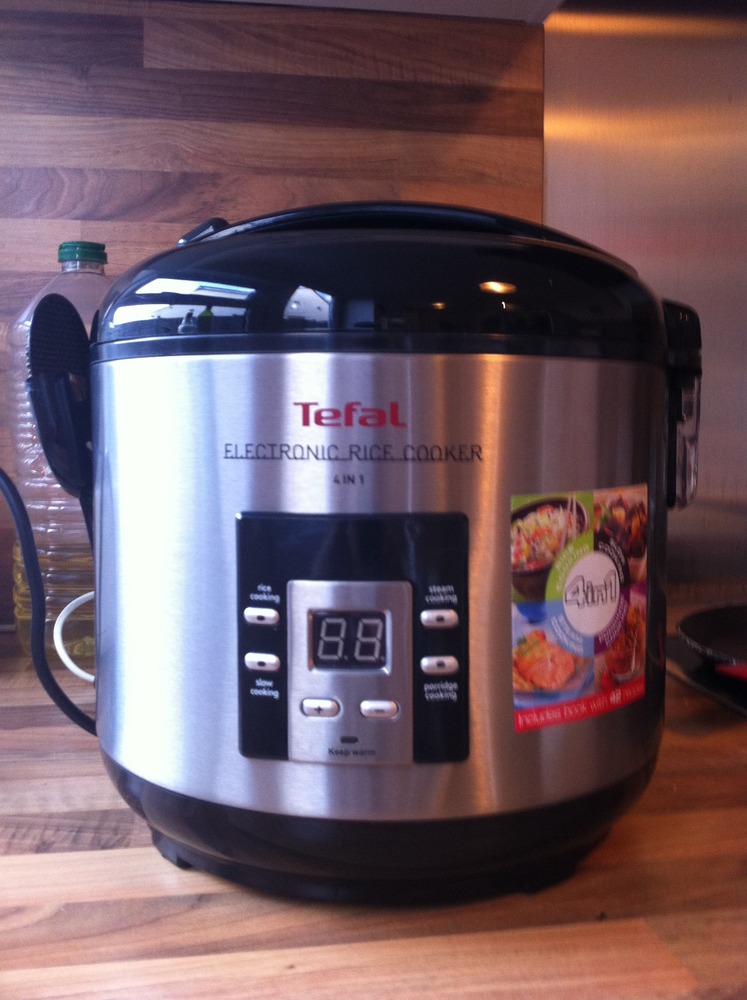
My proudest new possession is a Tefal, with four functions. (Ebert frowns on this, but I don’t really care). It’s a steamer and slow cooker as well as a rice cooker. It also has a porridge function, which made for the creamiest, most unctuous podge I’ve ever made.

So far, I have steamed broccoli for Xmas lunch and spuds for a fish pie in it. I have made blueberry and cream porridge. I have cooked a full chilli beef stew in it, and the meat was softly giving under light pressure from a spoon. I have even cooked rice in it.

This process has something of the magical about it. Rinsed rice and volume-and-a-half of liquid go into The Pot (after a while, you can’t help but go for the Ebert-style capitalisation). Press the cook rice button. It sits quietly on the counter, venting the occasional polite puff of fragrant steam. After about 15 minutes, it beeps gently. Your rice, sir. It will stay warm in the pot for an hour or so. Fluff it up and get stuck in. No muss, no fuss. The non-stick bowl washes clean in an instant. The simplicity and efficiency of the device has me filled with a profound, calm joy. I want to use this machine every day.

Something of a recipe, as spelled out to me by one of my work oppoes. It’s the perfect restorative after a night out, or indeed a long work day, and will withstand any manner of tweaking.

Tobias Clayton’s Back-From-The-Brink Rice.

Put the rice in The Pot and get it started. While it’s puttering away, finely chop a chili and a green onion. Once the rice has clicked over to stay warm, fluff it up, then throw in a glug of oil and the veg, and clap the lid back on. Give it five minutes. The veg will soften slightly in the heat. When you can’t stand it any more, throw in more soy sauce than you think you’re going to need, lob the whole lot in a bowl and bury your face in it.

If you want to gild the lily, some briefly cooked mushrooms, prawns or chicken would work well. Try flavoured oil stirred through the rice, or cook it in some stock. I’m going to try popping some fish in the steaming basket that comes with the pot next time, just to see how that’ll cook.

All of which sort of jibes with the elegant simplicity of the dish. The salty tang of the soy mixed with the crunch and zap of the chili, all bound with the nutty comforting rice. It’s pure cooking, all about flavour.

Look, I’m sorry, I know I’m gushing here. But this is a transformative moment for me. I’m spending more time than I ought thinking about what to cook in The Pot, and using it makes me grin like a gibbon. As my adventures in domesticity continue, this becomes yet another reason to get home, get comfy and cook.

Now, have I told you about my new pair of slippers?

The Tax Hike: something to talk about

I'm proud to say that I was one of the thousands that contributed to get this poster into papers and onto the sides of buses.

As the tax rises start to bite, the question that is
starting to be asked more and more is not “How will this affect
me?” but rather, “Are they necessary in the first place?”

That’s a
pretty good question. Tax hikes and cuts to essential public
services will save some money. But chasing down big corporate tax
evaders and getting them to simply pay what they owe will pretty
much clear the deficit with none of the pain.

It should of course
be noted that the pipsqueak that put these austerity measures into
place sees no problem in dodging tax himself.

“We’re all in this together.” Really. I’d love to see the wallet-tightening measures in place at Dodger Osbourne’s house. One less serving of swan a week, perhaps.
The most excellent website False Economy has come up with a handy
guide to the hikes and cuts, and why they’re not just unnecessary
but potentially suicidal. Chillingly, the economists and financial
experts that contribute to the site note that there’s a country
that has recently tried austerity measures almost identical to
Dodger’s. That country is Ireland, and we all know how well they’re
doing at the moment. At least the press across the water knows how
to call out a government that can’t help but run a thriving economy
into the ground.

The False Economy primer can be downloaded from their site here. Please, download, read, learn and share the knowledge. We are being lied to. It doesn’t have to be this way.

X&HT Reviews: Love And Other Drugs

The ad campaign for Ed Zwick’s Love And Other
Drugs seem content to have you believe it’s a straight up rom com.
There’s a little comedy, a little tragedy, some saucy nonsense with
flirting and nakedness. Not the sort of thing I’d normally be seen
anywhere near.

However, I may have mentioned in
the past that TLC is something of a fan of the leading man of the
piece, Jake Gyllenhaal (pronounciation guide: it’s a “soft” G, like
the J in Jake. I learned the tough way. I pass my bruised knowledge
on to you, Readership). Hence, it was a no-brainer that I would be
called upon to escort her to her latest tryst.

I’m glad she did. Love And Other Drugs is much more than
the posters would have you believe. There’s plenty of dick jokes
and nekkid ladies to keep the neanderthal in you happy, as well as
a genuinely involving story with some striking performances. Love
And Other Drugs is a solidly entertaining movie that plays nice
with all the rom com cliches while at the same time bringing it’s
own ideas to the table.

Jake plays Jamie, a
salesman for Pfizer during the early years of the Viagra boom. He’s
a fast-talkin’, low-hustlin’ hard-lovin’ guy with serious brains
and a little more of a soul than he’s letting people see. That is,
up until the point where he meets, sleeps and eventually falls for
Maggie, an artist with early-onset Parkinson’s, and his life is
changed. This relationship is the heart of the film, and it would
be very easy for it to collapse into mush. It’s saved by the
utterly astonishing rapport between Jake and his co-star, the
luminous Anne Hathaway. To my mind, she’s very much the best thing
about this film, and lights up the screen every time she’s on (I
can happily report she’s on screen an awful lot, and often not
wearing very much)(yes, I do have a crush now, thank you for
noticing). She takes the annoying manic pixie girl trope and makes
something fresh out of it, flashing between moments of toughness,
sass, sexiness and desperate, strung-out vulnerability.

Together, Jake and Anne bounce lines, looks and tiny
moments off each with the dexterity and subtlety of world class
ping-pong players, always in the moment, always totally believable.
Watching the press kit reviews for the film (are you at all
surprised that I’ve seen quite a few of these?) that rapport
becomes more understandable, as they cook up an act that’s half
mickey-take of Inside The Actor’s Studio, and half Marx Brothers
word play. It’s sometimes surprising that the interviewers get a
word in at all.

Love And Other Drugs is most
interesting when it talks about the state of healthcare in the
States. Although you’re never beaten over the head with the
message, you become quietly aware that the system is corrupt and
fundamentally broken, ruled by Big Pharma and the insurance
companies. Hank Azaria nails his role as Doctor Stan Knight,
vacillating between sleazy opportunism and caring doc on the verge
of nervous collapse. The most moving moments deal with the patients
themselves. Maggie helps coachloads of senior citizens across the
border to Canada, the only place where they can afford to buy their
meds. Meanwhile, the scenes at an Patient’s Unconvention directly
across the street from a huge medical expo slides home the
difference between the slick tactics of the drug companies, and the
realities of what it’s like to be sick in America.

Director Ed Zwick and his co-writer Marshall Herskovitz
are best known these days for widescreen historical epics like The
Last Samurai and Defiance. But they got their break with the
seminal TV drama thirtysomething, and Love And
Other Drugs feels like a story that could easily fit into one of
that show’s arcs. It’s not afraid to be clever and treat it’s
audience as grown-ups. Above all, it doesn’t fall into the romcom
trap of assuming that there’s a happy ever after when Maggie and
Jamie finally get it together at the end of the film. There’s a
maturity and pleasing lack of sweetness to the ending that sits
nicely with what has gone before, although Zwick’s insistance on
playing the “chase the girl to make the speech” bit in the last ten
minutes forced me into an eye-roll.

I’m sorry to
say that I think Love And Other Drugs could become something of a
victim of it’s marketing campaign. It’s being sold as something
that it’s not, and although it’ll draw the romcom crowd in without
a problem (and in fact the screening TLC and I went to was stuffed
solid) it deserves a wider audience. So I’ve taken the liberty of
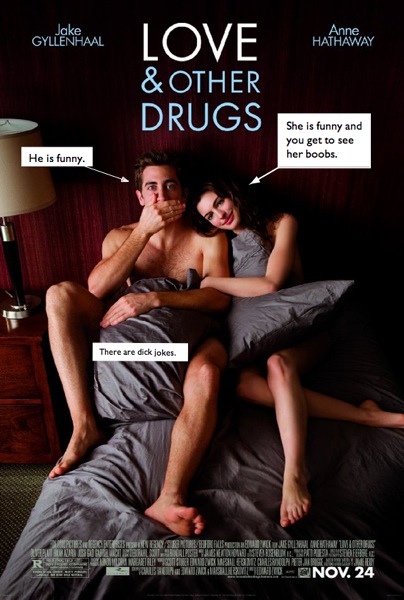
annotating the UK poster. Just to make sure that everyone who might
be interested in the film gets the message.

laod.jpg

There.
Isn’t that better?

+++Pronunciation Update+++
The Gyllenhaal G is soft, and matches the J. Thanks to TLC for pointing this out. I have amended the post accordingly.

(whimper)