The Year Of The Rabbit

NewImage

I’m often asked what it is about me and rabbits. The honest truth is that I’m not really sure. I could put it down to being called (ahem) Bobsy-Rabbit the Lodger by TLC and her housemate when she and I first starting living together. But that would be a poor excuse, and not really the truth. I’ve never owned a rabbit, although I’d like to. A big, floppy house-trained number. I would stroke him and love him and hug him and squeeze him and call him George. Probably.

It’s the cultural connotations that I find most interesting. The rabbit in myth and legend is a trickster and a herald, the bearer and frequently the source of bad news. Think B’rer Rabbit, or Alice’s White Rabbit. Think Bugs, or Roger. Or Frank from Donnie Darko, come to that. The Ojibwa tribe of North Amerindians have Nanabozho. Kalulu bounces around Central Africa with his tricks and scams.

Frank Kozik’s Smorking Labbit, the image of which has graced my internet presence for some years, is notoriously fluid in appearance, a many-coloured, always-changing little beast. The basic outline and attitude remains the same, but the Labbit can be any colour, his cigarette replaced with a bubble of gum, the pin of a grenade, even a fine moustache. The Labbit is disguise and statement of intent all at the same time.

The Internet is all about masks, aliases, alternate identities. To me the rabbit ties into that perfectly. Look at how many times Bugs will change his costume, his voice, even his sex to get the better of Elmer Fudd. Although I might not slip into a dress and slap on lipstick (sighs of relief all round), I’m not exactly the person I claim to be on the web. None of us are. We all choose the side of ourselves that we want people to see and respond to, and present that to the world.

But there’s something more about the rabbit. The simple fact that I have no real idea how the fascination arose, and indeed how my web alias Conojito developed with no conscious effort on my part, leads me to feel that I have somehow been guided towards identifying with the tricky little creature. Worldwide, cultures revere and are guided by their spirit animals. Is this the case with me? Have I been gifted with a Labbit-shaped, Pullmanesque daemon to help me through this life? I admit, the idea is strangely comforting.

The more I dig into the concept, the more it evades me. I claim that Conojito is a mangling of the Spanish for rabbit, conejo. (Tio Conejo is, you won’t be at all surprised to hear, a Latin American version of B’rer Rabbit). But a truer translation of the phrase con ojito would be “with a little eye”.* Do I have a blinkered view of the world? Does looking at life through a mask somehow obscure one’s vision? Or am I somehow using this disguise to obscure your view of me, to diminish myself, to seem less threatening so I can slip through your defences? That, after all is part of the purpose of camouflage.

That’s the thing about rabbits. They’re tricky little buggers to get a hold of.


*I’d love to take credit for that insight, but it was pointed out to me by Alejandra on the WDW forums. For which much thanks.
There’s A Light

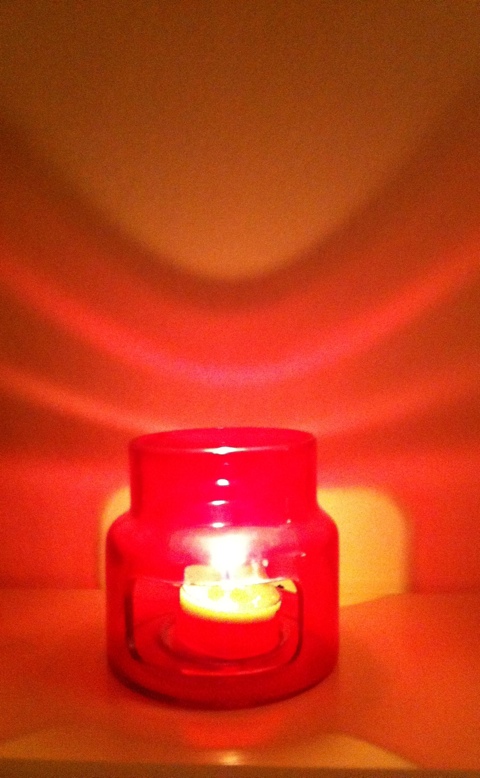
There’s beauty everywhere, if you’re open to it. Even the simplest of things, a tealight out of a big bag, a cheap plastic lamp and a bare wall, can bring about a moment of quiet wonder. Casting a glow even in the darkest of times. On a foggy morning like today, it seems even more welcoming.

Pumpkin Soup, Eventually

So this pumpkin’s been in the food cupboard, getting in the way. It’s been there for a while. At least since before Christmas. I have a nasty feeling it was snagged as a post-Halloween bargain. Which makes the darn thing at least three months old. It’s not soft or sagging, but it’s also significantly past the seriously over-zealous use-by date on the sticker on the side of the thing. The sticker telling me it’s a pumpkin as opposed to, I dunno, a mutant carrot or a novelty DVD player. Nonetheless, there it sits, accusingly in the food cupboard, daring me to make use of it.

It goes in the oven for an hour, after I chop it in half longitudinally, scoop out all the seeds and fibres, glug in some olive oil and, as a last thought, a head of garlic split into cloves and split evenly over the two halves. Once the flesh offers no resistance to the point of a knife, I set it aside and let it cool, while I cook off a couple of big shallots in a big pan. The spongy pumpkin soaks up all the garlic-scented oil. I pop the garlic out of it’s skin, and squish it into a rough pulp with my fingers.

When it’s cool enough to handle, I turn the pumpkin halves inside out, whch is the quickest way of getting the flesh away from the skin. A quick chop, then the pumpkin and garlic join the shallots in the hot pan.

It needs stock, and as I can’t be arsed to defrost any from the freezer, I make do with one of those strange gelatinous things that an angry TV chef endorses. It’s ok, but I know that the soup won’t need any extra salt. 500mls, a Pyrex jug full of stock go into the pan. After a five minute bubble, I chuck in a couple of tablespoons of a curry paste that’s kicking around in the fridge, and half a can of coconut milk. Then it bubbles gently for half an hour.

When we’re ready for it, I blitz the soup with my trusty blending wand until it’s silky smooth and unctuous. It’s sweet, warmingly spicy and moreish. We eat it with a toasted muffin apiece, and some nutty sheep’s cheese grated over. We like Issou D’Iraty, but most Dutch cheeses will do nicely. Nothing too cheddary with this one. It needs sweet mildness.

A pumpkin the size of a volleyball gave us enough soup for a light Sunday supper, with enough left for TLC’s tea tomorrow. It was nice to get there, even if it took a while.

The Sunday Lao Tzu: on governing

“To lead the people, walk behind them.”

When the best leader’s work is done the people say, “We did it ourselves.”


I enjoy Lao Tzu’s teachings on the art of government. He is pragmatic, practical, something of a libertarian, always aware of the importance of a light touch.  He’s also very clear on the need for a leader to have a deep understanding of the needs and the will of the people.

I wonder, then, what he would make of a leader who heavily taxes his people and cuts their services, and then loudly proclaims that it is now their job to take up the slack.

I wonder what he would feel about a politician who chooses to insult and demonise a large portion of his population, and time that speech to coincide with a parade by thugs and provocateurs who have made it their mission to do the very same thing?

How would he view a government that punishes it’s most vulnerable citizens because of the actions of the rich and powerful? Or a political party that systematically forgets, ignores or lies about the promises it made to the people in order to achieve power?

More to the point, what are WE supposed to think of all this?


(I understand and apologise to you, oh my Readership, for the political slant X&HT has taken over the last few days. It’s simply been the way my attention ha been drawn. We’ll be back to the usual shenanigans tomorrow. Thank you for your patience.)

The Big Problem With The Big Society

David Cameron’s Big Society is based around the idea that volunteers will take up the slack from public services that have been cut. This brings out my bristles. It makes the assumption that there are enough people out there with the time and spare income to be able to give their time for free. It also devalues the work that the public sector employees are doing.

As an example, let’s look at libraries. They offer all kinds of services above and beyond simple book-lending, and are involved in deeply complex digital archive and stewardship incentives. Sourcing and distribution of books, DVD, music and web-based services are all part of the remit. Take a look at this breakdown of a librarian’s day from the Voices Of The Library site:


  • Two separate TV companies want background info for programmes they are making for this autumn.
  • I need info on the founder of a local college for the deaf.
  • Please find me a local newspaper report of the death of a motorcyclist in 1951 (narrowed it down with GRO indexes on Ancestry).
  • Please search local trade directories for me for a pub on the county borders, 1870s to 1880s.
  • A lady from the USA comes in to research her family, who lived at a local manor house. She is delighted with the amount of resources we have on them.
  • Another lady needs help copying an exact small rural area on the 1880 map.
  • A man comes in to research the navigability of the local river.
  • Another man needs intensive staff help to search the FindmyPast site.
  • A lady needs guidance in using newspapers on microfilm.
  • When did a local village magazine start, and how can I write to them?
  • Please can you help us trace the whereabouts of a book containing original watercolours by a Victorian lady artist, which we think we saw in a local museum in 1995?
  • We need photographs and history of a jeweller’s shop in the county town.
  • A colleague from another council dept asks if we can suggest a local book suitable for official presentations? (We recommend a very good one published by ourselves, which will mean income for our photo website).
  • Local man would like us to run off more copies of his little book which we produced for him; his nephew has mentioned it on Facebook & it’s selling like hot cakes.

And that’s not the end of it!

Yet the government and local councils aiming the cuts seem to think that these tasks can be accomplished by the same kind of community-minded individuals that man the tills at Oxfam for a couple of mornings a week. As if the job was shelf-stacking and ticket-taking. Iman Qureshi treats this argument with the disdain it deserves over on the Open Rights Group blog. The Little Chalfont Community Library in Buckinghamshire is being held up as a prime example of what can be done when people rally together to save their local bookhouse. But, as this post on Words With Jam makes clear, it takes a certain kind of community to be able to take on the complex job:

Both Little Chalfont and Bucks’ other community library in Chalfont St Giles are in highly prosperous areas at the edge of the London commuter belt. The surrounding communities are both willing and comparatively able to raise the cash for a service it wishes to maintain. What’s more, there is a large pool of people (retired, at home with children etc) who have the professional, managerial and business experience to carry out all the functions necessary to run a library. The same thing simply could not work on, say, a sink estate where many of the residents are second generation unemployed, or a scattered farming community where a majority are working 18 hours a day just to survive.

The ConDem push to get volunteers to do the work of trained professionals is failing. The wheels are starting come off the idea of The Big Society. Liverpool County Council, one of the four showcase zones for community-driven regeneration has pulled out of the initiative – largely because of spending cuts that will directly effect thousands of volunteer organisations.

Worse/hilariously (delete where applicable), Lord Wei, the man in charge of the whole initiative, is cutting the hours he’s spending on the job. He simply can’t spare the time to work for free. This sums the whole idea up nicely. The coalition can’t even get it’s message straight, praising “alarm-clock Britain” while expecting those same hard-working yeoman to spend all their spare time running services that are subject to pointless and injurious cuts. It’s all a bit of a joke really, and not a particularly funny one.

Anyway. That’s enough cut-and-paste opinioneering for one day. I’m off to the library. Anyone else coming?


Barbarians At The Gate

NewImage.jpg
The Wheel Of Time, here we GO.

I grew up in libraries. This may seem a strange statement from the rakish man-about-town that you all know and tolerate, but it’s true. I was a bookish child. The mobile library that called once a fortnight to the small Cambridgeshire village where I spent my formative years was both fuel and engine to my imagination. Later, a long low building in Woodford was almost a second home –  a refuge, a place of discovery and contemplation, a place where I was free to simply be a reader and writer. I have held a library card as soon as I was able. I hold one now. It  gets heavy use.

I don’t really think I need to tell you what I think of the ConDem’s plans to eviscerate our library service. A better writer than I has beaten me to it anyway. Philip Pullman gave a speech last month that tells the sorry tale truthfully, with passion and anger. The whole thing is here, and I agree with every word.

Mr Pullman’s right to be furious. My home county, Berkshire, seems to have found a way not to cull their libraries. His home and my neighbour, Oxfordshire, isn’t so lucky. The number of libraries in an area that houses one of the great seats of learning on the planet is set to be halved. In Essex, one of the libraries for the chop is Woodford, my old refuge, my second home, the place where I discovered Kurt Vonnegut, Ray Bradbury, Andre Norton, Stephen King, Joseph Heller, John Irving, John Wyndham, Ramsey Campbell, Clive Barker.

The thought that kids are going to grow up in this country without the opportunity to learn, discover and grow that I had sickens and scares me in equal measure. Libraries are community spaces, somewhere safe for mums to bring their kids for story time, their internet connections vital lifelines for the 27% of British citizens that still don’t have a hookup to the web at home. Free access to news, information and education is a central tent pole of civilisation. Hacking away at it is the act of a barbarian.

Tomorrow is Save Our Libraries Day. Actions will be going on up and down the country. It’s a chance to show your local bookhouse some love. Go and join if you don’t have a card. Get something to read out if you do. Get lots out. Snag some DVDs or some music. Maybe a graphic novel or two. Use up that allowance. That’s what it’s there for.

I want to be clear on my feelings. Libraries are a light in the soul of a community, and snuffing that light is not just small-minded, short-term penny pinching. It wounds us all in ways that are hard to explain, but easy to feel.

(The excellent WW1 remix poster I’ve used as illustration is part of a set by Phil Bradley, that he put together to help publicise the issue. They’re all great, and you can check them out on Flickr here).

A Tangled Web, or some random thoughts on animation

I noted yesterday that Tangled is likely to be the last of the “Disney Princess” films. This still seems like a bit of an odd decision, considering how popular the girls are as a brand. They have their own clothing, doll and even comic ranges, and new direct-to-disc movies seem to roll out on a regular basis. It’s funny to see how Tinkerbell seems to have been folded into the gang. She’s an uncomfortable fit. A bit too feisty for the rest of the girls. It’s apparently to do with appealing to boys. Note that Disney didn’t say anything about quitting the fairy-tale genre. That Jack fella’s got some stories to tell.

When pictured together, the Princesses have a disturbing similarity. As their images are tweaked and refined, they are slowly nudged into templates that look very familiar. The eyes get bigger, the mouth smaller, the head shape more overtly heart-shaped. Granted, Mulan and Jasmine don’t quite fit the mould, but it’s starting to become difficult to tell Cinderella apart from Sleeping Beauty, Belle from Ariel*.

NewImage.jpg

Rapunzel’s the most extreme version thus far of the look. It’s a very anime approach. Her eyes take up half her head and her mouth almost disappears to compensate. There’s a lot of the japanimation heroine in Rapunzel. Her hair becomes prop, weapon and maguffin. Anime is full of characters with ridiculously long hair, that seems to have a life of its own (and also seems to randomly change length based on what the character is up to at the time).

NewImage.jpg

The thing is, of course, that the influence goes both ways. The father of modern manga, Osamu Tezuka, was famously influenced by early Disney, with characters like Astro Boy given the big eyes and childish features that he found so appealing in Mickey Mouse and his friends. We could say that by making Rapunzel look so anime, the designers are simply acknowledging, however subconsciously, the history and influences that have placed The House Of Mouse at the heart of world animation.

We can look to Europe too. It fascinates me how we are happy to have cartoony characters as long as the backgrounds and settings are rendered realistically. Tangled again is a prime example of this idea, with gorgeously rendered scenery playing up against massively stylised heroes and villains. It’s an example of the style that French bande desinee artists have made their own. Think of Tintin, with all those beautiful, exquisitely researched landscapes backing our blank-eyed hero. Or Asterix, if you want to go more cartoony. There’s nothing to say that Disney was at all influenced by the French school, but the comparisons are there to be had.

NewImage.jpg

The Europeans are also big on their anthropomorphic animals. The biggest selling comic album in France right now is Blacksad, a noirish detective tale. The main character just happens to be a panther, with a snappy line in suits. Again, Disney made their name with animals that wear clothes, walk on two legs and talk. Which came first – the mouse or the marsupilami? It’s a knotted mess of influence and cross-fertilisation. And it’s not helped by the fact that, contrary to common practice in modern animation, the two animal sidekicks in Tangled don’t talk. They react in human ways, but in dumbshow. Even more messily, the horse Maximus is presented as half cop, half jock and half dog. He chases down Flynn by smell, and reacts very favourably to Rapunzel scratching him behind the ears. It’s yet another knot in the net.

NewImage.jpg

It’s worth sticking around to watch the end credits, which are illustrated with character designs (by the brilliant Shiyoon Kim) in a lovely, scratchy inky style that has more than a nodding relationship to the work of one of my favourites, St. Trinian’s creator Ronald Searle. I’ve always seen nods to Searle’s style in some of my favourite Disney’s, and the linework in the Tangled end credits hearkens back to some of those classic mid-60s films. 101 Dalmations and The Aristocats are prime examples of this looser, freer form. It’s great to see this little tribute to past triumphs, and I was quietly amused to see how much more busty Rapunzel is in these early sketches. I didn’t think Disney did cleavage.

Dammit, this film has got me thinking about cartooning again in a big way. In a kind of unfocussed, scattershot manner, for which I apologise (how else could it be when talking around a film with a title like that?). But the fun in watching a film as rich this rich reference and tribute comes from seeing the images spark and fire off connections, however randomly. Tangled provides a dense web in which it’s a pleasure to get tied up.


*yes, alright, apart from the tail…

A Very Good Hair Day: X&HT Watched “Tangled”

Tangled is something of a landmark for Disney. It’s their fiftieth animated movie. It’s also, according to reports, most likely to be their last “princess” film. I’m still not sure if that’s a shame or not. Mind you, I’m not sure how many other princesses of legend are left to chronicle.

The film also marks a return to the core values and tropes that make your classic Disney films so satisfying. By going back to its roots, the House Of Mouse has made their most successful movie since 2007’s Enchanted; a film which took delight in extracting the Mickey out of the story beats that Tangled embraces and celebrates.

We all know the tale. A girl, imprisoned in a tower by an evil witch, whose only means of entry is by means of her long golden hair, is rescued by a handsome prince. It ties into the myth of the lost princess, one of the main building blocks of yer average fairy tale. Sleeping Beauty. Beauty And The Beast. Cinderella, stuck in near-slavery. Snow White, in exile with a bunch of vertically-challenged miners. It’s a base to build a story on, a solid foundation of myth and legend.

Tangled’s screenwriter, Dan Fogelman (sweetly, IMDB also lists Jacob and Wilhelm Grimm as co-writers) takes that core idea and answers the simple question that everyone asks. What happens if Rapunzel lets down her golden hair and breaks herself out of her prison, rather than waiting for a prince? By making her story a quest, a love story, a rite of passage and a return home, Fogelman does a great job of not just answering the question, but telling a story that bears retelling at bedtime. More importantly, by giving Rapunzel’s ‘do a point and a purpose, the story has an impetus, becoming the engine that drives the tale on.

It’s traditional enough, sure. There’s a happy ending (ok, fine SPOILER ALERT, Disney film has happy ending. In other news, water is wet, the sky is blue, yo’ mama wears an afro with a chinstrap) and cute animal sidekicks. It’s all set in that pleasingly ill-defined land of mittel-European castles, forests and jolly, clean, well-fed peasants that we may as well call HistoryLand. But there are subtle trims to the formula. The animals are unvoiced, letting the character animation do all the talking. Maximus the horse is bold and brave. Pascal the chameleon is loyal and sassy. We get it, and we don’t need a comedy voice to put a wig on it and make it do a shuck and jive. There’s plenty of slapstick and broad humour, but the jokes work on the grown-ups in the audience too. The main characters aren’t limp and lifeless. They’re sharply drawn and inhabit the screen with flair and verve.

And I mean sharply-drawn in all senses of the word. The animation is, as you’d expect, stunning. But it’s not just the vistas, set pieces and special effects that make it special (although yeah, the lantern sequence, something in my eye, I’ll be fine). The character animation is beautifully nuanced. Every little flit of emotion on Rapunzel and Flynn’s faces is exquisitely done. This isn’t performance capture or any of the other cheats in which Zemekis, Cameron and Jackson have decided to base their careers. This is proper, honest to goodness cartooning, showing the magic that happens when talented animators use the best tools the 21st century can offer.

It’s bolstered with great voice work too. Thank goodness, for Tangled the directors plumped for actors with Broadway experience, who know how to project a line and make it sing. I’m so sick of animated films with all-star casts that don’t understand how to act for cartoons. You have to be larger than life. Instead, you so often get a flat, cold delivery that’s not so much “will this do?” as “screw you, pay me.” Mandy Moore, Zachary Levi and the amazing Donna Murphy get it so right that I’m astonished there isn’t a Best Voice category at the Oscars. They bring the gold, the final grace notes of wit and charm, menace and wickedness that make the characters shine. You get to believe in, and root for them.

By bringing back Alan Menken, the talent behind most of the Disney songs you know since The Little Mermaid, Tangled gets another boost. I’d gone off songs in Disney films, (and towards the end of Menken’s run they were kind of jammed on and lacquered into place) but here they do the perfect job – commenting on the inner life of Rapunzel, the relationship between her and Mother Gothel and in the riotous Snuggy Duckling sequence, showing that even hardened brigands and ruffians have dreams. They’re neatly done, don’t overstay their welcome, and move the story forward in graceful ways to which the writers of Glee should be paying note.

The fiftieth Disney animated film shows how far the studio has come since Snow White, and how much they’ve learned. It’s a company that has always been prepared to take risks with their movies, and to learn from them. After the major mis-step of Home On The Range (Don’t. Seriously. Just … don’t.) Disney retrenched, learning with the brilliant Enchanted how to laugh at themselves, and with The Princess And The Frog that it’s the story rather than the CGI that makes the film. Under the watchful eye of Pixar’s John Lasseter I feel quietly hopeful that rather than marking the end of an era, Tangled takes the best of the past and zshuzzes it up into something new and fresh.

Maybe I’m overthinking it. Tangled is one of those films that works as entertainment and history lesson, but ultimately, it’s a fun, smart and extremely pretty family movie. You can just let your hair down and enjoy it.

The Chain Of Life

I gave my bike a little dose of love yesterday. A good dose of lube, a bit of a wash down and de-rust, a fresh tube on the back tyre. The poor old thing gets dreadfully neglected for the amount of abuse it gets, and it’s quarterly wash and brush up is quite literally the least that I can do*.

I try not to make it look too shiny though. I lock up at Reading Station when I’m at work, and a bit of protective colouration goes a long way to making sure that the thieves keep their mitts off my wheels. Hence, although I often swoon over the gorgeous machines at AW Cycles on the Henley Road, I know in my heart that I couldn’t use them. I’m not a competitive or leisure cyclist. My four-year-old Ridgeback Motion is a mode of transport, simple as that.

You notice things on a bike that simply pass most other people by. The state of the roads, for example. Last year’s brutal cold snap took place not long after a fairly major resurfacing project in Reading – a surface that simply hasn’t held up. The side roads, in particular are drastically potholed and cracked. My Ridgy has no suspension. You feel everything. I bounce around on the saddle so much that it makes the bell on my handlebar ring*.

IMG 1000000824
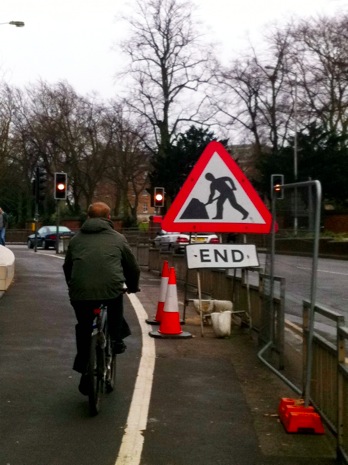
Our friend here is not in the bike lane. For obvious reasons.

Which wouldn’t be so much of a problem if we had a decent and consistent cycle lane policy. The bike lanes around here are badly-thought out, and have a tendency to merge you into traffic or simply disappear just when you least expect it. Or, in the case of the lanes around the Vastern Road rail bridge, they abruptly cut off with whacking great stop signs. Pedestrians grumble about cyclists on the pavement – in this case I simply have no option.

Ah, pedestrians. They walk in your bike lane. They wander out in front of you. They run out in front of you. They never look where they’re going. I’ve noticed this more and more over the past couple of years. I suspect, with absolutely no evidence whatsoever, that it’s connected to the fact that so many people are plugged into iPods and other devices when they’re out and about. With a soundtrack in your head, you become invulnerable.

They’ll still look out for cars. The mass displacement of half a ton of steel bering down on you must trigger some latent impulse to at least look around before you step out on to the road. If you’re on a bike, you’ve got no chance. If they’re texting while they’re walking, the temptation would be to plow into them anyway. I know riders that do that just to prove a point.

The problem is that when I’m off my bike, I’m guilty of exactly the same crimes that I’ve just bitched about. I dreamily amble around, letting stories and characters flit through my head, barely hearing the scream of brakes and curses from behind me. In Amsterdam, a true cyclists city, TLC and I both nearly ended up in someone’s front forks. I really thought I knew better, but it seems that as soon as I’m off the saddle, my spatial awareness goes to pot. I’m as bad as everyone else, bitching at cyclists on the pavement when I’m on foot, at pedestrians in my way when I’m on two wheels.

Some things never change. Pedestrians hate cyclists. Cyclists hate drivers. Drivers hate cyclists. Cyclists hate pedestrians. The chain of life continues, unending as the loop round my deraillieurs.

*The more waggish members of the Readership who might postulate that I’m not talking about my bicycle here are filthy minded reprobates – and that’s probably why you’re here. Fair do’s. Carry on.

.

So This Cake Happened

IMG_1000000821.JPG

I have no explanation for the fact that I have started baking cakes, other than the fact that I like baking, and I fancied a challenge that moved me away from bread. It’s very much a weekend thing, and fills me with a certain pride to be able to offer tea and homemade cake to TLC in the afternoon.

It also appeals to my economical nature. I can use ingredients that would otherwise be binned. Old, hard lemons and limes left over from Christmas are no good in your G&T. But they still have plenty of juice and useful zest for a lemon lime syrup cake.

The cake I’m going to tell you about came about because I had made a pot of coffee that we didn’t really drink. I fancied a coffee and walnut cake. But most of the recipes out there seemed to be as much about the filling and frosting as the cake. That seemed like a shame.

So, with guidance from this source, I struck out on my own. Is it any good. Well, let’s put it like this. There was more cake than the photo above when I put it away last night, so someone likes it…

Nutty Coffee Cake

Preheat your oven to 180C/Gas5, and grease a springform baking tin. Springform’s great. I love the solidity of unclamping your cake when it’s done. You might want to put some baking parchment in the bottom too. If you’re really flash, you can make a cartouche.

Chop some nuts. About 75g. I like almonds and pistachios, largely because that’s what I had at the time. Macadamias and pecans would be good too. The almonds might need toasting, if they’re blanched. Give ’em five minutes in a hot dry pan, and watch ’em. They burn in a second if you’re not careful. They just need to be golden.

Get a big bowl. Your biggest. Into it goes 175g of butter, 100g of caster sugar and 100g of brown sugar. Mash ’em together until they turn into a light, fluffy mousse-type thing. I started trying to use a fork and whisk for this, then remembered we own one of those food mixers with the interlocking whisks. Brilliant. Job done in moments.

Using your magic whippy machine, beat two eggs into the mixture. Now it looks like cake batter. Then add 100mls of hot coffee. That’s about two espressos. Now it looks like something that came out of a drain.

Now put in 200g of self-raising flour, and beat until it looks like a batter again. Throw in all but a palmful of the nuts, and beat again. Lot of beating going on. Baking is violent.

Now the whole gloopy mess goes into your baking tin, and into the oven. Give it 25 minutes, then poke it with a skewer or toothpick. You’re not taunting it, you’re seeing if it’s cooked through. If your implement of torture comes out clean, you’re done.

It’s fine like that, but this is Sunday, so make some damn effort. Throw together an icing.

200g of icing sugar in yet another bowl (your kitchen should look like a dirty bowl store by now). Add 3 tablespoons of coffee to that, then enough boiling water to make a runny icing. Think the sort of thing that goes on a doughnut. If you have lemon zest, half a teaspoon would be good here. Drizzle your icing over the top of the warm cake. It’s gonna go everywhere, so don’t try and be fancy. Scatter the nuts you held back from earlier (snicker) over the top. Let it cool a little more. Just a bit. Just to torture yourself.

Serve with fresh coffee, or if you’re a total heathen like me, the remains of the morning’s pot reheated with some milk. Sorry about that. Waste not want not.