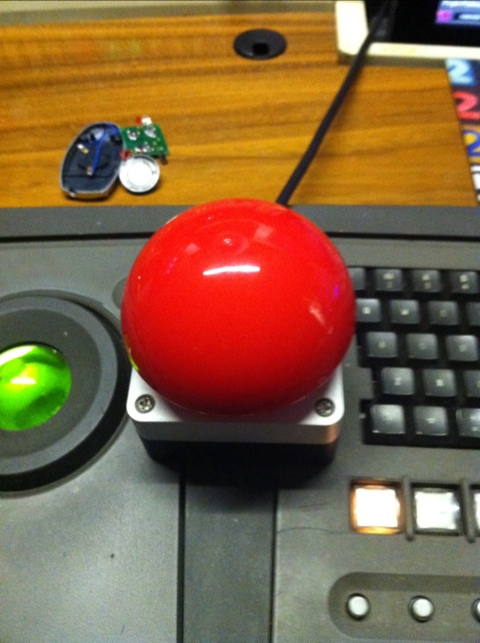
A Big Red Button for Red Nose Day

My Twittersphere already know about The Big Red Button, and the time has come to share it with you. I use it to start and stop my scanner in an instant. It’s much quicker and easier than clicking a mouse, and infinitely more satisfying.
You can use it to help give money to Comic Relief. Go on, give it a click. You know you want to. Be like Stimpy. Give in to the urge.


Shaken And Stirred: Against Shaky-cam

An interesting post hit yesterday on Salon from director of photography Matt Zoller Seitz. A summons to arms, a battle cry. In it, he calls out the increasing practice of directors and DOPs to use shaky-cam techniques on multi-million dollar films. The specific example he mentioned was Battle: Los Angeles (yes, THAT film again. Welcome to Battle: LA week. Not my intention, honest. Like I plan any of my content) but Paul Greengrass and Michael Bay are also singled out for special attention. You could argue that most big-budget actioners use this technique to a greater or lesser degree, and in a worst-case scenario, almost exclusively.

In Battle: LA, I assume that the idea was to give the impression of an embedded reporter following alongside 25 Recon. This reporter is clearly suffering from the coffee shakes. Shaky cam turned the last Bond film into an incomprehensible mess as the Broccolis tried to put Bourne style shot-work into the franchise. It was one of the flawed decisions that would stall the resurgence of Bond in it’s tracks.

I don’t want to spend time synopsising Matt’s post, so I’ll simply add my approval. There’s a whole genre of horror films that pose as found footage from camcorders in the tradition of The Blair Witch Project, and I can’t be alone in finding them unwatchable. They give me motion sickness, and are pretty much unreadable. There’s no sense of staging, or frame-building. Hand-held techniques, used sparingly, can be incredibly effective. When they become the only technique, there’s a problem. It looks cheap, ugly and lazy.

The problem is, it’s everywhere. Bandwagon jumping has always been an issue in Hollywood. A film-maker does something innovative, and others rush to follow. When shaky-cam techniques were folded into the effects sequences of Firefly and Battlestar Galactica, Hollywood made notes. The Star Trek reboot forgot the sweeping, graceful camera passes across the surface of the Enterprise as it flew past in favour of jittery zooms and whip pans. NCC-1701 is a beautiful ship, and it needs to be eye-candy, not half-seen in a thick layer of fake motion blur.

Shaky cam is hard to shoot, too. You need a multi-camera set-up, and even then there’s no guarantee that you’ll catch everything you need. It’s a mess to edit, a pain to sound sync and horrible to grade. As you can probably tell, I’m not a fan.

I don’t want to see the end of hand-held, by any means. It’s been a vital part of film technique since the French New Wave. But it’s time to stop relying on it as a way to mask poor direction, effects and acting. As Matt says: Get a tripod. Write a set list. Stop covering action. Start directing again.

(Heart)Breaking News

I’ve stopped watching the 24 hour news channels. I’ve contemplated switching off Twitter. In the face of a developing drama like the one that is engulfing Japan, I’ve come to the conclusion that there’s very little information coming out of rolling news sources, and a whole lot of conjecture, speculation and plain old stirring the pot.

We have no way of knowing what’s going on at Fukushima. Really, we don’t. Until Japanese authorities give us updates, we’re in the dark. But because the 24 hour stations have to say something, and because the nuclear emergency on the north-eastern coast of this beleaguered nation seems to be the only news story worth telling, (regardless of the awful ongoing crisis through the rest of the country) we get guesswork. An endless stream of experts, rolled on to give worst-case scenarios based on the tiny scraps of information they’ve been able to glean. We get what ifs and deadlines. If I hear the phrase “The next [vague time period] is crucial”, I’m going to scream.

And of course, it’s an ideal time for both pro and anti nuclear lobbies to pitch up a tent and start proselytising. You get scare stories and I told you so’s banging up against safety records and unforeseeable circumstance. I think I know less about nuclear power now than I did when I started.

Facebook and Twitter have always been home for the sudden appearance of rumour and conjecture dressed up as fact. I’ll make myself clear right now. Anyone on my feed that starts talking about how this is payback or divine retribution gets an instant unfollow and a report. I’ve already had to refute the outrageous map doing the rounds that claims to be from the Australian Nuclear Authority, stating radiation levels that the Fukushima plant will never come close to coming across the Pacific in a plume of death. This is the sort of environment in which pranksters thrive, and I think we all should all know not to feed the trolls by now.

Look, I don’t want to make light of the horrible situation that’s going on at the moment. Part of the reason for closing off the news feeds is because the images coming out of Japan are so unbearable. But I think it’s best to at least take a step back away from the torrent. You’ll never be able to slake your thirst if you try to drink from a full-on hosepipe. Developing news is just that. I’m allowing myself a daily update from a trusted source, and that’s it.

The best that we can do is to donate, keep Japan in our thoughts and prayers, and not, however inadvertently, spread harmful rumours and outright lies.

The best place I’ve found for donations and contact information is Google’s centre: http://www.google.com/crisisresponse/japanquake2011.html

Let’s keep our fingers crossed, and don’t believe the hype. Stay strong, Japan. We’re with you.

Cannon Fodder: the changing face of the villainous horde

NewImage

Battle: Los Angeles is a war movie. Let’s get that out of the way right now. The SF trappings are there to pull in the core audience of 16-25 year old males who will happily sit through it in the same way that they’d sit through a walkthrough of Crysis 2 on YouTube. But it’s really an excuse to have US military, modern US military with their grenade lobbing rifles and laser sights and night vision wage war against an enemy with which they can actually get their fight on. There is no fear of accidental civilian deaths or any of the horrible tangled messiness that modern warfare against an enemy that remains undefined and hard to find has become.

SF has always provided this kind of unambiguous thrill. As the audience becomes less and less excepting of the traditional war movie (which after all served primarily as propaganda against countries that have now been friends and colleagues for over fifty years) there’s still a need for shootybangbang excitement against a villainous horde. If you can make that villain completely fictional, and of a different species to the hero, then all to the good.

The aliens in Battle: Los Angeles are faceless, emotionless avatars, existing only to shoot and to be shot at. They spindle around in a backward-leg walk, and fire guns that have been grafted onto their arms. They couldn’t surrender if they wanted to, or were given the chance.

There’s little sign of pain or any kind of emotion when M-16 slugs tear through them (or, in one memorable sequenced, skewered on a bayonet and then torn apart by M-16 slugs). They make that default monster noise that’s becoming as over-used as the Wilhelm Scream, and then they fall over. As such, they’re simply the latest in a long line of invaders that runs all the way back to War Of The Worlds. Think the swarming hordes of James Cameron’s Aliens, mirrored helmets topping a drooling tooth-filled maw. The creatures of Independence Day, blankeyed and mouthless. Notice too, that the writers haven’t even bothered to give the enemy proper names. They are simply called by their function. Alien. Invader. Enemy. Monster.

Creatures from the Doctor Who universe have names, at least. Of their species, anyway. On the whole, they still follow the same idea of being interchangable, indistinguishable. Daleks and Sontarans differ from the Hollywood Horde ideal in that underneath the expressionless masks they wear, something hideous lurks. The Cybermen take this one step further – they were humanoid once, and chose to lock all that away behind a blank carapace. There’s a little more depth there, but their intentions remain the same. They are set on conquest and colonisation.

The Stormtroopers of the Star Wars Universe have the same purpose. Spookily, under their helmets, they all look the same. They’re clones, and therefore again one step away from the human. They’re constructs, manufactured and therefore easily expendable. And again, they have a collective name rather than anything that would allow us to see them as individuals, to give us the chance to empathise.

The one flipside to this idea that I’ve been able to find comes in, of all places, from the first Austin Powers movie. A running gag showed the home lives of some of Dr. Evil’s henchmen after they were killed by the International Man Of Mystery. Giving a faceless hench a wife, a family, friends and a social life is unthinkable in most of the cases I’ve talked about. We’re not supposed to care about them. They are obstacles to be removed without thought or consequence.

As @JaesonX pointed out to me on Twitter, SF invasion pics are starting to shrug off the old cliches. District 9 takes a much more complex and nuanced approach to the theme of first contact, a situation that’s unlikely to begin with the two sides shooting at each other. Gareth Edwards’ Monsters tells us that we’re just unlikely to be able to figure out what they want here in the first place. Both films end, not in full-scale conflict, but a grudging, uncomfortable co-existence, marred with sporadic violence. This can be tracked back to shows like Alien Nation, where the visitors arrive not as aggressors, but refugees. This reflects the fluid nature of national identity, racism and touches on the way people view their territory and the people that come into them in ways that the basic war movie simply doesn’t have the tools to address.

There will always be a place for war movies. But we live in a complicated world, and it’s sometimes difficult to figure out who the bad guys should be. I’m holding out for the first war movie that pits the USA against it’s own banking system. That’s a fight with some life in it.

(pic credit: Francesco Francavilla).

Why The Aliens Of Battle: Los Angeles Deserve Their Beatdown

Spoiler alert

nyakyakYAK
... and I look GOOD without a shirt.

I am the commander of an invasion force. We have travelled across the stars to parasitise a small, blue planet somewhere on the Western Spiral Rim of the Milky Way. Specifically, my comrades and I have come for its water. There’s a lot of it. This “Earth” (such a foolish name for a world whose surface area is 70% water) is a rich prize.

Because I am not stupid, and because I understand that a) tactically, high ground gives you a major advantage and b) there is no higher ground than low orbit, I begin my assault by making a note of all the major gathering points of the indigenous population. Usefully, these are lit up at night.

Then I start throwing rocks at those population centres. They don’t need to be massive. Just big enough not to burn up on their way through the atmosphere. Something the size of a skyscraper, tiny in terms of the masses of rock and metal that swing around the sun in tandem with the blue world, would have a pretty appreciable effect on a major urban conurbation when it’s travelling at several miles per second. I don’t even need to be that accurate. Shockwaves and airborne debris would do most of the work. Then it’s a simple mopping-up operation.

Or, if I’d rather start a harvest of the water without causing genocide, I could land my forces in the middle of the Atlantic and Pacific, and set up seaborne facilities that would be difficult to detect until it was too late. I could have a defence grid in place before the aboriginals have a chance to organise a meaningful response. Maybe I’m already at it. You’ve heard of the Bermuda Triangle, right?

The one thing I would unquestioningly not do is land a ground force on coastal zones of high population without immediate air support, and then force them to fight inland in order to start a refuelling and harvesting operation from the sewers. The sewers, for fate’s sake. This would afford me the barest trickle of the resources that are clearly available. You know, all the blue stuff I can see from orbit? The stuff I came hundreds of light years to get at? Why would I fight an expensive and potentially ruinous land war against natives who, quite rightly, are going to be pretty honked off at what I’m up to? Like I said, I’m not stupid.

I am the commander of an invasion force, and I laugh at your Aaron Eckhart, just before I throw an asteroid at him.

The Spirit Of The West: X&HT Watched Rango

Rango is a film that shouldn’t work. It’s a droll, adult-oriented Western pastiche featuring a wildly ugly protagonist, from a studio that had never done a full animated feature and a director that had never worked in animation. But it does, and not only that, it’s one of the best films I’ve seen all year.

Continue reading The Spirit Of The West: X&HT Watched Rango

X&HT MUSIC WEEK: The Bandcamp Option

Sorry, couldn't resist.

Yesterday I touched on how Radiohead had developed their own distribution and marketing after parting ways with their record company. You no longer need to be a big famous rock band to do that. These days, it’s as easy as signing up for Bandcamp.

Bandcamp is a bit of a paradigm shifter. It’s a quick and easy way for musicians to get their work out to an audience, with a good-looking home page featuring your own custom artwork and full previews. For a user like me, browsability and preview options are key, and Bandcamp has all this covered. Most interestingly, the pricing is set so that the minimum the artist is prepared to charge is always the default, but you can pay more if you think the music’s worth it. File options run the gamut from MP3 to massive lossless formats. It’s a great way of discovering new music at a pleasingly affordable price point, and compensating the artists appropriately.

My latest Bandcamp download is from Stepdad, who specialise in sunny, quirky synth-pop. They have the bounce and charm of early Depeche Mode before they discovered rubber leisureware. There’s nothing particularly original or innovative at play, but it’ll make you smile and jig about, and most days that’s all that you need. You can pick up the Ordinaire EP for under a quid. That has to be worth a punt, surely.

It’s not just the little guys that use Bandcamp. Longtime X&HT Crush Amanda Palmer has released her latest album on the platform after leaving her old label Roadrunner in 2008 – a process that she extensively documented on her blog and on stage, pleading to be released from her contract after it became clear that they were simply not interested in promoting her. Amanda Palmer Goes Down Under, a mix of live and studio recordings based around her regular trips to Oz and New Zealand, shows off her punk cabaret stylings beautifully. It contains odes on a mix of subjects, including one on the horror of Vegemite, and the joy and wonder of intimate female hairstyling in the hilarious Map Of Tasmania.

You can pick up the album for 69c, but there are a ton of other options, including vinyl, artwork packages and, for $5000, An Evening With Amanda Palmer where she will come to your gaff and perform. I’m not sure if anyone’s taken her up on the option yet, but I’m sure we’ll hear all about it when it happens.

Readership, I urge you to visit Bandcamp and have a sniff around. There’s a huge range of music to explore. The preview options make it a no-risk endeavour. Who knows, your new favourite band could be waiting there for you.

Let’s Show The Kids How To Do It: X&HT listened to Collapse Into Now

Music week continues on X&HT as I look at the new record by my favourite band, R.E.M. Mentioning this has led to responses as varied as “Oh, are they still going?” through to “…pukies”. I can see I’ve got my work cut out with this one.


Continue reading Let’s Show The Kids How To Do It: X&HT listened to Collapse Into Now