Castaway: Outcasts and other science fiction deniers

NewImage
"A moving, heartfelt tale about the dark side of colonialism, and the barriers to true love."

The producers and cast of most recent TV SF shows are at pains to point out that their programme isn’t actually science fiction at all. They tie themselves in semantic knots to make sure we don’t think that their show is anything to do with that woo-woo spacy stuff. This is as true as ever when we look at the press for the BBC’s new drama, Outcasts.

Set designer James North has said “This is futuristic drama with the focus on pioneering humans who, out of necessity, just happen to be living on a planet that isn’t Earth.” Showrunner Ben Richards elaborates, making it clear that the new world of Carpathia is “… an alien planet without scary monsters. Little green men and fearsome creatures isn’t what Outcasts is about at all.”

Which to my mind is a bit of a shame. A first contact show might be more interesting than the programme we’ve ended up with, a frontier drama with a simple message. We can’t ever make a fresh start, because wherever we go, we have to take ourselves along. It’s not a new theme for an SF show. Look at Battlestar Galactica. It’s clear Ben and James have.

When a producer, writer or actor disassociates themselves from SF, they’re really backing away from the furniture. Look out for phrases like “flying saucers,” “space aliens” “ray guns,” or indeed Ben’s own “little green men.” And of course, the dreaded “sci-fi”. But at the same time they’re happy to use the tropes and themes that have been part of the genre since Wells and Verne started marking out the territory.

I guess it’s the G-word that’s the problem. Somehow the idea that SF is either kid’s stuff or entertainment for the socially inept is still a belief that informs the way films and books are marketed and sold. For “genre” read “ghetto”, and if you can make a semantic little wiggle that ensures you don’t get stacked up in the racks at the back where all the pimply, friendless people go, then so be it. This is especially important for the literary types. It’s taken the best part of thirty years for Margaret Atwood to “out” herself as an SF writer. Jeanette Winterston still has problems with the terms, although her novel The Stone Gods is set on another planet in the future.


It seems crazy to me. You wouldn’t set a story in Arizona in the 1860’s, populate it with cowboys, chases on horsebacks and a climactic shootout and say “oh, but it’s not a Western.* It’s a ridiculous stance, and hopefully one that’s on the way out. Michael Chabon’s alternative history The Yiddish Policeman’s Union won a Pulitzer Prize, and Justin Cronin’s apocalyptic vampire story The Passage is a genuine hit on all levels. There’s a misunderstanding about the people that enjoy SF, fantasy and horror that seems at least 30 years out of date. It makes the attempts of creators like Ben Richards all the more silly. Why would you cut yourself off from an big potential audience that can prove itself to be loyal and supportive to the right show?

The thing is, at a deep core level, Ben and James are right. Strip away the silver foil and spandex, and SF transcends it’s often low-budget set dressing. (Not an accusation I can level at Outcasts, by the way. It looks great.) SF acts as a mirror on the times in which it was created. It becomes a pretty relevant document of the hopes and fears of the generation that made and consumed it.

In the 50’s, it was all about the fear of infiltration by a foreign power and nuclear destruction. I Married A Stalin From Outer Space. Invasion Of The Atomic Leech-Women.

In the 60’s, SF began to explore the inner spaces of the mind, and the implications of massive shifts in societal influence. The first inter-racial kiss on TV was on Emergency Ward 10 in 1964, but it’s the second one that everyone remembers – on the Star Trek episode “Plato’s Stepchildren.”

In the 70s, things went dark and creepy as the promise of the Age Of Aquarius melted away, and we were left with three day weeks, Vesta curries and The Generation Game. Sapphire And Steel was un-nerving and bleak. TV’s eternal optimist Gerry Anderson went live action, and in UFO and Space: 1999 crafted shows that were in equal measure silly and almost unbearably harsh. The latter show starts with the moon being blasted out of orbit, effectively ending all life on Earth and dooming the inhabitants of Moonbase Alpha to a nomadic life. Even Doctor Who went steampunk and gothy, and featured sequences that are still carved in my psyche today.

SF’s role as social and political commentary is often overlooked, which is a pity but in some ways a major strength. The deep stuff is in disguise, the way a concerned mum will sneak veggies into a pasta sauce for her fussy kid, giving the viewer something to chew on after the end credits have rolled. But ultimately, it doesn’t matter. Ben Richards can claim all he wants that his show isn’t SF. When the first shot has a spaceship gathering speed towards a strange new world, we all know what we’re looking at. What he’s trying to make clear is that there’s meat on the bones, that his show has substance and depth. Personally, I think audiences nowadays are sophisticated enough to make up their own minds about whether a show is worth watching or not without caring about the genre.

I’ll leave the last word to Jeanette Winterson, who I unfairly sneered at earlier. She nails the argument on her website, thusly:

People say to me, ‘so is the Stone Gods science fiction?’ Well, it is fiction, and it has science in it, and it is set (mostly) in the future, but the labels are meaningless. I can’t see the point of labelling a book like a pre-packed supermarket meal. There are books worth reading and books not worth reading. That’s all.

(The quotes from James North and Ben Richards come via a Daily Mail piece on January 29th – an article I picked up via Ansible, I hasten to add.)

*Unless you’re Cormac Macarthy, I guess.

A Tangled Web, or some random thoughts on animation

I noted yesterday that Tangled is likely to be the last of the “Disney Princess” films. This still seems like a bit of an odd decision, considering how popular the girls are as a brand. They have their own clothing, doll and even comic ranges, and new direct-to-disc movies seem to roll out on a regular basis. It’s funny to see how Tinkerbell seems to have been folded into the gang. She’s an uncomfortable fit. A bit too feisty for the rest of the girls. It’s apparently to do with appealing to boys. Note that Disney didn’t say anything about quitting the fairy-tale genre. That Jack fella’s got some stories to tell.

When pictured together, the Princesses have a disturbing similarity. As their images are tweaked and refined, they are slowly nudged into templates that look very familiar. The eyes get bigger, the mouth smaller, the head shape more overtly heart-shaped. Granted, Mulan and Jasmine don’t quite fit the mould, but it’s starting to become difficult to tell Cinderella apart from Sleeping Beauty, Belle from Ariel*.

NewImage.jpg

Rapunzel’s the most extreme version thus far of the look. It’s a very anime approach. Her eyes take up half her head and her mouth almost disappears to compensate. There’s a lot of the japanimation heroine in Rapunzel. Her hair becomes prop, weapon and maguffin. Anime is full of characters with ridiculously long hair, that seems to have a life of its own (and also seems to randomly change length based on what the character is up to at the time).

NewImage.jpg

The thing is, of course, that the influence goes both ways. The father of modern manga, Osamu Tezuka, was famously influenced by early Disney, with characters like Astro Boy given the big eyes and childish features that he found so appealing in Mickey Mouse and his friends. We could say that by making Rapunzel look so anime, the designers are simply acknowledging, however subconsciously, the history and influences that have placed The House Of Mouse at the heart of world animation.

We can look to Europe too. It fascinates me how we are happy to have cartoony characters as long as the backgrounds and settings are rendered realistically. Tangled again is a prime example of this idea, with gorgeously rendered scenery playing up against massively stylised heroes and villains. It’s an example of the style that French bande desinee artists have made their own. Think of Tintin, with all those beautiful, exquisitely researched landscapes backing our blank-eyed hero. Or Asterix, if you want to go more cartoony. There’s nothing to say that Disney was at all influenced by the French school, but the comparisons are there to be had.

NewImage.jpg

The Europeans are also big on their anthropomorphic animals. The biggest selling comic album in France right now is Blacksad, a noirish detective tale. The main character just happens to be a panther, with a snappy line in suits. Again, Disney made their name with animals that wear clothes, walk on two legs and talk. Which came first – the mouse or the marsupilami? It’s a knotted mess of influence and cross-fertilisation. And it’s not helped by the fact that, contrary to common practice in modern animation, the two animal sidekicks in Tangled don’t talk. They react in human ways, but in dumbshow. Even more messily, the horse Maximus is presented as half cop, half jock and half dog. He chases down Flynn by smell, and reacts very favourably to Rapunzel scratching him behind the ears. It’s yet another knot in the net.

NewImage.jpg

It’s worth sticking around to watch the end credits, which are illustrated with character designs (by the brilliant Shiyoon Kim) in a lovely, scratchy inky style that has more than a nodding relationship to the work of one of my favourites, St. Trinian’s creator Ronald Searle. I’ve always seen nods to Searle’s style in some of my favourite Disney’s, and the linework in the Tangled end credits hearkens back to some of those classic mid-60s films. 101 Dalmations and The Aristocats are prime examples of this looser, freer form. It’s great to see this little tribute to past triumphs, and I was quietly amused to see how much more busty Rapunzel is in these early sketches. I didn’t think Disney did cleavage.

Dammit, this film has got me thinking about cartooning again in a big way. In a kind of unfocussed, scattershot manner, for which I apologise (how else could it be when talking around a film with a title like that?). But the fun in watching a film as rich this rich reference and tribute comes from seeing the images spark and fire off connections, however randomly. Tangled provides a dense web in which it’s a pleasure to get tied up.


*yes, alright, apart from the tail…

Friday Fotos: A Day Among Ghosts

I took a day to plot and scheme with the mysterious docoBanksy yesterday. Usually we meet and cavort in Soho, but I fancied a change, so we met in Islington, before heading to Spitalfields and Brick Lane. It was a cold, cold day. Fun was had. Beer was drunk, including a pint of crude in the infamous Ten Bells. It’s been tidied up a lot, but there’s still a strange air about the place. An edge, sharp as a butcher’s blade. Or maybe I was just letting my imagination get away with me.

Anyway, here are some photos of the day. The area’s renowned for the street art which graces many of its walls and dead spaces, which will always get me pulling out a camera.

(edited, to include the fact that I was actually in Spitalfields, not Shoreditch. Maybe it’s because I’m no longer a London-errrr…)

Done To A Turn: The Things TV Cookery Shows Get Right

Cookery shows are entertainment gussied up as having some educational value – which for the most part they do not have. Important steps in the preparation of a delicious meal are either skipped, glossed over or mangled. I speak from bitter experience. There’ve been too many times when I’ve served TLC something barely edible that I’ve taken from a cooking sketch. The expensive hardbacked books that these shows are designed to hawk have the same problem. As Nigel Slater says, recipes don’t take your kitchen into account. Your oven might be calibrated differently. You might not have been able to get hold of all of the ingredients. The more precise the recipe, the greater the chance that it’s going to go wrong somewhere down the line. If you’re trying something from Heston Blumenthal, you’re SOL unless you’ve got a laboratory and a tame hunchback to hand.

A real annoyance is the moment when, when in the interests of entertainment, a cook will take a stone classic and needlessly muck about with it. TLC doesn’t cook much, but her specialties have a purity and forthrightness of purpose that shines through. When a TV chef starts throwing bacon, double cream and breadcrumbs into a mac and cheese, her disdain is palpable. She’s right, of course. There’s no need for it. Better to teach the viewers how to make food properly. Here’s TLC’s tip for perfect mac: “When in doubt – MORE CHEESE.”

Frankly, a philosophy to live by.

You can get valuable tips and tricks out of cookery shows, though, if you’re prepared to watch out for the telling details. The way a TV cook handles a knife, for example. Compare the cack-handed way Nigella chops an onion to the way Gordon Ramsay renders it down to fine dice in instants. Watch the pro chefs at work, and you get some inkling of the short cuts they use to make their lives simpler.

I always get something useful out of Jamie Oliver. He grew up in a professional kitchen, cooking for punters. And it really shows. He’s a natural around a rolling pin. I’m embarrased to say that it was Jamie that showed me the right way to crush a clove of garlic (twat it with the flat of a big knife, while still in it’s skin. Peeled and chopped in one easy move, without the un-necessary investment in presses, rollers or those funny neoprene sleeves. Yes, ok, you have to pick the garlic out of the skin and maybe chop it about a little more. If you have a problem with touching garlic, then maybe you shouldn’t be using it.) Watching him and others like him at work has moulded the way I operate in a kitchen environment, taught me the importance of sharp knives, solid implements and a worktop that can take a beating.

Every so often the shows will come up with a recipe that you just know is going to hit big. in that case, it’s going to be everywhere. Both Nigel Slater and new girl on the block Lorraine Pascale (the perpetrator of the criminal mac and cheese) have featured a no-knead quick soda bread made without yeast. It’s the reappearance of a great idea (it’s in Mrs Beeton, donchaknow), and means you have a warm loaf on the table 40 minutes after putting flour in a bowl. I’m not accusing anyone of plagiarism. In the culinary world, as in fashion, ideas are there to be taken and tweaked. But this one is going to run. Betcha the Hairy Bikers grab it next.

In fact, sod it, here’s my take on it.


Rob’s Sody Bread

Half and half measures of strong wholemeal and plain flour to make up 500g or 18oz go in a bowl.

Throw in a teaspoon of sea salt, another of sugar, the browner the better, and one more of bicarb of soda, and mix the dry ingredients together.

Throw in 350ml or 12 fl oz buttermilk, and scoosh it into a soft dough. Don’t got buttermilk? Add a tablespoon of lemon juice to ordinary milk before it goes in, and leave for five minutes. Now you got buttermilk.

Tip the dough onto a floured surface, and shape it into a ball. It’ll be sticky. Flour your hands too.

Score the top in a cross with a knife. Go deep. Imagine your enemies while you’re doing it.

Place your slashed dough on a baking tray, then into a hot oven 200C/400F/Gas6 on the top shelf. Give it half an hour.

When it’s nice and brown and risen and filling the kitchen with that bread smell, you know the one, the one they use in supermarkets only this is real, this is YOU making that smell you delicious creature, take the bread out  and let it cool slightly, before rending it asunder and using it to scoop up the juices of the casserole I didn’t tell you how to make. It’ll last a day or so, so you have my permission to be greedy and wolf the lot in one go. You’re worth it.


The Best Song The Beatles Never Wrote

There’s an ongoing discussion at work as to whether it’s possible to write a genuinely convincing Beatles song if you’re not a Fab. The Rutles have been considered and rejected, as Neil Innes was generally just swapping a couple of chords around and adding new lyrics to existing tunes.

There are plenty of bands that have made forays into the Cavern sound, and of course Merseybeat is an established pop genre. Crowded House get pretty close sometimes, as do sixties revivalists like The La’s. Noel Gallagher’s obsession with all things beat is pretty well known.

But I have a crush on Robert Pollard and the mighty Guided By Voices, and I don’t think it gets much better than this. Readership, to wake you up, shake your stuff and start your weekend right, X&HT gives you – Glad Girls!

+++UPDATE+++

On our Facebook page, Timothy P. Jones pointed out this little gem from Robyn Hitchcock. It’s not very Beatley, but it’s very solo Lennon.

Spend Spend Spend: Early Impressions of the Mac App Store

It’s been just over a week since OS 10.6.6 dropped for desktop and portable Macs, and with my usual early adopter flair, it’s taken me about that to update. So I’ve only just started to play with the big woop of the rollout – the big brother to the App Store, the feature that has turned iOS devices into such customisable, adaptable street computers.

The Mac App Store has a clean, clear interface that’s a lot like the iTunes version, complete with a front page showing the heavy hitters and featured products. Installed apps are clearly marked, which can serve as a handy reminder for what you have cluttering up your hard drive. It’s easy to browse and search, and each app has it’s own page complete with screen shots and customer reviews.

As with iTunes, the App Store hooks seamlessly into your Apple ID account, which turns the purchase of an app into a disturbingly easy one-click process. A flip-and-drop animation puts your shiny new thing straight into the Dock.

Pricing has been a major factor in early news coverage of the Store. Apple have cleverly broken up their iWork and iLife suites so that it’s now possible to just get what you want. I jumped at the chance to upgrade my copy of GarageBand to the latest version for under a tenner. The whole iLife package is normally four times that. Similarly, Aperture, Apple’s pro photography app is now priced at £44.99. That’s quite a drop from last weeks box tag of £170.

Of course, the speed at which the App Store appeared seems to have taken some developers by surprise. Pixelmator, Smith Micro’s brilliant Photoshop-buster, is front and centre on the home page, at a very tempting £17.99. But subscriber mailouts a day or so after the new OS dropped offered it at $29.99 – a couple of quid more expensive. Granted, the mail also makes the point that Pixelmator is cross-platform compatible, but a bit of a heads up about their prominent place on the new outlet couldn’t have hurt.

There are also a lot of big names that don’t have a presence on the store. No Final Cut Pro. No Final Draft, Scrivener, VLC or Toast. But it’s early days yet, and as at least one developer has already stated, the accelerated timeframe of getting the App Store up has meant a lot of product simply wasn’t ready for the launch. I’ll be very interested to see how the product lines grow over time.

For now, though, the App Store looks like a solid and easy way for me to blow money. Apart from GarageBand, I’ve upgraded Xtralean’s lovely little graphics app ImageWell to version 4, and started playing with the free SketchBook Express from Autodesk, which is the best free drawing program I’ve seen in a while.

But no, I’m still not tempted by Angry Birds.

Love And The Pot

Film critic Roger Ebert has one, and loves it so much that he wrote a book about it. My friend Rev Sherlock has one, and claims it’s the heart of his kitchen. After months of whining and pewling from yours truly, TLC caved in and bought me one for Christmas.

I’m talking about rice cookers, Readership. And I think it’s going to radicalise the way I do things in the kitchen.

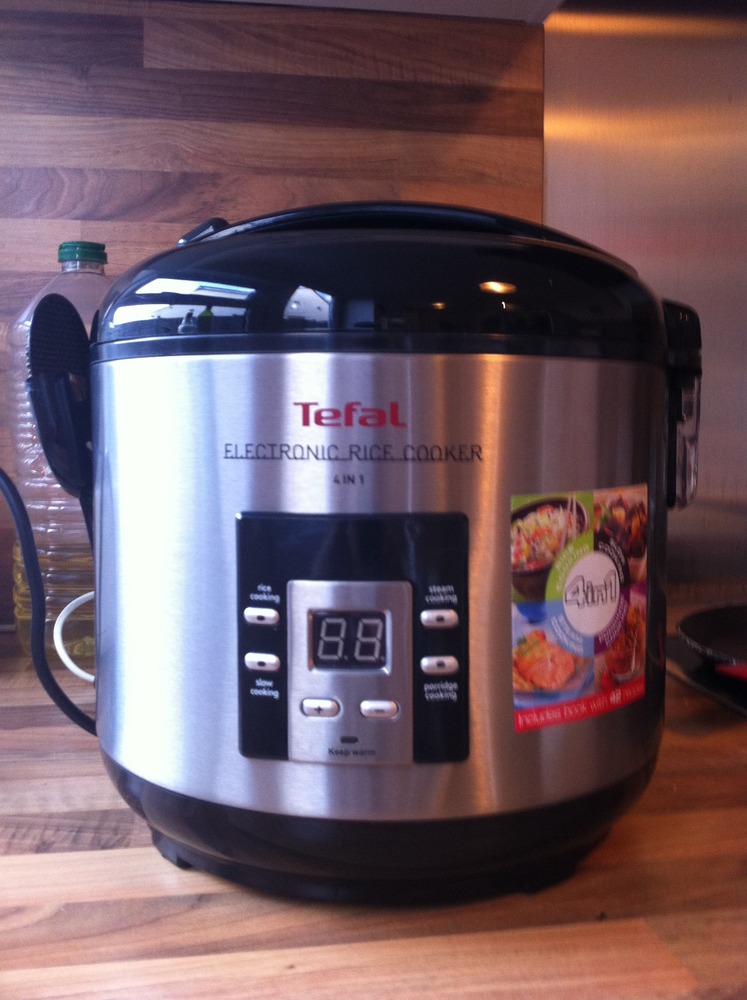
My proudest new possession is a Tefal, with four functions. (Ebert frowns on this, but I don’t really care). It’s a steamer and slow cooker as well as a rice cooker. It also has a porridge function, which made for the creamiest, most unctuous podge I’ve ever made.

So far, I have steamed broccoli for Xmas lunch and spuds for a fish pie in it. I have made blueberry and cream porridge. I have cooked a full chilli beef stew in it, and the meat was softly giving under light pressure from a spoon. I have even cooked rice in it.

This process has something of the magical about it. Rinsed rice and volume-and-a-half of liquid go into The Pot (after a while, you can’t help but go for the Ebert-style capitalisation). Press the cook rice button. It sits quietly on the counter, venting the occasional polite puff of fragrant steam. After about 15 minutes, it beeps gently. Your rice, sir. It will stay warm in the pot for an hour or so. Fluff it up and get stuck in. No muss, no fuss. The non-stick bowl washes clean in an instant. The simplicity and efficiency of the device has me filled with a profound, calm joy. I want to use this machine every day.

Something of a recipe, as spelled out to me by one of my work oppoes. It’s the perfect restorative after a night out, or indeed a long work day, and will withstand any manner of tweaking.

Tobias Clayton’s Back-From-The-Brink Rice.

Put the rice in The Pot and get it started. While it’s puttering away, finely chop a chili and a green onion. Once the rice has clicked over to stay warm, fluff it up, then throw in a glug of oil and the veg, and clap the lid back on. Give it five minutes. The veg will soften slightly in the heat. When you can’t stand it any more, throw in more soy sauce than you think you’re going to need, lob the whole lot in a bowl and bury your face in it.

If you want to gild the lily, some briefly cooked mushrooms, prawns or chicken would work well. Try flavoured oil stirred through the rice, or cook it in some stock. I’m going to try popping some fish in the steaming basket that comes with the pot next time, just to see how that’ll cook.

All of which sort of jibes with the elegant simplicity of the dish. The salty tang of the soy mixed with the crunch and zap of the chili, all bound with the nutty comforting rice. It’s pure cooking, all about flavour.

Look, I’m sorry, I know I’m gushing here. But this is a transformative moment for me. I’m spending more time than I ought thinking about what to cook in The Pot, and using it makes me grin like a gibbon. As my adventures in domesticity continue, this becomes yet another reason to get home, get comfy and cook.

Now, have I told you about my new pair of slippers?

Tron and The Conspiracy Of Surfaces

This post contains discussion of the plot
and characteristaion of Tron: Legacy.

Consider this to be your Spoiler
Warning.


I’m prepared to be an apologist for Tron: Legacy. I am, after all, the
perfect example of the film’s target audience. I clearly remember
going to see the film as an impressionable 15-year-old, and going
to an arcade afterwards that ACTUALLY HAD THE TRON GAME. I was a
late convert to the unsetting pleasures of girls. I drooled over
lightcycles instead.

So, for the most part, I had no problem with the reboot (yes, I’m going there). Tron
is perfectly tooled and cheerfully blatant nostalgia bait. The
acting is significantly better than in the original. The cast do a
sterling job of playing the absurdities of the plot and dialogue
absolutely straight. Apart from Michael Sheen’s green-screen
chewing performance as the treacherous Zeus. Ziggy meets David
Frost. Jeff Bridges somehow gets away with being The Dude again,
and Olivia Wilde plays action pixie girl Quorra with the right
level of crush-inducing flair.

The film sports a perfectly serviceable script that hits the right beats at the right
time. The characters are properly motivated and have a bit of
depth. And I like the idea of the villain of the piece being a not
very good copy of the star. CLU is the creepy new textbook
definition of the Uncanny Valley, and I applaud Digital Domain for
not getting it right.

I mean, I’m under no illusions. Tron: Legacy is rubbish. There are some supremely dumb
bits and longeurs. It’s over-long, and over-earnest. But the
original had what Leading Man Clive called “plateaus”. I, being
less charitable, consider Tron to be a film of one half that slows
to a crawl when Flynn and Tron reach the portal. Legacy is pacier,
prettier, and understands the audience. The little nods to the
earlier film and to eighties rivals such as WarGames made me
smile.

So why, then, did I walk out of the BFI IMAX with a frown and a headache?

It’s that bloody stereoscopy again.

Tron: Legacy should be the perfect film for 3D. It is a film about transparent
surfaces, of action glimpsed through slabs of glass, of characters
framed through the empty centre of discs. It It provides us with
the illusion of depth.

This is, in essence, my problem with the 3D process. It’s the “deck of cards” effect. There is no real sense of depth and solidity. Instead elements in the frame are
placed in a series of flat planes, much like a toy theatre where
paper cut-outs are slotted in and out of a proscenium arch. This
isn’t such a great idea when all you have to play with is a
close-up, and the nose is on a different plane to the
cheeks.

There are tricks to make this less apparent. Selective
focus becomes vital. Objects that we are supposed to perceive as
being further from the viewing plane are carefully defocused in
post. The problem is that this is frequently misjudged, especially
in shots where you are looking through windows, or in the case of
Tron, transparent walls. There are innumerable shots where
characters will walk towards camera and stay in focus throughout.
It’s as jarring as the split-screen effect used to keep two actors
sharp when they’re at opposite ends of a room.

3D claims to be a technique for enhancing storytelling, for involving the viewer more
deeply in the story. All it does is constantly remind you that you
are watching a 3D film. Things are shoved in your face – sort of.
Things rocket overhead – kind of. You have to wear a silly pair of
plastic shades. And then you have to pay extra for the privilege.
Tickets for the IMAX set me back £15, and got me a seat that was so
close to the screen that my eyes were watering after ten minutes.
And I can tell you, it’s disconcerting when odd eye-protein amoebas
start swimming around in the imaging plane and bumping into Jeff
Bridges. I can see a situation where you’re asked to pay extra
extra for the seats in the central sweet spot of the
range.

The sad thing is, that IMAX projection does a much better
job of allowing you to lose yourself in the image. 3D depends on
the proscenium arch effect, pushing elements backwards and forwards
from a flat imaging plane, the screen. An IMAX image is so big that
it extends past your field of vision. You are engulfed in the
picture. You are not being poked at, or peering through a window.
You are inside the picture, and it’s an utterly overwhelming
experience.

A reminiscence. There was a fairground attraction when I
was young that involved a 70mm film of a rollercoaster ride
projected onto the inside of a canvas dome. You stood in the dome,
gripping rails that had been driven into the ground. You needed
them. When the film started, the huge image fooled the brain into
thinking that you were on the ride, and you tilted and swayed
accordingly. No specs needed. You were elsewhere, and it was an
amazing ride.

Much in the same way as The Dark Knight moved between
35mm and Imax to pull the audience into the action sequences, it
would be interesting to see what would happen if, rather than 2/3D
to show the differences between our world and The Grid, Kosinsky
had chosen to shoot the Grid in IMAX. Imagine that first shot of
the Recogniser coming down through the clouds suddenly filling the
whole height of the cinema.

I think you know where I stand on 3D by now, Readership. I find it distracting, irritating and until my eyes settle it simply doesn’t work for me. I spent the first 45
minutes of Avatar thinking that there was either something wrong
with me, or that some pranker had swapped the lenses of the glasses
over (if you do this, according to Mark Kermode, the 3D is
cancelled out. Might have to try that).

I’ve given it a try, and I can now state as a New Year Resolution that I will never
see a film in 3D again. It’s a fake, a parlour trick, a conspiracy
of surfaces that makes a poor shadow play out of the most immersive
form of entertainment there is. 3D adds nothing to a film, and in
my opinion distracts from its pleasures. I was quite prepared for
Tron: Legacy to be a bit of silly fun. I walked out of the cinema
feeling both frustrated and disappointed, for reasons that had
nothing to do with the film.

IMG_1000000776.JPG


Also, I look ridiculous in the glasses.

Blu-Ray Is Dead (At Least For Me)

Christopher Nolan’s Inception is out to own this week, on good ol’ DVD and brandspanking new sexy eye-meltingly gorgeous Blu-Ray. Oh, you must buy it on Blu-Ray. Otherwise you’re missing out. The detail. The clarity. Oh, the colours. It’s almost an insult to everyone who worked on the film not to buy it in it’s purest, most perfect form.

Yes, alright, I’m taking the piss. I lived through the whole VHS-Beta thing, the whole vinyl-CD handover, so excuse me if I’m a little less than whelmed by the urgent push by the movie companies to have me rebuy films I already own. Or worse, pay a premium to watch new material, which would include an investment in new kit that I don’t need or particularly want. I have a halfway decent telly and an upscaling DVD player which delivers lovely results. We watched UP last week (yes, I know, right up on the moment here at X&HTowers) and the pictures were gorgeous.

But a lot of the supposed benefits are down to the way the end user (that’s you, Readership) has set up their telly and player. Are you going in HDMI? A lot of people still use the Scart connection, apparently. And have you calibrated your telly? If you’re now asking what calibrated means, then no, you haven’t. Which means that your lovely pricy digital telly is running with the factory presets. These won’t be right for your room, and in most cases will be waaaay too bright and saturated. Or, if you set up a TV the way my dad does, not bright and saturated enough. He doesn’t own a 3DTV. You just need sunglasses to watch the telly in Mum and Dad’s place. (sorry, pater.)

How do you calibrate a HDTV? Funny you should ask.

My major problem with Blu-Ray is that it is a transitional format. It’s high-density, high-capacity storage, and that’s all. It’s a carrier for content, and it’s the way that content is formatted in the first place that is important. A recent re-issue of Gladiator used exactly the same video files as were on an earlier, carelessly encoded DVD, with predictably horrible results. But very few people either noticed or cared, and as a result that disc is still on the shelves. You have to wonder how many reissues that people are paying a premium for have been put together the same way, with the odd “special feature” whopped on to make it seem bright, shiny and new.

The thing is that a lot of movie content sits on servers and hard drives in high definition quality and has done for quite a while. For DVD, that content has been compressed and down-converted to allow it to fit on a disc. There was a push a few years ago to “cinephile” editions (of such cinematic masterpieces as “I, Robot”) that had the highest resolution version of the movie that could be crammed onto a single disc, with extras either on a separate coaster or excised completely. Then Blu-Ray and HD-DVD appeared, and it seemed that we could have it all. Full, high-quality transfers and hours and hours of supplementary features that no one ever watches. But the fact remains that the content has not changed. It’s the same 1080p file that was originally created.

Which of course makes me look at iTunes, Netflix and the like and start to wonder why we need the disc in the first place. Up until a couple of years ago, a wall of our house was dedicated to our CD collection. In some places, the shelving was beginning to double-stack. At the same time, the books in the back room were making an attempt to break through the wall. We were swimming in content, much of which had been listened to or read once, if at all. I bought a big external hard drive, digitised the CDs, backed up that hard drive at least twice, and stored all the discs in the loft. We now have a lot more room for books we don’t read. But that process changed the relationship we have to music. It’s much less album based. We pick and choose, shuffle, build playlists. A cheap subscription to Spotify means that I rarely ever buy music anymore. I don’t need to.

It would be a more time-intensive job, but I could do exactly the same thing for the DVD collection that now takes up the wall where the CDs used to live. Dump everything onto a cheap media server and a back-up drive, and who knows, I might even start watching the discs that are shelved and still in their wrapping. Build playlists and mood reels with them. As someone in love with the on-demand services that the plusboxes offer, I love that flexibility. As with music, I’d then look at ways to buy my content in a form that doesn’t come in a box.

To my mind, the film companies are missing a trick. I’m usually a bit behind the curve on this kind of stuff. This means there are already hundreds and thousands of people who are not only thinking the same as me, but have done something about it. iTunes is a good first step, but I see no reason why the studios don’t have their own portals, or club together to create something that could do the job as well. I’d love to see something like Netflix’s streaming service in the UK. As a huge advocate of Lovefilm’s disc-on-demand service, this has to be the logical next step, doesn’t it? (I’d note that while Sky Movies and Virgin’s Front Row deliver something similar, they’re still not providing the depth of service and the ability to source esoterica that Lovefilm can. Plus, they’re both crippled by embargoes on when they can start showing movies – usually well after the coasters have hit the shops).

Yes, I know it would be a massive undertaking to get all that material onto servers that can reliably squirt it down the pipe and into your front room, but if it works, it’s a service I’d happily pay for, much in the way Spotify get money off me every month.

Certainly, I have no plans to buy a Blu-Ray player, which means I have no reason to buy coasters. Instead, if I want the absolute best quality image available, I do the right thing and go to the cinema. Project a Blu-Ray next to a 35mm print on the big screen, and you’ll soon see which one’s better. Even when, sadly, projection is done using big hard drives, the image quality of those files will still show that the disc is a massive compromise for the domestic market. Bear that in mind, and the argument that Blu-Ray is the ultimate viewing experience starts to look a bit thin.

And don’t get me started on bloody 3D…

+++UPDATE+++

Simon Aitken reminds me that while his most excellent horror Blood + Roses is currently available for rental, it will roll over to digital download and DVD purchase through Amazon in the new year. The metrics on who’s buying what should make for very interesting reading.

Life During Nano: Something for December, Perhaps

OK, this has nothing to do with anything apart from the fact that working on NanoWriMo tends to tune your brain into slightly different frequencies and you pick up on connections that you maybe wouldn’t normally notice.

Also, that you write in run-on sentences more. They normally get cut in half in the edit. But anyway.

Charlie Stross recently wrote a wonderful, curmudgeonly piece on steampunk (here it is). He made the point that the innovations of the early stories have devolved into mere set-dressing. If steampunk authors took the time to look at the worlds they were building, there would be very little glamour to be had, and a great deal of poverty and deprivation. He also cracked the joke that steampunk is what happens when goths discover brown, which made me snort tea back into my mug through my nose. He called out SF sites Tor.com and i09 as being particularly to blame for the spike in interest in the genre.

This is pretty nicely timed, as Tor have just been running a Steampunk fortnight. A lot of the critical thought and articles have been on the reinvention of the genre. Amal El-Mohtar’s piece, Winding Down The House is especially good in this regard, and successfully makes the point that steampunk’s tropes and conventions really are holding things back. If steampunk is to grow and stay interesting, it needs to move away from the Victoriana/Old West/Ruritanian bit, and find new directions.

Amal points out her frustrations neatly here:

I wrote a story in what, to my mind, would be a steampunky Damascus: a Damascus that was part of a vibrant trading nation in its own right, that would not be colonised by European powers, where women displayed their trades by the patterns of braids and knots in their hair, and where some women were pioneering the art of crafting dream-provoking devices through new gem-cutting techniques.

Once I’d written it, though, I found myself uncertain whether or not it was steampunk. It didn’t look like anything called steampunk that I’d seen. Sure, there were goggles involved in gem-crafting, and sure, copper was a necessary component of the dream-device—but where was the steam? My editor asked the same question, and suggested my problem could be fixed by a liberal application of steamworks to the setting. Who could naysay me if my story had all the trappings of the subgenre?

Syria, you may be aware, is a fairly arid country. There are better things to do with water than make steam.

Both articles are worth a read, not just as criticisms of the subgenre, but as roadmaps to a new future past.

And I have an unfinished steampunk book that could use a little attention…