
In the South of France, docoDomsy sets up a time-lapse shot before a day on his promo project for Mas De Calage, a local winery.

Meanwhile, I take my place amongst the flood of people pouring through London Paddington, facing another day at work.
In the South of France, docoDomsy sets up a time-lapse shot before a day on his promo project for Mas De Calage, a local winery.
Meanwhile, I take my place amongst the flood of people pouring through London Paddington, facing another day at work.

Caught the last episode of Torchwood: Miracle Day last night. It’s a series that, while riddled with flaws the way Swiss cheese has holes, I found myself enjoying. Once you stop trying to take it seriously as a genuine exploration of a Big Idea and buy into the high-camp, wildly gesticulating opera of the thing, then it becomes a far more palatable option. Let’s face it, if the show really wanted to show us the effects of a world without death, you’d be in for a much grimmer prospect.
I loved the way Lauren Ambrose and Bill Pullman both got the tone. Ambrose in particular, who I adored as Claire in Six Feet Under, really went for it, all hair and bug eyes and shrieking. The script even got a joke out of it, as she was smacked around by Gwen while the show built up to it’s Really Big Explosion. “How much lipstick can someone wear?” Well, in this show, there’s no such thing as too much.
The fanboi rollcall of ex-Trekkies and genre stalwarts simply added to the hilarity. Look, it’s Q! With a beard! Nana Visitor still looks like an alien even without the nose-thingy!
Look, come on. You couldn’t take it seriously. It was clever of Russel T and his co-conspirator Jane Espenson to move on from the bleakly adult themes that Children Of Earth had explored so effectively, and try something more over-the-top. And dear gods, they did it. Immortality, brought about through a magic tunnel through the earth that was somehow the physical manifestation of the soul of the planet. You couldn’t do that on Hollyoaks. The show became a manic, globe-trotting whirlwind of crazy ideas, big ‘splosions, gore, sex and tantrums.
Gwen Cooper has changed too. No longer the audience’s eyes, ears and questions, she’s a superspy now, a stone killer whose secret base just happens to be a terraced house in Cardiff. A woman whose mothering instincts include shoving a Glock into the face of any threat to her daughter. To be frank, she’s the reason I kept watching. She took the hysteria and bombast around her and made it, if not believable, then somehow bearable.
Everything’s geared up for another season, with a Buffy-style Big Bad in the shape of the Three Families and another immortal on the planet. Will we get one? Well, viewing figures in the UK have tanked. But Starz, who backed the show in the States, have form when it comes to pushing out high-concept, high-camp genre shows. This could be the start of something faaaabulous.

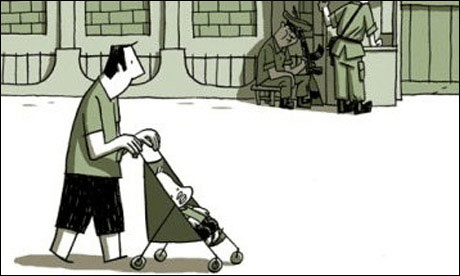
Journalism in comics has a much greater pedigree than you might think. Political cartoons have been with us since the Romans, who daubed parodies of disliked senators on the walls of their cities. To this day, the form has the ability to shock, provoke and anger to the point of murder, if you consider the case of Kurt Westergaard, the Danish cartoonist killed for his depiction of Mohammed.
Travel journalism is less well represented. You could argue that Herge’s Tintin took place in such carefully researched and exquisitely rendered locales that it equated to a kind of travelogue – although it would be decades before we could see how accurately he’d got the moon. For most people, Joe Sacco’s work in Bosnia and Palestine is the definition of travel journalism – angry, passionate comics that get to the heart of the conflict.
A different approach is taken by French-Canadian cartoonist Guy Delisle, whose Burma Chronicles is out in a new paperback edition from Jonathan Cape in the UK. Delisle is married to Nadege, a Medicins Sans Frontieres administrator, and their journeys into strife-torn areas give him unprecedented access. The book tells of their trip to Burma at a point when the generals who run the show are beginning the next in a long series of clampdowns. As funding and visas are pulled, Guy, his wife Nasege and their baby son Louis struggle to find a life in a country that, officially at least, refuses to admit that they are needed.
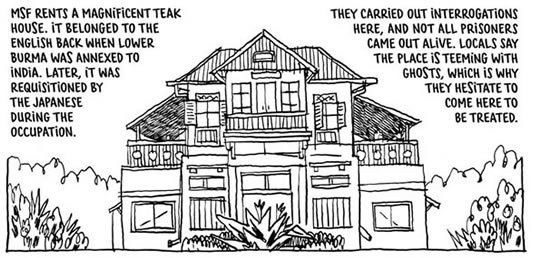
Delisle approaches his story from the opposite angle to Sacco. He is no journalist, and never agitates to get into the dangerous areas. He’s principally a house-husband, there to look after Louis, an adjunct to Nadege and her work. Tootling around town with Louis in a buggy, he becomes almost invisible, and is free to observe the everyday life of the people. He discovers that the place they have rented is just around the corner from the house where Aung San Suu Kyi has been held under house arrest for decades. He never sees her, of course, despite vague efforts to at least walk down her street (an effort that’s finally rewarded in an unexpected way). But, as in life, she is an unspoken presence, a thread running through everything, binding her people together in the face of crippling poverty and brutal repression.
Delisle has a simple, clean style that again is the polar opposite to Sacco’s pyrotechnic, fish-eye-lens freakouts. He draws himself as an abstraction, a simple collection of lines that reminded me a little of the 1992 Olympic mascot Cobi. Otherwise, his settings and characters are picked out with care and grace. As we follow Guy, Nasege and Louis through their year in Burma, we get to know and care about them and the lovely, punished country around them.

The story unfolds quietly, and always with a wry humour. Guy is lazy despite his best efforts, his promises to do more frequently washed away in the everyday tasks of looking after Louis or getting some drawing done. But he does, gradually, come to an understanding with Burma. There’s a lovely sequence towards the end of the book where he finally tries a three-day meditation retreat (granted, just round the corner from his house). Burma Chronicles is full of moments like these – the wordless, 24-panel pages of his trips to tourist destinations are sheer, joyful cartooning at it’s purest and most skilful.
If you need an antidote to the DC Comics reboot sturm und drang, Burma Chronicles fits the bill perfectly. It’s subtle, sharp and intelligent comics work, an incisive commentary on the state of Burma at a low point in the country’s history. Moving, hilarious and insightful stuff.
I’m crossposting this with my gig over at the United Kingdom Zombie Defence League. It ticks too many of the boxes I regularly mark off here not to make it available to you, oh Readership. Howevs, before we begin, I urge you to check out the UKZDL site – it’s full of zombieliciousness!
December 1999. A month filled with portent and pre-millenial tension. We were in New York, after a week in Boston in which I’d seen a red moon rise while we watched the sun set on the observation deck of the John Hancock Tower. TLC had suffered through a brutal bout of food poisoning, and I had an eye infection that had fused my eyelids shut. The red numbers of the signage at the old Marvel building on Broadway merged in my head with the posters for the new Schwartzenegger movie. 666. End Of Days. It had been, by any definition of the word, a strange holiday.
But it was our first time in the States, and New York was everything we’d imagined and hoped. We did all the tourist things, giggling like loons at the sheer sensory overload of Times Square, braced in the brutal cold at Battery Park. The towncar from Newark into town had been like the Sopranos titles in reverse, complete with a motormouth driver called Vinnie, who asked us if we’d heard of this chick called Madonna. We were two blocks from Grand Central. It was, just as everyone says, like starring in your own Woody Allen movie.
And here we were, on the brightest day I’d ever seen, standing on the roof of a 107-floor tower, gazing at the whole city spread out before us like a strange, magical carpet. Behind us, a school party chattered, peering unconcerned over the barriers, looking for their school. Even in winter, Central Park was green, and the sky around us (it felt as if we were so high that it could no longer be above our heads) an achingly flawless blue. Our breath froze, and I swore it sparkled in the clean air. TLC took my hand, and we lost, momentarily, the capability for speech. There was no need for it, in this still point of beauty and joy.
This is a memory I cherish, and it can never be tarnished, never be changed, never be corrupted. I choose not to reflect on the events that came after, or note the arbitrary anniversary of a lunatic deed. There are plenty of other places that will. Today, I choose to remember happier times. I choose to celebrate the gifts that we have been granted, and a city awash in light.
It takes a big man to admit he was wrong. Which must make me some kind of giant, even though I’m feeling quite small at the moment.
A telling off in the comments and quiet disbelief from everyone that had seen the film that I was taking a stand, mated with a quiet Thursday where there was nothing else on at the Vue led to me taking a seat at an afternoon screening of Rise Of The Planet Of The Apes.
Continue reading They Sure Made A Monkey Outta Me: X&HT (finally) Saw Rise Of The Planet Of The Apes

In a fine example of what TLC likes to call my tendency to overextend, I have signed up as writer to yet another website. At this rate, I will be doing the whole internet by this time next month. We are apologises in advance for the subsequent droop in kwalitee.
The new endeavour is a gig on a new zombie site, UKZDF. Stands for United Kingdom Zombie Defence League. There’s an element of ARG and role-play in here – head of the League, “Sarge” Rob May (an X&HTeam-mate of long standing, I might add) has spent a long while working out the best places to set up a defensive perimeter should the zombie plague hit Reading (hint: don’t do a Romero and hide out in the Oracle). But the site also seeks out and celebrates the best in zombie culture.
Up on the site at the moment, we’re looking at the upcoming launch of Dead island, which looks to be the zombie game of the year. There’s an interview with the producers of the Walking Dead, and a review of the first two in a great new series of books by Mira Grant, Newsflesh.
Oh, yes, and a brief history of the zombie in popular culture pre-Romero, which is my first contribution. Sarge has been good enough to give me my own section, so keep an eye out for weekly blather from me. It’s early days, but the site already looks good, and there’s some interesting people lined up to contribute. If anyone’s interested, let me know and I’ll forward your names onto Sarge.
In the meantime, read and enjoy. It’s a dead cert.

Horror, SF and fantasy, according to common knowledge, are not female friendly genres. Bad enough that the prototypical image of the genre fan is the sweaty overweight dysfunctional geek – that’s hardly representative. By making that image male, the picture is distorted even further away from the true. As a regular visitor to Frightfest, I’m happy to confirm the large number of women that attend that are just as vocal in their enjoyment of the movies as the men. The authors of the two biggest fantasy franchises on the planet are women – JK Rowling and Stephenie Meyer. Common knowledge is, as is usually the case, bass ackwards from the truth.
However, the depiction of women in SF, fantasy and horror needs a refresh. There are still far too many victims out there, female analogues waiting to be rescued or assaulted. When kickass women do appear, they’re frequently Buffy clones or, in the case of Hitgirl, children. It’s either that or the avenging angel of I Spit On Your Grave or Ms. 45. The wronged as killing machine, using their femininity as a weapon or a cloak from which to strike out at their abusers. It’s an old, tired tale.
I’ve seen a couple of movies lately that change that sorry state of affairs. Both films feature strong, uncompromising central performances from their lead actors, and both explicitly reject the myth of the female as victim in genre films.
Pedro Almadovar’s The Skin I Live In has a cool, controlled surface. Underneath that, lunacy boils and writhes. I need to be careful here. The central conceit on which the plot pivots is not one that should be easily spoiled, and it’s one that threatens to derail my whole argument before I even get started (feel free to give me a kicking in the comments).The film is part Pygmalion, part Frankenstein, part Eyes Without A Face. It tells a common genre tale – the mad scientist attempting to cheat God and death by resurrecting a lost love. Antonio Banderas is suitably driven and remorseless as the plastic surgeon, rebuilding a burn victim in the image of his dead wife. But all is not as it seems with the beautiful Vera. Played by Elena Amaya (pictured left) with a mix of vulnerability and shocking power, she seems at first barely human. A mannequin, meek before her master’s demands. As we discover her past, and all she has lost at the hands of Banderas, Vera shrugs off the weakness, becoming something fierce and strong. Her own creation, transcending the scientist’s plans, remade by sheer force of will. She ends the film as her own woman.
Lucky Mckee’s The Woman, which had it’s UK premiere at Frightfest, tells a similar tale, then rebuilds it from the bones up. A feral woman is discovered and captured by a suburban lawyer, who plans to “civilise” her. He locks her in an outhouse, hoses her off and dresses her in clothes with easy release fastenings. It’s clear what his intentions are from the beginning. Yet the Woman of the title, played with ferocious magnetism by Pollyanna Mackintosh, is no victim. She will never succumb to him, and is content to wait as the lawyer’s family collapses under the weight of revelation that her arrival sparks. Her release, and her revenge, are inevitable. Part monster, part hero, the Woman is never less than the mistress of her own destiny.
Frightfest was a bit of a showcase for this cliche-busting approach this year, with films like Susan Jacobson’s The Holding (with yet another fine central performance from Keirston Wareing) showing how genre doesn’t have to mean generic when it comes to gender. This is a good start, but we shouldn’t be complacent. Although I started this post in a bullish mood about equality in the realm of the fantastick, we’ve had a summer where DC Comics’ big relaunch was marred by the realisation that there were hardly any female creators on board, and a call from author Juliet Mckenna to promote equality in genre writing. There’s a way to go before we can get the balance right, but as Juliet points out, SF, fantasy and horror have always questioned unthinking prejudice and the status quo. Films like The Woman and The Holding are encouraging indeed, pointing the way to new, strong voices and bold, uncompromising stories.

One last thing, before I let Frightfest go for another year. Many people would balk at the prospect of spending five days in a cinema watching horror films. I’ll admit, I’ve only ever done a single full day, and that very nearly wiped me out.
But of course, Frightfest is not just about the films. Because it’s impossible to watch everything on offer, you simply have to take a break, get a drink, have a chat. There are seminars, Q&As, quizzes and plenty of opportunities to meet up with film-makers and like-minded fans. If anything, the extra-curricular activity is as much the point to Frightfest as the movies. It’s the community that’s built up around the love of the genre that makes this festival so special. The fabled Sleepy Queue, when the hardcore stake their claim on the weekend seats, usually forms in the early hours of the morning before the tickets go on sale. That has to tell you something about the attraction of Frightfest.
I will always try to make the effort to see at least a couple of films with the Frightfest crowd. Seeing horror with a bunch of people that love and appreciate the genre with all it’s foibles and eccentricities always makes for a more interesting experience. Seeing a good horror film with the Frightfest crowd is a genuine pleasure that I don’t think you get from any other type of film. Going to the cinema is, like any other communal experience, a heightened state of mind. I believe you get more out of a film when you see it on a big screen with a like-minded audience. At Frightfest, that feeling is amped up still further. It’s not just about the film. It’s about the audience, the gathering, the congregation. Together in the dark, loving the ride.
 My call for contributions led to a suitably … esoteric response from ace storyboard artist and illustrator Jaeson Finn. He tweeted his top five to me, one at a time. Twitter’s 140-character limit meant that he couldn’t put the titles up as well, meaning that I had to guess which films he was on about.
So, hey, why not, I’m reproducing Jeason’s top five below in the form of a quiz. Answers in the comments, please. Get them all right, and you get a properly certified and not at all cribbed from Marvel X&HTrophy (worth it’s weight in pixels).
Have fun. You get me again next week, and I’m starting off with a look at two films I’ve seen recently with very strong and very unusual female main characters. But for now, live, from the Interwebs, it’s the Quiz Of The Week! Take it away, Jaeson!
 </
</ EXCUSES AND HALF TRUTHS