In The Gutter

At some point today, I am reliably informed, X&HTowers will have it’s first dedicated e-reader. Sure, TLC and I both have laptops and iPhones, which are both perfectly capable display vectors, but she wanted something bigger than the phone, smaller than the Macbook. Plus, she’s a geek of the highest order and loves her tech.

Of course, in the process of researching which model to go for (no Kindle on the list, BTW. My wife likes it opensource. No wait, that came out wrong) I started considering the possibility of putting comic content on the device. Which got me thinking about digital comics in general.

The major and minor players are already pushing digital content hard, and in a hurried and unthoughtful way. Obviously reading from a screen is a whole different experience to picking up a book and flicking through it. It’s clear that there’s no way to replicate that experience on an e-reader. But what I’m seeing is a rush to completely rethink and reformat the way comics work, forcing them to fit the screen.  Alex De Campi on Bleeding Cool has already written insightfully about how this is likely to work. I can see the advantages, of course, (not least the financial benefits to the creators) but speaking as a consumer there’s still something missing when you’re forced to read a narrative panel by panel. It’s like trying to read a book when the formatting is set to one paragraph per page.

There’s less of a sense of flow, and certainly no way to expand and contract scale, say by moving from a tight 9-panel page to one with a single image. There are tricks you can play with pacing, sure, and tweaking for the Japanese market becomes slightly less of a pain but… I dunno. I’ve not seen an iPhone comic yet that’s been a satisfying experience, and downloads onto the laptop just feel cheap. I view them more as previews to see if I’m likely to want to invest in the comic or trade when it comes out in the real world.

And don’t get me started on motion comics. The bastard son of Crash Cargo-level animation and bad audiobook readings, I’m dumbfounded by any suggestion that this mongrel format is in any way the future of The Ninth Art. I watched a version of Brian Bendis’ Spiderwoman that had perhaps three frames in it, and a conversation between two characters on the top deck of a bus that seemed to go on for an hour and a half. Pretty impressive for a fifteen minute clip. I swear, I popped out to make a cup of tea and came back to find the same frame playing that had been on the screen when I left. This shit ain’t comics. It certainly isn’t entertaining.

I may be coming across here as something of a Luddite. In which case – good. I’ve not finished yet, either. Last week, on one of my increasingly rare trips to Forbidden Planet, I came across a title that quite genuinely had my head spinning with the possibilities.

I found the DC Wednesday Comics, and I fell in love.

The Wednesday Comics hearken back to the age of the comics section included in every big American Sunday paper. Broadsheet sized, and therefore able to cram a heck of a lot of story into a single-page strip. This was the place where Will Eisner’s Spirit blazed a trail, and where the story-telling techniques of masters like Alex Raymond and Chester Gould dropped through the mailbox of millions of American homes every weekend. In the UK, we’ve never really had anything like it. Our broadsheets simply don’t have the girth of the American heavies.

So, the Wednesday Comics have tweaked that look and feel for the modern audience, and the genius part is that they’ve made it transformable. It racks as an A4 (ish, I don’t have the proper dimensions to hand so I’m using shorthand) booklet, which then folds out to A3. Each single-page strip has an A3 page to itself, and in the centre two strips share a single unfolded sheet of A2.
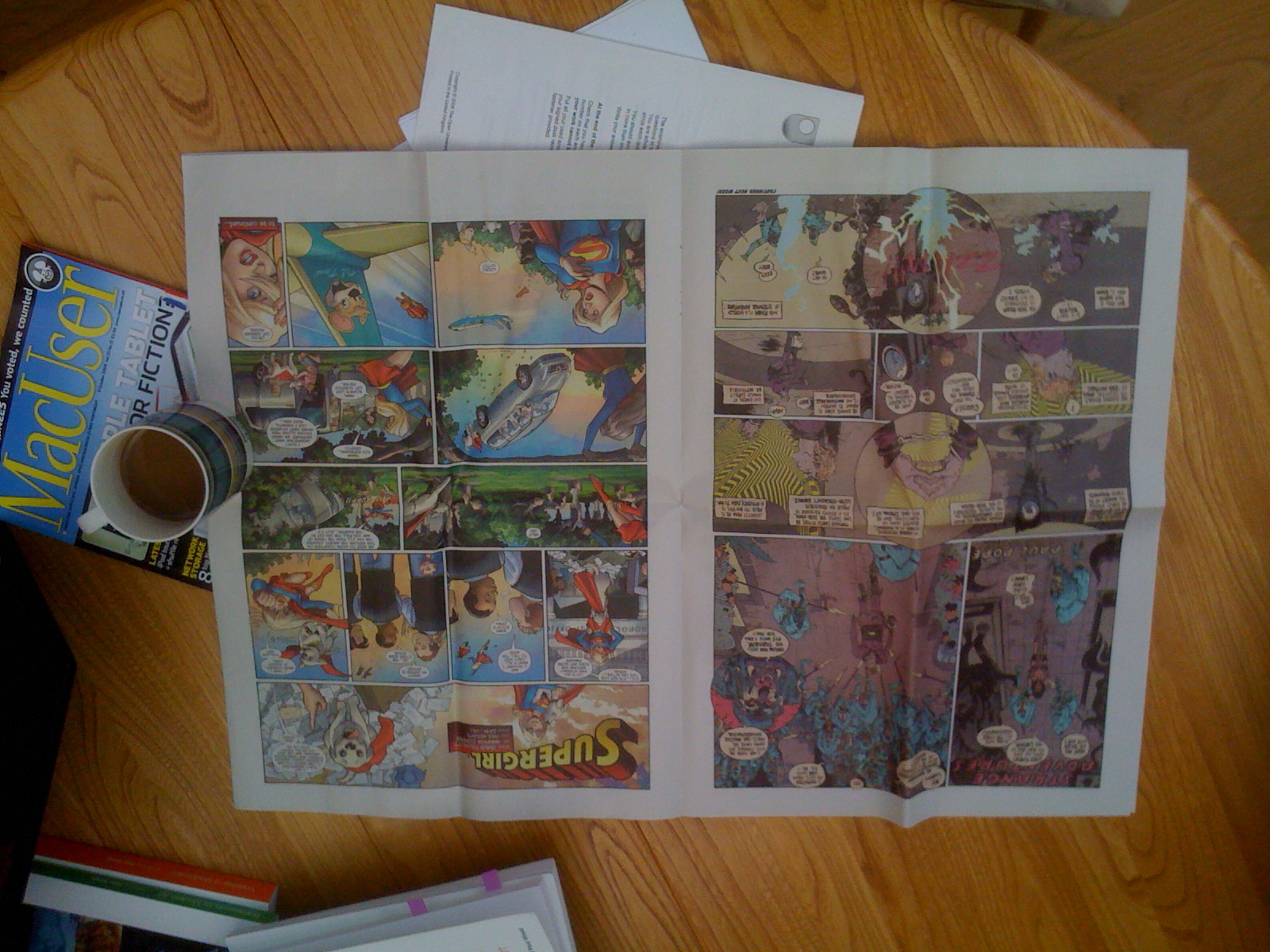
Coffee Mug For Scale

Are we seeing the possibilities yet? I see a story that can go from small and intimate to absurdly widescreen within a sixteen page spread. I can see stories where scale can be reined up and down with abandon. It’s a neat, flexible way to get huge swathes of art and story into a pocketable form. Plus, it’s printed on lovely tactile newspaper, the kind of stock that most Brit comics were on when I was a kid and buying them regularly. I’d love to see Paul Grist do something in this format with his Jack Staff or Kane universe. Screw it, I’d like to see Rebellion do some 20o0AD spinoffs on newsprint. A new Cursed Earth maybe. Certainly, I remember Dredd back when it was in the centre pages and started every episode with a big splash page. Dinosaurs, robots and mutants rampaging across a huge sheet of paper.

It was cheap, it was lurid, and above all it was fun.

Let me throw down my cards, let me show you the cut of my jib, and the lining of my jacket. I don’t like digital comics. I don’t think they work as the fetish objects that comics should be. It kills the magic. It sucks out the joy. It turns art into graphics files. It turns the process of reading into a linear, stilted and over-directed chore. It turns the magic of what happens in the gutter between every frame into a LOADING message.

Fuck that. The best and brightest stuff on the web will eventually find it’s way onto print, and there it will finally find it’s true home. I talk about Warren Ellis a lot on this site, and it’s telling that his web project with the brilliant Paul Duffield, FREAKANGELS, would always preview on the web before making it to print in an expanded and collectible edition. Sure, you can read it for free online, but it’s not the same. He, and other writers I admire like Cory Doctorow have long been exponents and advocates of the web as a place where content can be tasted and sampled before you, the discerning consumer, complete the cycle, and dump some cash on an object that’s nourishing to the soul. An OBJECT, not a file.

Let’s put it like this. X&HTowers is home to a pair of techy geeks, and yet it is a place groaning with bookshelves full of tatty paperbacks and vinyl records. A place where a fat internet pipe cannot compete with music, booze, a book and quiet conversation. Sometimes, it seems that we are the McLuhanist dream. We are a place where the medium really is the message.
Newsnight Review

520A6D78-A6E9-4461-A8DE-EF3B39B6C989.jpgI don’t often watch Newsnight Review these days. It’s been a bastion of the worst of contemporary cultural snobbery for quite a while, and would just wind me up into a fury that’s really not good for the soul at half eleven on a Friday night.

However, last night featured the mighty Kevin Smith, in town for signings of his new book and a short spoken word tour, so I figured it was worth tuning in. It was a pleasant surprise, then, to discover that the programme was specially themed around the idea of geek power. I instantly sat up and started paying attention. They were talking about my people, and what is more, not talking down to or condescending them.

Items on the Booker SF row, the prelevance of comics (well, more specifically, the superhero) in popular culture, and the role of the fan nowadays were dealt with humourously, and with a great deal of charm by the panel and Kirsty Wark, MCing with a great deal more empathy than she had shown to the two MPs she had been yelling at moments previously.

Joining Kirsty and Kevin were comedian Nathalie Haynes and author Jeanette Winterston. Here’s the first interesting thing. A panel on geek culture that’s three-quarter female? The one bloke on the panel admitting at one point that he is “barely male?” This reflects, to me, the sea change that is starting to take place. It’s OK to be a geek now. Girls can be geeks to, and in fact will revel in their status. Natalie, in particular was going full out to prove her geek creds, bouncing around the cultural signifiers with a barely concealed glee. More importantly, everyone on the panel was having fun. It was a riotous assembly of clever and outspoken commentators, and wildly entertaining.

The one problem for me was the material the producers chose to illustrate some of the points the panel had to make. Now, I know the show’s called Newsnight Review, and that it should be looking at art and media released that week. But focussing time on Eion Colfer’s Hitchhiker’s fanfic And Another Thing (as disappointing as post-Fleming Bond, or the painful rooting through Frank Herbert’s file cabinet that his son Kevin has done) seemed a bit of a waste, when I would have much rather heard more about the book Kim Stanley Robinson thought should have won the Booker, or even whether Jeanette Winterston agreed that the Booker is now perfectly accepting of genre books, as long as they are historical novels.

I would have widened the remit out some more, and talked about Micheal Chabon, who has won both the Pulitzer and the Hugo. Or looked at Iain Banks’ new novel which finally seems to be blurring the boundary between his mainstream and Culture novels. There was a fascinating discussion waiting in the wings that was never called out to camera.

Worse, using Mark Millar’s absurd adolescent power fantasy Kick-Ass as some kind of examplar of the way comics are now was just plain dumb. Jeanette, bless her heart, clearly doesn’t read many comics, and she rightly recoiled from this one. As well she might. A book whose principal female character is a homicidal eight-year-old with twin Samurai swords is hardly going to draw her into the fold. I couldn’t agree with Kevin or Natalie at this point, no matter how vehemently they argued that it was cool or fun. Or worse, how Kevin plans to take his ten year old, the brilliantly named Harley Quinn, to see it and cover her ears at the swears while making sure she sees the gore. A bit disingenuous, this, coming from one of the sweariest men on the planet.

The choice of Kick-Ass was not only poor, it was lazy. The final part of Warren Ellis and John Cassady’s Planetary was finally released this week after a three year wait. This would have been a much more interesting title to review. It works both as a brilliant adventure story, and a wide-ranging allegory that in equal parts satirises and skewers the all-encompassing hold the superhero has on mainstream comics. A far cleverer, far more interesting choice, to my mind.

However, I’m grumbling about things beyond my control, and on the whole I was surprised and delighted with the quality of discussion on a show that I would normally go out of my way to avoid. In a week when one of the Booker Judges claimed that SF fans hid in small rooms doing special, weird things, Newsnight Review came right out and showed what a ridiculous, blinkered statement that was. More like this, please, BBC!

A Progress Report

Dom discovers YouTube. That's it for work today, I guess...

Looking back over the past few posts, it’s painfully obvious that I am turning into a curmudgeonous old whiner, griping and complaining about the state of the country, signing petitions in lieu of doing something useful.

So, for a change, let’s be positive and constructive and look at how the film projects are coming along.

Time Out is taking shape nicely. We’ve closed up gaps, tweaked the edit ever so slightly, and laid in a sound bed that’s suitably overwhelming. We’ve storyboarded up the shots we need to get in a comparatively simple reshoot day, and are now getting that day together, in conjunction with our brilliant cast and crew. The plan is to complete Time Out in the next couple of months. Let’s call it a Christmas Present to the world.

Meanwhile, Decks Dance And Videotape continues on it’s glacially slow path to realisation. Dom had one of his busiest weeks ever, squeezing in interviews with Richard, promoter of the renowned Raindance night and Pez, the guy who defined the iconography of thee Acid House aera with his use of The Smiley Face. But that’s not all, dance fans. He also snagged an interview with house pioneer and legend, Marshall Jefferson. He can now brag that Marshall bought him a Chinese takeout. There aren’t too many people who can say that. All three came across as wise, insightful and funny. And they can all talk the hind legs off a kangaroo.

Logging work will commence on this prime chunk of footage, and next order of business will be a new trailer to drum up some interest, reflecting the wealth of interviewee goodness we now have on board.

And of course, how surreal the whole thing can be…

richardPEZ2
L-R, Richard, Pez. Or is it the other way round?

Over the past week, Dom and I have really made some progress on two very solid projects, and there’s more to come. We’re interviewing next Thursday, working on yet another film that I’ve been keeping shtum about on this blog for the time being. That may well have to change soon. Keep it locked to X&HT. News is approaching.

Random Thoughts During An Internet Outage

Being offline for a morning (not my fault by the look of it, the cable modem’s flashing where it shouldn’t, and the Virgin Media tech support line is permanently busy) does tend to concentrate the mind on all the other chores I should be doing rather than farting around on the web. But it also tends to concentrate one’s thoughts on the inherent fragility of the online existence.

Take Spotify, as an example. This brilliant music streaming service is being held up by many (including me) as the first step towards a radical new business model for the music business. Pay a tenner a month, and eight million tracks are yours. Up until the point where a workman with a jack-hammer chops a cable in half, killing internet connection. All of a sudden you’re paying for… nothing. Better hope the hard drive you stashed all your music on before eBaying all your CDs still boots.

Actually, let’s think this through. Say, like me, you use Google for a lot of your services, upload text to Google Docs, have online storage with any number of companies. Online banking. Chatting to friends in foreign countries. Online gaming, online shopping. Perhaps even running a business. If you couldn’t get at any of that stuff, then you’re stuffed.

This is, of course, exactly what the government’s proposing to do to alleged file-sharers, as part of their brave new digital strategy thought up in a couple of days flat and sketched out on a napkin by Peter Mandelson, completely superseding the moderate, carefully considered Digital Britain survey on which Labour spent months and millions. If one member of a household is “found guilty” of “excessive file-sharing” (these points are in quote marks as there’s no guidelines as to what either of these terms mean in reality. There’s no mention of any particular up/download limit after which filesharing becomes excessive, and certainly no mention of fair legal process or right to appeal) the whole household suffers.

There’s a school of thought that the Internet should become listed as an essential service, which it already is here at X&HTowers. This becomes more relevant when you consider that the Government is already moving some of it’s services and information onto a purely online basis. I now have to administrate Sick Puppy Films Ltd. through the Companies House website, as they charge me to submit my accounts on paper. This is only set to increase, and it becomes a matter of ever-growing horror and disbelief to me that there is consideration to throttle a vital conduit of services and information on shaky legal and ethical grounds.

See, even now I’m putting off sorting out the flat tyres on my bike in favour of ranting about the internet.

Ooh, look, the modem’s playing nice again. Gotta go. I have YouTubing to catch up on.

Give ‘Em Enough Rope

Come Get Some.

I would like to think that you know my feelings towards freedom of speech and information by now, o Readership. So it should come as no surprise that my reaction to the announcement that BBC Question Time has allowed Nick Griffin of the BNP to appear on the show is one of delight and relief.

It’s about time that he was given a chance to air his views and opinions in public, so that the people that elected him and Richard Barnbrook into office as MEPs earlier in the year can see exactly what it was they voted for.

The BNP have, by dint of claiming the role of outsider or maverick, been able to control the image they provide to the public, letting very little of what they say in closed meetings and rallies get out into the open air. They know that if that were to happen, the stink of their unfiltered outpourings would get people’s attention in the worst way.

Voters elected these two to office because they were represented as a way to protest against failures in the political structure of this country, and a way to register fears about the future. These views have, for the most part, been fuelled by an an irresponsible and at worst downright collusive right wing press. When the Express uses a BNP slogan as a direct front page headline, and the Star begins pretty active support of the hooligan paramilitary EDF, then you can see where the problem lies.

Freedom of information is all about freedom to correct information. The BNP are desperate not to be portrayed in the media as racists, despite the clear statements to the contrary in their manifesto. The EDF would like to be seen as protectors of an ill-defined “British way of life”, choosing to ignore the hundreds of years of multi-culturalism and tolerance that give a much truer picture of England’s history and heritage than these clowns would have you believe. Unlike most of Europe, this country has no history of mainstream representation of far-right political parties. We choose to treat racists with the respect they deserve. The respect you give to any ranting nutter.

I’m really happy that that Griffin is about to get his say, because it’s likely to open a lot of people’s eyes as to the truly toxic nature of his views. Frankly, I don’t think the producers of Question Time have gone far enough. I’d have a member of the EDF on there as well. Preferably in a balaclava. That’d kill two birds with one stone.

Save The EMD

When I was growing up, a popular refuge/meeting place/night out was the cinema that lived on Hoe Street in Walthamstow. It started off as a Granada, before becoming in short order a Cannon, an ABC and finally an EMD. It was a home from home during some of the toughest years of my adolescence, a place where I could be myself.

It helped that it was a proper, booming DecoGothic pile of a place, with a double-tongued swoop of a staircase up to the mezzanine level, and famous red and gold Moorish architecture, the work of Theodore ‘Komis’ Komisarjevsky, the man credited with bringing Chekhovian theatre to England. It was a palace of dreams and nightmares, a place where I fell in love with the films of John Carpenter, American wine gums and, for a while at least, a girl called Tracy Gilbert.

In 2003, after a disastrous stint as a Bollywood-only cinema, it was bought at twice market price by the controversial United Church of The Kingdom of God. They immediately shut it and declared their intention to turn it into a church. This move, which rendered the London Borough of Waltham Forest the only one in London without a working cinema, provoked an immediate and ferocious backlash, which spiralled up from a bunch of passionate local activists to the attention of the deputy Prime Minister at the time. The campaign worked. The cinema remained, unusable as a church, with owners unwilling to reinstate it to it’s former glory.

This year, the church reapplied for permission to retask the building. They have clearly been doing some work behind the scenes, as there are prominent members of Waltham Forest Council backing their scheme.

Fortunately, the original group of protesters, the McGuffins, have not been quiet either. Over the past few months they have been making it clear exactly what is at stake, and what Walthamstow will lose if the UCKG get their way. There is an enormous groundswell of opinion that it makes huge financial and cultural sense to restore this beautiful grade II* listed building to it’s original purpose, and get people watching films in Walthamstow again. Alfred Hitchcock used the cinema as a kid, and if it’s good enough for him…

So. To action. Waltham Forest Council are taking objections to the UCKG’s scheme until this Friday the 25th September, which is shockingly short notice, I know, but to my shame I only found out about the plans today, and then purely by chance. The time to act, unfortunately, is now.

The McGuffins have all the details here.

There’s a Facebook page. Of course there’s a Facebook page. There’s ALWAYS a Facebook page.

Got all that. Get to it, then. Walthamstow needs you.

Use It Or Lose It

We may be making progress. The Mandelson-backed shift in the government’s policy towards file-sharing (cut people off from the internet on a record company’s say-so) has attracted enough negative attention that the members of the Open Rights Group have snagged a meeting with his staff on Monday to put their point (internet access is too important to cut off on a record company’s say-so) across. This is because people who care about freedom of speech and expression, people like you and me, Readership, are willing to raise their voices to say no thanks, actually, this is not the sort of thing I voted you into office to do. Actually, remind me. Who voted you into office?

Aaaanyway. A couple of linkies for you. First and foremost, to the ORG petition on the issue. 3000 sigs so far, and they’re aiming to get 5 grand for Monday. Stick your moniker on this one, it’s important.

And I’m gonna repost a great piece on NRRF which makes all the right noises while simultaneously making a politician after a few column inches look like a complete knob. This HAS to be a good thing.

Keep the faith, my lovelies.

*UPDATE*

The ORG are staging an open forum in London on October 2nd to discuss the policy, and better approaches to the issue. Tickets are available from the ORG site.

Blood + Roses – a review

officialposter.jpg

Reviews should be objective. It’s never a good sign for a pundit to write a piece on a film when it’s known that he or she was involved in it’s creation. There’s no sense of distance, and every chance of bias.

Here is my review of Blood + Roses, a film which gives me a prominent colourist credit, and for which I put together an EPK.

Blood + Roses is a film about a girl who cannot help but get involved with bad boys.

At the beginning of the film we meet Jane, who is stuck in a loveless relationship with Martin, a cold, controlling bastard played with misogynistic glee by Kane John Scott. Jane, frail and wounded, has nightmares of something awful that has happened to her in the recent past. Something that she can’t quite remember, and that Martin is in no hurry to help her recall. Something that they have driven to an isolated cottage in the country to try and put behind them.

Once there, things don’t seem to be improving for Jane. Martin is unsympathetic, selfish. Then she meets, and is seduced by the ultimate tall, dark stranger – Seth, a vampire. As Jane begins to change, her memories of what has happened begin to return, and her frailty is shed in favour of something more primal. Physically and mentally, her strength returns. As it does so, Jane begins to thirst. Not just for blood, but for revenge.

Blood + Roses is an attempt to tweak some of the more romantic aspects of the vampire mythos, to tease out some dark truths about the nature of attraction and desire. Jane may be stuck in a loveless marriage, but she knows what she’s getting into with Seth. She embraces her new life with relish, and an almost unseemly haste, considering the consequences.

Jane is played by Marysia Kay with a touching fragility in the early stages of film, before her transformation. After, she becomes stronger, sleeker, more feline, graceful yet deadly. She portrays this change nicely, and as a vet of the BritHorror scene, I would have been surprised if she hadn’t. This is, after all, an actress who specialises in portraying strong women – sometimes strong enough to pull their hapless victims in two!

Seth, the third point in the triangle, is played with louche charm by Benjamin Green. Seth appears worldly and urbane, but at the same time he is very much the predator of the piece. He simply walks into Martin and Jane’s life and takes what he wants, without a wasted thought to the consequences. Jane is quick to embrace his attitude – any escape from the airless trap that her life has become with Martin would seem to be acceptable, even the loss of her soul.

Blood + Roses is a film to muse over, something that needs a little time to sink in and percolate. It’s careful to play with the mythos just enough – the “v word” is never mentioned, and in this film they can be seen in mirrors. An interesting move, perhaps to bring home the point that the life Seth offers is a dark mirror of the one Jane is so keen to leave. The life of a vampire is, in it’s way, as constrained as her marriage to Martin. She will never see the sun again, eat real food be able to have children. Her time with Martin may have stripped away most of her humanity, but accepting Seth’s bloody bargain means turning her back on what’s left of it.

The isolated location of Blood + Roses works in it’s favour. Most of the action takes place in the confines of the small cottage Martin and Jane have rented. The camera stays tightly framed on the actors, trapping them in dark corners, unable to escape their fate. The cinematography is lush and rich, though, and colour is used to surreal effect in a couple of dream sequences. Kudos to DoP Richard J. Wood and director Simon Aitken for resisting the temptation to desaturate the colour palette and give the pictures a mud wash. This is a good-looking film, even if it was shot in nasty HD video.

The film really comes to life when it’s focussed in on the vampires. The chemistry between Seth and Jane comes across beautifully, to the point where I was disappointed when they weren’t on screen. By contrast, I felt too much time was spent on the plot cooked up by Martin and his doctor friend Ted, and their crime against Jane. This wasn’t helped by the dry reading given by Adam Bambrough, which made the pair come across as buffoonish rather than truly evil. A shame, because on the whole I thought the script, by Simon’s long-time writing partner Ben Woodiwiss, worked well. And the guy can write a mean vampire.

On the whole, then, I found Blood + Roses an entertaining take on a couple of standard horror tropes. It doesn’t wallow in grue or histrionic performances, preferring instead a low-key approach that builds slowly towards the finale. Here, at last, my gorehound tendency was satisfied in an ending that riffed nicely on classical and Elizabethan revenge tragedy. It’s something a bit different, and I wish it well.

But then I would say that, wouldn’t I?

A Sight I Can Do Without

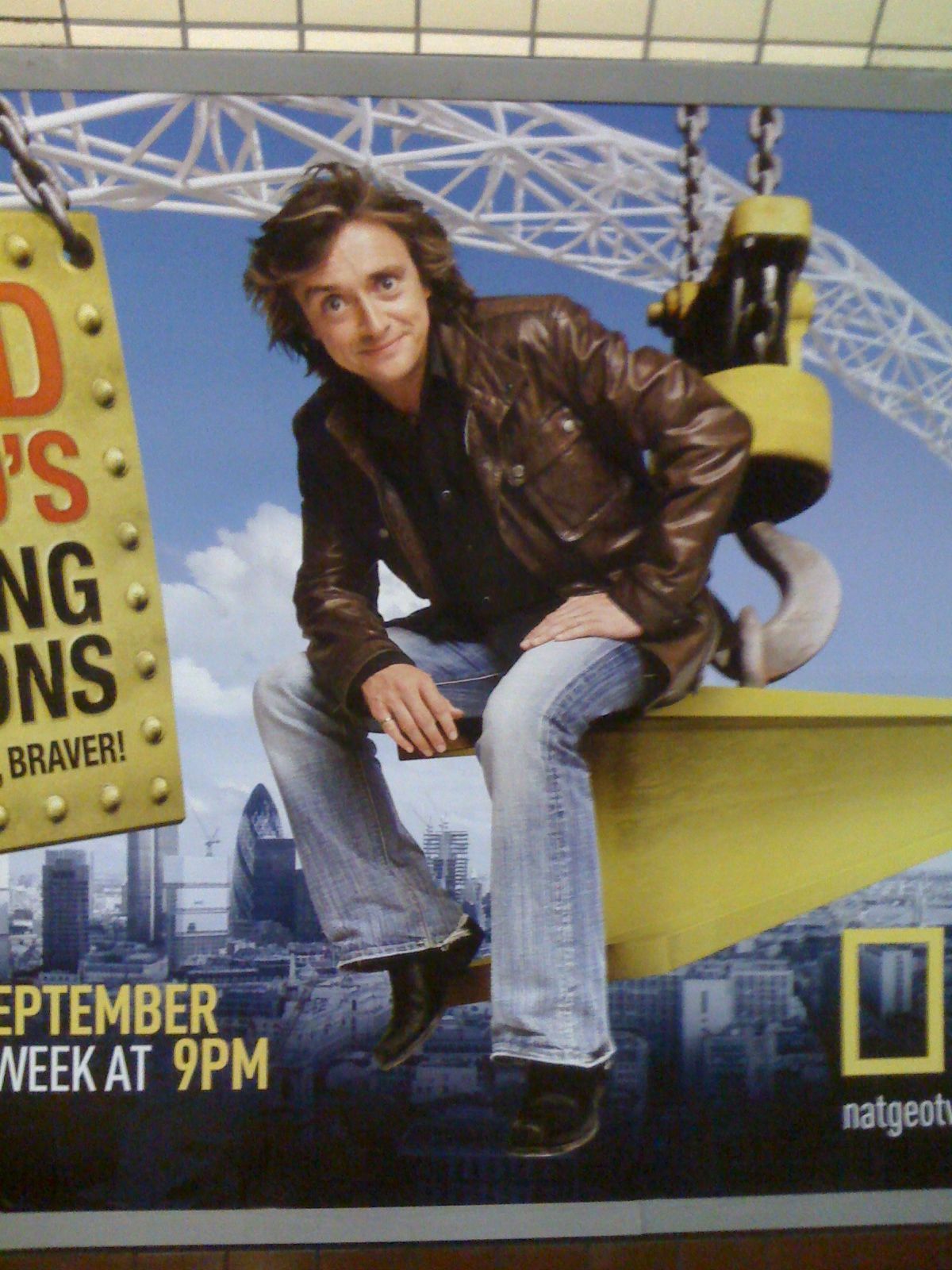
Or another entry in an occasional series where Rob over-reacts to an advertising hoarding…

Dear Gods, this is un-nerving. Who put the rodent in the leather jacket? I mean, look at that scrunched up muzzle. Those wittle feet in their tiny clompy bootkins.

But it’s the hungry look in those eyes that really freaks me out. Like it’s just spotted something tasty.

Clever little thing. It knows how this game works. Play it cute. Go doe-eyed. Wait for your prey’s defences to drop. Maybe it will come in to pet, to give you a skritchy-scratch behind the ears.

And then BANG. Go for the throat. Worry out the jugular with those sharp little claws. Bleed out your prey before it has a chance to think about what’s happened. Go for the eyes as it hits the deck. Chittering in triumph as you feed.

God, I hate hamsters.

A Night Of Blood And Roses

It’s a big day for UK indie film-maker Simon Aitken. Blood + Roses, his first feature, has it’s cast, crew and press screenings tonight. I’m really excited, and can’t wait to see it on the big screen at last. It’s been a long, hard two year fight to get the film to this position, and it shows the sort of tenacity and single-minded drive that Simon has in spades that he’s done it with no money, and certainly no help from government or lottery-funded grants. It’s a tremendous achievement, and I’m proud to be associated with it.

Plus, beer afterwards. Always good.