Rapture Fiction: The Hereafter

Yes, I know, fourth post in a row about the end of the world. I can’t help but find the subject of a failed Rapture fascinating. The following story came out of the idea of a calling that worked, but not quite in the way that anyone expected.

Continue reading Rapture Fiction: The Hereafter

The Sunday Lao Tzu: The Future

Those who have knowledge, don’t predict. Those who predict, don’t have knowledge.

It’s a beautiful spring day in England. The kind of day fir which, if you are religiously inclined, you would want to offer thanks to whatever deity you have chosen to worship. The predictions of a deluded old man have been blown away in the fresh wind, insubstantial and dead as dust, vanishing like broken promises into a clean blue sky.

Let’s not waste our pity on Harold Camping. He is at best a fool, at worst a charlatan and thief. He spent a hundred million dollars on an exercise in self-promotion. Hardly the most Christian use of such a large sum.

Worse, his followers are waking up this morning to realise that they have blown life savings and mortgages to pass his message along.

We all need a sage, a mentor, a muse to help guide us down the road. Sadly, we could also use some advice on choosing that wise man or woman, and it’s all too easy to listen to the wrong person. I choose to be guided by the precepts of Master Lao, but I understand that he too can be contradictory. For example, I offer the quote above, but he has also said:

The sage does not hoard. The more he helps others, the more he benefits himself, The more he gives to others, the more he gets himself. The Way of Heaven does one good but never does one harm. The Way of the sage is to act but not to compete.

…which, you could argue, is perhaps what Camping thought he was doing. Nevertheless, two opposing koans on the same subject, allowing me to put my own perspective onto a text. Which is exactly what Camping did.

Any reading of a text is subject to the reader’s interpretations and bias. As a writer, I understand that clearly. As does Master Lao, who says:

The words of truth are always paradoxical.

…which is just so incredibly helpful.

It’s very likely that Camping will regroup, rejig his numbers and come up with a new date for the heavens to fall. This is the fifth time he’s done this, and as long as his followers give him money, he will continue to do so. This saddens me, but it’s their choice, and there is nothing I can do to change their minds. I simply hope that at least some of them will wake up in every sense of the phrase today, and take joy and comfort in the precious gift that is the first day of the rest of their lives.

The End Of The World, Continued

NewImage

It’s a big old world out there, and everyone has their own ideas about how it’s going to end. It would be silly of me to suggest that the Christians have the whole Empty Earth thing wrapped up. And anyway, the concept of The Rapture bothers me. I think the whole idea of a chosen few being whisked away to safety leaving all the non-believers behind is incredibly selfish. There’s an element of that in all religions, of course. Our way is the right way, and the rest of you can (quite literally) go to hell. It also gives a whole new spin on the idea of Christian family values.

Every culture has a view on the apocalypse. The Abrahamic tradition (your Jews, Christians and Islamics) tend to view it as the end of all things. God ringing down the curtain as punishment, or rebooting creation as it’s started going a bit funny and his spreadsheet package has frozen. Buddhist and Hindu philosophy tends to think cyclically. As one age ends, another begins. It’s almost a seasonal thing, the endless cycle of death and rebirth. I can sympathise with this. Every time I think I’ve wrought the End Times on the weeds in my garden, back they come, regular as the new Golden Age.

Most religions seem to agree that we are living, if not in the End Times, then at the corrupted end of a cycle. Hindus call it Kali Yuga. The thinking goes that as we and our world go through time, we devolve from divine beings that know nothing of sin, into the sort of base creatures that can happily watch the X-Factor. According to Buddha, our life spans are also attached to this cycle. In the past, people lived for 80,000 years and were endowed with beauty, grace and strength. Over time, as we took on more worldly habits (organised religion, frozen stuffed crust pizza, Sky Sports) our life span and the gifts that go with it started to decline. Eventually, as the cycle comes to an end, we will live for ten years, become sexually active at five, and hunt each other for sport. Once only a few of us are left to repent that we ever thought Eastenders was any good, we will somehow regain virtue and become again divine. See, much more sensible than this Rapture nonsense.

I’m intrigued by the idea that most religions think that we are living in a time that is significantly more corrupt and evil than any that has gone before. I’ve heard that argument before. From my nans, mostly. Things were so much better when they were kids. There was Hovis for everyone, and there was none of this war stuff, you know apart from the war.

This hearkening back to a mythical Golden Age, and dire warnings for our future if we don’t behave, has been going on for longer than you think. Sumerian cave writings have been found that gloomily document a society grown weak, venal and corrupt – a society that, the grumpy writer predicts, will soon collapse into rubble. These writings, surely the first example of a Daliy Mail editorial, have been conservatively dated to around 2800BC. Which goes to show. If we really are living in Kali Yuga, we have been doing so for a veeeeery long time.

It’s The End Of The World Again, Almost Definitely This Time, Really, Honest.

Well, I hope you’re all packed and ready. According to Christian radio show host Harold Camping, 3% of the world’s population will be gathered up to Heaven in some sort of holy Hoovering tomorrow morning. The rest of us will then have five months to wait until God draws the curtains and shuts off the lights for good on October 21st. The fact that most churches have scheduled regular services for Sunday shows how seriously Mr Camping is being taken by the religious community at large.

In eschatological circles, Harold is a bit of a pipsqueak. He’s predicted the Rapture four times thus far, giving up (or rather, diving back into the books for a bit more of a considered approach into the numbers) in 1995. This is small potatoes. Fire and brimstone preacher Charles Taylor saw the end coming 12 times between 1972 and 1992. That’s got to put a crimp into your long-term savings plans.

The end-of-the-world racket is a fascinating subject for study, and stuffed to the brim with nutballs, loonbags and conmen of all stripes. It’s surprisingly easy to pick a date for the Four Horsemen to gallop over the horizon and then backtrack when the sun sets when nary a hint of apocolypic hoof beats. For example, Edgar Whisenant wrote a best-selling book 88 Reasons Why The Rapture Will Be in 1988. His prediction: final trump to sound between September 11th and 13th. When those dates turned out to be trumpet-free he pushed the date forward, first to the 15th, then October 3rd. Still nothing. This didn’t deflate Whisenant, though, who released another book the following year, The Final Shout: Rapture Report 1989, and would continue to release updates until 1993.

Predictions of the end time are born out of intense, numerology-heavy readings of the Bible, and as reactions to ongoing world events. The recent triple-whammy of disaster landing on Japan has, as you’d expect, sent the scene into a tizzy. But events as varied as the Rodney King shooting, the founding of the state of Israel and any manner of celestial objects getting within astronomical spitting distance have all sparked doomy predictions. As for the close-study readings, Camping’s method is an exemplar of clarity and logic compared to some I can mention. Dan Brown’s got a lot to answer for…

None of this would be a bother if it didn’t involve hucksters conning gullible rubes out of their hard-earned, and self-styled prophets setting themselves up as cult leaders. End of the world predictions can mean exactly that. Suicide cults like Heaven’s Gate and the followers of messianic maniacs David Koresh, Jim Jones and Joseph Kibweteere are all evidence that apocalypses can and do happen, and are events that we cannot see coming, and have no way to prepare for.

As for Camping and his Rapture? Well, his past record isn’t encouraging, and frankly his methodology has holes wide enough to steer the Halle-Bopp comet through. I’m not convinced. And anyway, aren’t we supposed to have until December 2012, when the Mayan calendar runs out?

Tell you what, while we’re waiting, let’s have a little dance, shall we?

This post would not have been possible without reference to Chris Nelson’s extraordinary Brief History of The Apocalypse, which is anything but brief and will eat your day if you let it.

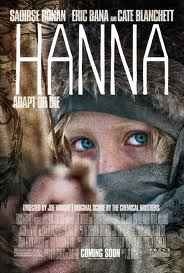
Out Of The Woods: X&HT Watched Hanna

20110519-173058.jpgA girl and her father live in a cottage in the middle of a forest. It’s a simple existence. They hunt, and read together, and every so often the father will leap out of the undergrowth and try to beat the girl up. He warns her that she needs to be ready for attack even when asleep, and she assures him that she will be in several languages.

The girl decides she is ready to leave the forest. So the father digs up a military transponder. Once she flicks the switch on it, the world and all it’s dangers will come to her.

She flicks the switch, and the wolves come running.

Joe Wright, director of so-so adaptations of literary classics, has decided to radically change direction with Hanna, his first film based on an original story. It’s an up-tempo thriller with an SF twist, backed with a killer soundtrack from the Chemical Brothers (the best I’ve heard since Daft Punk’s Tron: Legacy monster). It boasts a couple of great central performances from Saiorse Ronan and Cate Blanchett and a nice story idea.

But it doesn’t hold together. The script is full of plot holes and dangling threads. Tom Hollander’s monstrous assassin is a bundle of cliches tied up in an ill-fitting Tacchini tracksuit. The nice bunch of middle-class hippies that offer Hanna a different definition of “family” to any she has hitherto known simply vanish at the end of act two, never to be seen again.

While watching, I kept coming back to the transponder, the literal flick of the switch that starts the movie going. Why would Hanna’s father insist that if she was going into the world, it would be as a warrior at bay? I waited for the reason, the revelation of the long game that he had been playing. The revenge play, the public exposure of the terrible plot.

It never came. There was no point to bringing Marisa, evil step-mother and big bad wolf in one power-suited package, back into the picture. It seemed to be an unnecessary sacrifice of everything that father and daughter had shared in the forest. It started to seem uncomfortably like a fit of pique.

As a movie, Hanna is dressed up nice and plays pretty. There are some sterling action sequences, some fun camerawork, and it’s not, at least, part of a franchise. But the lazy comparisons with the work of Luc Besson do both parties a disservice. Hanna is not Nikita meets Leon. It doesn’t have Besson’s bite and fire. Worse, it has a hamfisted way with visual metaphor (count the eyes on posters as Eric arrives in Germany. We get it. He’s being watched) and a final line and shot that you can see coming a mile off.

Summary: Not quite a wasted opportunity, but nowhere near as clever or groundbreaking as it believes itself to be. What a shame.

Why I Blog

X&HTeam-mate Rob May asked me one of those questions last night.

http://twitter.com/robwmay/status/70598204093235200

I replied with a flippant fob-off, but my blood ran cold. It was too closely related to one of The Big Two Questions That All Writers Hate. One of which is “Where do you get your ideas from?” (stock answer for that one – “there used to be a guy operating out of a lock up under the rail bridge by St James St station in Walthamstow, but now I just do what everyone else does and get them online, ideas4u.ru). The big one is “Why do you write?” And there is never  an answer to that one that won’t make you sound like a self-absorbed arsehole. “I knew when I was a child.” “I had to find somewhere to put all the stories.” “It’s a calling.”

The swine of it is, all of these are true to a greater or lesser extent. I’ve written since I was a scrawny, speccy runt. I was always good at it, and I always enjoyed it. Even now, drifting into the fugue state where a tale just seems to present itself and all I have to do is write it down is one of my greatest pleasures. I must have been put on this earth to tell these stories. It’s my mission in life.

See. Told you. Cain’t hep masel. Self-absorbed arsehole.

Of course, understanding the grunt work that comes out of polishing and repolishing my words until they shine is another story, There is a world of difference between the first draft that can be banged out in a six-week period if you’re disciplined (braces for howls of outrage from the Nanowrimo crowd) and making something that people would actually want  to read. A story without plot holes, clunky dialogue, cookie-cutter characters, screeds of needless exposition and the hundred thousand little details that can derail a tale if you don’t get them right. Changing eye colour is a good one. Or everyone having the same eye colour. I’ve had heroines that change their age from page to page. The basic misunderstanding of Newtonian physics that sends the engine of your plot off-track and into the trees. I’m writing this on a train, you can see where the metaphors are coming from.

None of which answers Rob’s question. Bear with me.

The thing with writing is that it’s a monstrous, time-eating task that will gobble years like a sugar-starved tween presented with a handful of Haribo. Blogging is very much the opposite. It’s a quick, sharp hit, an espresso instead of a venti moccochoccolattechino with extra whipped cream and sprinkles and three flakes. It’s first draft, front-lobe spillage. It’s 4-track demo, rough sketch, workshop level output. It’s also pragmatic. I can clear out brain cruft that needs to go somewhere, I can work up ideas, try things out. It’s a place to react, to rage, to vent, to roar. It’s the mouth of the gushing hose. Twitter’s great for a lot of things, but it doesn’t let me bend the language in the way that I like. I can’t roll out a run-on sentence in 140 characters. And I LOVE run-on sentences. Blogging is as close to I get to an honest, true immediate response to the world and everyone in it. (As close as I get? Well, take a look at the title of the blog you’re reading…) Broadcasting at the click of a trackpad.

And of course, it’s an exercise in vanity. How could it be otherwise? I’m labouring under the assumption that there are people out there that want to read my views on the AV referendum, on horror, on comics, on beer, on food, on every little thing that pops into my tiny head and gets me to fire up Marsedit. Writers are egoists. They have to be. How else could you blare your opinions at the world if you didn’t think they were worth the world’s attention? Why do it if you didn’t think someone was listening? The blogger that doesn’t check their stats after every post isn’t really a blogger at all.

Rob, I’m sorry, I’m still not sure that i’ve answered the question. X&HT is a huge part of my writing life. It’s a home, a platform, potentially a shop window, a shelter, a stage. It’s me, in some ways, and a weird simulacrum of me in others. It’s a distraction and a workspace. It’s me and the cartoon rabbit-eared, fluff-tailed version of me all at one.  It’s an excuse, Rob. It’s a half-truth.

Why do I blog, Rob? Because I can. Because I must. Because.

The Food Feeds You Should Be Watching On Youtube

The Internet is an unending fount of goodness for the curious chef. Although I have certain favourite cookery books I go back to again and again, I will often dive onto the web if I simply need a recipe for blueberry muffins or a decent quick flatbread. My netback has become as essential as good knives and pans in my kitchen.

On my travels I’ve found several YouTube feeds that balance instructability and deliciousosity in a most entertainifying fashion. I would like to share those feeds with you.

First up, Epic Meal Time. The brainchild of a group of extremely hungry Canadians, the aim of the site is to create the most calorific food on the planet, and then eat it so we don’t have to. Bacon features heavily. Very heavily.

For something a little lighter, perhaps you should try My Drunk Kitchen. Hannah Hart teaches you the basics of late night cookery while blasted on red wine. This is an essential for those of you, like me, who were heavily influenced by Keith Floyd at a formative stage of their kitchen lives.

A new addition to the oeuvre, and the prizewinner for doing exactly what you’d expect in a four word title, is Vegan Black Metal Chef. His detail-oriented approach, coupled with a crushing riff and death grunt or two make the show the ideal place to help you polish your vegan pad Thai-fu. Just the one ep so far, but I’m eager for more.

You can see how healthy the internet cooking scene is. Any favourites I should know about, Readership?

In Defence: Michael Bay’s “The Island”

the_island.jpg

The Island was Michael Bay’s last film before he disappeared into the creative black hole of the Transformers films. It had a difficult shoot, an advertising campaign from which Bay disassociated himself, and a public response that varied between lukewarm and actively hostile. He rushed it out in less than a year to get the jump on a mooted remake of Logan’s Run, and the experience and reaction to it nearly broke him. He retreated to a sweet franchise deal with a baked-in non-judgemental audience, where it didn’t matter what the critics said.

That’s a pity, because The Island has a lot to recommend it. The basic pitch is clear – Logan’s Run meets the Clonus Horror. A post-apocalyptic colony, isolated after an ecological disaster are gradually revealed to be clones, grown as organ donors for rich clients. The island of the title, allegedly the one uncontaminated place on the planet, is a mirage. It allows the evil scientists running the place to whisk away their bags of meat with no questions asked. Everyone in the colony wants to go to The Island, but being picked for the privilege means death. When two clones discover the truth about the world and their place in it and escape,  the running, chasing and shooting at which Bay excels can begin.

However, up until that point it barely feels like a Michael Bay film at all, and you can see why he and the studios were so concerned about the Logan’s Run reboot. The opening section of The Island is a solid rip-off of the early parts of the kitsch 70s classic, with a Nike-futurist twist. The surfaces are all glass, polished concrete and ribbed fabrics. The clones waft about serenely in form-fitting tracksuits, and the dome comes across less like a living space and more like a mall. The similarities between the lottery for The Island and the black crystal marking you for Sanctuary are clear. The idea of a friend moving on to a better place and leaving everyone behind, never to be seen again, and for that sudden loss to be an expected and normal event is the dark place at the heart of both films, and they both reap benefits from it.

In fact, there are quite literally dark places in both films. Evil scientist Merrick’s offices are clad in dark stone and underlit through patterned glass. The computer that controls life in Logan’s dome sits in a vast, dim, cathedral-like space, the status panels glowing like stained glass. Bay and his design team seem to be drawn back to the design cues and plot beats of Logan’s Run – Merrick’s private army are dressed like Sandmen, and are relentless in their pursuit of the two runners, Lincoln and Jordan.

Famously, Bay was drawn to The Island because of the script and its exploration of how much value we put on life. He’s never subtle, but the way in which the clones are treated more like prized and pampered cattle than people still packs a punch. The moment that drew him to the project has a shocking power that’s not matched by anything else in his back catalogue. A pregnant clone is “taken to The Island,” giving birth only to see her baby taken away before she is put to sleep. The newborn is given to her client duplicate, who shows no concern for the surrogate. This is the point of the movie. The clones have been sold to the public that use them as unthinking, unfeeling creatures. Jordan and Lincoln’s escape puts that fiction under threat.

The world outside the dome is a hard, cruel place with some harsh lessons for the childlike clones. Jordan and Lincoln are both confronted by their doubles, who are shown as vain and duplicitous – quite literally two-faced. Ultimately, it’s the clones, sheltered from the world, that come across as the characters with the most humanity. There’s nothing particularly original about the story or it’s themes, but compared to Bay’s other films The Island is Shakespearean in depth and scope.

It’s a real shame that Bay, one of Hollywood’s purest visual stylists, has retreated from scripts with a bit of resonance and interest to spend the last five years directing Shia LaBeouf shouting “Optimus!” into a bleached-teal sky. The Island is no masterpiece, but it’s interesting enough to be worth your time.

Boom Bang A Bang: How Twitter Saved Eurovision (for me, anyway)

So, here we are again. The day after Eurovision. We’re all feeling a little grainy, a little dull around the edges, perhaps a trifle embarrassed at how much time we spent on Twitter last night.

Twitter has transformed Eurovision for me. It turns the show into a community pastime. I wouldn’t be caught dead at a Eurovision party, but I’m more than happy to sit at home, drink copiously and rant on the webs about the silly minutiae of Moldovan headwear or the relationship status of the Azerbaijani pair. And I know full well that there are hundreds, thousands of people out there all doing the same. I’ve bitched about the show in the past, but I simply couldn’t resist, despite fair warning from Twitterpal Selcaby:

(I missed out a couple. I was cooking dinner at the time.)

It can seem that the whole thing devolves into a scrum where everyone is shouting at the telly at once, and you do sometimes wonder whether the songs are getting the fair judgement that they deserve. But then there were some genuine clunkers and deranged decisions at the Dusseldorf Arena that needed commentary. And more and more celebs seemed to be joining in this year. Charlie Brooker, Chris Addison and Caitlin Moran all added a welcome dose of acid to the event.

Eurovision has become, despite (or perhaps because of) the obviously partisan voting a genuinely exciting and unpredictable contest. I was certain, to the point of nearly putting money down, that the Hungarian entry would romp away with the prize. She never got out of the bottom eight.

Ireland’s blatant attempt to make sure that they didn’t winning by fielding sugared-up quiffbots Jedward looked as if it could backfire, and at one point midway through voting they were looking dangerous. Well, as dangerous as a pair of ADHD-twitchy bubbleheads in red leather can look, anyway. Which just goes to show that Eurovision is as much about the performance as the song, and a dose of surrealism can actually catch you some mileage.

As for the UK, well, at least we’d moved away from the talent-show method of picking an act, and for that managed the best result we’ve had in years. Untouched by partisan voting (six points? THANKS, Ireland) we stayed resolutely mid-table, but with none of the embarrassment of the nul points years. The song was a bit of a clunker, but the back-to-business approach worked. It’s something to build on for Azerbaijan. A proper, honest-to-goodness pop band doing a proper, honest-to-goodness pop song, with none of the amateurism that’s marred our recent entries.

In short, this was the year when I learned to relax and enjoy Eurovision. Saturday night saw TLC and I both curled on the sofa, hammering away on laptops and cackling like loons. It was my FA Cup final, with an end result that had a certain poetry and ironic charm. Especially when the winners couldn’t stay in tune for their second performance.