The Sunday Lao Tzu: Little Wonders

“From wonder into wonder existence opens.”

As a writer, as an artist, the most important thing for me is to keep hold of my sense of wonder. I never want to feel like I know everything, and that I can no longer be surprised or amazed. I want to start every day with the expectation of learning something new, to be astonished or uplifted by an event, a piece of music, a film, a picture, a sunrise, a night sky. Even a simple act of kindness, an unexpected smile or laugh can be the tiny spark that lights up my day.

I’m open to all and every experience, and still have the capacity to be mesmerised or moved by the simplest thing. Some call the ability to hang on to your sense of wonder child-like, and from there it’s a simple step to call it childish, to sneer as if the ability to find the extraordinary in the ordinary is something to put away once we are grown. I couldn’t disagree more. Finding wonder in the everyday, in the sights and sounds that surround us is the first step in making and remaking our world into a better, more magical place.

The Mirror Crack’d From Side To Side: X&HT Watched BLACK SWAN

NewImage.jpg

Black Swan is the first great horror movie of 2011. Darren Aronofsky has taken the beloved movie trope of the doomed ballerina, and created something new, sumptuous and berserk out of it. It references Polanski’s Repulsion, the moody, lush quality of Dario Argento’s Suspiria, and most boldly, the work of David Cronenberg. The body horror may be going on in her head, but for poor Nina Sayers, the changes that happen as she struggles with the dual roles of the White and Black Swan are all too real.

It’s a simple story. Nina is a ballerina plucked from obscurity in the corps to dance a career-defining role as the Swan Queen in Swan Lake. She is precise, technically perfect. But passionless, controlled. Her quest to embrace the sensuality and darkness at the heart of the role, the evil twin, the Black Swan, leads her down the path to madness.

It’s a film about duality, and Aronovsky makes that clear from the start. The film is jammed full with mirrors, obscured windows, and all sorts of other reflective surfaces that offer up warped views of the world. We often see two or more versions of Nina in the frame. As her sanity starts to fray, those mirror images start to show something other than reality. Her reflection no longer maps to her, taking on it’s own life. When that happens, she is free to release herself from her old existence, taking on the mantle of the Black Swan both mentally and physically.

Like the tortured, driven characters in much of Cronenberg’s work, and indeed in Aronovsky’s own extraordinary debut Pi, Natalie Portman plays Nina as fragile, unworldly yet driven to succeed at all costs, even if that cost is mental and physical transformation. When Thomas, the exploitative and abusive head of the corps (played with sleazy physicality by Vincent Cassel), demands that she become the Black Swan, that is exactly what she does. It’s a tour de force, and Portman is on record as throwing herself into the role, training for ten months before shooting started. She makes a convincing prima ballerina, and worryingly, an even more convincing psychotic.

The film works beautifully at blurring the boundaries between the real and Nina’s mirror world, undoing murders and seductions in the blink of an eye, showing us flashes and warped reflections of her unravelling mind. The atmosphere throughout is unsettling. There are a few shockhits, but for the most part Aronofsky keeps the mood low-key, and his audience on edge. It’s a brave, bold and scary film. For once, I’m behind the Oscar hype. This one deserves to fly.


(WDW isn’t so much of a fan, for reasons that I can totally get behind. Her contrasting review is up on MovieBrit.)

Friday Fotos: A Day Among Ghosts

I took a day to plot and scheme with the mysterious docoBanksy yesterday. Usually we meet and cavort in Soho, but I fancied a change, so we met in Islington, before heading to Spitalfields and Brick Lane. It was a cold, cold day. Fun was had. Beer was drunk, including a pint of crude in the infamous Ten Bells. It’s been tidied up a lot, but there’s still a strange air about the place. An edge, sharp as a butcher’s blade. Or maybe I was just letting my imagination get away with me.

Anyway, here are some photos of the day. The area’s renowned for the street art which graces many of its walls and dead spaces, which will always get me pulling out a camera.

(edited, to include the fact that I was actually in Spitalfields, not Shoreditch. Maybe it’s because I’m no longer a London-errrr…)

The Clock Is Ticking: One Month Before Heartbreak

I wrote yesterday about the importance of simplicity, patience and compassion in our daily lives. Sometimes, decisions are made that make it very difficult to keep my peace or feel anything but revulsion for those that are imposing them.

It’s already become clear that the financial measures that are being put in place by the government will directly and adversely affect our poorest and most vulnerable. But when they start gleefully and spitefully kicking people when they are down, something has to be done.

As an example, let’s look at the reviews that are being considered for the Disability Living Allowance. The DLA is a necessary safeguard, allowing those of us unlucky enough to be unable to work through ill-health to carry on, funding mobility allowance and help with care. I see no problem with this. You’d like to think that, should you need it, the state would give you the funds you need to continue functioning as a useful member of society. To contribute, rather than be stuck in a hospital or care home. To have a life rather than an existence. Lisa Elwood on the UKUncut blog puts a contemporary spin on a very old saying when she points out

“The moral health of a society can be judged by how it treats its most vulnerable members.”

If that’s the case, then modern British society must be very sick indeed. The poisonous attitude spread by the government and certain media outlets (I’ll leave you to figure out which ones I’m talking about) is that claimants are scroungers, layabouts and leeches on the state. Worse, that a lot of “them” (notice the anonymous, amorphous terms that begin to be used in arguments like this, taking away the individuality and humanity of the people concerned) are fakers, plain and simple. In an interview in the Sun on the 1st of December, Iain Duncan Smith went so far as to try to partly blame claimants for the fiscal deficit.

What a horrible way to think. What a STUPID way to think. The changes to the current system are rushed, flawed and un-necessary. Worse, they’re invasive and upsetting, forcing people into needless reassessments and retests, even for chronic or untreatable conditions, conducted by private healthcare assessors, not doctors. And of course, there is the insistence of cuts to the caseload of the new service. The figure of 20% has been bounced around, with no clear method or reasoning as to what the new guidelines might be, or what constitutes a pass or a fail.

It is clear that the changes that are being considered for the DLA will force more people under the poverty line, and make it more likely that an greater number of disabled people will be unable to fend for themselves. This is desperately wrong. No-one chooses to be disabled, and to have further indignities and ill-informed spite piled up on top of everything else you have to deal with on a daily basis must be close to unbearable.

A Nanowrimo mate, Emma, has launched One Month Before Heartbreak, a blog that tells the stories behind the lying headlines and snarky commentary. It lets the people that will be directly affected by the cuts tell their story. It’s an absolute must-read. I’d like to quote from one poster, who makes the point:

David Cameron has claimed that “we’re all in this together”, but these cuts won’t affect him in the slightest. He is not relying on friends or family to enable him to live from day to day. He is not facing the prospect of having his care funding cut, and being left to lie in his own urine and faeces all night, because his carer has been replaced with an incontinence pad, nor is he looking at spending every day of his life within a respite home, because the removal of his mobility Disability Living Allowance component has been withdrawn and he can no longer afford an electric wheelchair. He will not be a working person, taking over from the agency carer the local council can longer fund. He won’t feel suicidal because he is being made to feel that he doesn’t deserve to live, or because he simply does not have to means to to. These are real issues being faced by people with disabilities.

So please, the next time you see a story about the ConDems cuts on benefits in the newspapers and you tut about these disabled people draining the state, please remember three things:

1) Disabled people aren’t spongers, they are people who truly need the money, and desperately wish they didn’t.

2) When you go to bed tonight, you won’t need someone to dress you, or clean your bottom, and you won’t be left to lie in your own defecate. You will be free to do as you please.

3) Not all disabled people are born that way, and many are disabled due to accidents and illness, and you may find yourself in their dependent shoes one day.

One Month Before Heartbreak was envisaged as a weekend campaign to highlight the issue, but I see no reason why it should not carry on to be a vital resource. Certainly, Emma has now opened up the submission deadlines, so if you have a story to tell contact the website.

Further work? Right then. Here’s a link to a petition asking for a recall on the consultation work being done. There is still time to stop this, and to make sure that the people that most need our support to lead meaningful and fulfilled lives can continue to do so.


On Sunflower Seeds

When a hospital appointment spits you out onto the South Bank at half nine on a Sunny winters morning, it seems foolish not to make the most of it. A coffee and pecan Danish fuelled some Nanoing, before I decided to amble east, and pop into Tate Modern.

I love it there. The place has a genuine sense of theatre and spectacle, especially if you make the effort to use the main ramp as you go in. Its an entry that I don’t think is bettered by any museum in London, and really needs to be soundtracked by John Williams’ Imperial March for full effect. The collection is thoughtfully curated, and I have my favourites that will always have at least five minutes of my time. That long, jazzy Jackson Pollack and anything by Mark Rothko will always have my attention.

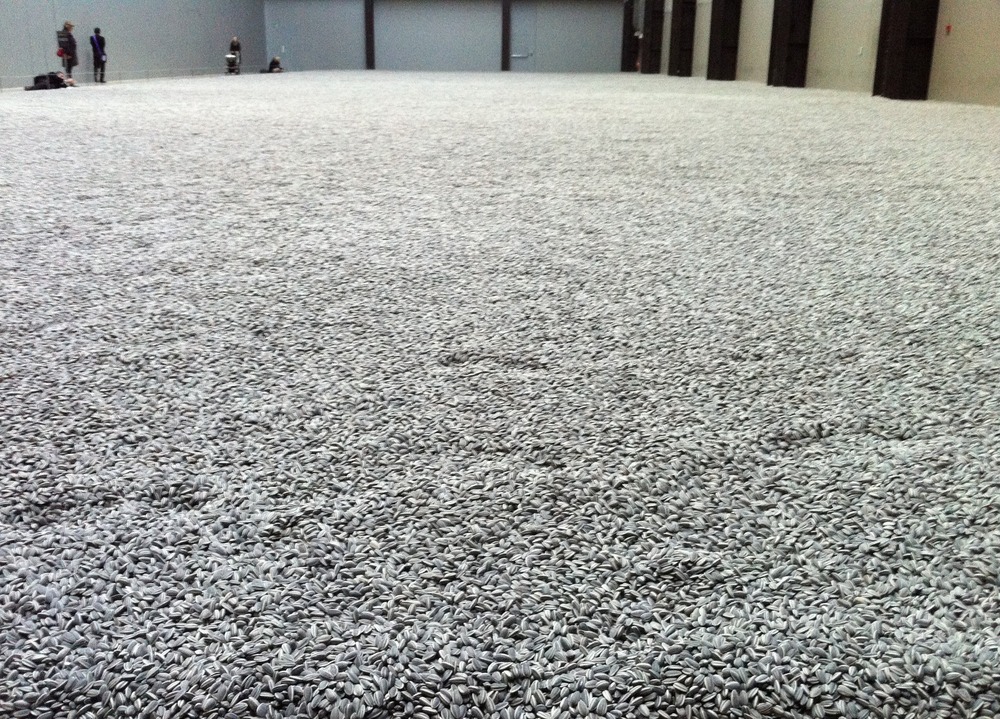
But the main reason for the visit was Ai Wei Wei’s Sunflower Seeds. It’s an impressive piece, made of one hundred million individually cast and painted porcelain seeds. It cleverly touches on ideas of craft, disposability and material worth while also being accessible and beautiful.

The problem is that it’s not the piece that was originally envisaged. Sunflower Seeds was supposed to be an interactive artwork, where the public were allowed to walk in the seed-field. This would have been wonderful, adding an extra dimension to a work that already resonates on a ton of different levels. Sadly, after two days the seeds were roped off. The excuse made was that the porcelain gave off dust that was potentially carcinogenic over time.

I find this to be disingenuous. The film that accompanies the artwork shows guys in dust masks smoothing out the seeds as they landed in the turbine hall. It was obvious they gave off dust.

I have another idea. The seeds are clearly covetable and collectible items in their own right. I remember an earlier exhibition in the Turbine Hall which featured pulpy SF novels attached to dormitory-style beds in a neat nod to post apocalyptic fiction. A month into the run, and most of those books had gone. If the public can squirrel away books, then it would be a simple matter to tuck a couple of seeds up your sleeve. There would be no way to police it, short of a “no stooping” rule. Oh, and a banishment of deep-soled boots in which some of the seeds could get caught. And let’s not forget, Sunflower Seeds runs until May next year. I wonder how long it would take for the Turbine Hall to empty completely?

Gods know, I was tempted, and there were a couple that were within arms reach. The gift shop’s missing a trick by not selling a handful in little baggies. A fiver a pop for a bit of controversial art? They’d fly out of the door.

Snack sized art. It’s the way forward.

Nanowrimo: A Few Useful Tools

There are just under three weeks to go until the start of the 2010 Nanowrimo, and already there’s a sense of real anticipation and nervous excitement. Wordsprints (where you write as much as you can for a given period; say half an hour) and timed exercises are happening on Twitter, with the #nanolove hash getting a lot of … well, love. The forums at the Nanowrimo site have reopened, and are buzzing with activity. It always seems a shame to me that they don’t stay open for the whole year, as for November they are a hive of crazed creativity and overwrought drama. It would be great to get some of that feeling all the time.

The Nano forums are essential for those moments when you just need to bitch about how badly things are going, or crow about your rapidly expanding wordcount, or wail about your lack of inspiration. In the forums, you realise just how many other people are in this with you, and feeling and suffering and exulting in exactly the same way. Nanowrimo puts you in touch with an awful lot of like-minded people, and if you sign up to the regional forums, you could even meet up with some of them face to face!

And of course, software developers are there to help the aspiring writer part with their cash – in the name of productivity, of course. There are a few tools out there that are worth your time, and funnily the good ones are open source and free.

I had great results last year with OpenOffice, which has hella good error correction and auto-complete functions – a boon for sloppy typists. On full-screen mode it’s a good distraction-free option and really helps you bang up the word count. The team behind it have just broken away from their corporate masters at Oracle to create the new LibreOffice, which I will be viewing with interest. I’m also eyeing up FocusWriter, which seems like a neat, prettier version of the Gedit/Notepads of the world. I’m having some issues installing it on my little Linux netbook, as it doesn’t come as a prettily packaged .deb file, but I’ll get there, I’m sure. With a choice of background, word count and daily goals built in, it seems to have been designed specifically for the shenanigans in November. But frankly, I’m happy as long as there’s autocap and a little something to help out my dreadful spelling.

Meanwhile, have you got your Dropbox account yet? and if not, why not? It’s free, it’s 2gigs of storage that seamlessly syncs across all your machines (including your smartphones), it’s a complete no-brainer to set up and use. It saved my butt during Script Frenzy early in the year, and it’s an essential for me now. In fact, if it sounds good, drop me a line. If you go through an invite from me we both get an extra 256mb for free. Used in conjunction with PlainText, I can jot down ideas on my phone and know that they will be waiting in a folder in my Dropbox whenever I need them. If you’re a writer on the go like me, these two bits of free loveliness are my solid recommendations.

And oh look, Scrivener is rolling out a major update in time for November! Scrivener is brilliant for thwacking out a first draft and letting you organise it at the same time. I used it exclusively for my first three Nanoes, and it’s still a favourite. The upgrade will set you back about $25, $45 for a new licence, with a thirty day free trial – just enough time to complete your Nano challenge. Totally worth it.

But these are only tools. When it comes down to it, Nanowrimo is about a very simple act. Writing 1700 words a day for a month, and being consistently surprised at what comes out. I know I always am, and that’s what brings me back year on year.

Want to know more? Feel like giving it a go? then start HERE. And if you need a friend, then this is me.

The Messiest Sandwich You’ll Ever Eat

The title above is a bit misleading, as I have no idea if what I’m about to tell you is indeed the case. (In fact, go ahead and share your messy food stories in the comments. As long as they’re not, you know, too saucy…) Certainly, this is not the messiest sandwich I ever ate. That would be a pulled pork roll at Sear’s in San Francisco, which drooled delicious barbecue sauce down to my elbow. I couldn’t lick it off, no matter how hard I tried, so TLC had to help. We got some strange looks that day, I can tell you.

But this sandwich will be in the top five, especially if you make it yourself. Are you ready to get messy?

Chop up a couple of small beetroot1, some overly ripe tomatoes, half a can of corned beef and a green onion for colour. Don’t go too fine with this. You want flavour and texture. Something to grab onto.2 Moosh everything together with your hands. Yes, you can use a spoon, but why would you want to? Wash your hands first, obvs. No sense in giving health and safety an aneurysm.

Let that gorgeous mixture get acquainted while you grate up some cheese (a decent strong cheddar preferably, although a soft garlicky number rings the changes well) and warm up a couple of pittas. Open those bad boys up in whichever direction feels right, and pile in the filling and cheese, topping everything off with a big dollop of ranch or Caesar dressing. Dig in. The sandwich will ooze, sag and squirt. You will end up wearing some of it. There will be filling in your lap if you’re eating with the appropriate level of gusto. Your hands will be stained pink from the beetroot. It won’t matter. It will be delicious. You will have a very happy tummy.3

Serves two, unless you have my appetite, in which case; serves me.

Best eaten with a goddamn beer, because there’s no point in pretending this is at all healthy, and the wholemeal pitta isn’t fooling anyone, lardychops.

1. By beetroot, I mean either veg you have grown and cooked yourself, or the stuff in vacuum packs without vinegar. Pickled beetroot never worked for me, and it will fight the overalll sweetness of the filling here. Don’t do it to yourself.

2. This is an appropriate mantra for life in general, and my life in particular.

3. I can’t think of a decent veggie alternative for the corned beef here. You want something salty, fibrous and crumbly. Any suggestions, herbivores?

Scott Pilgrim Vs The Movies

Me Vs. Scott Pilgrim

It had stunning reviews, gob-smacking word of mouth, an ad campaign that was arguably more expensive than the film. So why, then, did Scott Pilgrim Vs. The World open low and drop further in it’s first two weekends at the box-office? Why did I, a long-time fan, walk out at the end of it feeling a little hollow, a little underwhelmed?

The answer lies in my immediate first response after seeing the movie. I wanted to go home and read the books again. I wanted to remind myself of the things that the film had chopped out, or compressed, or glossed over. Once again, I realised, Hollywood had done what it always does to comics. The adaptation process had pulled the spine out of the story.

Scott Pilgrim is a six-book series that tells the story of the lovelorn hipster of the title, and his struggles to win the girl who has been skating through his dreams. It’s a wry, funny and frantic tale that sucks in video game, manga and anime references and squelches them together in a lo-fi zine-centric aesthetic. It’s cartoony, it’s typesetting is (perhaps deliberately) wonky, it’s all black and white. The fact that it’s packaged in the small-footprint form of most of the manga we see in this country only helps to strengthen these references.

It doesn’t rush things, either. The books are by their very nature episodic, as comics should be, and time passes in a natural, relaxed way. The group that Scott is a part of hang out, go to gigs and parties, and fumble their way through life. Everyone makes mistakes. They fall in and out of relationships. A major character comes out. We’re privy to six months in the life of Scott, Wallace, Steven, Kim, Young Neil, Stacy and Julie, and you end up involved in all their troubles and joys.

All of this subtlety is lost in the film. It becomes a one-note Battle-Of-The-Bands with added Streetfighter gloss. The sense that we’re seeing things through Scott’s eyes and that he’s not the most reliable narrator is wiped away in favour of a clean clear line of character progression. He often has to be reminded about how horrible he has been to the women in his life, or about how events simply didn’t pan out in the way he remembers them. This isn’t to say that he doesn’t learn and grow in the course of the story. But there’s more to it than grabbing a power-up and suddenly not just Getting A Life. He gets hurt and has to grow up.

Then there are the fights. They’re the engine of the tale. They keep things moving. But in the film, they become kind of the whole point, and they take up more and more of the running time. This is never the case in the books. The fights are a necessary part of the story, but they never overwhelm the comedy, pathos and drama that goes on around them. Unfortunately the film structures the whole film around the fights, to the detriment of a lot of really cool character-based humour.

A note on the characters. Over on MovieBrit, WDW has described the women in the film as “angels or stalkers”, which I think is a little unfair. It negates Stacey’s role as advisor, Kim Pine’s place as the coolest kid in the room AND lynchpin of Sex Bob-omb, and Envy and Roxy, equally wounded by our hero and heroine. Again, there’s lots more going on around Scott and his precious little life than we’ve been permitted to see in the film.

I think I knew going into the film how I would feel afterwards. It’s a fun movie, with a lot to recommend, and I’d hate to think that I’m talking you out of going to see the film, Readership. Because you should. It works in it’s own right, and some of the visual invention that Edgar Wright layers onto the screen works really well. I’d love to see more panel and subtitle commentary appearing in films.

But to my mind Scott Pilgrim Vs. The World is a Cliff Notes version of a much richer and more complex story, and I hope that it’ll encourage the curious to pick up the books. You owe it to yourselves to get the full story.

Contents

I’m a mobile writer, which means I don’t have a dedicated place where I go to work. I always smile at the photography series in the Indie that shows off writer’s spaces. The places they have made for themselves where they can create a masterpiece in comfort. There’s a lot of book-lined studies in there. It’s all very cosy.

If I were ever to have that honour, I’d have to show the photographer onto the 06:56 to London Paddington and get him to take a snap of a window seat. Lord knows, I’d love a place like Roald Dahl’s shed, or Neil Gaiman’s library, but that just don’t suit the way I do things. Maybe I should try a stint of writing in the summerhouse.

Writing on a train is the best way I know of getting some no-distraction work done. I can’t connect to the internet. I deliberately use a small, light netbook that doesn’t have too many fancies, but does have a good keyboard I can happily abuse. There’s power on the train, and access to coffee, which is really all I need to at least get a handle on the writing task of the day. I’m an early bird when it comes to this particular task, which means I can get a half-hours work done at the day’s creative peak.

A mobile writer needs a sturdy bag. It’s the office, essentially. It should be able to withstand all the rigours of a daily commute, while being light and small enough to be easily portable. When I began my rambling life, I carried my 13″ Blackbook in a solid, heavy Redline bookbag that was built to withstand a low-yield nuclear strike, but very nearly twisted my spine out of true whenever I picked it up. That was a lesson learned. Only carry what you really need, not everything you think you might.

If you’re interested in the sort of thing I lug around, allow me to point you at TLC’s new photo blog. She’s taken shots of our two bags, which are strangely accurate portraits, and interesting insights into our inner workings.