Fandom – when obsession becomes passion

My post on fandom a couple of weeks ago was very much coloured by the fact that I’m not part of a fan community. I thought that this would give me an objective outside view of the world. All it really did was provide a barricade behind which I could lob brickbats and snarks without fear of blowback. That’s unfair to a lot of people, and nudges me dangerously close to the kind of snobbish commentary that drives me to fizzing spasms of rage when it’s directed at something I happen to like.

I’ve decided to offer a right to reply to a friend and writer who is deeply involved in fandom. WDW runs a very well respected blog on one of the more interesting A-listers on the scene, Jake Gyllenhaal. She knows the highs and lows of being a fan, and I’m delighted to offer her a slot on X&HT in order to set me straight.

Continue reading Fandom – when obsession becomes passion

What I Did On My Holidays Pt. 2

TLC and I are big on parks and gardens. We’re paid up members of the National Trust, and like to support the work that they and organisations like them do for the great British countryside.

One of our days out on our recent holiday to Norfolk was a visit to Sandringham, the Christmas retreat of the Royal Family. This was, as you’d expect, stunning. It goes to show what you can do with a decent budget, and it’s the first time that I’ve seen a point to the Civil List. It’s not the cheapest of days out, but it’s one with plenty to see and do, making it reasonable value for money.

We were there on a breezy, overcast day. That didn’t matter.

PoPcorn

Early CGI tests were not promising.

I have a review of Prince of Persia: the Sands of Time up at MovieBrit, in which I am not entirely complimentary. Not at all complimentary, in fact. As WDW, who runs the site, is a massive Gyllenhaalic, it’s good of her to run it uncut (although she couldn’t resist the temptation to adorn it with lots of pics of the man with his shirt off. I guess that’s what you call editorial input). Anyhow, go read. It’s one of your five-a-day of snark, bile, angst, over-reaction and humbug.

The fun starts here.

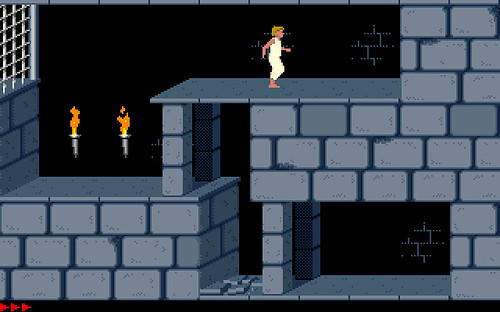
More fun here – a reminder of why Prince of Persia was the most frustrating game I’ve ever played!

Zen Gardening

The last time I bought a video camera was in 1999. It was to document our first trip to America, a two centre run round Boston and New York. It was an amazing trip, and one that I won’t forget any time soon. New York in those edgy, pre-millenial days was some place to be, and the red moon I captured rising over 666 Broadway seemed to sum up the weird feeling perfectly. I’d promised that I would cut those shots down to a short film in time for the New Year. Needless to say, those tapes are still in my store at home, untouched in ten years. It’s always going to be a thing to do when I have more time. And don’t get me started about the Australia footage that’s sitting in boxes beside it.

I love that camera. It’s a Sony MiniDV, and it cost us a fortune at the time – getting on for a grand. I blanch at the thought of spending that much dosh even now. But it’s earned it’s keep. It’s been to the States, Oz, Africa and Europe, and still gets used as a back-up camera for interview shoots. It’s small enough to tuck unobtrusively into a corner, and works brilliantly for cutaways and closeups. It’s got a decent lens and a good optical zoom. And the big battery I bought for it still gives nearly 4 hours recording time. And of course, plugged into the Mac it still does the business as a transfer dock for the Super 8 transfers I get done for films like Code Grey and the upcoming Time Out.

But of course it’s been ten years. So I’ve been humming and harring about getting a new camera. Clare’s Panasonic shoots HD video, and that’s fine, but it’s not MY camera. And much as I believe in the “what’s yours is mine” ethos, there are some boundaries that it’s uncomfortable to cross. I don’t touch her laptop, for example. It would be like going through her knicker drawer. There needs to be some respect for privacy. The Panny is hers, and she’s doing great work with it. And video is my field, after all.

I have therefore been mooning around Currys and Comet, eyeing up the camcorders, astonished by the drop in size and price. £350 would seem to get a hand-filling, sexy little number with a decent hard drive that would stow in a bag nicely.

But at the same time… they’re still consumer machines. And I’ve had my head turned by Dom’s lovely Sony cam, a professional piece of kit that he uses for paid gigs. If I ever needed it, he would let me borrow it without question. So really, I have no need of another video camera. The arguments go round and in my head, distilling down to the simple phrase, “Don’t need. WANT.”

Then I came across an Amazon link for the Kodak Zx1, an example of the “good enough” school of basic pick up and play vidcams that have none of the frills or functionality that I was used to. But it shoots HD video to an SD card, runs off a couple of rechargable AA batteries, has stills capability, and is small enough to go in a pocket. It’s the same size as my first-gen iPod. It was on sale.

£50.

Readership, I bought one. I very nearly bought two.

The picture quality is redonkulously good for something of this form factor. It’s fixed lens is sharp and clear. It won’t do macro, and barely has a zoom worth talking about, but so what? It’s the complete opposite to the kind of thing I wanted, and all the better for it. It will be used this summer for a short film mixing HD video and Super 8, and in the meantime for filmlets and squibs that I can shoot, cut and upload while an idea’s still fresh. I’m excited all over again.

Here’s the first fruit of my labours. Clare wanted documentary proof that I’d done the mowing on a day off. So that’s what I did.

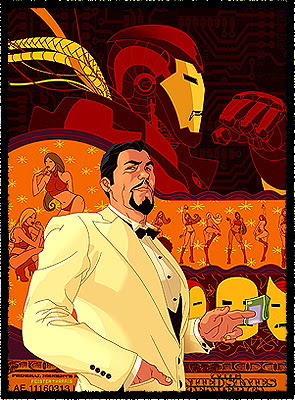
Some Stark Home Truths About Tony.

...and an extra $200 if you wear the helmet and call me Howard.

I dutifully trekked to the movies last week to check out Iron Man 2. Following the runaway success of the first film, and it’s winning formula of laughs, action and a fittingly dramatic tale of an arms dealer’s epiphany and redemption, expectations for the new one were high. There have been some poor reviews, and general complaints that in this movie you didn’t get to see that much of the armour. It’s a fair point, given that this is the first of the tentpole big bang movies of 2010. But I really enjoyed the film, for precisely that reason. The enduring fascination for me lies in the flawed, self-destructive character of Anthony Stark.

He’s based, according to Stan Lee, on Howard Hughes, the playboy billionaire technocrat turned paranoid recluse. Like Hughes, Tony Stark is a glamourous, globe-trotting ne’er-do-well. Like Hughes, he’s also fundamentally broken at base level. He’s bi-polar, alcoholic, has serious daddy issues and seems unable to have any real friends outside his staff. He’s dating his secretary, fercryinoutloud…

That Stark/S.H.I.E.L.D. consultancy - not going so great.

With this in mind, it becomes much easier to sympathise with the bad guys in Iron Man 2. Vanko has a very clear and obvious grudge against Stark, whose father used and deported his dad for pretty nebulous reasons. “He was only in it for the money”, we’re told. How vile, an industrialist trying to make a profit, never heard of such a thing. Similarly, Justin Hammer and Senator Gary Shandling have justifiable grievances against this raving narcissist who somehow has access to bleeding edge tech, is using it in one-man vigilante operations without any sort of international sanction, and keeps it locked down and proprietary. I can’t help but imagine that this is like Steve Jobs moving into weapons design. The implications for someone with Iron Man tech using it for means that are not US friendly are never really explored in the film. Sure, Vanko will probably sell his designs on (to the usual bloody suspects, Iran, North Korea et al, when he’d be much better advised simply undercutting Stark and Hammer and making a mint out of the US military, who have no bones about dumping manufacturers if they can make a saving) but his primary motivation is revenge. I’m lost as to why he doesn’t just sue Stark Enterprises for a half share of the profits. It’s not like he doesn’t have any evidence. It’s all a bit – well basic and unimaginative, really.

As befits the industrial espionage theme at the story’s core, most of the villains or opponents Stark comes up against are after the Iron Man tech, and it’s his refusal to hand over or share that causes conflict. The principal villains in both movies are industrialists first and foremost, and more honked off about Stark’s assault on their profit lines than anything else. His petulant outburst at the Senate hearing “It’s mine, and you can’t have it!” tells us everything. The guy simply cannot play nice with others. When you consider that the arc reactor at it’s heart wasn’t his idea in the first place, and that it’s his father’s blueprints for the new element Starkonium (as I’ve decided it should be called) that save his life, that petulance is a bit rich. Ivan Vanko has just as legitimate a claim to the tech as Tony, and yet somehow he’s the bad guy? I walked away from the film feeling that Vanko had been spectacularly hard done by, simply because he chose to deal with the grief of losing his father in a more direct fashion than might have been advisable.

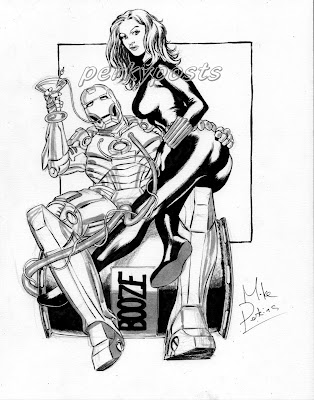
Well, tell him I'm in a MEETING or... somethng *urp*

As ever with comic book adaptations, it’s better to go back to the source. Here we see some really interesting developments in Tony Stark’s character. For the last couple of years in the Marvel universe, he’s been effectively a villain. Heading up an initiative to unmask the superhero community that split them down the middle, taking over S.H.I.E.L.D. after an assassination attempt on Nick Fury, he has become an authoritarian stuffed-shirt with little of the joie-de-vivre that fans of Robert Downey Jr. would expect. He is trouble, pure and simple, melting down into a puddle of booze or paranoid delusion just when the planet needs him most.

He can be even more toxic to those around him. The moment when Tony, in an attempt to bring Pepper a gift to apologise, offers her strawberries, the one thing she is allergic to, says a lot about the character. The flippant comeback line, “I knew there was something connecting you and strawberries” is the capper. He doesn’t care about her. He only has a vague idea of her likes, dislikes and the fruits that could potentially kill her. I genuinely felt that he was closer to the robots in his lab than to Pepper, Happy or Rhodey.

But maybe there is another aspect to the character that needs to be tied into the mix. The Iron Man armour itself. A major part of the film is the hunt for a power source for the suit that won’t kill Stark (palladium poisoning won’t give you techno-emo tattoos, by the way. It’s nasty stuff). In the comics, Rhodey’s take-over of the War Machine armour nearly kills him too. The suit is dangerous. Stark has no qualms with flying unproven prototypes of the armour in to combat, regardless of the risks (and as the arc reactor generates almost absurd amounts of power, the catastrophic failure of that device could cause the end of everything. Imagine Iron Man losing containment over China, airbursting with a force equivalent to every nuclear weapon ever made at once. That, my friends, is an extinction level event. All because Tony-baby couldn’t wait to play with his latest toy.)

So, let’s sum up. Our hero is a narcissistic drunk, incapable of a meaningful relationship, and a hoarder of world-changing technology who has taken it upon himself to police the planet without any form of oversight or supervision. All it would take is one bout of alcoholic hallucinations leading him to believe that Kim Jong Il is actually a lizard from outer space and he could spark off World War 3.

I dunno about you, but Tony Stark flippin’ terrifies me.

Haters gonna hate.

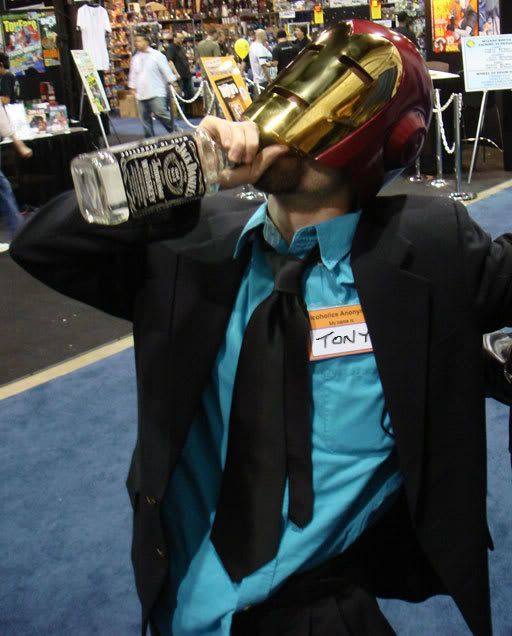
(The Wizardworld photo is courtesy of Mike Bartolomeo.)

Endings, beginnings and others.

It’s been an interesting week, filled with activity of all sorts which could make 2010 a very fulfilling year for me creatively.

winner_night_120x240.pngFirst up. I hit page count on Script Frenzy. I made it a couple of days before the deadline, which is always a nice feeling. Not having to race to the line gives you a feeling that you’re ever so slightly more in control of the material, and not just lobbing random words at the screen in the sure and gloomy knowledge that they’re all coming back out when it comes to the second draft.

Writing a comic script is different from anything I’ve ever tried before. I’ve had to be much more aware of the way the story flows from page to page, keeping things moving while leaving little bits of room for the story to breathe, for the characters to come to life. Essentially, I’ve had to write 96 little stories, each with their own cliffhanger. It’s been fun, and a challenge.

The job now is to get an artist on board. I can layout and probably do character design, but I’m fully aware of my shortcomings as an artist. I know I couldn’t do the story in my head justice. Any takers out there that might be interested collaborating in a dose of decent old-fashioned skiffy?

In Straight8 news, Dom and I finally got together with the brilliant Kiki Kendrick for a morning of reshoots on our 2009 film Time Out. It’s been over a year since the initial shoot, and we’ve been trying to merge schedules for the last nine months. Third time turned out to be the charm. In an intense two hour session we nailed five shots in two locations. The film is being processed, and with luck and a fair wind we can drop these shots into our existing cut and have something we can show you in a couple of weeks.

Finally, potentially the biggest news of all. Leading Man Clive and I are collaborating with Simon Aitken, Ben Woodiwiss and Brendan Lornegan, the guys behind Blood + Roses on a feature horror, Habeus Corpus. It’s an anthology movie, and we’ve all contributed a short script. The overarching theme of the film will be “the exploitation of the dead”. Treating the dead as a resource, rather than a threat. Humanity doesn’t come out well in our tales.

We’ll be directing our own segments, apart from Ben, whose opening segment will be helmed by the mighty Paul Davis of Beware The Moon fame. I’m incredibly excited and gut-wrenchingly nervous about this. It’s a massive step up for me, and I really hope I can do it justice. It’s some comfort to do something like this with friends, though. People whose judgement and skill I trust without question.

The script is just about locked and it kicks significant barrelfuls of ass. We’re starting on the long painful task of looking for finance. It’s going to be hard work, and I know blood will be spilled. But at the same time it’s another step up, another barrier to vault.

See? Told ya. Exciting times.

Hit Girl, and why film reviewers should stick to what they know

333F347B-56F2-4E31-A4E0-83B24823E40E.jpg

Last week, I had a bit of a night out with a bunch of friends. All male, all film-makers, all nerds (and I mean that as a compliment). A few beers, a bite to eat and a movie. There was only one choice of film with that crowd, really. It had to be Kick-Ass.

Now, I will admit to a slight feeling of unease going into the Vue West End for this one. I’m not the biggest fan of Mark Millar. I find his work simplistic and derivative. And Matthew Vaughn made a bit of a hash of Stardust, dazzled by a big budget and Hollywood starfuckerage. But I’d had a couple of beers, and I was feeling accommodating.

I had a really good time. It was fun, silly, gory, sweary no-brakes nonsense, and I laughed more in the cinema than I have since subjecting myself to Emmerich’s godawful 2012. The comics references were spot on, the fight scenes just on the right side of wire-fu overload, and Nicolas Cage was a delight as he channeled Adam West’s 1960’s Batman.

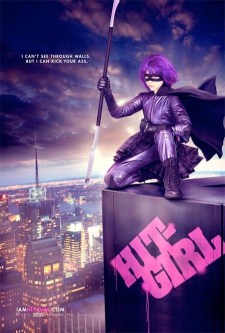
But the absolute star of the piece is Chloe Moretz as Hitgirl. She oozes confident nonchalance throughout, curling her lip with aplomb at every curseword. She still comes across as a kid, but not one that has been damaged in any way by the manner in which her dad has brought her up. Frankly, seeing an 11 year old girl on the screen that isn’t interested in Barbies or makeup makes a refreshing change.

Of course, certain members of the press have glommed onto the fact that Hitgirl dresses up in a short skirt and throws c-words around like shiruken, and began shrieking that the end times have come. Christopher Tooky in the Daily Fail loses the plot completely, throwing teenage pregnancy stats into the mix, before stating

The film-makers are sure to argue that there’s nothing wrong with breaking down taboos of taste – but there are often good reasons for taboos.

Do we really want to live, for instance, in a culture when the torture and killing of a James Bulger or Damilola Taylor is re-enacted by child actors for laughs?

…which is, of course a typical Mail tactic. Take an argument and then immediately present the worst possible scenario as the next logical step.

It’s telling that the Mail website has closed the comment thread on Tookey’s review. As the Bleeding Cool forum notes, every single comment blasted the critic for his over-reaction. Kinda cheering, considering that it was pretty obvious that the Mail would have it in for the movie – or rather it’s writer, Jane Goldman, wife of Mail bete noir Johnathon Ross.

Meanwhile, over at the New York Times, Manohla Dargis also manages to find the wrong end of the stick with both hands. Calling Mark Strong’s mob boss a “supervillain” is a bit of a head-desker, but I can let that go. However, she can’t resist the icky angle either, claiming

Tucked inside this flick is a relationship as kinky and potentially resonant as that between Lolita and Humbert Humbert…

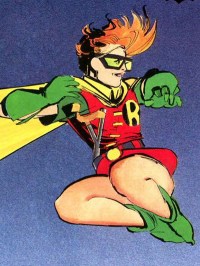
*wince* Well… no. Not unless she was watching a whole different cut to the one I saw. While Manohla has at least sussed that Kick-Ass is at heart a satire of superhero movies, she hasn’t cottoned on to the fact that Hitgirl is the latest in a looong line of kid sidekicks. Robin is the obvious example, and notably in Frank Miller’s Dark Knight incarnation, the cape and pixie boots were worn by a girl.
C940A52E-5A0A-442E-9AEB-AD20304D46EC.jpg

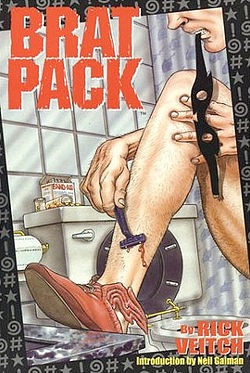
Sidekicks are typically wounded characters, and will frequently suffer at the expense of the main character. Green Arrow’s ward Speedy famously ended up on drugs (the clue was kinda in the name he chose) and the Jason Todd incarnation of Robin was killed off by popular demand. Rick Veitch’s Brat Pack goes even further, making a group of sidekicks both stooges and over-worked helpmeets to their headliners, and the victims of a superpowered serial killer. 9B5AE7E2-4DC2-4803-9305-30C800D73E56.jpg
Hitgirl’s character path tightly knits into the rites of passage that every sidekick undergoes. The tragic loss of a family. The extensive training, interspersed with the fatherly urging of the superhero in charge that she’ll never quite be good enough, that she keeps making schoolgirl errors. By having her break free from this towards the end, by having a (kinda) normal life with a new family, she breaks the dysfunctional chain that would always see characters like Dick Grayson unable to forsake the cape.

It’s the fact that she can rise above that training, use what’s appropriate and discard the unhealthy bits that makes Hitgirl such a powerful character. She’s no role model, but no-one’s claiming that she should be.

The last word, though, should come from Hitgirl herself… or rather, Chloe. In an interview with MTV, she comes across as likeable, grounded and totally cool about the whole situation – unlike the critics, who don’t seem to be able to see past the fight scenes and swearing. Swearing that, as Chloe herself points out, would have her grounded until she was twenty if she dared to try.

Chloe, the commentators of Mail Online and just about every other person with at least two brain cells to bang together should be able to see that Kick-Ass is broad satire with a few wry points to make about the state of the comics, and indeed the comics movie scene. Claiming it as a symptom of some greater malaise is not so much missing the point as running past it blindfolded while whooping and waving your arms about. Apart from an uptick in purple wig and mask sales, I can’t see the Hitgirl phenomenon hitting the streets in any major form.

Although if it helps to drop the instances of playground bullying – I’m all for it.

Oh, Chloe’s on Twitter as well. @ChloeGMoretz. Keep an eye on this kid. She’s gonna be something.


For Your Consideration

HIGH SNARK CONTENT.gif

oscar.jpg

Oscar season is over for another year, the tents and awnings are coming down, the pretty dresses are, for the most part, going back to their designers.

What have we learnt this time around, Readership?

1. It is possible to be both Best and Worst Actress at the same time.

2. You can win a Best Cinematography Oscar even when your cameras were principally used as motion capture devices.

3. You will win an Oscar eventually, if you hang on in there for long enough. The Oscar will never be for your best work, but for the one that most accurately portrays your public image. For example, Jeff Bridges didn’t win the Oscar this year. The Dude did.

4. Oscar ❤ Pixar, unconditionally.

Every year I can depend on the Oscars being even more bloated, self-congratulatory and pointless. There were no major surprises, no astonishing turn arounds. I’m pleased Kathryn Bigelow and The Hurt Locker grabbed so many awards, but what does that prove?

5. Oscar ❤ war movies.

5a. Oscar hates SF. Avatar was there because Oscar is scared of James Cameron. District 9 was there because Oscar ❤ Peter Jackson.

The question we should be asking is why does it take until the second decade of the 21st century for a woman to win Best Direction Oscar?

Further, the illusion of choice in the Best Film shortlist drives me nuts. Expanding the list out to ten does not give us more choice. There’s still a shortlist of 5. It’s just been bloated out with a B-list that have no chance of getting the award. Oscar has been capable of some deeply eccentric choices over the years, but it was blatantly clear this year which movies were in with a shot. The football movie? Uh-uh. The harrowing race/abuse tale? I don’ sink so. The cartoon? Gimme a break. There’s already a slot for Best Pixar Movie of the year.

And then there’s the Moon debacle. The short, sharp debut of a bright new talent, featuring an astonishing, nuanced performance from one of the best actors of his generation was ignored by Oscar this year. It’s partially the fault of Sony, of course, who decided that the film was not worthy of consideration (way to back your creative teams, there, guys. Nice work.) Nonetheless, there should have been an inkling that the film was perhaps worth a look after it did so well at the Baftas. By then, it was probably too late. Another missed opportunity for Oscar to show that it had interest in a broader range of films. But no. Once again Oscar showed hisself to be old, slow and out of touch. It’s the awards show that’s just too easy a target, too bloated and dumb to actively hate. It’s just there, wheezing into view every March like a despised older relative, staying that little bit too long, before blubbering away again leaving nothing behind but a faint whiff of cabbage water and a couple of trinkets that’ll just gather dust on the sideboard.

Until a horror movie wins Best Movie, I shan’t be watching again.

How A Geek Rolls


There seems to be a visual shorthand that film-makers employ when they want the viewer to quickly get the idea that their lead character is something of a geek. Oh, sure, there’s the usual sartorial (glasses, trousers that run slightly too high above the ankle, slogan tees) and home furnishing cues (retro SF movie posters, computers front and centre, toys EVERYWHERE), but there’s another, slightly more subtle method.

The film geek will not go to work or school in the usual means of transportation. No, we’re looking at grown men on bikes. Or cars that are falling to bits, strangely decorated or just plain don’t fit the landscape.

The humble bicycle is a great way of letting your audience know that your character is a bit … well, different. You will see them on their contraption within the first ten minutes of the film, frequently within the title montage. If your protagonist lives in a college town, or god forbid Oxford or Cambridge, then it’s a cert that they will be cycling to work. Steve Carell’s character in the 40 Year Old Virgin hits all these notes, negotiating rush hour traffic with an aplomb that he simply can’t apply to his love life. The fact that he doesn’t drive actually becomes a plot point later in the film, but nevertheless he’s easy to pick out of a crowd.

This trope doesn’t just apply to the movies, of course. Uber-geek Sheldon Cooper from The Big Bang Theory hasn’t been behind a steering wheel since driver’s ed. This again becomes a plot point in the season three episode “The Adhesive Duck Deficiency” when he has to drive Penny to hospital after she slips and falls in the shower. Hilarity ensues.

There’s a message here, of course. Geeks ride bikes because the rest of us drive cars.* If you choose not to drive, then there is by pure deductive reasoning something a bit odd about you, and the writer can use that off-key note for comic or emotional effect. Just look at John Nash in A Beautiful Mind, reimagining the universe while spinning through Princeton on a Shwinn.

If the geek can pull him or herself together and get behind the wheel of a car, then [deity] forbid that they are put into a Ford Focus. No, although the cues are a little more subtle, the geek choice of ride will be either an old banger or a wilfully obscure choice of marque. Take, for example, the Ford Pacer that Wayne and Garth cram into in Wayne’s World. Molly Ringwald drives a beautiful, if somewhat battered, VW Karmann** Ghia in Pretty In Pink. And of course, let’s not forget the geekiest transport of all – Professor Emmett Brown’s time-travelling Delorean.

I watched Jean-Pierre Jeunet’s Micmacs this week, and was heartened to see my theory in action. The circusy recyclers of the title use a fine array of old lorries and that peculiarly French method of transport, the lawnmower-engine powered truck-trike, to get around. It’s a neat juxtaposition with the villains of the piece, who smooth about in high-end Peugeot limousines. In fact, it seems to me that the quirkier the transport, the more heroic the driver. Their ride seems to reflect their personality. Just look at the Munstermobile.

But to my mind, there is one car that rules them all. The car that belongs to fiction’s alpha geek. The quintessential loner, a technological whizz who has trouble with girls and spends more time in front of a computer in his basement than he likes.

But MAN, does he ever have a sweet ride…

*I ride a bike. This has nothing to do with anything.

**Due to poor research, I initially had Andie’s ride down as a Carman Ghia. Cheers to Charlie, the Readership’s motoring correspondent for setting me right.

Windows In SF

No, not the Microsoft version, and you’d like to hope that the systems on board the Enterprise and the like are not based on an underpinning that’s liable to blue-screen on you halfway through a transporter cycle, or need to download an important security update before you can fire those photon torpedoes.

I'm not sure that's the best way to clean windows...

Windows in SF tend towards the panoramic. They are great floor to window room-width panes, around which your crew can gather to goggle in wonder at each new wonder they encounter on their impossible mission to the gates of forever. More recent iterations of The Big Window have embedded graphics. Just in case you weren’t sure about the exact designation of the Klingon Warbirds moving into battle configuration in front of you, handy pop-up windows, scrolling text boxes and spinning wire-frame models tell you more than you needed to know.

In reality, of course, the sort of panoramic window that you’d see on the bridge of the Enterprise or the command deck of an Imperial Destroyer could never happen. That much glass, under atmospheric pressure on the inside and the constant risk of micrometeorite impact from the outside, would be far too dangerous to install. On the International Space Station and the Shuttle, windows are tiny, quadruple-glazed portholes of thick crystal. You want a peek outside? That’s what video cameras are for.

The guy in red doesn't realise he's up for window-cleaning duty yet...

Which is why most “windows” in SF are actually really big projectors. They have zoom functions. They can hook into communication circuits, so that looming close-up of the approaching enemy warlord demanding your immediate surrender and the handover of fifty of your most fragrant ensigns can be really threatening. You can even show that things have gone really badly wrong by having the screen just show that fuzzy analogue static that is somehow still a signifier of lost signal even after ten years of fizz-free digital telly.

I’m a fan of The Big Window in Danny Boyle’s Sunshine, which started this whole SF decor riff in the first place. That window is a way for the crew to have a look at the approaching sun in all it’s fearful magnificence, and it’s tunable to filter out all but 3% of the light. This, for once, does just seem to be a portal, albeit one with some really smart sunblock. But it fulfills all of the rules I outlined earlier – it’s a Really Big Window, probably twenty feet square, and at one point the whole crew do gather around it to gawp in wonderment at Mercury passing across the surface of the sun. It’s a lovely moment, and sums up for me the important thing about SF set design. It should always be there to help the story along. Let’s face it, that bit of the film wouldn’t have had the emotional impact if the crew of the Icarus II had been crowded around a foot-square porthole.

We're gonna need a bigger tube of Factor 50.

One word you should never hear in an SF movie? “Budge up a bit, let me have a look.”