DC: Dunces and Conmen?

Every time I think the comics industry can’t get any stupider, something happens to make me wonder how I got so complacent.

No, hang on, let me qualify that. Every time I think the American superhero-based comics industry can’t get any stupider, something like, well, this happens. DC are cancelling and rehashing 52 of their titles, starting them all back at no.1 with simplified back stories and in some cases changes to the origins.

Retcons. The curse of the American superhero-based comics industry. Ever since DC killed Superman, brought him back in a new costume before slowly reverting him back to the old blue-and-red romper suit, this nonsense happens on an annual basis. The claim is always that creators want to do something fresh and new with the old franchises. Rubbish. It’s all about squeezing a few more cents out of them. The new editions are scheduled to take place over the traditionally quiet sales period of September. No. 1’s of any title always sell, and all of a sudden DC are flooding the market with 52 of the buggers at once.

The argument brought forward by DC head Dan DiDio is that it’s a chance to make the books relavent for a 21st century audience who have little investment in the stories of the past. Which is, in it’s way, fair comment. Fifty years of character development and story cruft can leave any title in a funk, unable to properly innovate or tell tales in a fresh way.

But, as comics blogger and funny-book shop owner Mike Sterling points out, a jumping-on point can also be a jumping off point. The end of a story gives the bored reader who just wanted to see how things turn out the excuse not to bother with next month’s issue. Especially if it’s not the character he or she enjoyed reading about.

I’ve long been bored with the American superhero-based comics industry’s obsession with huge, multi-book events and gimmicky promotions, to the detriment of decent characterisation and storytelling. If this event doesn’t work, it could signal a reboot for DC as a whole, becoming a placeholder for superhero franchises, a brand name for movies, TV shows and lunchboxes. Which can only be bad news for fans and retailers again. Mike Sterling again:

“While I’m curious as a fan about what DC is doing, as a retailer I’m a little worried. Not just about the jumping-off point thing I noted already, but also about how I’m going to explain this to the customers who are going to be caught completely by surprise by DC’s plans. I know it sounds strange, since all of you reading this are plugged into the Web Matrix-style via interface ports at the bases of your skulls, but I have regular customers for whom their exposure to comics news comes from walking into the store and looking at the rack to see what’s new. I can hear them already: “Hey, why is Superman at issue again? And Batman? …And, hey, Legion of Super-HeroesAgain? What’s going on?” Which is fine…that’s part of my job, to explain what new dumb thing a comic publisher has done to confuse and frighten its readership this week.

But as a pal of mine noted to me in email, if this particular publishing initiative falls flat on its face, where does DC go from there? This is an awfully drastic and wide-ranging strategy that won’t be easy to reverse without some consequences. And not just of the “fans and Marvel Comics laughing at DC’s failure” kind, but having highers-up at Warner Brothers looking at the crash-and-burn and thinking “that didn’t work, so why are we bothering with these pamphlet-thingies? Let’s just do cartoons and movies with these characters, and make some real money on them.”

Yes, quite. Although I’m no fan of capes and masks any more, and will gleefully and at length point out how comics are so much more, I don’t want to see a huge part of the industry collapse into rubble. I can see DC’s core readership shrink rapidly as no-one wants to read crappy new interpretations of perfectly good characters, with no new fanbase to take over. I could be wrong. I really hope I am. But confusing and alienating your customers is no way to run a business.

However, there’s no reason you can’t have a little fun with the idea…

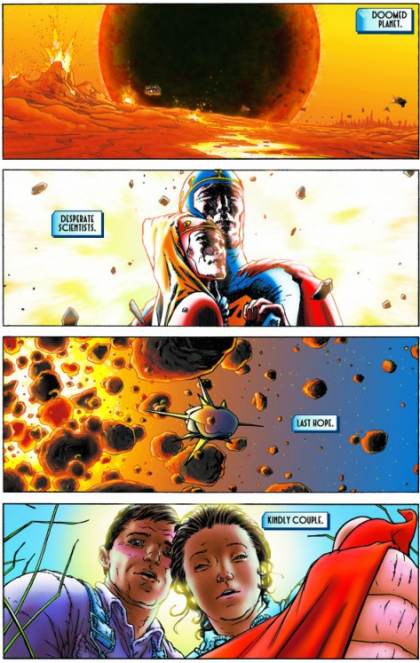
Oh, and if you want to know how to elegantly tell an origin story without letting it taking over an issue, Grant Morrison’s four panel recap that started off his masterly All-Star Superman is the way to go. Perfect comics work.

Four panels. Eight Words. Seventy Years Of Back-story.

*One last thing. The heads up/impetus/desperate steal of an idea at the end of a dry creative day for this one came from long time X&HTeam-mate, Rob May. His new geek-friendly website Cake And Lies is very much worth your time. And as he says here, there are prizes to be won.  

It’s The End Of The World Again, Almost Definitely This Time, Really, Honest.

Well, I hope you’re all packed and ready. According to Christian radio show host Harold Camping, 3% of the world’s population will be gathered up to Heaven in some sort of holy Hoovering tomorrow morning. The rest of us will then have five months to wait until God draws the curtains and shuts off the lights for good on October 21st. The fact that most churches have scheduled regular services for Sunday shows how seriously Mr Camping is being taken by the religious community at large.

In eschatological circles, Harold is a bit of a pipsqueak. He’s predicted the Rapture four times thus far, giving up (or rather, diving back into the books for a bit more of a considered approach into the numbers) in 1995. This is small potatoes. Fire and brimstone preacher Charles Taylor saw the end coming 12 times between 1972 and 1992. That’s got to put a crimp into your long-term savings plans.

The end-of-the-world racket is a fascinating subject for study, and stuffed to the brim with nutballs, loonbags and conmen of all stripes. It’s surprisingly easy to pick a date for the Four Horsemen to gallop over the horizon and then backtrack when the sun sets when nary a hint of apocolypic hoof beats. For example, Edgar Whisenant wrote a best-selling book 88 Reasons Why The Rapture Will Be in 1988. His prediction: final trump to sound between September 11th and 13th. When those dates turned out to be trumpet-free he pushed the date forward, first to the 15th, then October 3rd. Still nothing. This didn’t deflate Whisenant, though, who released another book the following year, The Final Shout: Rapture Report 1989, and would continue to release updates until 1993.

Predictions of the end time are born out of intense, numerology-heavy readings of the Bible, and as reactions to ongoing world events. The recent triple-whammy of disaster landing on Japan has, as you’d expect, sent the scene into a tizzy. But events as varied as the Rodney King shooting, the founding of the state of Israel and any manner of celestial objects getting within astronomical spitting distance have all sparked doomy predictions. As for the close-study readings, Camping’s method is an exemplar of clarity and logic compared to some I can mention. Dan Brown’s got a lot to answer for…

None of this would be a bother if it didn’t involve hucksters conning gullible rubes out of their hard-earned, and self-styled prophets setting themselves up as cult leaders. End of the world predictions can mean exactly that. Suicide cults like Heaven’s Gate and the followers of messianic maniacs David Koresh, Jim Jones and Joseph Kibweteere are all evidence that apocalypses can and do happen, and are events that we cannot see coming, and have no way to prepare for.

As for Camping and his Rapture? Well, his past record isn’t encouraging, and frankly his methodology has holes wide enough to steer the Halle-Bopp comet through. I’m not convinced. And anyway, aren’t we supposed to have until December 2012, when the Mayan calendar runs out?

Tell you what, while we’re waiting, let’s have a little dance, shall we?

This post would not have been possible without reference to Chris Nelson’s extraordinary Brief History of The Apocalypse, which is anything but brief and will eat your day if you let it.

A Day For Change

NewImage

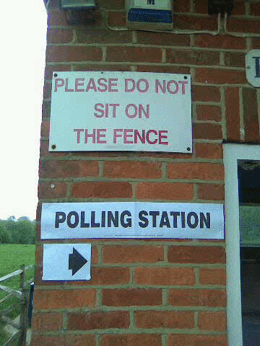
This is it. We’re finally here. I’m so excited. Today’s referendum is only the second that we have ever had in this country (the first was on our membership to the Common Market in 1975). It’s a chance to change the way we vote for a fairer, more representative system.

I love voting. It always gives me a weird little thrill to take my card down to my local station, to stand in the booth with my pencil poised. Even when I know exactly who I’m going to vote for (and I usually do – I also enjoy getting the research done on my decision, and I read every bit of political literature that come through the door) I like to have a short dramatic pause, just to extend the moment. Then I will swoop, marking my preference with a flourish. I will walk out of the station with a straight back, head held high, a smile on my face. “There,” I will tell myself. “I HAVE VOTED.” I can be such a ponce sometimes.

The very fact that I am able to stand and give myself a little moment in a voting booth is the result of hundreds of years of struggle to get power out of the hands of the privileged, monied few and into the grasp of the people of Britain. I always want to recognise and appreciate that fact, and the sacrifices that have been made on my behalf. The simple act of voting, that so many people take for granted and that less and less of us actually manage to get off our arses and complete, is the foundation of our democracy.

Many people these days say that their vote doesn’t matter, that it makes no difference whose box they put their cross into. It’s this argument that makes everyone’s vote less powerful. Not showing up devalues everyone else’s vote. It’s a selfish, dangerous stance. That’s what makes today’s referendum so important. A Yes vote will give us a system where our vote does matter, where extremists can’t get power, where you can vote your conscience instead of tactically.

But that’s my opinion. You have yours. And it’s your inalienable right to express it whichever way you like. Whatever you do, don’t waste it. Be a citizen today. Take a half hour and enjoy the fact that we live in a country where you can freely go into a voting booth and say what you think.

See you at the voting station!

(The excellent photo comes via Andrew Bloch on Twitter).

Just A Kiss, or My Gaff, My Rules: The John Snow Falls Out Of Love

No, honestly, I've seen this sign at the JS. I just never realised it was the house rules. The facts, as far as we can ascertain, are plain. Two people, out on a first date in Soho, allow the moment to take them and have their first kiss. The landlord of the pub they have chosen for this sweet little moment, The John Snow, tells them to stop. Later that evening, they kiss again, and at this point they are told to leave by the landlady. One of the pair, Jonathan Williams, chose to vent his anger about the event on Twitter. Which is when the whole thing exploded. Because Jonathon and his date, James Bull, are gay.

The John Snow closed on Friday night, as a 400-strong protest snogathon took place outside. Another one is scheduled for next Thursday, and it’ll be interesting to see if the pub shuts again. Frankly, I doubt it. The point’s already been made, and the damage has been done. The management of The John Snow have managed to make themselves notorious in one night. Any arguments about whether Thomas Paget and his staff are homophobic are supplementary to one simple fact. A pub is a place to have fun. If the staff of said pub stop you having fun, then there’s a big problem.

Should Jonathon and his date, James Bull, have simply taken their business elsewhere? Perhaps, but I personally think they were right to stick to their guns and stay put. They weren’t doing anything wrong. Posting about it on Twitter was also fair enough. Jonathon was right to point out that the staff of The John Snow are anti-fun. Caitlin Moran made an excellent point:

http://twitter.com/caitlinmoran/status/58925915819872256

Everything else that happened was a result of people on Twitter, Facebook and the press picking up on the story and organising. It’s not fair to say that Jonathan and James overstated the issue or portrayed themselves as victims. In the same position (I know I can’t be, but indulge me for the sake of argument) I probably would have run away – but I also would have boycotted the pub and bitched about the incident on every social network to which I belong.

Any pub that has rules against PDA (the illustration above is indeed on display in the JS) is not worth the bother. If the “house rules” prohibit snogging on the premises, that’s bad enough. If those rules prohibit gay snogging, then there’s legislation in place that makes that stance not just unacceptable but illegal, and in a worst case scenario, Paget could be up on charges. That’s unlikely to happen, but I bloody hope it’s front and centre in his thoughts at the moment.

I wonder if the reputation of the John Snow has been badly damaged now. It’s not as if they’re the only pub in Soho, and there is much talk on the Twitters of boycott. Meanwhile, Paget and the owners of the chain to which the pub belongs are silent on the issue. That’s as silly as the initial stance. Soho is not the place to allow an anti-gay rep to fester.

I’ve always seen the John Snow as a bit of a dump, and haven’t been through the doors of the place in years. That’s not likely to change after the dramas of the last few days. There are plenty of other places to get a drink within a two-minute walk, and the last time I looked, none of them were chucking people out for showing a little affection.

(pub sign via David Schneider)

Low Blows And Dirty Tricks: X&HT Saw Sucker Punch

I’m grateful. Really, I am. It’s good to have a low water mark against which all else can be judged. It’s good to know that when a friend rags on a film that you can chip in and say, “Yeah, but at least it’s not…”

Let’s put it another way. We have our new Battlefield Earth.

Continue reading Low Blows And Dirty Tricks: X&HT Saw Sucker Punch

A Response To The Chancellor

(I didn’t watch the live Budget broadcast yesterday, for fear that I might throw something at the telly. This is a fairly common occurrence whenever George Osborne is on screen, so I figured probably best not. However, I was following the Twitters, with particular interest shown to tax expert and strident reformist Richard Murphy. He was not impressed. I’ve had a chance to see what was in young Osborne’s little red satchel, and I would like to respond as if I was the Shadow Chancellor (incidentally, isn’t that a great name for a fantasy villain?) – admittedly, with the benefit of hindsight that I don’t think Ed Balls gets.)

The Shadow Chancellor rises, and waits for the applause and jeering to die down. He fixes his opposite number with a hooded glare, and taps impatiently on his lecturn with the eraser end of a pencil.

The House of Commons is, unusually, completely silent as he speaks.

“Is that it? Really? Is that the best you can do? Have you given up so early in the game, George? I mean, this is just derisory. There’s hardly anything here! Alright, let’s see what you’ve managed to do, shall we?

A penny off fuel duty. When you’d raised it by two in the last budget, and a postponement of the next hike until January. Which means you’ve just promised the drivers of the nation two price rises on fuel in 2012. 50p on a packet of fags. Fine, I’m with you on the coffin nails. A sneaky play on alcohol duty though. No rise doesn’t mean you’ve abolished the duty escalator. So that’s a 2% rise above the rate of inflation. 10p on a pint over the next year. You’ve just doomed the rural pub market. Not that people can afford to drive to them in the first place, but that on top of the VAT hike is going to grease the slide on which a lot of these local community businesses are already teetering. Nice work.

“That’s a sweet little drop in corporation tax rates there. And I see you’ve made an attempt to address tax avoidance. Sort of. A bit. A fifty grand payment if you’ve lived in the UK for twelve years. I can see Philip Green quaking in his boots over that one. And you’ve not put a limit on the tax assets that banks are sitting on from the losses they incurred in the 2008 banking crisis. That’s what kept Barclay’s tax bill down to a 1% payment. Nicely done. Keeping your paymasters sweet.

“If you were serious about tax avoidance, you’d give HMRC the cash and staffing it needed to get to grips with the staggering amount of revenue we lose to corporate shenanigans every year. Instead, you’ve provided loopholes in inheritance tax and charitable contributions that will turn this country into a haven for tax abusers. Nicely considered.

And after that, we can still see that growth has slowed for the third successive quarter that you’ve been in charge of the accounts. That’s not the best record, really, is it?

“I suppose we should be grateful that you haven’t done more. After all, the cuts that will begin to bite in the next couple of weeks will be bad enough without you turning the screws any further. Unfortunately, you’ll probably find that your lame duck budget hasn’t fooled any one. I suggest you have a look at the people who will be filling the streets of London this Saturday. The people who will be clearly and directly affected by your politically motivated financial agenda. Is it a coincidence that you’re rushing through your attempt to clear the deficit in time for the elections of 2015, when most economic experts consider that there’s no problem with taking 12 years to do it? And in fact that this country is in significantly better financial shape than you’d have us believe?

“It’s becoming pretty clear to everyone with two brain cells to bang together and a fast internet connection that your policies aren’t working, that your interests are not those of the people you claim to represent, that you’re lying to the electorate in order to push through policies that are based on discredited economic theories dragging us back to the worst excesses of the Thatcher years, that your arrogance and hubris will not allow you to admit that the gamble you’re taking with this country’s future is putting us on a path to disaster. This Budget is pointless, because the damage is already done.

“I’d say thanks for nothing, George, but the sad fact is that you’re going to leave us with less than that.”

The Shadow Chancellor sits, and waits for the inevitable tumult.

The Invisible Genre: How The BBC ignored SF on World Book Day

NewImage

World Book Day is a celebration of all things literary, a chance to put your hand up and say, “Hell yes, I’m a reader. Give me a book and I’ll read the living stuff right out of it!” It’s an important event that brings together writers and readers worldwide and unites them under a common, quarto-shaped banner.

But there’s a problem. Author Stephen Hunt watched the BBC’s coverage of the day, and noticed that there was something missing. Something big.

Apart from a brief mention of Philip Pullman’s Northern Lights as a YA crossover, SF, fantasy and horror were not represented. No Pratchett. No Rankin. No Tolkein or Lewis. No Iain M. Banks, no JK Rowling. No China Mieville or Joe Abercrombie. No Clive Barker, no Christopher Priest. Genres that between them take between 20 and 30% of the UK book market were roundly ignored.

I wish I could say I was shocked or surprised. The publishing world is more than happy to make money from the fantastic end of the market, but they’re not so keen on promoting it. You’ll hardly ever see SF or fantasy on the front-of-house deals at your local Waterstones unless your name happens to be Rowling or Meyer. As Hunt points out, it’s pure and simple snobbery. What’s more, it’s damaging.

The publishing industry always depicts the book as a gateway to a world of imagination, to a place of limitless possibility, of endless adventure. At the same time, the act of picking up and reading a novel is considered to be an act that is good for you, in the same way as running twice a week or eating a high-fibre cereal for breakfast. It’s an educational action, a pathway to moral improvement and good citizenship. In some ways, you can be defined by what, and how much, you read.

The perception amongst most mainstream critics is reading SF, fantasy and horror is not an improving activity. That these books are of low character, of dubious morality. That somehow you will put the book down, and not gain the insights into the world and it’s people that you would if you’d only pick up something by Margaret Atwood. Or Jeanette Winterson. Or Kazuo Ishigura. Something without spaceships or aliens, clones or creatures grown from genetic experiments gone wrong.

You can see where I’m going with this, can’t you? All the above authors have written SF. They simply choose not to identify the books as such for fear of hurting their profits.

It’s the same skewed thinking that forces Iain Banks to flag his Culture novels as written by Iain M. Banks. As if they were somehow written by a different person. He at least is pushing the envelope, however gently. His latest “mainstream” novel, Transition, was an SF book in all but name, and contains references to a culture that may be … well, The Culture. But the book is packaged and marketed in a very different way to his SF excursions. The back cover blurb calls it a “fable”.

Stephen describes SF, fantasy and horror as a “gateway drug” to the world of literature. I agree. What’s more, that’s proven to be true by one of the growth markets in the publishing sector – the young adult or YA book. This new stream is stuffed full of fantastik stories – and I’m not just talking about Potter or Twilight knockoffs. Cory Doctorow’s agit-punk books such as Little Brother and For The Win are politically driven and yet still filled with action and drama. Scott Westerfield’s Uglies postulates a world where it’s a crime to be ugly – a pointed and direct comment at the sort of world in which kids struggle with their self-image every day. YA is where a lot of the interesting stuff is happening right now.

Should I be bothered by the fact that the BBC ignored the fantastik? It’s fair to say that a lot of people do buy, read and enjoy genre fiction, and it seems to tick along quite happily without mainstream critical attention.

But a lot of truly great books, head and shoulders above the latest “contemporary” efforts in terms of literary merit, plot, character and inventiveness are marginalised purely because of their subject matter. It’s a stigma that prevents deserving authors from reaching their full potential readership. This is simply not on, and needs to be addressed.

It”s a real shame that genres need to be compartmentalised, but it’s a fact of the industry. However, the playing field should be fair. A good book is a good book regardless of where or when it’s set, irrespective of the species of the main character.

What next? Well, Stephen’s set up a Facebook page, and there’s a petition to sign. If you love SF, fantasy and horror and feel that it didn’t get a fair chance in the BBC’s coverage of World Book Day, you know what to do.

O2’s Childish Mistake On Age Verification

O2 logo

Say you’re waiting on a bus or a train. It’s dead time, so to ease the boredom you grab your smartphone to check the latest post on your favourite site – this one, of course. You get a nice strong 3G signal, and hit the bookmark.

Instead of that familiar, beautifully designed opening page, you get a warning from your mobile provider, telling you that the site you’re trying to reach is only suitable for over-18s, and that you need to go through an age verification process. You’re then taken to another page which, although it has livery from your provider, seems to be from another website entirely. And this page is asking you for your credit card details.

It’s an obvious and rather lame attempt at phishing. You’re not any kind of idiot (you’re a member of The Readership, after all) so you spot it as that instantly, and sadly inform the webmaster that his site has been hacked.

Except it’s not a scam. Well, not in the true textbook sense of the word, anyhoo. The scenario above happened yesterday to O2 customers across the country, as a age verification process was extensively rolled out. It only affects their 3G and GPRS networks, and it’s really, really stupid.

The reason for the credit card charge (£1, following which you’re refunded £2.50 as a one time payment) is to ensure that the person attempting to access “adult” material is over 18. You have to be over 18 to own a credit card. QED. But you also have to be 18 to set up a Pay Monthly account, and surely it would be simpler to set up a password controlled block in the website accessible only to the bill-payer. And the over-enthusiastic filter O2 have put in place means that PAYG customers are being blocked from sites they have perfectly legitimate reasons to visit. It’s just nonsense.

What on earth was going through the O2 mind (you know, the one that’s currently TV advertised with a very badly disguised version of Mr. Tumnus in place)? Did no-one think that suddenly switching on a filter without fair warning that would direct their customers to a site asking for credit card details might not be taken as entirely genuine? O2 claim that the company in question, Bango, have many years experience and are a trusted partner. Fine. I’ve never heard of them, and have no reason to trust them on O2’s say-so.

More worryingly, O2 have yet to explain what Bango (the name that doesn’t fill me with trust, it has to be said) do with your credit card details after the verification transaction. And, for that matter, how long your payment stays in Bango’s account before you get your £2.50 refund. I call shenanigans on this. It all feels a bit suspect, a bit slippery. Why a quid, for example? PayPal do a similar thing to ensure the card you’re linking to their system is legitaimate, but they do it with payments or 3 or 4p. Stick a couple of hundred thousand pounds of your customers cash in a high interest account for a couple of days, and there’s a decent profit to be made.

It’s the mealy-mouthed, box-ticking nature of the exercise that really makes my teeth itch. The block only operates on O2’s mobile internet services, meaning that your child can easily access all the adult content they want as soon as they hop onto a wi-fi signal. That, of course, is outside O2’s remit. They’ve done their job, and been seen to be compliant with a self-regulatory agreement with no legal basis.

O2 have really dropped the ball on this one. If they wanted to worry, bother and honk off a fat chunk of their customer base in short order, then they’ve found the perfect way of doing it. The process assumes a blithe ignorance of internet safety 101, and contravenes advice that they give on their own website. The O2 forums are full of seething customers that had no idea that O2 were about to drop this on them.

I’m absolutely furious. At one point yesterday morning, I was convinced that X&HT had been hacked, compromised and retasked as a phishing site. All because some hand-wringing twonk at O2 doesn’t want to take responsibility when a 15 year old accesses questionable material on their network.

Here’s an idea. If you don’t have a credit card, you can age verify at any O2 store with photo ID. I suggest that every aggrieved customer who feels a bit uncomfortable at giving out their credit card details to a third party for access to the sites they’ve always been able to access with no trouble before does exactly that. If that happens en masse, we’ll clog up the stores and cut into O2’s profits a bit. Direct action, taking a page from the UK Uncut playbook. That’ll send a message that they can’t ignore.

Who’s with me?

The Accidental Shareholder

I was pleased to see that the Lloyds Banking Group has posted pretax profits of £2.2 billion. It’s cheering to see a publicly owned company announcing healthy returns on our investment.

However behind the headlines, the news isn’t all so rosy. Despite the increase, shares in Lloyds have dropped sharply, and their profit forecasts for 2011 have been downgraded. The group as a whole has also dropped over 26,000 jobs in it’s quest to cut costs – in a week when it’s departing chief executive, Eric Daniels, pockets a £1.45m bonus, and is in line for another £6m payout based on shares he already owns.

Let’s not forget, this is the guy who railroaded through a toxic merger with HBOS at the height of the banking crisis. This is the guy that saddled the group with billions of pounds of bad debts, and still seems to think it’s a good investment. It’s thanks to Daniels that the UK taxpayer is a major shareholder in Lloyds. We should all be worried about his financial acumen, and loudly question his bonus.

The profit announcement also serves as a reminder not to swallow the Coalition Koolaid, and believe the line that our current financial difficulties are due to overspending in the public sector. It was the bailouts of banks like Lloyds and Northern Rock that did for the deficit, not the NHS. If the Tories were in power at the time, they’d have had to do exactly the same thing.

Bail-in protests are going on this Saturday, turning HBOS banks across the country back into publicly owned and run spaces. These actions are great at pointing out the wild disparity between the profits that huge financial institutions make and the bonuses they pay, while vital services are being cut to the bone. Check out the UK Uncut site for more info, or follow @ukuncut on Twitter for the news on the ground as it happens.

Meanwhile, I’m going to find someone to help me dump these toxic shares I’ve been saddled with.