Documenting disorder: a riot aggregator

I think the last thing we need today is another under-informed commentator spraying ill-thought opinion around like a muskrat marking it’s territory. I’ll stick to aggregating some of the more interesting output I’ve seen over the past 36 hours,

As a sign that things have turned upside down, the most cogent and thoughtful early analysis came from the Telegraph. Mary Riddell’s piece “The Underclass Lashes Out”, nails the financial meltdown, the failings of the Met and the complacency of the government as equally contributory factors. The always provocative Laurie Penny is even starker:

People riot because it makes them feel powerful, even if only for a night. People riot because they have spent their whole lives being told that they are good for nothing, and they realise that together they can do anything – literally, anything at all. People to whom respect has never been shown riot because they feel they have little reason to show respect themselves, and it spreads like fire on a warm summer night.

Meanwhile, anger at the riots was coming from the most unexpected of sources. National Treasure Danny Baker’s Twitter account seemed to have been taken over by one of his listeners.

That tweet got his show on Radio London shut down for the day, and he remains unrepentant. I can’t condemn his reaction.

Meanwhile, news that the mobs, taking a cue from student protestors and UK Uncut, were mobilising via Blackberry Messenger led to calls for the system to be opened and searched for clues. RIM, unsurprisingly, are less than keen, and as Boing Boing report, a bunch of hackers calling themselves Team Poison hacked into the company website and left threatening messages.

Squawks of outrage at the use of technology during the unrest were quashed as Twitter and Facebook users united to clean up the streets on Tuesday morning. This picture summed up the attitude, and the intent to keep the streets clean and safe.

NewImage

That effort, of course, continues. The best one-stop shop for info on how you can help is riotcleanup.co.uk.

Technology is also helping to spot and stop the miscreants, and the Met have set up a Flickr group to help users identify looters. Photoshoppers have also entered the fray, and the Photoshop Looters Tumblr is doing a great job of making the fools look more foolish. My personal favourite:

NewImage

Homes, families and businesses have all suffered as a result of the unrest. But the riots have been potentially disastrous for small UK independent record labels and DVD distributors. Their stock was mostly held in one central warehouse, the Sony DADC distribution centre in Enfield, which was burnt to the ground on Monday night. Labels like Sub Pop, Matador, and Domino, and DVD labels like Artificial Eye, Dogwoof and Guerrilla, have all lost their entire stock catalogue. This is a horrible situation for small, dedicated businesses trying to bring a little bit of art and independent thought to the music and film scene.

There are ways in which we can help. Brendon Connelly of Bleeding Cool has compiled a comprehensive list of sites where you buy downloads of films from the stricken distributors. Meanwhile Boomkat has an easy-to-navigate list of MP3 or FLAC purchases you can make from the labels of the PIAS catalogue affected by the fire. It’s worth spending a little time and money helping these guys out.

In fact, now more than ever, community is the keyword. Whatever we think of the riots, the rioters, their root causes and their likely after-effects, we are all in this together. It’s a platitude, I know, but I don’t have any easy answers. In fact, I’m not even sure what questions to ask. Like I said at the beginning, all I can reasonably add to the discussion is a bit of context, and a little help. You don’t need my liberal hand-wringing, or my reactionary howls for justice. I’m with David Allen Green, to whom I will give the last word:

…the realization came that people with political opinions tend to find exactly what they want in any civil disturbance.

Radicals and leftists find underlying socio-economic causes for certain riots, and mass vulgar prejudice for others. In turn, conservatives from Burke onwards tend to see any civil disturbance as being a failure of “law and order”.

The actual riots are rarely predicted; but when they happen, people with political opinions tend to immediately know why they happened – what really caused them.

…In fact, civil disturbances are invariably used to validate political opinions which people already hold; no conservative or radical will ever say, “Gosh, that riot changes the way I think about society. Perhaps my principles or my policies are wrong?”.

In this respect, civil disturbances are profoundly reactionary: they tend to reinforce rather than challenge views which already exist.

Meaty, Beaty, Big And Bouncy

IMG 1000001320

On a weekend when I’m not working, I love to spend time in the kitchen coming up with a slow-cooked stew or casserole. Something with a bit of improv behind it. Jazz cooking. If it uses up some bits and bobs that are looking a bit sad in the fridge, then so much the better. Yesterday’s pot of love was a fine example of the form, so I thought I should share.

Start off with some chunked-up chorizo and lamb mince in a hot pan. I always use my deep saute pan for this sort of thing. It’s got a lid, and the all-metal build means it’ll happily go in the oven. We bought it with some of our wedding money, and it shows no signs of tiredness. Unlike it’s owner. I digress.

The chorizo and lamb will exude their own oil, so once they’re hot and sizzling, decant them to a warm bowl and use that paprika-spiked bounty to cook the veg. In this case, the cajun trinity of onion, celery and green pepper. I usually add some carrots to this as well. Give it five minutes. If you don’t have a beer or a glass of wine in hand by now, go pour yourself one. You’ve done some chopping. You deserve it.

Once the veg have softened a bit and taken on some colour, throw the meat back in, along with a couple of cloves of garlic and the slightly over-done sausage that was left over from breakfast. Let everything get acquainted. Now add a can of mixed beans (usually called three-bean salad or something like that) that’s been drained. After that, tomatoes. A good and lazy tip is to use a posh tomatoey pasta sauce instead. Most of the TV chefs do them, and they’re a good storecupboard standby. The supermarket/ Finest/Best/Taste The Difference ranges are all worth exploring too. I used one with cherry tomatoes and a hint of chilli. It was a very subtle hint. Too subtle for my liking, so I threw in a couple of my dried chilis, pierced but otherwise left whole so I could fish them out when everything was singing from the same hymn sheet.

The mix is smelling great, but it’s pretty dry, so I let it down with some chicken stock. I make my own, but a stock cube is fine. Just watch the salt. About half a pint, I reckon. Hard to tell. It was in a ziploc bag. Enough to cover the meat and veg, anyway.

Let that bubble gently for half an hour with the lid on, then half an hour with the lid off until the stew has thickened to your liking. Taste a few times along the way, and season as you feel the need. Keep an eye on those chilis. Crank up the music. Have another glass. If the weather’s anything like it was yesterday, watch the rain hammering the roof of the conservatory, and listen to the thunder.

When your stew is thick and glossy and delicious looking, fish out the chilis and serve over rice, and a freezer-burned peshwari naan if one happens to be kicking around. TLC thinks they’d be nice with some fruit and yoghurt, and who am I to argue with a girl that’s officially twice as smart as I am? I should have garnished it with some lovage from the herb patch, but buggered if I was going out in that weather.

If you’re lucky, clever and not too greedy, there’s enough stew left over for your dinner tomorrow too. Sometimes, improv is the way to go.

The soundtrack for the meal should really be the OST to season one of Treme. Lots of groovy N’Awlins jazziness. Perfect when you’re cooking up a storm. Or in a storm.

A New Phase pt. 2: The View From The Pier

The item below has been crossposted from my other gig. I write three days a week for Pier 32, a promotional clothing company. The twist is that they do everything to a set of strict ethical and Eco-friendly guidelines. My work on their blog reflects that, so I write about ethical and green issues from a fashion perspective.

Readership, I know what you’re thinking. I agree. I am a very fashionable chap, and this is therefore a perfect fit for me. And as X&HT is such a focussed and well-regimented blog, then the concept of writing regularly to a tight brief should cause no challenge whatsoever. Right again. This isn’t giving me any sleepless nights at all. Not a one.

However. You all know I like a challenge, and the Pier 32 gig is pushing my writing in new and unexpected directions. So, do feel free to check both the blog and the main site out. I post on Mondays, Wednesdays and Fridays. Mostly, anyway. Here’s the most recent post…

We’ve seen over the past week or so that sustainability and ethics need to be baked into the core of a company’s mission statement. If they’re not, then accusations of box-ticking and complacency are always going to be waiting around the corner, and a brand that can’t quickly respond to those accusations has a PR disaster on their hands.

It’s tough to get big complex corporate structures to understand why it’s so important to make sure that their suppliers are run ethically and responsibly. Child labour and inhumane working conditions can seem like abstract concepts or easily explained away as a different cultural trait to a company whose focus is purely on the bottom line. Not everyone can have Pier32’s ethical guidance, which comes from the very top of the corporate structure.

So, how do we put the issues involved in this complicated subject into a simple and easily understood form?

Well. Shall we play a game?

Channel 4 have just released Sweatshop, a game where you run a clothing factory staffed by skilled workers and child labour. Based on a simple tower defence model (think Cooking Dash, Plants Vs. Zombies or something similar), your job is to fill the orders as best you can while keeping profits high.

The clever thing about the game is how easy it becomes to make the wrong choices. It’s quicker and easier to fill the production line with unskilled kids, and skimp on the essentials like cooling fans and toilet breaks, especially when a big order comes down the line.

But as you make those choices, your karma meter will begin to skew, and it soon becomes clear that by making the wrong choices you’re losing the game and becoming a monster in the process.

Sweatshop is subtle and extremely clever at making the player think on the consequences of their actions, and slips in plenty of informational nuggets along the way. The game is aimed at a teenage audience, but I see no reason why a lot of high-ups in the fashion chains that use sweatshops as a matter of course shouldn’t have a go at it. Who knows, it might just change their thinking.

You can read more on the thinking and design behind Sweatshop here, and play it for yourself for free here.

Pier32’s blog: The View From The Pier

Pier32

A New Phase

This landed in my Gmail today, with no further commentary.

What are we to make of this, Readership? Can it be that the years-in-the-making docoBANKSY has finally reached the point of completion?

What we seem to have here is a scan of a new sticker design, different to the Di-faced tenners that have been popping up worldwide for the past couple of years. This has to mark a new phase in the project.

Perhaps at last that damned elusive docoB has decided to share his vision with the world. As with everything that comes out of his SEKRIT lair, we will just have to wait and see. But I recommend you keep an eye open for the new stickers. I have a feeling we’ll be seeing a lot of them very soon….

The Warrior’s Code: X&HT Watched Captain America: The First Avenger

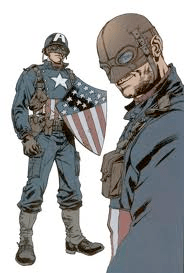
NewImage
Give me a tweaked uniform over spandex any day...

Captain America: The First Avenger is not a superhero film. There, I said it. Oh sure, it’s got a superhero in it, and a supervillain, and a lot of the trappings and furniture of your average cape film. But what we have here is more akin to the legend of America’s most decorated soldier, Audie Murphy.

Like Steve Rogers, Murphy struggled to get enlisted, a puny, underaged dweeb who just wanted to serve. But heart, soul and tenacity succeed where all else failed, and Murphy would eventually go on to fight throughout Europe, winning the Medal of Honour, Legion of merit and the French Legion of Honour along the way. He went on to be a film star, musician and advocate of veteran’s rights – a true American hero whose image was used extensively in the post-war years as a positive national self-image.

NewImage
Captain America? This guy was a MAJOR.


Steve Rogers is a lot like Murphy. Fearless, determined to serve, always conscious of the need to do the right thing in the face of overwhelming evil. He gets the superserum and (eventually) the suit, but he gets them because of who he is on the inside. It’s a fairly typical wish-fulfillment strategy, based on the old saw that you can get what you want as long as you want it badly enough, but it works in this context. In a way, he has Murphy’s career backwards. Captain America is a propaganda asset long before he gets a chance to fight.

To reiterate, I look on Captan America as a pulpy war movie with SF trimmings rather than your bog-standard superhero joint. Director Joe Johnston understands this kind of material well. He helmed “The Rocketeer”, after all, still one of my favourite movies. He brings the same design flair and sense of fun to Captain America. It’s a good looking film, with a good-looking cast that understands the light touch required to make period SF work. Chris Evans fills the uniform out nicely, Hayley Atwell shines as the kind of glamourous Girl Friday that Cap would come to depend on in the 60’s, Tommy Lee Jones is a delight as the gruff-but-fair colonel in charge of the missions. Hugo Weaving was really the only choice as the Red Skull. Even under a thickness of makeup that would make Julia Roberts blanch, his villain skills shine through.

It’s a shame then, that even though Johnston has said in interviews that Captain America would be the stand-alone piece in the jigsaw of Marvel films that will piece together to form next year’s Avengers movie, the ending hauls it into line. Up to that point, the film had stood on it’s own two feet. You didn’t need to know who Howard Stark would sire, or where the cube came from that gave the Skull’s infernal devices their power. They were Easter eggs for the fans, but didn’t spoil the flow. The last five minutes, in which Steve is brought brutally up to date, are clangingly out of place with the tone and feel of the rest of the film. It was the kind of scene that would have been better suited to a post-credit vignette. It’s a real shame, because up to then I had really enjoyed the ride.

There’s a lot to enjoy in Captain America: The First Avenger. It’s pretty, funny and sharp. Good, pulpy fun with enough to keep both the fans and the non-comic reader happy. The ending aside, it’s a great summer movie.

The Wisdom Of A Dog: X&HT Watched Beginners

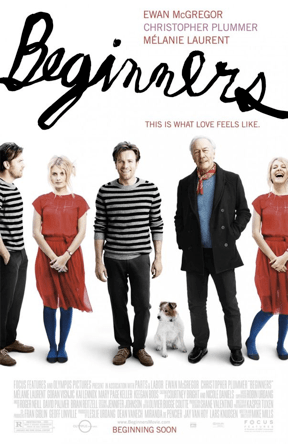
NewImage

A couple of weeks ago, The Corpus Crew decided to get our script looked at by a professional script consultancy, just to poke under the bonnet, kick the tyres and let us know if there was anything that needed tweaking.

It was an un-nerving and humbling experience, to put it mildly. Everything had problems. The film was structurally weak, had no real flow, the dialogue was mannered and out of place. We left the meeting feeling as if we’d been repeatedly kicked in the nuts. We got what we wished for, I suppose.

I wonder, then, what the consultancy guys would have made of Beginners, a film that seems to have no real structure, uneven flow and deeply unrealistic dialogue. I guess I’d be no good at the whole script breakdown lark, because cards on the table right here and now: it’s instantly one of my top five films of the year.

Beginners is a film about transformation. It’s about how radical change can bring on radical change in all kinds of other directions. It’s the story of Oliver, a David Shrigley-style artist, still numb with grief after the death of his father, Hal some months earlier. He meets a French actress, Anna, a Manic Pixie Girl with troubles of her own. As she enters his life, we find out that Hal had gone through changes himself, coming out at the age of seventy-five.

The film pings backwards and forwards in time, letting us see the changes in Hal and Oliver evolve, and how they come to life in the midst of tragedy and newly discovered love. Batting around the timeline makes perfect sense, and this lack of linearity never feels forced or cripples the storyline.

The acting is uniformly excellent. Ewen McGregor still can’t do an American accent, but that really doesn’t matter here. He’s open and vulnerable without being a damp rag. Christopher Plummer is an old-school delight, raging against the dying of the light. Melanie Laurent is a revelation as Anna, vibrant and unpredictable but never kooky. She was a fearless standout in Inglourious Basterds, and she is equally brave and luminous here.

Beginners is also the first film since Up to get away with a talking dog, and not have it come across as cutesy or irritating. In fact Arthur is a pivotal part of the cast, and his (oh, alright, subtitled) dialogue is on the button. But Cosmo, who plays the lonesome pup, gives an informed and naturalistic performance. Yes, really. Not bad for a Jack Russel from a rescue home.

Beginners is an autobiographical film, based strongly on writer/director Mike Mill’s relationship with his father. It’s filled with little flashes of memory and recollection. It feels like a scrapbook, or a compiled reel of old Super 8. Bopping between the 50s and the present day opens up the storytelling, allowing the performance and script room to breathe.

You could argue that the film is slow in places, perhaps a little mannered, but if you’re in the mood for an antidote to all the summer blockbusters, you honestly couldn’t do better than this lovely, vibrant, life-loving film. It certainly got me thinking about the biology of film-making, the bones and spine that have to be in place before you can give a script heart and guts. Beginners may seem scattered and haphazard on the surface, but every shot has a place and reason. It’s assured, grown-up film-making that shrugs off tired ideas about structure in favour of a pleasingly freeform approach. It hit me right in the sweet spots.

Don’t miss this one, Readership. It’s equal parts hilarious and heartbreaking, joyful and sorrowful, tart and tender.

A Lot Of Sustain: X&HT watched Sex, Food, Death … and Insects

I have a longstanding soft spot for Robyn Hitchcock. He’s one of our greatest songwriters and a godsdamned National Treasure. I have seen him live, covering Sgt. Pepper in it’s entirety, a gig notable for the moment when he knocked the jack out of his Telecaster and I handed it back to him.

You could, I suppose, if you’re feeling lazy, tie him in with the great wellspring of British eccentric artists that tracks through William Blake and Lewis Carroll, through Barrett-era Pink Floyd, the Bonzos, Ivor Cutler, Spike Milligan. Surrealism and humour backed up by a steely determination to tread one’s own path, and talent and ability up the hoozit. Long time fan and collaborator Peter Buck off of R.E.M. has said that he can’t understand why someone hasn’t taken his songs and made big hits out of them. I’d love to see one of the X-Factor clonoids do Brenda’s Iron Sledge or (probably more appositely) Sheila’s Having Her Brain Out, but I don’t think I’ll hold my breath.

The 2006 documentary Sex, Food, Death … and Insects follows Hitchcock, Buck and other musical collaborators as they work through the songs that would make it onto the Robyn Hitchcock and the Venus Three albums Olé Tarantula and Propeller Time. These songs mark a continued resurgence in Robyn’s fortunes, and are equal part rippling psychedelia and heartfelt pop-folk. It’s tough to write a song that can sound warm and tender while keeping in the weird angles and off-note touches that make Hitchcock’s stuff so much fun. These songs nail it time and again.

The documentary has a pleasingly intimate air, bringing us into Hitchcock’s rambling house, where Olé Tarantula was recorded. The process is ramshackle, ad hoc and spontaneous, leading to songs filled with happy accidents and unexpected guest turns. John Paul Jones drops in for a cuppa and a couple of chiming mandolin solos. Robyn’s niece Ruby Wright adds lovely, quavering musical saw to the proceedings. It feels like a delightful way to make an album. Defences drop. The famously grumpy Peter Buck airs his grievances about being part of one of the biggest bands in the world, and how much more he prefers the Venus Three. Certainly, his guitar work evokes R.E.M. at their jangly, shiny best.

But Hitchcock is the revelation here. Wise, centered and at peace, he seems the very opposite of the stereotypical eccentric. He observes things in a different way to most of us, certainly. But because he is so observant, he has a well-stocked cupboard of imagery to play with, and it’s the way he recontextualises these that brings up the surreality in his songwriting. When he talks about rotating elephants in the song Belltown Ramble, he’s talking about a sign he saw above a Seattle car-wash, in the district of the title. There’s reason and method to everything he does. The insight we get from these moments, along with the wonderful music are what make Sex, Food, Death … and Insects such a satisfying watch.

Tell you what, have a couple of clips.

Thanks and blessings to the inestimable Timothy P. Jones, without whom this documentary would not have hit my DVD playing machine.

The Face Of Dredd

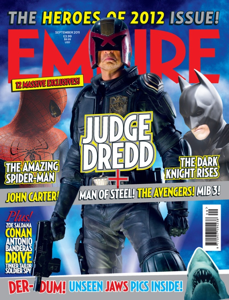
NewImage
Clicky for more piccy

The release yesterday of the first real look at Karl Urban as Judge Dredd sent a certain portion of the nerdiverse, myself included, into geekgasm. It’s great to finally see the character up close. Every still we’ve seen up to now, coupled with Alex Garland’s taut, claustrophobic script, shows that Dredd The Movie is going to be a grim and gritty affair. The man in his scuffed bike leathers and stubble owes as much to Mad Max as the version we see every week in 2000AD.

I still think the helmet’s too big. But then, in the comic it has to serve as the top half of his head. Some artists have drawn it as so close-fitting that it would be impossible to get off. Either that, or Joe Dredd has made the ultimate sacrifice, and shaved off his ears. Urban’s hat is as close as dammit to the one that I have been drawing since I was 9, with the obvious exception of having to serve a real world purpose.

Of course, we’re now a world away from the Stallone version with the spandex and gold-plated plastic and the talking gun and flying bike. I cannot in all honesty defend the 1995 movie, although the first ten minutes is a very fine adaptation of the “Block War!” story. And goddamn, Stallone has the chin for the job. But I’m a purist, and the moment the hat came off was the moment that I lost interest.

Of course, you could argue that Dredd has taken his helmet off and we have indeed seen his face. At which point I’d note that you can’t fool a fanboy, because it’s clear you’re talking about The Dead Man. This was a spin-off strip set in The Cursed Earth that followed a drifter, burnt beyond all recognition, who is taken in by a friendly family of mutants. But the man has a past, and it hasn’t finished with him. The big reveal, that few readers saw coming was that The Dead Man was an amnesiac Dredd, left for dead by The Dark Sisters Of The Apocalypse.

This story is a major milestone in the Judge’s long history, and I’d argue it ties him much more explicitly to the fictional exploits of another iconic loner, Clint Eastwood. If Dredd in MegaCity is Dirty Harry, then in The Dead Man he has become, quite literally, The Man With No Name. Scarred and haunted, he becomes a clear analogue to the ghostly avengers of westerns like Pale Rider and High Plains Drifter. The look, though, is clearly based on William Munny in Unforgiven. His return to Megacity and Judgehood is marked by reconstructive surgery. The glimpse at Dredd’s face that we get in The Dead Man is fleeting and illusory. For the most part, we are left with the early legend that he is simply too ugly to be looked at directly.

NewImage

The fact that we never see Dredd’s face is kind of the point. He was imagined as an avatar of justice, soul-less, almost machinelike in his single minded dedication to The Law (always capitalised, as much an abstract concept as a set of rules). Through the last 34 years and thousands of progs, he has become much more, while still staying true to the core idea. He’s a cipher, on which any number of stories can be hung.

I’m pleased that the makers of the movie have embraced the unwritten rule of the character, and the helmet will be staying firmly on Karl Urban’s head. besides, as any fan knows, the face of Dredd is not the most important part…

NewImage

Six Thousand Days

To be accurate, six thousand, two hundred and six. There’s probably some flexibility in there to allow for leap years and other temporal shenanigans. Let’s stick to my back-of-an-envelope calculations for simplicity’s sake, then do a little division to come up with a rounder figure.

Seventeen years and a day ago, I stood up in front of a friendly looking registrar and a bunch of friends and family, and made a promise. I’ve broken many pledges since that day, whether by accident, spite or sheer laziness, but this one has been kept.

I’ve been incredibly lucky to have someone beside me to help do that, and I would no more let her down than I would choose to stick my right arm into a wood chipper.

It all seems so mind-bogglingly simple to me that I find it hard to write it down without relying on mush and platitudes. I made a pledge. I kept and continue to keep it. in that simple act, I have found contentment.

I won’t dispute that I have been lucky, that I married my best friend, muse and lover. I do not consider the alternatives, all the choices and decisions that had to fall the right way to lead us to a bright room in the West Midlands six thousand and some days ago. I simply remain grateful that they happened in the way they did.

Seventeen years can seem like a long time. A lot of things have happened. A lot of things have changed. But the promise, and everything we have built using it as a foundation, remains unbroken. I intend to keep that promise, in the same way I always have. Day by day.

Whatever Happened To The World Of Tomorrow?

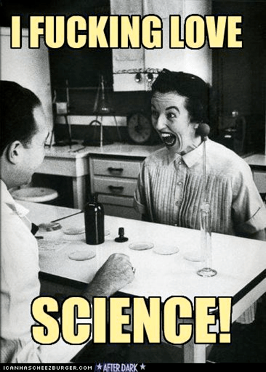
NewImage

A short Twitter conversation the other night about Richard Hammond’s tv show Journey to The Centre Of The Planet had me musing on the state of science programming. It’s not great, to be blunt. Hammond’s show was damned by knowledgeable observers like X&HTeam-mate MadameWDW…

She echoed the consensus.

Science shows seem to fall into camps nowadays. You have the big specials, filled with expensive CGI and hosted by a housewives’ favourite, full of sound and fury and very little content. I’d roll the James May show where he plays with oversized Lego into this camp, too. You have shows like Spring/Autumnwatch, cosy and cute, slipping in odd bits of science amidst all the cute wittle chickywickies and a disturbingly gleeful focus on hedgehog poo.

Then you have Bang Goes The Theory, a more polite version of Discovery’s Mythbusters and a direct descendent of Hammond-hosted shows like Blast Lab and Brainiac. You could maybe parse two minutes of interest out of these shows. They’re light entertainment disguised with a white coat and protective goggles. Not that I have a problem with blowing things up on camera in the name of science, but the shows are painfully thin on actual content. Finally, god help us, the hipster Top Gear that is The Gadget Show. It’s thin gruel, but on occasion rolls out an innovation or two amidst the endless competitions and tests of the top five waterproof cameras.

There’s a hole in the schedule.

I mourn, Readership, for a memory. I mourn for a show that combined raffish charm with excitement and enthusiasm for the science of the day. I mourn for a show forged in the era of the white heat of technology, that is ever more needed in this most sciencefictional of centuries.

I miss Tomorrow’s World.

In the 60s, 70s and 80s, TW had the sort of sway, impact and viewership that was only topped by shows like Top Of The Pops. It was slick and glamourous, and not afraid to talk to it’s audience like grown-ups. It was wide-ranging, yet capable of bringing depth and focus to a subject when it was needed. It roamed the world, from the science parks and boffins of rural England to the rocket jockeys of the California deserts. In William Woollard it had a genuine, frequently shirtless sex symbol. In Raymond Baxter, a Chairman Of The Board, a smooth-talking master at the tricky job of making science approachable. You never felt you were being talked down to. Tomorrow’s World was pacy, newsy and in the right place at the right time. It was at the forefront of the computer boom of the early eighties, showed us the first home video cameras and recorders, and was all over the launch of the shuttle Enterprise. As Atlantis touched down for the last time, I couldn’t help but feel a twinge that the Tomorrow’s World team weren’t there to welcome it home.

As science becomes increasingly under threat from swivel-eyed fundamentalists and swingeing budget cuts, I think the time is right for a revival. A weekly science-based magazine show would be a great way to spark interest in the field. We need the legacy of Baxter, Woollard, Michael Rodd and the others more than ever. Let’s celebrate the world of tomorrow, with a show that will give us up-to-the-minute updates in the fast-moving field of science and technology. Boing Boing TV, anyone?

(Speaking of Boing Boing, they’ve posted some background to the picture that heads up this post. Short version: the lady, Jane Root, was a test subject into early prenatal gender screening in the 1950s. She’s just been told she’s having a girl.

I suggest that you show that picture to the next person that tries to tell you that science is a soul-less, uncaring endeavour, and then tell them to go gruff in a hat. I love this picture. And I fucking LOVE science.)