2011: New Day Rising

When I was young and foolish, I used to believe it was the height of cool sophistication to start New Year’s Day by putting the U2 song of the same name on at high volume. A totemic beginning to the New Year, I thought.

I know better now, and wouldn’t assume to sully the intelligence or patience of my dear Readership by forcing Bono on them while they’re still in a delicate place.

Instead, please to enjoy Leatherface rocking out to Hüsker Dü’s “New Day Rising.”

Aah. BRACING.

This Was The Year

…that Twitter turned me into an activist.

The 38 Degrees and Avaaz guys had me signing petitions and writing angry letters to my MP (admittedly, I’ve been annoying Rob Wilson for a while now, but surely the point to democracy is to make sure your elected representative to government is aware of your needs?), forwarding links on, and in general becoming one of those people that the mainstream press like to demonise as a kneejerk reactionary. I make no apology for that. I’ve watched in horror as we ended up with a government that nobody voted for, that seems dead set on a swingeing series of cuts to essential services that is not only unjustified, but un-necessary. Not only un-necessary, but ideologically motivated. This, from Adam Ramsay on the @ukuncut blog:

…what George Osborne spotted is what right wing politicians around the world have known for the last 40 years: a disaster is a great time to radically change a country. From the privatisation of New Orleans’ schools after Katrina, to the corporate plunder of Iraq after the 2003 invasion, this trick is nothing new. Naomi Klein’s book The Shock Doctrine describes in detail how it has been used the world over.

There is a big problem. People understand this might require a big solution. And so they accept policies they would never normally countenance – policies not designed to solve the problem, but to radically change society in a way no one ever voted for.

And like this sleight of hand, Osborne’s “solutions” too are nothing new. The Conservative students I studied with at university – the generation who were born under Thatcher, and are now the researchers and aids to this government – were arguing for 30% spending cuts long before the recession. And their predecessors did too – in fact, in 1910, the Conservative Party brought down the Government rather than allow the people’s budget, the foundation of the welfare state, to pass. And they have used every opportunity since to rid this country of what they see as a dangerous socialist experiment.

And this “solution” is, of course, nothing of the sort. The idea that you solve a deficit caused by unemployment by cutting jobs is economically illiterate. Don’t take it from me – look at what is being said by the world’s leading economists, including most recent Nobel prize winners: Britain is embarking on a radical economic experiment which is not only un-necessary, but probably going to make the recession worse.

(The whole post is well worth reading if you want to whip yourself into a spiralling rage about the lies and nonsense that we are being fed about the state of our economy, it’s causes, and why the phrase “We’re all in this together” is the sickest joke of 2010.)

Twitter has also been the sharpest way to stay up to date on the happenings of the happy pranksters that have been shutting down tax avoiders Vodafone, HSBC, Boots and Topshop every weekend for a while now. Reading the streams from participants like @pennyred as stuff was happening had a giddy, unprocessed thrill to it. In events like this, the mainstream news media was left floundering to catch up.

Rest assured, there’ll be a lot more of this from me next year.


…that I was up on the main stage at FrightFest.

A seriously heady moment, as the writers and directors of Habeas Corpus (with the exception of Ben Woodiwiss, sadly) introduced the teaser, which was shown on the giant main screen at the Empire Leicester Square. This is a big deal, and we’re working towards getting the whole thing done in time to be screened next year. Once we can get the funding, of course… In the meantime, the final shot of the teaser is getting a rep on YouTube as “The Most Revolting Kiss EVAR”, which fills us all with a quiet sense of pride.

…that I wrote my head off.

Count ’em up. Nanowrimo and Script Frenzy this year left me with a completed 100 page graphic novel and two-thirds of a first draft of the second “Moon” novel. Five short stories. Innumerable blog posts. The thing is, I still feel like I’ve been slacking this year. God only knows what could happen if I light a fire under myself.

…that I made short films.

Dom and I finished Time Out, finally. It’s off to festivals, and we’re quietly hopeful of a screening somewhere. Meanwhile, experiments with a dirt-cheap Kodak digicamcorder and Garageband led to a flurry of creative output in July as I squirted out five short mood pieces in short order.  They were fun to do, and worked as document and commentary on a quiet moment. It’s a zen approach to film-making, and one that suits me. There will be more of these next year, promise.

…that I changed my reading habits.

Thanks to the Kindle. This thin, light, clever piece of kit has turned me back into a voracious reader and helped me to rediscover the hidden gems I had tucked in the depths of my hard drive as PDFs. My early worries about the open nature of the device were calmed as soon as I realised that it would flawlessly open just about any book format out there (and if it couldn’t I use the brilliant Calibre to convert it) and I am now a complete drooling convert. Much in the way that 2010 marked the end of my purchasing music in physical form (and, thanks to Spotify, barely buying music at all), 2011 will give the over-worked bookshelves at X&HTowers a much needed break. I’m eyeing up a couple of magazine subscriptions, as well as revisiting glorious indulgences from the past for surprisingly small amounts of money. I’m a blissful little bibliophile, I can tell you.


And as for 2011? Well, I want to be looking at getting something available for download on Amazon – probably Satan’s Schoolgirls as a start. Who knows, maybe even make some money off it.

Work continues on Habeas Corpus, Ghosts Of The Moon and Dom’s ongoing Banksy doco, which he hopes to have done by the end of January.

I want to start drawing more, as a complement to TLC’s interest in crafty stuff. A life drawing class is going to be vital, I feel.


Oh, and I pledge to blog more. No, really, I mean it this time. I’m signing up to WordPress.com’s PostADay initiative. That’s something new from me every single bloody day. You’re going to be sick of me by the the time I give up some time in February. There’s a very good chance, therefore, that X&HT will devolve into single line posts, photos and the occasional recipe. It’ll be different, that’s fur shure.

Right. 2011. Here we flippin’ well GO.


Tron and The Conspiracy Of Surfaces

This post contains discussion of the plot
and characteristaion of Tron: Legacy.

Consider this to be your Spoiler
Warning.


I’m prepared to be an apologist for Tron: Legacy. I am, after all, the
perfect example of the film’s target audience. I clearly remember
going to see the film as an impressionable 15-year-old, and going
to an arcade afterwards that ACTUALLY HAD THE TRON GAME. I was a
late convert to the unsetting pleasures of girls. I drooled over
lightcycles instead.

So, for the most part, I had no problem with the reboot (yes, I’m going there). Tron
is perfectly tooled and cheerfully blatant nostalgia bait. The
acting is significantly better than in the original. The cast do a
sterling job of playing the absurdities of the plot and dialogue
absolutely straight. Apart from Michael Sheen’s green-screen
chewing performance as the treacherous Zeus. Ziggy meets David
Frost. Jeff Bridges somehow gets away with being The Dude again,
and Olivia Wilde plays action pixie girl Quorra with the right
level of crush-inducing flair.

The film sports a perfectly serviceable script that hits the right beats at the right
time. The characters are properly motivated and have a bit of
depth. And I like the idea of the villain of the piece being a not
very good copy of the star. CLU is the creepy new textbook
definition of the Uncanny Valley, and I applaud Digital Domain for
not getting it right.

I mean, I’m under no illusions. Tron: Legacy is rubbish. There are some supremely dumb
bits and longeurs. It’s over-long, and over-earnest. But the
original had what Leading Man Clive called “plateaus”. I, being
less charitable, consider Tron to be a film of one half that slows
to a crawl when Flynn and Tron reach the portal. Legacy is pacier,
prettier, and understands the audience. The little nods to the
earlier film and to eighties rivals such as WarGames made me
smile.

So why, then, did I walk out of the BFI IMAX with a frown and a headache?

It’s that bloody stereoscopy again.

Tron: Legacy should be the perfect film for 3D. It is a film about transparent
surfaces, of action glimpsed through slabs of glass, of characters
framed through the empty centre of discs. It It provides us with
the illusion of depth.

This is, in essence, my problem with the 3D process. It’s the “deck of cards” effect. There is no real sense of depth and solidity. Instead elements in the frame are
placed in a series of flat planes, much like a toy theatre where
paper cut-outs are slotted in and out of a proscenium arch. This
isn’t such a great idea when all you have to play with is a
close-up, and the nose is on a different plane to the
cheeks.

There are tricks to make this less apparent. Selective
focus becomes vital. Objects that we are supposed to perceive as
being further from the viewing plane are carefully defocused in
post. The problem is that this is frequently misjudged, especially
in shots where you are looking through windows, or in the case of
Tron, transparent walls. There are innumerable shots where
characters will walk towards camera and stay in focus throughout.
It’s as jarring as the split-screen effect used to keep two actors
sharp when they’re at opposite ends of a room.

3D claims to be a technique for enhancing storytelling, for involving the viewer more
deeply in the story. All it does is constantly remind you that you
are watching a 3D film. Things are shoved in your face – sort of.
Things rocket overhead – kind of. You have to wear a silly pair of
plastic shades. And then you have to pay extra for the privilege.
Tickets for the IMAX set me back £15, and got me a seat that was so
close to the screen that my eyes were watering after ten minutes.
And I can tell you, it’s disconcerting when odd eye-protein amoebas
start swimming around in the imaging plane and bumping into Jeff
Bridges. I can see a situation where you’re asked to pay extra
extra for the seats in the central sweet spot of the
range.

The sad thing is, that IMAX projection does a much better
job of allowing you to lose yourself in the image. 3D depends on
the proscenium arch effect, pushing elements backwards and forwards
from a flat imaging plane, the screen. An IMAX image is so big that
it extends past your field of vision. You are engulfed in the
picture. You are not being poked at, or peering through a window.
You are inside the picture, and it’s an utterly overwhelming
experience.

A reminiscence. There was a fairground attraction when I
was young that involved a 70mm film of a rollercoaster ride
projected onto the inside of a canvas dome. You stood in the dome,
gripping rails that had been driven into the ground. You needed
them. When the film started, the huge image fooled the brain into
thinking that you were on the ride, and you tilted and swayed
accordingly. No specs needed. You were elsewhere, and it was an
amazing ride.

Much in the same way as The Dark Knight moved between
35mm and Imax to pull the audience into the action sequences, it
would be interesting to see what would happen if, rather than 2/3D
to show the differences between our world and The Grid, Kosinsky
had chosen to shoot the Grid in IMAX. Imagine that first shot of
the Recogniser coming down through the clouds suddenly filling the
whole height of the cinema.

I think you know where I stand on 3D by now, Readership. I find it distracting, irritating and until my eyes settle it simply doesn’t work for me. I spent the first 45
minutes of Avatar thinking that there was either something wrong
with me, or that some pranker had swapped the lenses of the glasses
over (if you do this, according to Mark Kermode, the 3D is
cancelled out. Might have to try that).

I’ve given it a try, and I can now state as a New Year Resolution that I will never
see a film in 3D again. It’s a fake, a parlour trick, a conspiracy
of surfaces that makes a poor shadow play out of the most immersive
form of entertainment there is. 3D adds nothing to a film, and in
my opinion distracts from its pleasures. I was quite prepared for
Tron: Legacy to be a bit of silly fun. I walked out of the cinema
feeling both frustrated and disappointed, for reasons that had
nothing to do with the film.

IMG_1000000776.JPG


Also, I look ridiculous in the glasses.

Kindle, Spotify and the view outside the box

TLC bought me a Kindle for my birthday. It was bound to happen. She swears by the Sony e-reader I got her last year, and both Leading Man Clive and Wetdarkandwild are advocates of Amazon’s sexy new toy.

I have to say, I love it. It’s as skinny as an overweight fashion model, perches in the hand like an attentive bird, and is almost Mac-like in it’s simplicity of use. It’s funny how many people I’ve shown it to that have begun prodding at the e-ink screen as if it’s an iPad. In a lot of ways the dedicated controls are even easier to use than the swipe-to-turn gesture that the iPhone uses on it’s Kindle app.

My one concern was that it would not be able to read the electronic library I’ve accrued over the last couple of years. This was unfounded. It’ll happily read PDFs, .rtf and even .txt files with aplomb, keeping the formatting impeccably. I have a chunk of cash to spend, which will granted mostly be going to the Kindle store, but I am still downloading and reading other formats – most notably Cory Doctorow’s new collection With A Little Help, available in all kinds of free and paid versions. I hadn’t realised just how much I had to read in electronic form. As publishing models begin to inexorably change, and readers begin to embrace new formats as a complement to the existing ones (I, for example, have no interest in reading comics and graphic novels in an e-format. I really don’t like reading things panel-to-panel, and Comixology’s Guided Technology is just infuriating) it’s going to be very interesting to see how things open up. Certainly, as a writer with a vested interest in new markets and opportunities for my work, it feels like exciting times.

With that in mind,  can I point out that this looks great on a Kindle right now?

Meanwhile, my love affair with Spotify continues, getting sloppier and ickier by the second. I have an Unlimited account, which for a fiver a month gives me all the music I can eat with none of the ads. There are some obvious omissions and holdouts on the service, of course. Most annoyingly for me, The Arcade Fire aren’t there. But then I bought The Suburbs on the day it came out so it’s no biggy.

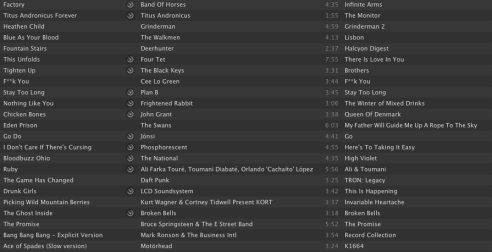
But the point is that The Arcade Fire was one of about five albums I’ve bought this year, down from a figure that was getting up to ten times that five years ago. I have not downloaded anything from a link that does not have the creators stamp of approval, and does not put money into their pockets. I’m using sites like Bandcamp (where I discovered and bought Zoe Keating’s astonishing album Into The Trees) a lot more. Everything else has been streamed. I’ll probably treat myself to the new/old Springsteen. Apart from that, the subscription has me covered. On those rare occasions when the service does go down, I still have a hundred gigs or so of tunes in the drives. Granted, if the service is ever bought or merged (witness the reports earlier in the year that Google wanted it) it could change in ways that would make it a lot less attractive. But for me, for now, streaming this playlist to our surround amp through Airport Express and Airport, the world seems like a very big, very musical place.

For the most part I use Spotify in conjunction with music blogs like The Quietus and No Rock And Roll Fun, which broaden and open up my horizons without having to budge off the sofa. At this time of year, when all the best-of-the-year playlists come up, Spotify comes into it’s own as a way of catching up and finding new things to love.

Looks like 2011 is the year when I don’t just start thinking outside the box, but living outside it too.

Sixteen Thousand And Sixty

According to my calculations, I am 16 thousand and sixty days into my shift here in this phase of existence. This can be divided into a round number, if you’d care to do the maths. Therefore, tradition dictates that there should be some manner of celebration.

However, I am an old curmudgeon, and will just be having a quiet night in with a few close friends.

NewImage.jpg


A quiet, simple life is all I crave.

(pic via Clayton Cubitt)

Blu-Ray Is Dead (At Least For Me)

Christopher Nolan’s Inception is out to own this week, on good ol’ DVD and brandspanking new sexy eye-meltingly gorgeous Blu-Ray. Oh, you must buy it on Blu-Ray. Otherwise you’re missing out. The detail. The clarity. Oh, the colours. It’s almost an insult to everyone who worked on the film not to buy it in it’s purest, most perfect form.

Yes, alright, I’m taking the piss. I lived through the whole VHS-Beta thing, the whole vinyl-CD handover, so excuse me if I’m a little less than whelmed by the urgent push by the movie companies to have me rebuy films I already own. Or worse, pay a premium to watch new material, which would include an investment in new kit that I don’t need or particularly want. I have a halfway decent telly and an upscaling DVD player which delivers lovely results. We watched UP last week (yes, I know, right up on the moment here at X&HTowers) and the pictures were gorgeous.

But a lot of the supposed benefits are down to the way the end user (that’s you, Readership) has set up their telly and player. Are you going in HDMI? A lot of people still use the Scart connection, apparently. And have you calibrated your telly? If you’re now asking what calibrated means, then no, you haven’t. Which means that your lovely pricy digital telly is running with the factory presets. These won’t be right for your room, and in most cases will be waaaay too bright and saturated. Or, if you set up a TV the way my dad does, not bright and saturated enough. He doesn’t own a 3DTV. You just need sunglasses to watch the telly in Mum and Dad’s place. (sorry, pater.)

How do you calibrate a HDTV? Funny you should ask.

My major problem with Blu-Ray is that it is a transitional format. It’s high-density, high-capacity storage, and that’s all. It’s a carrier for content, and it’s the way that content is formatted in the first place that is important. A recent re-issue of Gladiator used exactly the same video files as were on an earlier, carelessly encoded DVD, with predictably horrible results. But very few people either noticed or cared, and as a result that disc is still on the shelves. You have to wonder how many reissues that people are paying a premium for have been put together the same way, with the odd “special feature” whopped on to make it seem bright, shiny and new.

The thing is that a lot of movie content sits on servers and hard drives in high definition quality and has done for quite a while. For DVD, that content has been compressed and down-converted to allow it to fit on a disc. There was a push a few years ago to “cinephile” editions (of such cinematic masterpieces as “I, Robot”) that had the highest resolution version of the movie that could be crammed onto a single disc, with extras either on a separate coaster or excised completely. Then Blu-Ray and HD-DVD appeared, and it seemed that we could have it all. Full, high-quality transfers and hours and hours of supplementary features that no one ever watches. But the fact remains that the content has not changed. It’s the same 1080p file that was originally created.

Which of course makes me look at iTunes, Netflix and the like and start to wonder why we need the disc in the first place. Up until a couple of years ago, a wall of our house was dedicated to our CD collection. In some places, the shelving was beginning to double-stack. At the same time, the books in the back room were making an attempt to break through the wall. We were swimming in content, much of which had been listened to or read once, if at all. I bought a big external hard drive, digitised the CDs, backed up that hard drive at least twice, and stored all the discs in the loft. We now have a lot more room for books we don’t read. But that process changed the relationship we have to music. It’s much less album based. We pick and choose, shuffle, build playlists. A cheap subscription to Spotify means that I rarely ever buy music anymore. I don’t need to.

It would be a more time-intensive job, but I could do exactly the same thing for the DVD collection that now takes up the wall where the CDs used to live. Dump everything onto a cheap media server and a back-up drive, and who knows, I might even start watching the discs that are shelved and still in their wrapping. Build playlists and mood reels with them. As someone in love with the on-demand services that the plusboxes offer, I love that flexibility. As with music, I’d then look at ways to buy my content in a form that doesn’t come in a box.

To my mind, the film companies are missing a trick. I’m usually a bit behind the curve on this kind of stuff. This means there are already hundreds and thousands of people who are not only thinking the same as me, but have done something about it. iTunes is a good first step, but I see no reason why the studios don’t have their own portals, or club together to create something that could do the job as well. I’d love to see something like Netflix’s streaming service in the UK. As a huge advocate of Lovefilm’s disc-on-demand service, this has to be the logical next step, doesn’t it? (I’d note that while Sky Movies and Virgin’s Front Row deliver something similar, they’re still not providing the depth of service and the ability to source esoterica that Lovefilm can. Plus, they’re both crippled by embargoes on when they can start showing movies – usually well after the coasters have hit the shops).

Yes, I know it would be a massive undertaking to get all that material onto servers that can reliably squirt it down the pipe and into your front room, but if it works, it’s a service I’d happily pay for, much in the way Spotify get money off me every month.

Certainly, I have no plans to buy a Blu-Ray player, which means I have no reason to buy coasters. Instead, if I want the absolute best quality image available, I do the right thing and go to the cinema. Project a Blu-Ray next to a 35mm print on the big screen, and you’ll soon see which one’s better. Even when, sadly, projection is done using big hard drives, the image quality of those files will still show that the disc is a massive compromise for the domestic market. Bear that in mind, and the argument that Blu-Ray is the ultimate viewing experience starts to look a bit thin.

And don’t get me started on bloody 3D…

+++UPDATE+++

Simon Aitken reminds me that while his most excellent horror Blood + Roses is currently available for rental, it will roll over to digital download and DVD purchase through Amazon in the new year. The metrics on who’s buying what should make for very interesting reading.

Life After Nano: and then this happened

First things first, then.

nano_10_winner_240x120-7.png


I hit 50, 000 words on the evening of November 29th, which is slow by my standards, but perfectly acceptable in the scheme of things. As ever, the moment when I upload wordcount to the Nanowrimo site (painfully slow on the first and last couple of the days of November, a phenomenon we refer to as “the robust nature of the nano servers”) to get redirected to the winners page is a bittersweet one.  You expect fireworks, or a party, and what you get is… well, a very nice round of applause from the Nano staff, and a couple of downloads. But then the point is not to have the world fall at your feet at the enormity of your achievement. If you’re anything like me, the end of Nano is not the end of the story. Nowhere near, in my case. Ghosts is dangling on a massive cliffhanger. The casual reader may consider that I have written myself into a corner. Not the case, kids. But if you want to find out what happens next, you’re going to have to let me know.

Work on Ghosts will now continue behind the scenes. The first draft will stay up until the new year, at which point it’s being pulled into Scrivener so I can start work on the second draft. As for the first part of the story, Pirates of The Moon – well, I have plans for that, which I’ll share with you in due course.


On the same subject, you can now view Simon Aitken’s brilliant Blood + Roses on a rental pass at the all new revamped site. I can’t recommend it enough, and I’m not alone. Critical Film called it “a turning point, for the better, in the constant evolution of the modern cinematic vampire”, and I agree. This is a great opportunity to support an acclaimed independent horror, and you should run, not walk (well, metaphorically speaking, as you’re no doubt reading this at home in your slippers with no intention of budging off the sofa) to the site and check it out.


Finally, a little self-promotion that I can’t believe slipped through the gaps. Time Out is now available to view at Raindance.TV, at significantly improved quality from the YouTube link. Those who sniff that it was only shot on Super 8 in the first place are so very missing the point it’s not even funny. Go check it out, and witness the glory. Also, we get a tiny morsel of cash for every view, so that’s nice, isn’t it?

Right, back to work. The twist I have in mind won’t write itself…

On Sunflower Seeds

When a hospital appointment spits you out onto the South Bank at half nine on a Sunny winters morning, it seems foolish not to make the most of it. A coffee and pecan Danish fuelled some Nanoing, before I decided to amble east, and pop into Tate Modern.

I love it there. The place has a genuine sense of theatre and spectacle, especially if you make the effort to use the main ramp as you go in. Its an entry that I don’t think is bettered by any museum in London, and really needs to be soundtracked by John Williams’ Imperial March for full effect. The collection is thoughtfully curated, and I have my favourites that will always have at least five minutes of my time. That long, jazzy Jackson Pollack and anything by Mark Rothko will always have my attention.

But the main reason for the visit was Ai Wei Wei’s Sunflower Seeds. It’s an impressive piece, made of one hundred million individually cast and painted porcelain seeds. It cleverly touches on ideas of craft, disposability and material worth while also being accessible and beautiful.

The problem is that it’s not the piece that was originally envisaged. Sunflower Seeds was supposed to be an interactive artwork, where the public were allowed to walk in the seed-field. This would have been wonderful, adding an extra dimension to a work that already resonates on a ton of different levels. Sadly, after two days the seeds were roped off. The excuse made was that the porcelain gave off dust that was potentially carcinogenic over time.

I find this to be disingenuous. The film that accompanies the artwork shows guys in dust masks smoothing out the seeds as they landed in the turbine hall. It was obvious they gave off dust.

I have another idea. The seeds are clearly covetable and collectible items in their own right. I remember an earlier exhibition in the Turbine Hall which featured pulpy SF novels attached to dormitory-style beds in a neat nod to post apocalyptic fiction. A month into the run, and most of those books had gone. If the public can squirrel away books, then it would be a simple matter to tuck a couple of seeds up your sleeve. There would be no way to police it, short of a “no stooping” rule. Oh, and a banishment of deep-soled boots in which some of the seeds could get caught. And let’s not forget, Sunflower Seeds runs until May next year. I wonder how long it would take for the Turbine Hall to empty completely?

Gods know, I was tempted, and there were a couple that were within arms reach. The gift shop’s missing a trick by not selling a handful in little baggies. A fiver a pop for a bit of controversial art? They’d fly out of the door.

Snack sized art. It’s the way forward.

Life During Nano: The week in wordcount.

NewImage.jpg

It’s always an exciting moment. November 1st. The first day of NaNoWriMo. And let me tell you, Readership, this time I was ready. I was primed. I knew my story, I knew my characters. I was plotted up and ready to go. I stepped onto a slightly slower train than usual at Reading, all the better to get a good start on the day’s wordcount. It was perfect. There was a seat with a table for my coffee, and room to perch my netbook. I had the software I needed, I had my backup strategy sorted out. I was good, as any number of eighties action movie icons would tell you, to go.

I opened my netbook. It was dead. I’d forgotten to charge it. And of course, I was on a train with no handy power outlets. Not, I have to say, the best of starts.

I coped by using my phone. I’ve quietly refined my typing skills to the point where I can double-thumb with pleasing rapidity. But even I was surprised to see that I’d managed over 700 hundred words on that first morning. It’s not an experiment I’d choose to replicate, but it’s good to know I can do it if I need to.

What this shows is that Nano is about getting the wordcount, any which way you can, in any way that suits you. Do it on the kitchen table. Do it on your lunchbreak. Do it like me, on the train or the bus. Yes, I’m still talking about writing, mostly.

Nano does funny things to your head. It makes you write and think in much longer sentences than you would normally. It’s always there, nagging at the back of the head. Have you done your words? Why haven’t you done your words? Why are you hoovering? Shouldn’t you be writing?

And the world around you becomes fair game. That funny thing the old dear in front of you said on the bus? You can use that in the book. That silly thing that happened at work today? You can use that in the book? That book you’ve been reading? You can use that in… oh, maybe not.

There are, of course, the freaks of nature that will finish Nano in absurdly short periods of time. Four days. Although there are writers on the forums that had hit 300,000 words in a week. The mind boggles and the fingers tingle at the thought of that much writing. I’m at … well, have a look to your left. See the widget? That’s how well I’m doing. At the time of writing I’m at 17,000 words, which will get me to the 50,000 word mark a day or so early, although I’m planning on improving on that. The story has a long way to go yet, and I’m enjoying the way it’s changing and reforming under my fingers. The John Carpenter influences are coming out a lot more clearly than I’d expected, which means the story is much more actiony and horrific than I’d thought. None of this is a problem. I’d planned on a big, fast-moving story. And hoo boy, that’s what I’ve got.

A gentle reminder that I’m posting every word I write this month up in the Ghosts Of The Moon link above, so feel free to read and comment. Pointing out spelling mistakes and grammatical errors will be met with hollow laughter. This is writing in the raw, Readership. Out of my head and into your hands. Fiction doesn’t get any purer than that.


Life During Nano: Something for December, Perhaps

OK, this has nothing to do with anything apart from the fact that working on NanoWriMo tends to tune your brain into slightly different frequencies and you pick up on connections that you maybe wouldn’t normally notice.

Also, that you write in run-on sentences more. They normally get cut in half in the edit. But anyway.

Charlie Stross recently wrote a wonderful, curmudgeonly piece on steampunk (here it is). He made the point that the innovations of the early stories have devolved into mere set-dressing. If steampunk authors took the time to look at the worlds they were building, there would be very little glamour to be had, and a great deal of poverty and deprivation. He also cracked the joke that steampunk is what happens when goths discover brown, which made me snort tea back into my mug through my nose. He called out SF sites Tor.com and i09 as being particularly to blame for the spike in interest in the genre.

This is pretty nicely timed, as Tor have just been running a Steampunk fortnight. A lot of the critical thought and articles have been on the reinvention of the genre. Amal El-Mohtar’s piece, Winding Down The House is especially good in this regard, and successfully makes the point that steampunk’s tropes and conventions really are holding things back. If steampunk is to grow and stay interesting, it needs to move away from the Victoriana/Old West/Ruritanian bit, and find new directions.

Amal points out her frustrations neatly here:

I wrote a story in what, to my mind, would be a steampunky Damascus: a Damascus that was part of a vibrant trading nation in its own right, that would not be colonised by European powers, where women displayed their trades by the patterns of braids and knots in their hair, and where some women were pioneering the art of crafting dream-provoking devices through new gem-cutting techniques.

Once I’d written it, though, I found myself uncertain whether or not it was steampunk. It didn’t look like anything called steampunk that I’d seen. Sure, there were goggles involved in gem-crafting, and sure, copper was a necessary component of the dream-device—but where was the steam? My editor asked the same question, and suggested my problem could be fixed by a liberal application of steamworks to the setting. Who could naysay me if my story had all the trappings of the subgenre?

Syria, you may be aware, is a fairly arid country. There are better things to do with water than make steam.

Both articles are worth a read, not just as criticisms of the subgenre, but as roadmaps to a new future past.

And I have an unfinished steampunk book that could use a little attention…