
Fight films are rarely complex. They are the closest the male of the species get to chick flicks – a warm comfortable space where we can bond, laugh and yes, even cry. Fight films are simple, primal things. They are about redemption and escape; from poverty, from a hopeless future. They are also about the things that we can’t escape from; family, and our own worst impulses. Gavin O’Connor’s Warrior does nothing to alter this template, and is all the stronger for it.
Tag: Film
Play The Game, The Game Plays You: X&HT Saw Tinker Tailor Soldier Spy
A note, before we begin, on the vexed question of remakes. I’ve already been caught out once this year by taking a stand against them, and came close to missing out on a film that may be in my Top five for the year. I should know better. There’s no such thing as an absolute rule. Everything on this blog runs according to the Pirate Code. I contradict myself? Very well, then I contradict myself.
Continue reading Play The Game, The Game Plays You: X&HT Saw Tinker Tailor Soldier Spy
The Tale Of The Scorpion: X&HT Saw Drive

You think you know this film. You already have your references in your pocket like a deck of cards. Two-Lane Blacktop, maybe Vanishing Point. Bullitt, of course. Walter Hill’s The Driver, for sure. If you’re clever, William Friedkin’s To Live And Die In L.A has been slipped into the stack.
The pre-title sequence does nothing to change your mind. Throbbing synths, a heist, a chase. A nameless driver, expressionless, almost wordless, dressed in a retro silver jacket with a scorpion on the back. Even the titles are done in hot pink Brush Script. You’re guided towards Risky Business, After Hours. It’s 80s kitsch done with flair and style. Nothing more.
And then, just when you think you’ve got a handle on it, the damn thing keeps changing gears on you, accelerating away, upping the game. The film wrongfoots you at every turn. Moments of heart-glow tenderness are matched with scenes of shocking violence. The bad guys are worse than you think. But the plan they concoct, the engine of the film, has a fatal flaw. No-one really knows the driver. Which means that no-one really knows what he’s capable of. And that scorpion on his jacket isn’t an affectation. It’s a plain-as-sunrise warning.
You won’t see a better slice of LA noir this year. Newton Thomas Sigel’s cinematography is dripping with hot gold and sky blue. NOT teal and orange, let me stress that – this is one good looking film. Ryan Gosling has the driver nailed. He wears a mask, and when it slips, when the cracks start to show, that’s when the fireworks start. Albert Brooks has finally figured out rule number one: comedians make the best villains. The real star of this film? Los Angeles herself, dolled up in cheap diamonds and lurid stripper-chic. The driver knows every inch of her, and doesn’t understand how cruel she can be at all.
Drive takes all the assumptions you have about driver films and flips them over. This one really is about the journey as much as the destination, and believe me, it’s one hell of a ride.
You think you know this film. Trust me. You don’t.
Rules Of Engagement: Easy A and the laws of Highschool-land

The Laws Of Highschool-Land are clear and sharply defined. As a citizen of the state, there are certain people you must be friends with, certain things you must wear, certain actions you must carry out, certain things you must say. As long as you stick to those rules, then you will be safe and content, and nothing will ever happen.
Which is why those rules are designed to be broken.
Continue reading Rules Of Engagement: Easy A and the laws of Highschool-land
Out Of The Woods: X&HT Watched Hanna
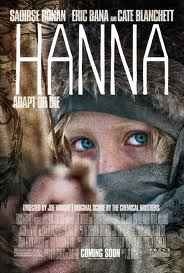 A girl and her father live in a cottage in the middle of a forest. It’s a simple existence. They hunt, and read together, and every so often the father will leap out of the undergrowth and try to beat the girl up. He warns her that she needs to be ready for attack even when asleep, and she assures him that she will be in several languages.
The girl decides she is ready to leave the forest. So the father digs up a military transponder. Once she flicks the switch on it, the world and all it’s dangers will come to her.
She flicks the switch, and the wolves come running.
Joe Wright, director of so-so adaptations of literary classics, has decided to radically change direction with Hanna, his first film based on an original story. It’s an up-tempo thriller with an SF twist, backed with a killer soundtrack from the Chemical Brothers (the best I’ve heard since Daft Punk’s Tron: Legacy monster). It boasts a couple of great central performances from Saiorse Ronan and Cate Blanchett and a nice story idea.
But it doesn’t hold together. The script is full of plot holes and dangling threads. Tom Hollander’s monstrous assassin is a bundle of cliches tied up in an ill-fitting Tacchini tracksuit. The nice bunch of middle-class hippies that offer Hanna a different definition of “family” to any she has hitherto known simply vanish at the end of act two, never to be seen again.
While watching, I kept coming back to the transponder, the literal flick of the switch that starts the movie going. Why would Hanna’s father insist that if she was going into the world, it would be as a warrior at bay? I waited for the reason, the revelation of the long game that he had been playing. The revenge play, the public exposure of the terrible plot.
It never came. There was no point to bringing Marisa, evil step-mother and big bad wolf in one power-suited package, back into the picture. It seemed to be an unnecessary sacrifice of everything that father and daughter had shared in the forest. It started to seem uncomfortably like a fit of pique.
As a movie, Hanna is dressed up nice and plays pretty. There are some sterling action sequences, some fun camerawork, and it’s not, at least, part of a franchise. But the lazy comparisons with the work of Luc Besson do both parties a disservice. Hanna is not Nikita meets Leon. It doesn’t have Besson’s bite and fire. Worse, it has a hamfisted way with visual metaphor (count the eyes on posters as Eric arrives in Germany. We get it. He’s being watched) and a final line and shot that you can see coming a mile off.
Summary: Not quite a wasted opportunity, but nowhere near as clever or groundbreaking as it believes itself to be. What a shame.
In Defence: Michael Bay’s “The Island”

The Island was Michael Bay’s last film before he disappeared into the creative black hole of the Transformers films. It had a difficult shoot, an advertising campaign from which Bay disassociated himself, and a public response that varied between lukewarm and actively hostile. He rushed it out in less than a year to get the jump on a mooted remake of Logan’s Run, and the experience and reaction to it nearly broke him. He retreated to a sweet franchise deal with a baked-in non-judgemental audience, where it didn’t matter what the critics said.
That’s a pity, because The Island has a lot to recommend it. The basic pitch is clear – Logan’s Run meets the Clonus Horror. A post-apocalyptic colony, isolated after an ecological disaster are gradually revealed to be clones, grown as organ donors for rich clients. The island of the title, allegedly the one uncontaminated place on the planet, is a mirage. It allows the evil scientists running the place to whisk away their bags of meat with no questions asked. Everyone in the colony wants to go to The Island, but being picked for the privilege means death. When two clones discover the truth about the world and their place in it and escape, the running, chasing and shooting at which Bay excels can begin.
However, up until that point it barely feels like a Michael Bay film at all, and you can see why he and the studios were so concerned about the Logan’s Run reboot. The opening section of The Island is a solid rip-off of the early parts of the kitsch 70s classic, with a Nike-futurist twist. The surfaces are all glass, polished concrete and ribbed fabrics. The clones waft about serenely in form-fitting tracksuits, and the dome comes across less like a living space and more like a mall. The similarities between the lottery for The Island and the black crystal marking you for Sanctuary are clear. The idea of a friend moving on to a better place and leaving everyone behind, never to be seen again, and for that sudden loss to be an expected and normal event is the dark place at the heart of both films, and they both reap benefits from it.
In fact, there are quite literally dark places in both films. Evil scientist Merrick’s offices are clad in dark stone and underlit through patterned glass. The computer that controls life in Logan’s dome sits in a vast, dim, cathedral-like space, the status panels glowing like stained glass. Bay and his design team seem to be drawn back to the design cues and plot beats of Logan’s Run – Merrick’s private army are dressed like Sandmen, and are relentless in their pursuit of the two runners, Lincoln and Jordan.
Famously, Bay was drawn to The Island because of the script and its exploration of how much value we put on life. He’s never subtle, but the way in which the clones are treated more like prized and pampered cattle than people still packs a punch. The moment that drew him to the project has a shocking power that’s not matched by anything else in his back catalogue. A pregnant clone is “taken to The Island,” giving birth only to see her baby taken away before she is put to sleep. The newborn is given to her client duplicate, who shows no concern for the surrogate. This is the point of the movie. The clones have been sold to the public that use them as unthinking, unfeeling creatures. Jordan and Lincoln’s escape puts that fiction under threat.
The world outside the dome is a hard, cruel place with some harsh lessons for the childlike clones. Jordan and Lincoln are both confronted by their doubles, who are shown as vain and duplicitous – quite literally two-faced. Ultimately, it’s the clones, sheltered from the world, that come across as the characters with the most humanity. There’s nothing particularly original about the story or it’s themes, but compared to Bay’s other films The Island is Shakespearean in depth and scope.
It’s a real shame that Bay, one of Hollywood’s purest visual stylists, has retreated from scripts with a bit of resonance and interest to spend the last five years directing Shia LaBeouf shouting “Optimus!” into a bleached-teal sky. The Island is no masterpiece, but it’s interesting enough to be worth your time.
Hammer Of The Gods: X&HT Watched Thor
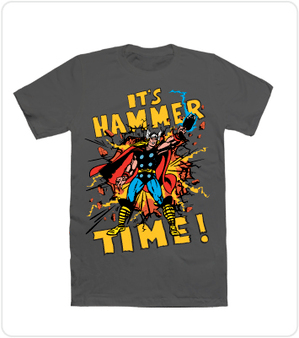
Superheroes are mythical beings. They stand above and apart, capable of acts that we humble mortals can only accomplish in our dreams. In many cases they are not human at all, choosing to protect us out of some sense of loyalty or in gratitude for an act of kindness. They are otherwise aloof, and they have their own agendas and motivations. We should be grateful that they are not gods, for as any student of mythology knows, gods are cruel, capricious and selfish beings.
In 1962, Stan Lee, Jack Kirby and scripter Larry Lieber realised that they could take existing mythological beings, and tweak them for the comics market. Greek and Roman tales were too familiar. But the legends of Asgard had a fresh feel. Hence, with a crack of lightning, Thor, the God of Thunder appeared in the pages of Journey Into Mystery. He would battle monsters, man-made and otherwise, and struggle against the machinations of his brother and arch-enemy, the trickster Loki. Like many Lee/Kirby creations, Thor had an alter-ego, the crippled doctor Donald Blake, whose disguise would vanish should he strike his cane, the cloaked hammer Mjolnir, on the ground.
It’s hard to write about Thor without slipping into the vernacular. Lee and Leiber have no truck with understatement, and their prose can never be too purple. Thor and his Asgardian family speak in a strangled cod-Shakespearean English which makes no sense when you consider that they’re supposed to be Norse gods, but somehow fits with the goofy charm of the series. It’s widescreen, deep-focus, scenery-chewing fun of the highest order.
Kenneth Branagh, tasked with bringing nigh-on fifty years of myth, mystery and magnificence to the screen has taken the right approach. He’s kept things lighthearted, while giving the simple script some proper emotional heft and weight. He was always an interesting choice of director. He gets blockbuster action, while not allowing it to overwhelm the story.
The film looks great, taking the best parts of Kirby’s technomythological (yes, that’s a word now) designs and giving them a subtle modern sheen. The scale and spectacle of the piece give you, true believer, one big fat double page spread after another in full eye-popping Kirbyvistascope. Upgrading Asgard into a society that has moved beyond the simple definitions of magic and science is a neat move, and making sure that the Clarke Paradox gets an airing shows that he knows the core audience. The film is full of little nods and winks to the fanboi community, but they’re not in your face.
Our Ken is very much an actor’s director, though, and it shows. All the cast get a chance to shine, and help move the story away from Wagnerian bombast and towards a tale that has a little more humanity. I’d save special kudos for Jaimie Alexander, who embues warrior maiden Sif with the right blend of toughness and vulnerability. But it’s Tom Hiddleston as Loki that makes the film. Whenever he’s on screen, you can see him plotting, planning, always ten steps ahead of everyone else. In interviews, he’s admitted that this was how Branagh had directed him; another sign of how attuned the director is to the mythology.
If I have one grumble, it’s that the script gives Loki a backstory, a reason for his schemes. That’s unnecessary. Gods don’t need motives. Loki is a trickster because it’s in his nature. The scorpion will always sting, even if it means his own doom. It’s how the myth works.
Branagh and his cast and crew have proven themselves worthy bearers of the torch that Lee, Lieber and Kirby lit forty-nine years ago. At last, we’re starting to see superhero movies that can stand up to the weight of all that history, and all those stories, and present them with grace, wit and style. It’s a thundering good film. Excelsior!
Five Horror Films You’ll Never See In A Horror Festival
An interesting discussion on the Frightfest forums about the nature of the genre – and more specifically, when is a horror film not a horror film – led me into a bit of a muse last night. Frightfest was one of the first venues in the country to show The Girl With The Dragon Tattoo. A strange but somehow logical place to show a film about a woman-hating serial killer. The curators have frequently shown movies that stretch the bounds of what you or I would call horror.
Which films, I thought, would be out of bounds to most horror festivals? I’ve come up with a list of five films that I reckon really wouldn’t fit the bill. You might not agree, but that’s part of the exercise. I’d love to know if you think I’m wrong, or which films you’d put on instead.
Continue reading Five Horror Films You’ll Never See In A Horror Festival
Shaken And Stirred: Against Shaky-cam
An interesting post hit yesterday on Salon from director of photography Matt Zoller Seitz. A summons to arms, a battle cry. In it, he calls out the increasing practice of directors and DOPs to use shaky-cam techniques on multi-million dollar films. The specific example he mentioned was Battle: Los Angeles (yes, THAT film again. Welcome to Battle: LA week. Not my intention, honest. Like I plan any of my content) but Paul Greengrass and Michael Bay are also singled out for special attention. You could argue that most big-budget actioners use this technique to a greater or lesser degree, and in a worst-case scenario, almost exclusively.
In Battle: LA, I assume that the idea was to give the impression of an embedded reporter following alongside 25 Recon. This reporter is clearly suffering from the coffee shakes. Shaky cam turned the last Bond film into an incomprehensible mess as the Broccolis tried to put Bourne style shot-work into the franchise. It was one of the flawed decisions that would stall the resurgence of Bond in it’s tracks.
I don’t want to spend time synopsising Matt’s post, so I’ll simply add my approval. There’s a whole genre of horror films that pose as found footage from camcorders in the tradition of The Blair Witch Project, and I can’t be alone in finding them unwatchable. They give me motion sickness, and are pretty much unreadable. There’s no sense of staging, or frame-building. Hand-held techniques, used sparingly, can be incredibly effective. When they become the only technique, there’s a problem. It looks cheap, ugly and lazy.
The problem is, it’s everywhere. Bandwagon jumping has always been an issue in Hollywood. A film-maker does something innovative, and others rush to follow. When shaky-cam techniques were folded into the effects sequences of Firefly and Battlestar Galactica, Hollywood made notes. The Star Trek reboot forgot the sweeping, graceful camera passes across the surface of the Enterprise as it flew past in favour of jittery zooms and whip pans. NCC-1701 is a beautiful ship, and it needs to be eye-candy, not half-seen in a thick layer of fake motion blur.
Shaky cam is hard to shoot, too. You need a multi-camera set-up, and even then there’s no guarantee that you’ll catch everything you need. It’s a mess to edit, a pain to sound sync and horrible to grade. As you can probably tell, I’m not a fan.
I don’t want to see the end of hand-held, by any means. It’s been a vital part of film technique since the French New Wave. But it’s time to stop relying on it as a way to mask poor direction, effects and acting. As Matt says: Get a tripod. Write a set list. Stop covering action. Start directing again.
Oscar analysis from someone that didn’t watch the show

The usual pointless farrago of asskissery and balls-out flint-eyed marketeering fancied up with a couple of handfuls of pink frosting, but a few points sprang to mind on a brief spin through the results.
1. Boy, the producers of True Grit must have really pissed someone off. Not a sniff of a golden dildo. I would have laid money on Roger Deakin’s luminous photography getting the nod, and I’m on record about my admiration for the acting skills of Hailee Steinfeld as Mattie Ross.
2. when it comes to supporting actor/actress, bigger is clearly better. In terms of performance, that is. I thought Christian Bale sailed pretty close to the wind in The Fighter, but Melissa Leo ran up all her flags and bared her fangs at the storm. Cartoony performances go down well with Oscar, and Leo’s role as the Ward matriarch was as broad as it gets. I thought Amy Adams was better, frankly.
3. The only reason anyone’s disappointed that Exit Through The Gift Shop didn’t win? It would have been fun to see what Banksy would have come up with. Inside Job is this week’s cinema trip, and by all accounts it lives up to the high reputation it’s received.
4. SF films have to make do with technical Oscars. The Awards Committee is full of actors who look to script and performance rather than the whole package. It’s blatantly clear that they’re not interested in films with a fantastic bent, and Inception is just the latest example of this tiresome snobbery. These films will get a pat on the head for looking and sounding pretty, then sent off to play while the grown-ups take the stage.
5. The King’s Speech should have won the award for Film Most Likely To Tickle The Academy’s Fancy. Historical drama? Check. Historical drama featuring Brits with plummy accents? Check. Historical drama featuring BRITISH ROYALTY? Check-o! Historical drama featuring a British royal with a disability? OMG Checky Checkington III! It was so blatantly tooled to the Academy’s proven weaknesses that the other nine nominations might as well just not bothered turning up.
Once again, there will be crowing about what a great day this is for British film. No, it’s not. British film is in a real state, and tosh like The King’s Speech only puts a pretty mask on an increasingly withered and ugly old trouper. There was no official British presence at the Chermont International Short Film Festival this year, despite a strong independent showing. British short film is blooming, as Shaun Tan’s deserved Oscar in the Short Film category made clear, but otherwise things are looking grim. I shudder to think what representation or support there’ll be for Brit film-makers at Cannes. The King’s Speech shows the idea of a British film becoming caged up into a shrinking pool of acceptable subjects. Funding for films that fall outside this net will only become more and more difficult to achieve, in a market that’s vanishing day by day.
Meanwhile, over at the Razzies, I was delighted to see M. Knight Shamalangadingdong’s Last Airbender get the thorough kicking it deserved. Until I saw that it had taken $360million worldwide, despite the fan-hate and critical pantsing the movie had endured. That means the rotten thing actually made a profit. It also shows that Oscar is meaningless. In it’s way, Last Airbender was as successful as any of the Oscar winners last night, in that it accomplished it’s primary objective. It made money, and without any of the posturing and shmaltz that the rest of the industry had to put up with last night.
Having an Oscar is great for marketing purposes, but if you can make a buck without it, you have to question the point of the whole exercise.
(EDITED, once I realised I was claiming that there were no British short films at Chermont. Very not true, and X&HTeamate Nick Scott was there flying the flag amongst many others.)
 EXCUSES AND HALF TRUTHS