

I feel like I’m in a very lonely place at the moment.
Continue reading Jupiter Ascending: In Defence Of Space Opera.
I feel like I’m in a very lonely place at the moment.
Continue reading Jupiter Ascending: In Defence Of Space Opera.
(with, obviously, spoilers emplaced for those of you unlucky enough not to yet have seen the marvellous Kingsman: The Secret Service).
Continue reading Considerations On The World, Mission And Methods Of The Kingsmen
I have a good example of a film-maker who has, without question, destroyed every scrap of credibility he once had. The writer and director of some of the greatest horror films ever made, his output in the last 20 years has lurched from barely competant to outright laughable.
The UK Government's attempts to nanny up the images that we are allowed to make and view just took a new and twisted turn. Under amendments to the outdated Obscene Publications Act, which have already passed the Lords and become law on December 1st, there's about to be a major clampdown on the legality of extreme imagery—one that should worry every British film-maker.
I've made my disapproval of state control on the moving image clear in the past. If people want to bring a camera into the bedroom, that's their business. But, in using worries over child porn to pass ever more restrictive legislation, lawmakers have gone too far.
The existing rules are already open to abuse, and cases with laughably thin evidence have already gone to court—thankfully, usually to be thrown out. A recent case featuring an unfortunate young man found to have a beastiality video on his phone hit the headlines when the animal in question turned out to be a bloke in a tiger suit, who finished off with a cheery thumbs up and a Tony The Tiger-style “that's grrrreat!” Hilarious, right? Not for the poor sod in question, who lost his job and suffered two years of approbrium. Turns out the film was sent to him by a mate. I wonder how strong that friendship turned out to be…
The new amendments seek to legalise (gee thanks) the depiction of normal sexual activity on screen. And therein lies the problem, of course, because we now have a government intent in codifying what constitutes normal sexual activity and criminalise anything that isn't—at least, on screen. God help you if you like a bit of bondage and the rules and safe words that you and your partner worked out in advance aren't on there at the beginning as a kind of censor's warning.
So let's look at those amendments, just in case you think I'm over-egging the pudding. The new restrictions make it illegal to show torture with instruments, bondage with no clear sign of consent, realistic depictions of rape, and dismemberment. Which are terms so vaguely drawn that they could describe almost anything. Certainly, most horror movies made in the last 50 years fall into those definitions in one way or another. As does art-house fare like Gaspar Noe's Irreversible and Lars Von Trier's Anti-Christ. As does the work of prominent directors like Quentin Tarantino and Martin Scorsese. As does last week's episode of Marvel's Agents Of SHIELD. As do recent episodes of Eastenders. At a rough count, thirteen nominees for the Best Picture Oscar over the last 20 years would be illegal under these new laws, including five winners and the current holder of the award, Steve McQueen's 12 Years A Slave. In short, any film that shows any gore other than a gunshot squib or a blood-pack stabbing, or any captive tied up against their will will be subject to prosecution under these new laws.
Except, of course, there's a handy little out-clause. Anything with a BBFC certification is exempt from the rules. Hollywood breathes a sigh of relief. But where does that leave the film-makers who choose not to go through the hoops and expense of the Soho Square tango for a short film they made for zero budget in their shed? Where does that leave the horror enthusiasts who show at festivals like Horror-On-Sea or Grimm Up North? Where does that leave talented film-makers like my mate Mike Tack, whose work is based on just the kind of extreme imagery that Westminster wants to ban?
The law as it stands has sent innocent people to jail and ruined their lives for entirely consensual activities. Now that law is tightening its grip on independent film-makers who choose to use rubber and corn syrup, or CGI, to create films that will shock and disturb, but also get us to think about our lives and the frequently fragile grip we have on them. I could talk at length about the importance and history of horror, and how we love to be shaken and stirred by the dark arts. There should be no need.
There should also be no need for legislation to reach this far, or be worded so vaguely that it can be used on nearly anything on which the police care to prosecute. It appears that in fact, police are increasingly using the Act when they can find no other way in which to charge people, as Jane Fae points out in a recent politics.co.uk article (which at least opens up a little hope that this law may be quashed in the court). In the meantime, indie and underground film-makers are on the verge of discovering that their work has made them lawbreakers.
Let's end with a fun game. Take a look at the Charging Practices section of the new Obscene Publications Act, and see how many films you can prosecute!
http://www.cps.gov.uk/legal/l_to_o/obscene_publications/
Clive and Rob are joined again by film-makers Maria Thomas and Simon Aitken as we revisit our May Summer Movie preview. Did we see the films we said we’d watch? Did we like the films we said we’d watch? Did we watch films we didn’t say we’d watch? Did we film watches we didn’t have the time for?
From the game-changing Guardians Of The Galaxy to the tender, insightful Frank, we’ve got the whole gamut of the summer movie experience–summed up.
Direct link: http://traffic.libsyn.com/xhtspeakeasy/October_Movie_Sum-up.m4a
Ooh, yes. We mentioned the music video that Simon directed, starring Maria. Check it out!
And we're back. After a long hot summer, in which the last thing on my mind is sitting in X&HTower's screening theatre (plush and opulent though it may be), the weather has turned appropriately autumnal. Time to close the blinds, fire up the projector and dig into the teetering pile that is the Unwrapped archive.
Today's choice was informed by the fact that Peter Strickland's The Duke Of Burgundy has lit up the Toronto Film Festival. Time to look at the movie that brought his name to the public eye: Berberian Sound Studio.
Plot dump approaching, topped with the red flag that is the Spoiler Alert.

Gilderoy (played with twitchy reserve by Toby Jones) is a renowned dubbing mixer, who is hired by an Italian sound studio to help rescue an Argento-like horror film that has run into problems. He quickly finds that the environment, people and material are hugely different to the world of pastoral documentaries and children's programmes that he knows, and quietly begins to lose his mind…
Shot on a tiny budget on location at Three Mills Studio in East London, Berberian Sound Studio is a prime example of a film-maker getting the most out of his environment. There's no questioning the authenticity of the production design, and the attention to period detail is astonishing. If you're a fan of old film gear, be prepared to fangasm now. I was especially pleased to recognise an Albrecht sound follower: a piece of kit that I still use on a near-daily basis.

The action is kept completely indoors. There isn't an exterior shot in the film, adding immeasurably to the airless, claustrophobic atmosphere. It's all artificial light, pools of darkness, empty corridors.
The word that kept springing to mind while watching the film was Kafkaesque. Gilderoy is an outsider, floundering in an environment in which he doesn't understand the rules, where he keeps making the wrong impressions. His efforts to reclaim expenses are thwarted as the accounts department claim there's no record of him flying to Italy in the first place. As his work in sound-designing the film starts to become an ordeal, the walls and dark rooms of the Berberian Sound Studio start to look ever more like those of a prison—or an asylum.
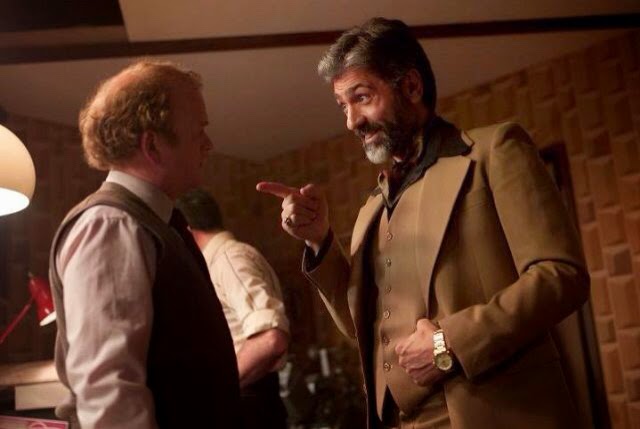
Let's make one thing clear, directly from the lips of Santini, the maestro behind The Equestrian Vortex, the movie on which Gilderoy labours. This is not a horror film. Sure it takes plenty of cues from the mise en scêne of giallo. Just look at the black gloves of the never-seen projectionist, the pumping, Goblin-like soundtrack from Broadcast. The film is full of attractive Italian voiceover girls, of just the kind that would find a horrible end in yer typical Eurohorror. But if you're looking for gore, best keep looking. The only things to see the edge of a blade in this movie are the fruit and veg that Gilderoy attacks to provide the sound effects for Santini. We don't even see a single frame of the film itself that the diminutive sound engineer reacts so strongly against. That being said, the sight of a witch being vaginally violated with a red-hot poker, the scene that causes Gilderoy the most problems, is one that I could do without.
Strickland's refusal to bow to expectations as to what Berberian Sound Studio is or how events in the film pan out have led many to view the film as a frustrating experience. I understand that. The film is deliberately slippery, dodging away from genre tropes and formula story beats. Santini isn't an anagram for Satan, however hard you try to make it so.

The trouble with slippery things is, of course, that they're hard to grab hold of, and Berberian Sound Studio remains opaque, asks far more questions than it answers. How much of it is real? Are we, as is suggested at the end, simply watching a film within a film? There's no definitive answer, and loose ends aplenty. It famously divided opinion right down the middle when it was screened at Frightfest in 2011. Even now, synopses of the film differ wildly and are mostly inaccurate, pitching the movie as proto-giallo when it's nothing of the sort.
Which brings us to the 64,000 lire question—was Berberian Sound Studios worth Unwrapping?
Yes, it was. Difficult but tought-provoking, it's at once a treatise on the craft and sheer hard work involved in getting a film made, and a warning of the cost that the process can exact on you. The people that Gilderoy encounters are, for the most part, monstrous. One of the ADR actors even goes by the nickname 'The Goblin'. Gilderoy, the very image of the innocent abroad, has no chance amongst these creatures.
As a stylistic exercise Berberian Sound Studio is a storming triumph, and there's enough going on to keep you watching, and guessing, until the end. And indeed after. Enter without expectations, and you just might find yourself ensnared.

Eat My Crescendo!
This month on The Speakeasy, Rob and Clive are joined by actual honest-to-heck film composer Neil Myers. Along with adagio and strings from the mighty Keith Eyles, we highlight composers we think are unfairly overlooked, and pick out a soundtrack each that’s a bit of a hidden gem.
First movement and opening titles, everyone…
https://soundcloud.com/rob-clive-speakeasy/august-film-music-speakeasy
Here’s a Spotify playlist with a lot of what we’re talking about…
and a few that Spotify couldn’t help us out with.
Cobra by Sylvester Levay
The Haunting Of Julia by Colin Towns
Perfume by Johnny Klimek, Tom Twyker, Reinhold Hell
To find out more about our very special guest, check out http://www.neilmyers.com.
Hands up who knew there was a new Terry Gilliam movie out. Continue reading Theories Of Invisibility: The Zero Theorem
Mike Tack goes for the throat in his latest urban horror short. Continue reading Two Careful Owners
The problem with food movies is that they are fundamentally incapable of expressing the two most important things about their subject: smell and taste. Don't mention Smell-O-Vision. A scratch and sniff card can no more evoke a beautifully cooked plateful of food than a kazoo can accurately reproduce Beethoven's Ninth. The end results are the same: faintly amusing but not the experience you want.
That's probably why there have been so few films explicitly about the subject. And of course, they can't just be about food–as much as I enjoy the M&S adverts, I couldn't sit through 90 minutes of them. All the good food movies deal with those aspects of the human condition that we most readily connect with food: love, sex and family. Look at Babette's Feast, where a woman expresses gratitude for the community that has taken her in by cooking them an extraordinary banquet. Or Big Night, a film that tracks the struggle for supremacy between two feuding brothers, which culminates in a remarkable wordless climax where they cook breakfast together. Tampopo contains one of the sexiest scenes featuring an egg yolk that you'll ever see.
Jon Favreau, he of Iron Man and presidential speech-writing fame, has taken a risk with Chef, his latest movie. Food films don't do well at the box office, for the reasons I've mentioned above. But Chef is first and foremost a film about the sacrifices that a really good cook will make to get to the top, and what happens when he's forced to reinvent himself–a process that reconnects him with the things he holds dearest.
OK, Cliffe Notes (and note that from this point, a SPOILER ALERT is in operation). Favreau plays Carl Casper, a top chef who feels as if he's stuck in a rut. It's a feeling that's starting to come out in his cooking. He's filling the house every night, and his boss is happy. But the reviews are stinkers, and Casper is starting to lose his way. After a cake-crushing meltdown in front of his food critic nemesis, Casper buys a ratty old food truck, and goes back to basics, cooking and selling the food he loved back in the day. With his estranged son and buddy line chef in tow, Casper sets off on a road trip that takes in some of America's culinary hotspots, and finds the flavour in life again.
So, it's a bit on the nose from an elevator pitch. But Chef works, for me, because it's good on the details. Favreau spent months in restaurant kitchens, working his way up from herb-chopping to line work. The restaurant scenes feel authentic and sharply observed, down to the way Casper cleans down his station att the end of a shift. Favreau enlisted the help of food truck maestro Roy Choi and Texas barbecue pit king Aaron Franklin to give his film some old-school patina. That's Choi's Cubano that everyone's talking about, and Mitchell serves fall-apart pork shoulder just like the one in the movie every day.
The clever thing about Chef is the way it dials into modern trends in food fandom. Food trucks and real-deal meat-smoking are obsessions with many foodies. Favreau also nails the importance of social networking to the scene: Instagram and Twitter are the way a lot of people initially hear about the hot places to eat, whether that be a Michelin-starred joint or a high-sider on a street corner pushing out the greatest food you can get on a paper plate. Let's also note here that Casper's meltdown is sparked off by a food blogger, not a traditional critic.
Chef is a deeply sensual, warm and funny film, with a great soundtrack of classic Cuban cuts, reggae and blues and solid performances from Favreau and his supporting cast. John Leguziamo buzzes and pops as Casper's line chef buddy, and Emjay Anthony, playing his son, is sweet and charming. I thought it was a shame that Scarlett Johannsen and Dustin Hoffman seem to disappear once Casper gets his food truck (which is a lust object in and of itself: that chrome! that griddle!) and that we didn't see more of Carl's life pre-restaurant in Miami. Where does that love of Cuban food come from? Maybe a director's cut is in the offing. Anyway, I wanted to see more, which has to be a good thing.
With the long-mooted adaptation of chef Anthony Bourdain's autobiographical/crime novel Bone In The Throat finally looking like it's going in front of cameras, there's a chance we could be seeing more interesting movies set in the world of food. On the evidence of Chef, I'd be happy to see more. The film has the highest of accolades from me–TLC and I left the cinema absolutely starving hungry.







 EXCUSES AND HALF TRUTHS