The Face Of Dredd

NewImage
Clicky for more piccy

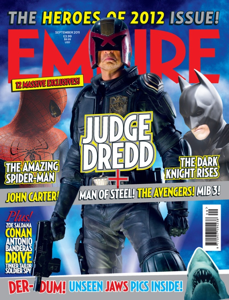
The release yesterday of the first real look at Karl Urban as Judge Dredd sent a certain portion of the nerdiverse, myself included, into geekgasm. It’s great to finally see the character up close. Every still we’ve seen up to now, coupled with Alex Garland’s taut, claustrophobic script, shows that Dredd The Movie is going to be a grim and gritty affair. The man in his scuffed bike leathers and stubble owes as much to Mad Max as the version we see every week in 2000AD.

I still think the helmet’s too big. But then, in the comic it has to serve as the top half of his head. Some artists have drawn it as so close-fitting that it would be impossible to get off. Either that, or Joe Dredd has made the ultimate sacrifice, and shaved off his ears. Urban’s hat is as close as dammit to the one that I have been drawing since I was 9, with the obvious exception of having to serve a real world purpose.

Of course, we’re now a world away from the Stallone version with the spandex and gold-plated plastic and the talking gun and flying bike. I cannot in all honesty defend the 1995 movie, although the first ten minutes is a very fine adaptation of the “Block War!” story. And goddamn, Stallone has the chin for the job. But I’m a purist, and the moment the hat came off was the moment that I lost interest.

Of course, you could argue that Dredd has taken his helmet off and we have indeed seen his face. At which point I’d note that you can’t fool a fanboy, because it’s clear you’re talking about The Dead Man. This was a spin-off strip set in The Cursed Earth that followed a drifter, burnt beyond all recognition, who is taken in by a friendly family of mutants. But the man has a past, and it hasn’t finished with him. The big reveal, that few readers saw coming was that The Dead Man was an amnesiac Dredd, left for dead by The Dark Sisters Of The Apocalypse.

This story is a major milestone in the Judge’s long history, and I’d argue it ties him much more explicitly to the fictional exploits of another iconic loner, Clint Eastwood. If Dredd in MegaCity is Dirty Harry, then in The Dead Man he has become, quite literally, The Man With No Name. Scarred and haunted, he becomes a clear analogue to the ghostly avengers of westerns like Pale Rider and High Plains Drifter. The look, though, is clearly based on William Munny in Unforgiven. His return to Megacity and Judgehood is marked by reconstructive surgery. The glimpse at Dredd’s face that we get in The Dead Man is fleeting and illusory. For the most part, we are left with the early legend that he is simply too ugly to be looked at directly.

NewImage

The fact that we never see Dredd’s face is kind of the point. He was imagined as an avatar of justice, soul-less, almost machinelike in his single minded dedication to The Law (always capitalised, as much an abstract concept as a set of rules). Through the last 34 years and thousands of progs, he has become much more, while still staying true to the core idea. He’s a cipher, on which any number of stories can be hung.

I’m pleased that the makers of the movie have embraced the unwritten rule of the character, and the helmet will be staying firmly on Karl Urban’s head. besides, as any fan knows, the face of Dredd is not the most important part…

NewImage

A Fiendishly Good War Comic

Wartime horror is one of those subgenres that’s never really taken off. War itself is horrific enough. You don’t need to overegg the pudding with something supernatural.
SF can get away with the setting, as it’s an excuse for cool dieselpunk gadgets and Nazi robots and that.
There’s been a bit of an upsurge in films about Nazi zombies lately, but really they’re just the walking dead in an emotive costume.

I’m kind of disappointed that there’s been so little material on Nazi vampires. I can’t think of anything in the realms of film apart from Michael Mann’s discodelic The Keep (oh, those lasers…). Angel and True Blood have both had WW2 vignettes.*

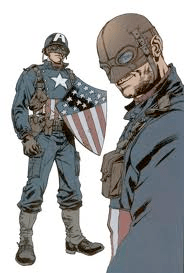
But it’s comics that have brought us the best examples of an admittedly niche trope. Some fine recent examples include the current run of American Vampire, and a lovely, creepy Captain America strip by Ed Brubaker and the sorely missed Gene Colan, that you can read in full here.
But for the definitive WW2 vampire story, look no further than my beloved 2000AD, and Fiends Of The Eastern Front. Drawn by one of the most celebrated artists on the British scene, Carlos Ezquerra, and written by one of it’s most under-rated scribes, Gerry Finley-Day, FOTEF is a stark, uncompromising and gloriously pulpy bit of horror.
The comic is set during the Russian campaign of 1942, and takes the form of a diary written by a German trooper, Hans Schmitt. His regiment becomes host to a group of Romanian partisans led by the charismatic Captain Constanta. They seem unstoppable in battle, and fight by night, spending the day asleep.
You’ve guessed it. They’re Transylvanian, and Schmitt discovers their bloody secret. Of course, none of his comrades believe him, and Constanta gives him a not-so-friendly warning. When the tide of the war turns, and Romania changes sides, Schmitt and his regiment face a new and remorseless enemy who are quite literally after their blood.
2000AD is unfairly tagged as the Judge Dredd comic, when it has published a wide range of solid genre work over the years. Their horror is particularly good (and probably worth a post all to itself), and I would hold up FOTEF as one of the AD’s finest hours.

Ezquerra’s stark black and white art is dripping with atmosphere and a sweaty, febrile dread. Findley-Day’s script is stripped to the bone, as tight and inevitable as a hangman’s noose. Bookended with a scene set in a Berlin bunker twenty years later that provides a neat final twist, FOTEF is a deeply satisfying read that motors along breathlessly. As a treatise on the way allegiances can all too quickly shift, and how trust be be so easily compromised, it has few equals in the comics field.
Finley-Day is best known as Tharg’s future war specialist, creating both Rogue Trooper and The VC’s. But FOTEF’s roots can be traced to his work with Battle and Action in the mid-70s. He was already known for creating sympathetic German heroes, and his work had a sharply political and cinematic edge. Rat Pack, an earlier collaboration with Ezquerra, is a neat take on The Dirty Dozen, and I can’t help but be reminded of Peckinpah’s Cross Of Iron when reading Hermann Of Hammer Force. Not least because Ezquerra’s heroes look a bit like James Coburn…
Fiends Of The Eastern Front was revamped (sorry) for modern audiences in the early norties by David Bishop, and those stories, dropping Constanta and his bloodsucking crew into real life battles, are a lot of fun. But the original is the best, and Gerry Finley-Day deserves recognition for a solidly original work of horror fiction. War, with Constanta at your heels, can indeed be hell.

Revolution Books have a nice new edition of Fiends Of The Eastern Front for your viewing pleasure, which include the original tale and David Bishop and Colin MacNeil’s reboot. Highly recommended.

*As expected, I has UPDATES from X&HTeam-mates. Ben Woodiwiss issues a Uwe Boll warning, and reminds me of Bloodrayne 3, which features more vampNazis than you can shake a stake at! Trailer here. Caution: not safe for anyone.

Meanwhile, Leading Man Clive has pointed me at this:

http://www.youtube.com/watch?v=cEI9BLZ6460

Looks like you have to go to the Germans for your Nazi Vampires…

The Mutant Question: X-Men First Class, prejudice and revenge

We humans are a venal, fickle bunch. We’re fine with superheroes as long as they’reaccidental (bitten, exposed to gamma radiation, struck in the face by toxic sludge); gifted by otherworldly outsiders (aliens or magical beings, or indeed aliens posing as magical beings); or if they’re otherworldly outsiders (aliens from a stricken red-sunned world, gods of thunder, Amazonians). If you’re unlucky enough to be born with your power, then we will fear and despise you. Talk about a mixed message.

(spoilers after the cut)

Continue reading The Mutant Question: X-Men First Class, prejudice and revenge

DC: Dunces and Conmen?

Every time I think the comics industry can’t get any stupider, something happens to make me wonder how I got so complacent.

No, hang on, let me qualify that. Every time I think the American superhero-based comics industry can’t get any stupider, something like, well, this happens. DC are cancelling and rehashing 52 of their titles, starting them all back at no.1 with simplified back stories and in some cases changes to the origins.

Retcons. The curse of the American superhero-based comics industry. Ever since DC killed Superman, brought him back in a new costume before slowly reverting him back to the old blue-and-red romper suit, this nonsense happens on an annual basis. The claim is always that creators want to do something fresh and new with the old franchises. Rubbish. It’s all about squeezing a few more cents out of them. The new editions are scheduled to take place over the traditionally quiet sales period of September. No. 1’s of any title always sell, and all of a sudden DC are flooding the market with 52 of the buggers at once.

The argument brought forward by DC head Dan DiDio is that it’s a chance to make the books relavent for a 21st century audience who have little investment in the stories of the past. Which is, in it’s way, fair comment. Fifty years of character development and story cruft can leave any title in a funk, unable to properly innovate or tell tales in a fresh way.

But, as comics blogger and funny-book shop owner Mike Sterling points out, a jumping-on point can also be a jumping off point. The end of a story gives the bored reader who just wanted to see how things turn out the excuse not to bother with next month’s issue. Especially if it’s not the character he or she enjoyed reading about.

I’ve long been bored with the American superhero-based comics industry’s obsession with huge, multi-book events and gimmicky promotions, to the detriment of decent characterisation and storytelling. If this event doesn’t work, it could signal a reboot for DC as a whole, becoming a placeholder for superhero franchises, a brand name for movies, TV shows and lunchboxes. Which can only be bad news for fans and retailers again. Mike Sterling again:

“While I’m curious as a fan about what DC is doing, as a retailer I’m a little worried. Not just about the jumping-off point thing I noted already, but also about how I’m going to explain this to the customers who are going to be caught completely by surprise by DC’s plans. I know it sounds strange, since all of you reading this are plugged into the Web Matrix-style via interface ports at the bases of your skulls, but I have regular customers for whom their exposure to comics news comes from walking into the store and looking at the rack to see what’s new. I can hear them already: “Hey, why is Superman at issue #1 again? And Batman? …And, hey, Legion of Super-HeroesAgain? What’s going on?” Which is fine…that’s part of my job, to explain what new dumb thing a comic publisher has done to confuse and frighten its readership this week.

But as a pal of mine noted to me in email, if this particular publishing initiative falls flat on its face, where does DC go from there? This is an awfully drastic and wide-ranging strategy that won’t be easy to reverse without some consequences. And not just of the “fans and Marvel Comics laughing at DC’s failure” kind, but having highers-up at Warner Brothers looking at the crash-and-burn and thinking “that didn’t work, so why are we bothering with these pamphlet-thingies? Let’s just do cartoons and movies with these characters, and make some real money on them.”

Yes, quite. Although I’m no fan of capes and masks any more, and will gleefully and at length point out how comics are so much more, I don’t want to see a huge part of the industry collapse into rubble. I can see DC’s core readership shrink rapidly as no-one wants to read crappy new interpretations of perfectly good characters, with no new fanbase to take over. I could be wrong. I really hope I am. But confusing and alienating your customers is no way to run a business.

However, there’s no reason you can’t have a little fun with the idea…

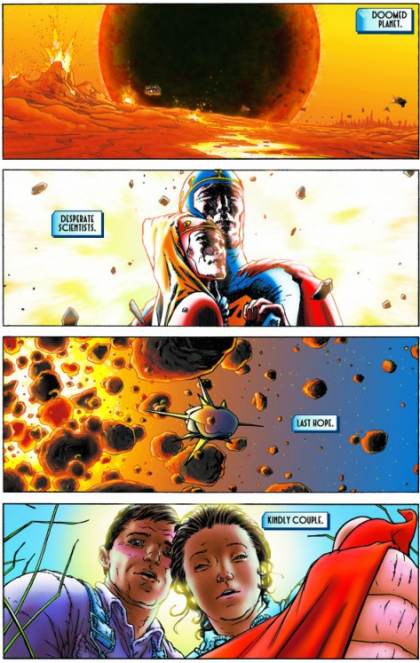
Oh, and if you want to know how to elegantly tell an origin story without letting it taking over an issue, Grant Morrison’s four panel recap that started off his masterly All-Star Superman is the way to go. Perfect comics work.

Four panels. Eight Words. Seventy Years Of Back-story.

*One last thing. The heads up/impetus/desperate steal of an idea at the end of a dry creative day for this one came from long time X&HTeam-mate, Rob May. His new geek-friendly website Cake And Lies is very much worth your time. And as he says here, there are prizes to be won.  

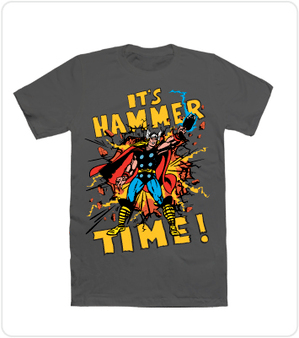
Hammer Of The Gods: X&HT Watched Thor

NewImage

Superheroes are mythical beings. They stand above and apart, capable of acts that we humble mortals can only accomplish in our dreams. In many cases they are not human at all, choosing to protect us out of some sense of loyalty or in gratitude for an act of kindness. They are otherwise aloof, and they have their own agendas and motivations. We should be grateful that they are not gods, for as any student of mythology knows, gods are cruel, capricious and selfish beings.

In 1962, Stan Lee, Jack Kirby and scripter Larry Lieber realised that they could take existing mythological beings, and tweak them for the comics market. Greek and Roman tales were too familiar. But the legends of Asgard had a fresh feel. Hence, with a crack of lightning, Thor, the God of Thunder appeared in the pages of Journey Into Mystery. He would battle monsters, man-made and otherwise, and struggle against the machinations of his brother and arch-enemy, the trickster Loki. Like many Lee/Kirby creations, Thor had an alter-ego, the crippled doctor Donald Blake, whose disguise would vanish should he strike his cane, the cloaked hammer Mjolnir, on the ground.

It’s hard to write about Thor without slipping into the vernacular. Lee and Leiber have no truck with understatement, and their prose can never be too purple. Thor and his Asgardian family speak in a strangled cod-Shakespearean English which makes no sense when you consider that they’re supposed to be Norse gods, but somehow fits with the goofy charm of the series. It’s widescreen, deep-focus, scenery-chewing fun of the highest order.

Kenneth Branagh, tasked with bringing nigh-on fifty years of myth, mystery and magnificence to the screen has taken the right approach. He’s kept things lighthearted, while giving the simple script some proper emotional heft and weight. He was always an interesting choice of director. He gets blockbuster action, while not allowing it to overwhelm the story.

The film looks great, taking the best parts of Kirby’s technomythological (yes, that’s a word now) designs and giving them a subtle modern sheen. The scale and spectacle of the piece give you, true believer, one big fat double page spread after another in full eye-popping Kirbyvistascope. Upgrading Asgard into a society that has moved beyond the simple definitions of magic and science is a neat move, and making sure that the Clarke Paradox gets an airing shows that he knows the core audience. The film is full of little nods and winks to the fanboi community, but they’re not in your face.

Our Ken is very much an actor’s director, though, and it shows. All the cast get a chance to shine, and help move the story away from Wagnerian bombast and towards a tale that has a little more humanity. I’d save special kudos for Jaimie Alexander, who embues warrior maiden Sif with the right blend of toughness and vulnerability. But it’s Tom Hiddleston as Loki that makes the film. Whenever he’s on screen, you can see him plotting, planning, always ten steps ahead of everyone else. In interviews, he’s admitted that this was how Branagh had directed him; another sign of how attuned the director is to the mythology.

If I have one grumble, it’s that the script gives Loki a backstory, a reason for his schemes. That’s unnecessary. Gods don’t need motives. Loki is a trickster because it’s in his nature. The scorpion will always sting, even if it means his own doom. It’s how the myth works.

Branagh and his cast and crew have proven themselves worthy bearers of the torch that Lee, Lieber and Kirby lit forty-nine years ago. At last, we’re starting to see superhero movies that can stand up to the weight of all that history, and all those stories, and present them with grace, wit and style. It’s a thundering good film. Excelsior!

Blood In The Gutter: A Comics Noir Primer

If you’re a fan of noir, if you like your crime tales bleak and nihilistic, if you like your movies to be in black and white, and your morals to be all shades of grey, then there are some comics that you should know about. See, crime stories were a news-stand staple long before the capes and masks came over the rooftops and camped up the joint. You could get your fix of guns, broads and hard-faced men making bad decisions in the newspapers. The true crime comics vied with Warren and EC’s horror titles for pure visceral, authority-baiting thrills. And that tradition carries on today with writers and artists across the planet giving us stories that hit hard and stay put.
Continue reading Blood In The Gutter: A Comics Noir Primer

Catching The Buzz – X&HT Reviews The Green Hornet

NewImage.jpg

The fun of The Green Hornet lies in its familiarity. A millionaire tools around The Big City, fighting crime by night as a masked vigilante, in a souped-up super car, faithful sidekick at his … side. Holy ho-hum!

But let’s not forget, the radio serial in which Britt Reid and Kato first stung crime predates everyone’s favourite Caped Crusader by three years. The hidden lair and funky weapons that would become a staple of the crime-fighter’s armoury also made their first appearances here. As an urban version of the Lone Ranger, and a testing ground for all kinds of superhero tropes that included the mask’s uncomfortable relationship to the law, the Hornet was popular for decades.

The new film version has been a long time coming. Kevin Smith’s original scripts for a version that came close to shooting in 2006 have popped up as comics (Smith has form with heroes of the verdant hue, starting his comic career with a sterling run on Green Arrow. I’m sure there’s a Green Lantern script kicking around his hard drive somewhere). The Seth Rogan script that finally went before cameras helmed by French lo-fi wizard Michel Gondry was sat on by Sony for the best part of a year, and suffered innumerable reshoots. But it’s here now, and to my mind works as a fitting tribute to the gleeful silliness at the heart of all superhero fiction.

The film plays out as dumb, loud comedy, but it’s honest to its sources and to the shows and films they influenced in their stead. There’s a house-wrecking fight scene straight out of the Pink Panther movies (Blake Edwards loved the Kato character so much that the closest he came to disguising Inspector Clouseau’s sidekick’s origins was to change a consonant in his name). The irreverent tone and slapstick are nods to the William Dozier/Greenway Productions stable that sired both the Green Hornet and Batman shows in 1966. There’s a (possibly) clever skew here too though, as The Green Hornet was played straight, with little of the camp humour that made the Adam West show so popular. Nice to see the propulsive Billy May/Al Hirt theme tune popping up towards the end too.*

The neat twist to the Green Hornet story is that the true hero of the partnership is the sidekick. The Green Hornet show famously made a star out of Bruce Lee, and it’s a dynamic that, while hardly original these days, still has comedy and dramatic value. While I don’t think the new Kato, Taiwanese pop star Jay Chou, has the charisma of The Dragon, he has the moves. His masked counterpart Seth Rogen handles the many fight scenes with aplomb, floundering around after his black-clad buddy and getting in a couple of good hits … purely by accident, of course.

Whether you buy him as the hero of the piece depends on how you like him in general, because there’s no great artistic stretches in the acting. Rogan plays the same affable stoner he’s always played, giving Britt Reid the air of a low-rent Tony Stark (playboy crimefighters with daddy issues. The genre’s full of ’em). Christophe Waltz plays the Eurotrash bad guy Chudnovsky with flair, nailing the ridiculousness of the themed villain when he changes his name from one unpronouncable syllable salad to another. Cameron Diaz appears to be in it so that she can prance around in short-shorts at one point. Tom Wilkinson and Edward James Olmos add gravitas.

Michel Gondry finds himself in the same boat as any other cinematic stylist that takes on the Hollwood suitcase full of dollars. There’s little there to tell you that the director of Eternal Sunshine and The Science Of Sleep is behind the camera at all. The much-touted games he wanted to play with the 3D format aren’t really obvious. The action is frenetically comic-booky without going the extra yard or so that might have made it really interesting. I have the feeling that the director’s cut, should we ever see it, would be a very different film to the one I saw.

I wanted a 2D screening, but my local Vue couldn’t accommodate me. I had no option but to splash out for a 3D screening, and spent it popping the glasses on and off to see the differences. I found for the most part I didn’t really need them, and subsequently left the cinema without my usual stereoscopy-derived headache. The end titles looked nice in 3D though, and I was pleased to see that just about every Blambot font made an appearance in a crazed Lichtensteiny Benday-dot frenzy of OTT typography.

I enjoyed The Green Hornet quite a bit. It’s stupid, loud and nonsensical. But then so were the radio, movie serial and TV shows based on the character that came before. In that sense, the new version is carrying on the tradition admirably.

*Pop Quiz: an X&HTrophy to the first person to answer this in the comments: in which Quentin Tarantino film did the Green Hornet theme make an appearance?

Kindle, Spotify and the view outside the box

TLC bought me a Kindle for my birthday. It was bound to happen. She swears by the Sony e-reader I got her last year, and both Leading Man Clive and Wetdarkandwild are advocates of Amazon’s sexy new toy.

I have to say, I love it. It’s as skinny as an overweight fashion model, perches in the hand like an attentive bird, and is almost Mac-like in it’s simplicity of use. It’s funny how many people I’ve shown it to that have begun prodding at the e-ink screen as if it’s an iPad. In a lot of ways the dedicated controls are even easier to use than the swipe-to-turn gesture that the iPhone uses on it’s Kindle app.

My one concern was that it would not be able to read the electronic library I’ve accrued over the last couple of years. This was unfounded. It’ll happily read PDFs, .rtf and even .txt files with aplomb, keeping the formatting impeccably. I have a chunk of cash to spend, which will granted mostly be going to the Kindle store, but I am still downloading and reading other formats – most notably Cory Doctorow’s new collection With A Little Help, available in all kinds of free and paid versions. I hadn’t realised just how much I had to read in electronic form. As publishing models begin to inexorably change, and readers begin to embrace new formats as a complement to the existing ones (I, for example, have no interest in reading comics and graphic novels in an e-format. I really don’t like reading things panel-to-panel, and Comixology’s Guided Technology is just infuriating) it’s going to be very interesting to see how things open up. Certainly, as a writer with a vested interest in new markets and opportunities for my work, it feels like exciting times.

With that in mind,  can I point out that this looks great on a Kindle right now?

Meanwhile, my love affair with Spotify continues, getting sloppier and ickier by the second. I have an Unlimited account, which for a fiver a month gives me all the music I can eat with none of the ads. There are some obvious omissions and holdouts on the service, of course. Most annoyingly for me, The Arcade Fire aren’t there. But then I bought The Suburbs on the day it came out so it’s no biggy.

But the point is that The Arcade Fire was one of about five albums I’ve bought this year, down from a figure that was getting up to ten times that five years ago. I have not downloaded anything from a link that does not have the creators stamp of approval, and does not put money into their pockets. I’m using sites like Bandcamp (where I discovered and bought Zoe Keating’s astonishing album Into The Trees) a lot more. Everything else has been streamed. I’ll probably treat myself to the new/old Springsteen. Apart from that, the subscription has me covered. On those rare occasions when the service does go down, I still have a hundred gigs or so of tunes in the drives. Granted, if the service is ever bought or merged (witness the reports earlier in the year that Google wanted it) it could change in ways that would make it a lot less attractive. But for me, for now, streaming this playlist to our surround amp through Airport Express and Airport, the world seems like a very big, very musical place.

For the most part I use Spotify in conjunction with music blogs like The Quietus and No Rock And Roll Fun, which broaden and open up my horizons without having to budge off the sofa. At this time of year, when all the best-of-the-year playlists come up, Spotify comes into it’s own as a way of catching up and finding new things to love.

Looks like 2011 is the year when I don’t just start thinking outside the box, but living outside it too.

RED and the finer points of growing up rather than old

TLC and I went to the pictures yesterday, and thoroughly enjoyed RED, a movie about Special Ops killers coming out of retirement after their lives are threatened by a spectre from their past. This makes it sounds all grim-faced and dark, and that’s exactly how the graphic novel by Warren Ellis and Cully Hamner reads. It is a dark little tale with very little in the way of humour or even light patches, and a very unhappy ending.

The film is nothing like that. It takes Warren’s themes and setpieces and ties them into a story that bears only passing resemblance to the book. This is a very good thing. It’s one of the most entertaining films I’ve seen in a while, with a script that understands the mechanics of the action movie, but winks and blows them a kiss as it breezes by. It’s a lot of fun, but it also has a heart and backbone, and takes time to make the point that being retired doesn’t make you useless. Far from it. Frank Moses, the RED of the title, played as Bruce Willis by Bruce Willis, is always one step ahead, always capable of thinking on his feet. He’s not an impotent old man or an easy target. And he’s even mature enough to shrug off the jibes about his hair.

There’s a wonderful moment towards the end of the film when he explains to his opponent Cooper (played with aplomb and empathy by Karl Urban, who I’m now very excited to see as Judge Dredd) about what it has taken to bring him here, and the awful lessons he’s had to learn. He is the lonely, unstoppable ronin because he has lost everything he’s ever cared about. The last hurrah that RED documents so entertainingly is his last chance at redemption, rather than revenge. It’s a chilling moment that brings home a few home truths about the process of growing up and growing old, and the things we have to lose along the way.

For me, RED’s major strength is in the casting of its female characters. These are front and centre, the engine of the story rather than the brakes. Rebecca Pidgeon is sharply efficient as the cold Control of Urban’s killer. Helen Mirren is regal and deadly, and you can just tell she was having a blast with the heavy artillery. [SPOILER ALERT] Even the commuter that John Malkovich’s character threatens with a gun comes back at him with a rocket launcher. [/SPOILER ALERT]

But it’s Mary-Louise Parker that makes the show for me. Goofy, sweet and tough all at once, always ready for a challenge and an adventure. There are no simpering dolly-birds here. You can see from the first minute of the film why Frank is so smitten with her. I am too.

Interestingly, there were a bunch of screensurfers in the back row. You know the sort, kids that’ll get in for one film then stick around all day moving from screen to screen. They were clearly intent on just chatting and pissing around, until the cinema as a whole made their feelings perfectly plain. A cinema, incidentally, full of people in their thirties and forties – the target audience for RED. An aural eye-roll (how do kids DO that?) and a muttered “Cuh, old people” was the closest we got to rebellion, and they sloped away minutes before the explosive end to the film. Their loss, in all kinds of ways. There was a lesson to be learned, if they could have been bothered to listen.

Warren gives us his insight into the story and themes of RED in a piece for the Guardian HERE. The figure of the Unretired Hero isn’t going away anytime soon.