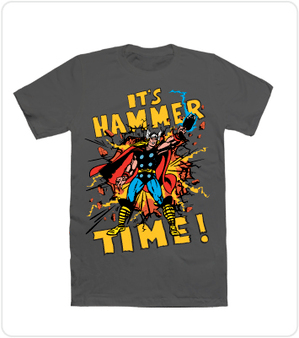
Hammer Of The Gods: X&HT Watched Thor

NewImage

Superheroes are mythical beings. They stand above and apart, capable of acts that we humble mortals can only accomplish in our dreams. In many cases they are not human at all, choosing to protect us out of some sense of loyalty or in gratitude for an act of kindness. They are otherwise aloof, and they have their own agendas and motivations. We should be grateful that they are not gods, for as any student of mythology knows, gods are cruel, capricious and selfish beings.

In 1962, Stan Lee, Jack Kirby and scripter Larry Lieber realised that they could take existing mythological beings, and tweak them for the comics market. Greek and Roman tales were too familiar. But the legends of Asgard had a fresh feel. Hence, with a crack of lightning, Thor, the God of Thunder appeared in the pages of Journey Into Mystery. He would battle monsters, man-made and otherwise, and struggle against the machinations of his brother and arch-enemy, the trickster Loki. Like many Lee/Kirby creations, Thor had an alter-ego, the crippled doctor Donald Blake, whose disguise would vanish should he strike his cane, the cloaked hammer Mjolnir, on the ground.

It’s hard to write about Thor without slipping into the vernacular. Lee and Leiber have no truck with understatement, and their prose can never be too purple. Thor and his Asgardian family speak in a strangled cod-Shakespearean English which makes no sense when you consider that they’re supposed to be Norse gods, but somehow fits with the goofy charm of the series. It’s widescreen, deep-focus, scenery-chewing fun of the highest order.

Kenneth Branagh, tasked with bringing nigh-on fifty years of myth, mystery and magnificence to the screen has taken the right approach. He’s kept things lighthearted, while giving the simple script some proper emotional heft and weight. He was always an interesting choice of director. He gets blockbuster action, while not allowing it to overwhelm the story.

The film looks great, taking the best parts of Kirby’s technomythological (yes, that’s a word now) designs and giving them a subtle modern sheen. The scale and spectacle of the piece give you, true believer, one big fat double page spread after another in full eye-popping Kirbyvistascope. Upgrading Asgard into a society that has moved beyond the simple definitions of magic and science is a neat move, and making sure that the Clarke Paradox gets an airing shows that he knows the core audience. The film is full of little nods and winks to the fanboi community, but they’re not in your face.

Our Ken is very much an actor’s director, though, and it shows. All the cast get a chance to shine, and help move the story away from Wagnerian bombast and towards a tale that has a little more humanity. I’d save special kudos for Jaimie Alexander, who embues warrior maiden Sif with the right blend of toughness and vulnerability. But it’s Tom Hiddleston as Loki that makes the film. Whenever he’s on screen, you can see him plotting, planning, always ten steps ahead of everyone else. In interviews, he’s admitted that this was how Branagh had directed him; another sign of how attuned the director is to the mythology.

If I have one grumble, it’s that the script gives Loki a backstory, a reason for his schemes. That’s unnecessary. Gods don’t need motives. Loki is a trickster because it’s in his nature. The scorpion will always sting, even if it means his own doom. It’s how the myth works.

Branagh and his cast and crew have proven themselves worthy bearers of the torch that Lee, Lieber and Kirby lit forty-nine years ago. At last, we’re starting to see superhero movies that can stand up to the weight of all that history, and all those stories, and present them with grace, wit and style. It’s a thundering good film. Excelsior!

Five Horror Films You’ll Never See In A Horror Festival

An interesting discussion on the Frightfest forums about the nature of the genre – and more specifically, when is a horror film not a horror film – led me into a bit of a muse last night. Frightfest was one of the first venues in the country to show The Girl With The Dragon Tattoo. A strange but somehow logical place to show a film about a woman-hating serial killer. The curators have frequently shown movies that stretch the bounds of what you or I would call horror.

Which films, I thought, would be out of bounds to most horror festivals? I’ve come up with a list of five films that I reckon really wouldn’t fit the bill. You might not agree, but that’s part of the exercise. I’d love to know if you think I’m wrong, or which films you’d put on instead.

Continue reading Five Horror Films You’ll Never See In A Horror Festival

A Ring, A Tree and Yuan Fen: How We Interviewed Iain Sinclair

The second filmed interview in a week led docoDom and I to Hackney. This one would be a big deal. As part of the M25 Spin documentation, Dom had somehow snagged a chat with Iain Sinclair, acclaimed author and, for our purposes, writer of probably the best book about the ring around the capital, London Orbital. It would be a long, tense, but massively rewarding day.

Continue reading A Ring, A Tree and Yuan Fen: How We Interviewed Iain Sinclair

Both Sides Of The Track: Source Code, Sucker Punch And Fun And Games In The Multiverse

Source Code is a tightly written, sharply executed dose of intelligent SF, with winning performances and characters that you can care about. Why then does it remind me so much of Sucker Punch, the bloated ugly adolescent fantasy I ragged on last week?

Continue reading Both Sides Of The Track: Source Code, Sucker Punch And Fun And Games In The Multiverse

Low Blows And Dirty Tricks: X&HT Saw Sucker Punch

I’m grateful. Really, I am. It’s good to have a low water mark against which all else can be judged. It’s good to know that when a friend rags on a film that you can chip in and say, “Yeah, but at least it’s not…”

Let’s put it another way. We have our new Battlefield Earth.

Continue reading Low Blows And Dirty Tricks: X&HT Saw Sucker Punch

Shaken And Stirred: Against Shaky-cam

An interesting post hit yesterday on Salon from director of photography Matt Zoller Seitz. A summons to arms, a battle cry. In it, he calls out the increasing practice of directors and DOPs to use shaky-cam techniques on multi-million dollar films. The specific example he mentioned was Battle: Los Angeles (yes, THAT film again. Welcome to Battle: LA week. Not my intention, honest. Like I plan any of my content) but Paul Greengrass and Michael Bay are also singled out for special attention. You could argue that most big-budget actioners use this technique to a greater or lesser degree, and in a worst-case scenario, almost exclusively.

In Battle: LA, I assume that the idea was to give the impression of an embedded reporter following alongside 25 Recon. This reporter is clearly suffering from the coffee shakes. Shaky cam turned the last Bond film into an incomprehensible mess as the Broccolis tried to put Bourne style shot-work into the franchise. It was one of the flawed decisions that would stall the resurgence of Bond in it’s tracks.

I don’t want to spend time synopsising Matt’s post, so I’ll simply add my approval. There’s a whole genre of horror films that pose as found footage from camcorders in the tradition of The Blair Witch Project, and I can’t be alone in finding them unwatchable. They give me motion sickness, and are pretty much unreadable. There’s no sense of staging, or frame-building. Hand-held techniques, used sparingly, can be incredibly effective. When they become the only technique, there’s a problem. It looks cheap, ugly and lazy.

The problem is, it’s everywhere. Bandwagon jumping has always been an issue in Hollywood. A film-maker does something innovative, and others rush to follow. When shaky-cam techniques were folded into the effects sequences of Firefly and Battlestar Galactica, Hollywood made notes. The Star Trek reboot forgot the sweeping, graceful camera passes across the surface of the Enterprise as it flew past in favour of jittery zooms and whip pans. NCC-1701 is a beautiful ship, and it needs to be eye-candy, not half-seen in a thick layer of fake motion blur.

Shaky cam is hard to shoot, too. You need a multi-camera set-up, and even then there’s no guarantee that you’ll catch everything you need. It’s a mess to edit, a pain to sound sync and horrible to grade. As you can probably tell, I’m not a fan.

I don’t want to see the end of hand-held, by any means. It’s been a vital part of film technique since the French New Wave. But it’s time to stop relying on it as a way to mask poor direction, effects and acting. As Matt says: Get a tripod. Write a set list. Stop covering action. Start directing again.

Cannon Fodder: the changing face of the villainous horde

NewImage

Battle: Los Angeles is a war movie. Let’s get that out of the way right now. The SF trappings are there to pull in the core audience of 16-25 year old males who will happily sit through it in the same way that they’d sit through a walkthrough of Crysis 2 on YouTube. But it’s really an excuse to have US military, modern US military with their grenade lobbing rifles and laser sights and night vision wage war against an enemy with which they can actually get their fight on. There is no fear of accidental civilian deaths or any of the horrible tangled messiness that modern warfare against an enemy that remains undefined and hard to find has become.

SF has always provided this kind of unambiguous thrill. As the audience becomes less and less excepting of the traditional war movie (which after all served primarily as propaganda against countries that have now been friends and colleagues for over fifty years) there’s still a need for shootybangbang excitement against a villainous horde. If you can make that villain completely fictional, and of a different species to the hero, then all to the good.

The aliens in Battle: Los Angeles are faceless, emotionless avatars, existing only to shoot and to be shot at. They spindle around in a backward-leg walk, and fire guns that have been grafted onto their arms. They couldn’t surrender if they wanted to, or were given the chance.

There’s little sign of pain or any kind of emotion when M-16 slugs tear through them (or, in one memorable sequenced, skewered on a bayonet and then torn apart by M-16 slugs). They make that default monster noise that’s becoming as over-used as the Wilhelm Scream, and then they fall over. As such, they’re simply the latest in a long line of invaders that runs all the way back to War Of The Worlds. Think the swarming hordes of James Cameron’s Aliens, mirrored helmets topping a drooling tooth-filled maw. The creatures of Independence Day, blankeyed and mouthless. Notice too, that the writers haven’t even bothered to give the enemy proper names. They are simply called by their function. Alien. Invader. Enemy. Monster.

Creatures from the Doctor Who universe have names, at least. Of their species, anyway. On the whole, they still follow the same idea of being interchangable, indistinguishable. Daleks and Sontarans differ from the Hollywood Horde ideal in that underneath the expressionless masks they wear, something hideous lurks. The Cybermen take this one step further – they were humanoid once, and chose to lock all that away behind a blank carapace. There’s a little more depth there, but their intentions remain the same. They are set on conquest and colonisation.

The Stormtroopers of the Star Wars Universe have the same purpose. Spookily, under their helmets, they all look the same. They’re clones, and therefore again one step away from the human. They’re constructs, manufactured and therefore easily expendable. And again, they have a collective name rather than anything that would allow us to see them as individuals, to give us the chance to empathise.

The one flipside to this idea that I’ve been able to find comes in, of all places, from the first Austin Powers movie. A running gag showed the home lives of some of Dr. Evil’s henchmen after they were killed by the International Man Of Mystery. Giving a faceless hench a wife, a family, friends and a social life is unthinkable in most of the cases I’ve talked about. We’re not supposed to care about them. They are obstacles to be removed without thought or consequence.

As @JaesonX pointed out to me on Twitter, SF invasion pics are starting to shrug off the old cliches. District 9 takes a much more complex and nuanced approach to the theme of first contact, a situation that’s unlikely to begin with the two sides shooting at each other. Gareth Edwards’ Monsters tells us that we’re just unlikely to be able to figure out what they want here in the first place. Both films end, not in full-scale conflict, but a grudging, uncomfortable co-existence, marred with sporadic violence. This can be tracked back to shows like Alien Nation, where the visitors arrive not as aggressors, but refugees. This reflects the fluid nature of national identity, racism and touches on the way people view their territory and the people that come into them in ways that the basic war movie simply doesn’t have the tools to address.

There will always be a place for war movies. But we live in a complicated world, and it’s sometimes difficult to figure out who the bad guys should be. I’m holding out for the first war movie that pits the USA against it’s own banking system. That’s a fight with some life in it.

(pic credit: Francesco Francavilla).

Why The Aliens Of Battle: Los Angeles Deserve Their Beatdown

Spoiler alert

nyakyakYAK
... and I look GOOD without a shirt.

I am the commander of an invasion force. We have travelled across the stars to parasitise a small, blue planet somewhere on the Western Spiral Rim of the Milky Way. Specifically, my comrades and I have come for its water. There’s a lot of it. This “Earth” (such a foolish name for a world whose surface area is 70% water) is a rich prize.

Because I am not stupid, and because I understand that a) tactically, high ground gives you a major advantage and b) there is no higher ground than low orbit, I begin my assault by making a note of all the major gathering points of the indigenous population. Usefully, these are lit up at night.

Then I start throwing rocks at those population centres. They don’t need to be massive. Just big enough not to burn up on their way through the atmosphere. Something the size of a skyscraper, tiny in terms of the masses of rock and metal that swing around the sun in tandem with the blue world, would have a pretty appreciable effect on a major urban conurbation when it’s travelling at several miles per second. I don’t even need to be that accurate. Shockwaves and airborne debris would do most of the work. Then it’s a simple mopping-up operation.

Or, if I’d rather start a harvest of the water without causing genocide, I could land my forces in the middle of the Atlantic and Pacific, and set up seaborne facilities that would be difficult to detect until it was too late. I could have a defence grid in place before the aboriginals have a chance to organise a meaningful response. Maybe I’m already at it. You’ve heard of the Bermuda Triangle, right?

The one thing I would unquestioningly not do is land a ground force on coastal zones of high population without immediate air support, and then force them to fight inland in order to start a refuelling and harvesting operation from the sewers. The sewers, for fate’s sake. This would afford me the barest trickle of the resources that are clearly available. You know, all the blue stuff I can see from orbit? The stuff I came hundreds of light years to get at? Why would I fight an expensive and potentially ruinous land war against natives who, quite rightly, are going to be pretty honked off at what I’m up to? Like I said, I’m not stupid.

I am the commander of an invasion force, and I laugh at your Aaron Eckhart, just before I throw an asteroid at him.

The Spirit Of The West: X&HT Watched Rango

Rango is a film that shouldn’t work. It’s a droll, adult-oriented Western pastiche featuring a wildly ugly protagonist, from a studio that had never done a full animated feature and a director that had never worked in animation. But it does, and not only that, it’s one of the best films I’ve seen all year.

Continue reading The Spirit Of The West: X&HT Watched Rango

Follow The Money: X&HT watched Inside Job


It’s telling that Charles Ferguson’s Oscar-winning documentary Inside Job hits UK screens in a week when no less a figure than the head of the Bank Of England has made it clear that the blame for our financial woes should be placed squarely on the shoulders of the banks. Telling, and in some ways heartening, although the conclusion Ferguson reaches in his film isn’t at all comforting.

Like a financial version of An Inconvenient Truth, or a less schmaltzy Michael Moore, Inside Job makes no attempt to be objective. It’s a film that has no interest in painting the leading monetary figures behind the 2008 bust as anything but ogres or incompetents. Ordinarily, I’d be bothered about the fact that so many of the key players declined to be interviewed. But in these arena that doesn’t really matter. It’s the numbers that count, and Ferguson does a good job of showing how the venality of the banking sector tried and failed to skew those numbers in the interest of quick and massive profit.

It’s a film that demands your full attention. One point that the bankers who are seen in Congress sessions make time and again is that the situation is and remains way too complex for we mere mortals to understand. Ferguson uses graphics and a measured, careful narration from Matt Damon to ensure that we can.

We are taken though a history of financial deregulation since the Reagan era that led to investment banks packaging loans that were designed to fail, and betting that they would in the quest for spiralling short term profits and bonuses. It is complicated, I’ll admit. I’m a complete doofus when it comes to money, and I found myself squinting more than once at the screen to make sure I got it. But it’s worth the effort.

The end picture is clear. The banking industry in the US (and although it’s not mentioned, I realised there was a direct correlation to the UK bailouts of Lloyds and Northern Rock) has systematically engineered a structure in which it can operate without regulation or any real restraint, and with the clear understanding that they will be bailed out by government funds if they should screw up.

The failure to appear by most of the big noises in this perfect storm begins to look less like a flaw, and more like an admission of guilt. It’s a dirty journalistic trick, to be sure, and Ferguson doesn’t come across as a sympathetic interviewer. But the silence at the heart of the film speaks volumes, and you get the feeling that these guys very definitely have something to hide. Something that Ferguson’s simple, clear graphs and extensive research winkle out with mathematical precision.

In short, no-one in this story gets away clean. When the rot even extends to the compromised state of the educators at Harvard and the Columbia Business School (who, while they should have taken the Fifth that their smarter colleagues invoked, also provide some wonderfully squirm-inducing moments) you have to wonder if there’s anyone you can trust with your money anymore.

Inside Job is a brutal indictment of an awful situation that has been allowed to fester for years. Sadly, as Ferguson points out, not only are the banks in question unlikely to be punished for their misdeeds, many of the key players are still in power, and in many cases in central roles that will enable them to dictate US and hence world financial policy under the Obama administration. It’s not an easy or fun watch, but I think it’s essential, and left me wanting to know more. There’s a lot of cant and waffle about the state we’re in, and we need more work like Ferguson’s to at least begin to answer the unasked questions.

I wonder if George Osborne’s seen it.