

I spent the weekend in the garden, and had to face the rambling wildness of our herb patch. In particular, the time had come to do something about the horseradish. Continue reading Riding The Horse
Category: Fodderblog
Thank You For Smoking
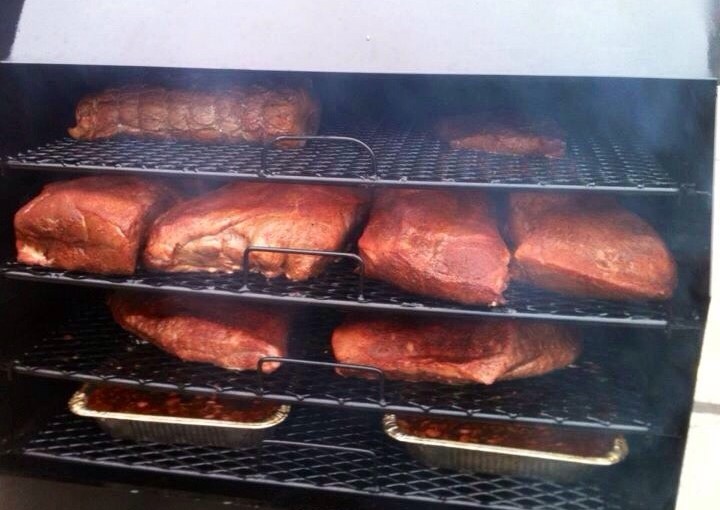
As the weather starts to draw in, and you start to think about digging jumpers and coats out of the wardrobe, you might think it's time to pack the barbecue away. Although it's probably past the time of year for you to be standing in front of a blazing grill in your shorts and “Kiss The Chef” apron, you might still get a bit of traction out of that unused bag of charcoal yet.
Readership, you may recall that I have been playing around with the notion of smoking my food. Certainly, our recent trip to Seahouses and the beautiful kippers and smoked prawns that they served up sharpened my appetite for all things hot-cured. Let's not forget, autumn is a time of bonfires and woodsmoke. Why not use that to our advantage?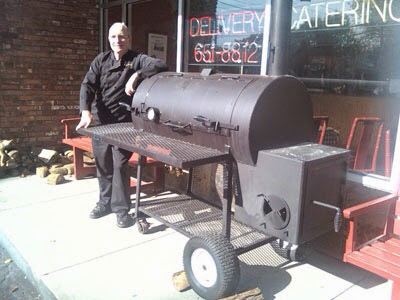
Now, my slightly cobbled together smoker is a testament to what can be done with an unassuming starting point–to whit, a lidded barbie from B&Q that we picked up half price a few years back. It's never really done the job, sadly, somehow managing to take ages to come up to heat. I'm an impatient man when dinner time is near, and it's very tempting to just slap that steak on my cast iron griddle, especially if I'm just cooking for the two of us.
But really, a lidded barbecue is all you need to start smoking. WIth the addition of a thermometer that gives you the optimum temperature for cooking with smoke, you're away.
Now, I mentioned that I'm not a patient man, but this method of cooking will teach you how important that virtue is. There are no shortcuts when you're smoking food. When you're cooking ribs or a pork shoulder, you need to be thinking in terms of 12 hours or so, 8 at a bare minimum. Fish or chicken won't take as long. Maybe six hours. The serious players in the US barbecue scene put their meat on overnight. The really dedicated guys sleep with their ovens, all the better to tweak the temperature or wood mix.
Slow and low, that is the tempo. The Beastie Boys said that, and who are we to argue? Do not allow your coals to go over 225 degrees (farenheit, that's about 110 celcius). I find it's best to just use one of those little bags of self-lighting coals, which will heat up and cool quickly, but hold enough residual heat to keep things ticking over nicely. If I need to change over, It's just a case of covering the meat in foil while I dump another bag in.
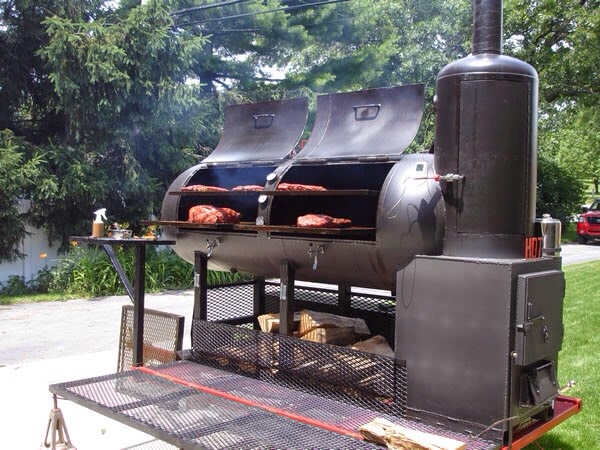
You'll need wood in there as well, of course, soaked for an hour or so beforehand so they'll smoke rather than burn. Some barbies have a tray in which you can spread the chippings. If not, just form a rough bowl out of a couple of sheets of foil and pop the wood in that, next to the meat or fish. A sturdy jug of water will help to keep the atmosphere in the oven nice and moist too, helping the smoke to permeate deeper into your dinner.
The choice of wood is yours, and most garden centres have a reasonable selection (or, of course, there are online resources). Oak's better for fish and chicken, the more robust flavours of mesquite work brilliantly with beef and pork. Play around, see what works.
IIt may sound perverse after you've got up at six in the morning and spent all day watching a barbecue puttering away, but it's really nice to char your meat a little on a grill once it's smoked. It's the double cooking that makes the end result so mind-blowing. We had some pork ribs recently that, after 8 hours smoking, I drenched in Sweet Baby Ray's (the one and only barbecue sauce, accept no substitute) and blasted on a hot griddle. The end result was full of smoky flavour, absurdly rich and unctuous. Even TLC, who normally won't go near a rib, had three or four.
It's early days for me with this technique, and I'm absolutely guaranteed to have messed something up (all advice, hints and tips welcome, drop 'em in the comments if you would be so kind). I haven't even touched on the complex subject of wet and dry rubs, marinades and sauces. Again, any suggestions are very welcome.
But I'm eyeing up the bag of chicken in the freezer, thinking about a big bag of prawns, maybe a side of salmon. And considering how nice the sharp autumnal air in my back garden is going to smell with the sharp tang of woodsmoke in it.

Will There Be Kippers, Then, For Tea?
It takes six hours, if you're prepared to drive with little in the way of breaks, from the gates of X&HTowers to Seahouses, the jewel of the Northumberland coast. Readership, I'm here today to tell you: it's worth the trip. Continue reading Will There Be Kippers, Then, For Tea?

The American Burger
The chunk of time between sixth form and college was tough for me. I didn't get the grades I needed for university, so I had to stay behind while a lot of my friends, the best and brightest of my year, went off to study. My girlfriend was one of those that left. She went to Cambridge, and she found someone else. Someone who was, you know, there. I read the Dear Rob letter on a busy Victoria Line train into work. I burst into tears in a packed tube carriage.
Like I said, tough times.
Family life was equally interesting. Mum and Dad had split up while I was studying for 'A' Levels, and as I studied for retakes, I realised I needed to take some time away from the tumult of life with my mum and brothers. I had become one of those sensitive teenagers who wrote poetry and moped constantly. With a broken family home and my romantic life in tatters, I suffered as no young man ever had before or would after.
Christ, I was insufferable.
Dad, at the time, was living in a small house in Wanstead, and I moved in over that summer of 1985 to get my head together and sort out enough of an improvement in my grades to get the heck out of Essex. It was a peaceful time. I looked after Dad's shop (he was even good enough to call me the manager) to earn my rent and a little beer money, wrote and studied.
And Dad started to teach me how to cook. It was, he said, an essential skill for when I set off on my own. Also, he'd had to bloody learn when mum kicked him out, so he was going to pass the pain on. He had a limited repertoire, gleaned mostly from the two cookbooks on his shelf, but one treat was always his American Burgers, a recipe he'd found in a newspaper and carefully noted down in his round, solid cursive.
Common knowledge now is that burgers are at their best treated simply, with care taken as to the mix of fatty and lean meat used. Back then, Dad used what he had, knowing that the flavours and spices that went into the burger would give it the right taste. They became a weekly treat for us, one that we would often cook together, with the tape player blasting out Bruce Springsteen.
The other week, TLC and I drove up to Essex to visit the 'rents. Time has been kind. Mum and Dad got back together during my first year at college, buying a new house and making things right with each other. I had done enough to get a place at the Dorset Institute Of Higher Education (now Bournemouth University) and packed my bags for the south coast in the autumn of 1986. In one of those bags was the notebook in which I had cribbed my favourite recipes from my time with Dad. The American Burger was in there, of course. It was a connection to home, and to a peaceful, healing time.
Dad doesn't cook very often anymore, but when he does the grub is always good. We had a sort of indoor barbecue on the Saturday night, and he pulled out the big guns. The American Burger was on the menu. He still has the notebook in which he wrote the recipe, stained and brown from decades of use. The Burger tasted just as delicious as it always had. I had no Proustian moment connecting me to the tumultuous past, no great epiphany. But I have fond memories of cooking with my Dad in that summer, as he and Mum gently negotiated a truce, then the rebudding of a romance.
I'd like to share that recipe–as best I can, anyway. You can't get the Knorr onion soup mix it recommends any more, so you'll have to manage with what you can find. Dad uses an Ainsley Harriott mix, if that's any help. If you do have a fatty mince blend, then you can probably get away without the egg. But try it as is, just to give you an idea of the flavours of my bumpy adolescence.

AMERICAN BURGERS
- 1lb minced beef
- half-package Knorr dried onion soup mix
- one raw egg
- seven squirts, Lea & Perrins Worcestershire Sauce
- three squirts of Tabasco
- one tablespoon of Daddie's Sauce
- four shakes of garlic salt
- half a chopped onion
Mix together. Makes 3
Cook in hot frying pan, cover, 2-3 minutes each side.
Extras:
- white sesame-seed bun
- iceberg lettuce
- Kraft cheese slices
A Quick Summer Traybake
Those working weekday dinners are such a bind. The clock's ticking from the moment you get in the door to the second that food hits the plate. You want something that's nutritious, tasty and above all quick. Is it any surprise that, as the hardest-working nation in Europe, we've fallen back on ready meals, pasta or pizza? When you've done a full day's work, gathering up the energy to sort out dinner is tough.
But there are ways and means. Although I'm the first to admit that I sometimes fall back on rigatoni with sauce from a bottle, there are other alternatives for that dull Wednesday evening when the tempation is high to roll past M&S or the chippy. How about this summer traybake–really easy and full of the flavours of this golden season?
As you walk in the door, get the oven on and preheating to 200C, and put a pan of water on to boil. I have been known to do this before I take my jacket and shoes off. Now you may kiss the partner and tickle the cat.
Once the water's bubbling, throw in some salt, then a handful per person of new potatoes. They'll need ten minutes to parboil. Now grab a sturdy roasting tray. Chuck in some chicken thighs or breasts, cut into slightly bigger than bitesize pieces, a thickly sliced red onion, and cherry tomatoes. Leave them whole. If you don't have cherries, normal size ons are fine, but quarter them.
Once the spuds have had their ten minutes, drain them and throw 'em in with the rest of the meat and veg. Mix everything up and give it a generous seasoning and a good glug of olive or rapeseed oil. Fresh herbs would be nice here too: robust thyme or fragrant rosemary. Oregano works as well.
Then just pop the whole lot into your hot oven, and set a timer for twenty minutes. Time for a beer, perhaps.

After twenty minutes, check the tray, and give everything a stir around. The potatoes should be golden at the edges, the onion soft, the chicken a bit sticky. If it's all looking a bit pale, just give it another ten minutes. Bear in mind that the spuds won't go as crispy as roasties, but they will go fudgy and soft. Half an hour in total is all this dish'll need at absolute maximum.
Once time's up, just mix everything up a bit, squirt over a little lemon juice, sprinkle on some parsley and serve. Looks good, eh?

Now, this dish is really tweakable. You could use little pork chops or thick fish fillets to replace the chicken (if you're using fish, no more than twenty minutes in the oven). If you're feeling bold a whole fish would work beautifully. You could add mushrooms, peppers, some whole garlic cloves, maybe parsnips or steamed sweet potatoes as the weather cools. Have a play, put in the flavours that you love and make it your own.
That's better than an M&S curry, isn't it?

Soul Food
I have an old and slightly crummy barbecue, that I converted into a smoker yesterday. Continue reading Soul Food
Crock-pot ‘Barbecue’ Pork
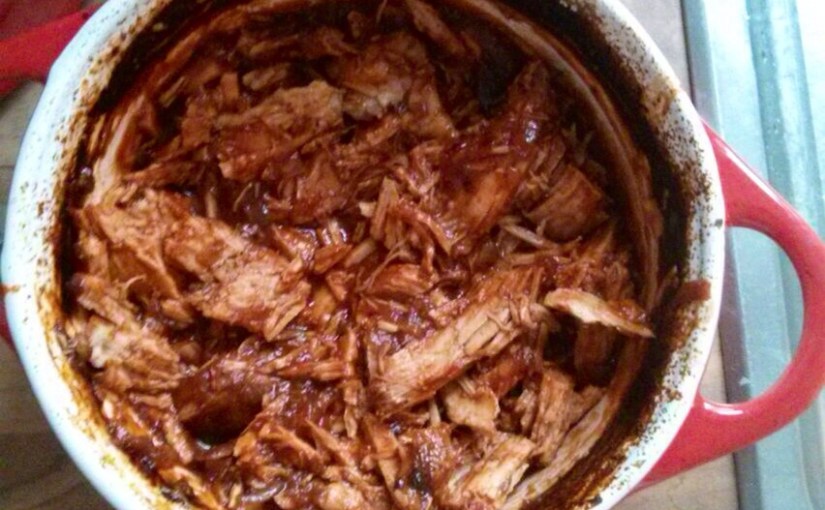
There's been a lot of talk about Blake's 7 recently. It's made me real hungry. Continue reading Crock-pot ‘Barbecue’ Pork

Chef: satisfying the hunger for a good food movie
The problem with food movies is that they are fundamentally incapable of expressing the two most important things about their subject: smell and taste. Don't mention Smell-O-Vision. A scratch and sniff card can no more evoke a beautifully cooked plateful of food than a kazoo can accurately reproduce Beethoven's Ninth. The end results are the same: faintly amusing but not the experience you want.
That's probably why there have been so few films explicitly about the subject. And of course, they can't just be about food–as much as I enjoy the M&S adverts, I couldn't sit through 90 minutes of them. All the good food movies deal with those aspects of the human condition that we most readily connect with food: love, sex and family. Look at Babette's Feast, where a woman expresses gratitude for the community that has taken her in by cooking them an extraordinary banquet. Or Big Night, a film that tracks the struggle for supremacy between two feuding brothers, which culminates in a remarkable wordless climax where they cook breakfast together. Tampopo contains one of the sexiest scenes featuring an egg yolk that you'll ever see.
Jon Favreau, he of Iron Man and presidential speech-writing fame, has taken a risk with Chef, his latest movie. Food films don't do well at the box office, for the reasons I've mentioned above. But Chef is first and foremost a film about the sacrifices that a really good cook will make to get to the top, and what happens when he's forced to reinvent himself–a process that reconnects him with the things he holds dearest.
OK, Cliffe Notes (and note that from this point, a SPOILER ALERT is in operation). Favreau plays Carl Casper, a top chef who feels as if he's stuck in a rut. It's a feeling that's starting to come out in his cooking. He's filling the house every night, and his boss is happy. But the reviews are stinkers, and Casper is starting to lose his way. After a cake-crushing meltdown in front of his food critic nemesis, Casper buys a ratty old food truck, and goes back to basics, cooking and selling the food he loved back in the day. With his estranged son and buddy line chef in tow, Casper sets off on a road trip that takes in some of America's culinary hotspots, and finds the flavour in life again.
So, it's a bit on the nose from an elevator pitch. But Chef works, for me, because it's good on the details. Favreau spent months in restaurant kitchens, working his way up from herb-chopping to line work. The restaurant scenes feel authentic and sharply observed, down to the way Casper cleans down his station att the end of a shift. Favreau enlisted the help of food truck maestro Roy Choi and Texas barbecue pit king Aaron Franklin to give his film some old-school patina. That's Choi's Cubano that everyone's talking about, and Mitchell serves fall-apart pork shoulder just like the one in the movie every day.
The clever thing about Chef is the way it dials into modern trends in food fandom. Food trucks and real-deal meat-smoking are obsessions with many foodies. Favreau also nails the importance of social networking to the scene: Instagram and Twitter are the way a lot of people initially hear about the hot places to eat, whether that be a Michelin-starred joint or a high-sider on a street corner pushing out the greatest food you can get on a paper plate. Let's also note here that Casper's meltdown is sparked off by a food blogger, not a traditional critic.
Chef is a deeply sensual, warm and funny film, with a great soundtrack of classic Cuban cuts, reggae and blues and solid performances from Favreau and his supporting cast. John Leguziamo buzzes and pops as Casper's line chef buddy, and Emjay Anthony, playing his son, is sweet and charming. I thought it was a shame that Scarlett Johannsen and Dustin Hoffman seem to disappear once Casper gets his food truck (which is a lust object in and of itself: that chrome! that griddle!) and that we didn't see more of Carl's life pre-restaurant in Miami. Where does that love of Cuban food come from? Maybe a director's cut is in the offing. Anyway, I wanted to see more, which has to be a good thing.
With the long-mooted adaptation of chef Anthony Bourdain's autobiographical/crime novel Bone In The Throat finally looking like it's going in front of cameras, there's a chance we could be seeing more interesting movies set in the world of food. On the evidence of Chef, I'd be happy to see more. The film has the highest of accolades from me–TLC and I left the cinema absolutely starving hungry.

Rob’s Dirty Rice
There's nothing wrong with plain, simple white rice. It's calming, pure, and my accompaniment of choice to most meals. As a counterpoint to spicy flavours, you can't go wrong. In some cuisines, it serves as a mop-cum-utensil for sopping up a gravy-thick stew.
But the joy of rice comes around when you start adding stuff to it. Risotto. Paella. Fried rice. Biryani. And the Deep South way: dirty rice. Now, my way with dirty rice is completely inauthentic. Regular members of The Readership will be aware that I have a tendency to read through the traditional method, and then merrily go my own way. But know this: my dirty rice is damn tasty and even… a little bit healthy.
Start, of course, with the star of the dish. For this, basmati or sticky rice won't give as good a result as plain ole long-grain. Cook it first, using whatever method suits, and let it cool slightly. My rice cooker, as ever, does sterling service here, and I'm sometimes frugal and forward thinking enough to throw a couple of corn cobs in the steaming basket to cook over the rice. Saves time, effort, energy etc.
Heat a couple of tablespoons of oil in a big, deep, frying pan, and when hot, add two teaspoons each of cumin and sweet paprika. If you're feeling frisky, throw a little chili powder in there too. Let that bubble for a minute or so. Now for some veg. Traditionally you'd add the cajun trinity of onion, celery and green pepper. I used a big spring onion and half a red pepper. I was feeling lazy, had a scallion to use up and there wasn't a green pepper in the house. I am unrepentent.
Aaaanyways. Give the veg a couple of minutes to soften, then add a handful of frozen peas, and a few pucks of frozen spinach. This stuff is genius. It softens quickly in a hot pan, adding a shock of greenery and all the benefits of a leafy green, without needing to cook down huge bags of the stuff. A cheeky way of getting some goodness into any stew or ragu.
Now, bear in mind you've just thrown frozen stuff into a hot environment. That means the temperature in the pan will drop, but you'll also add a little moisture, which will create a kinda-sorta sauce to coat the rice. Season, then simmer until the spinach has broken apart and the peas have gone bright green.
Now throw in a handful of raw prawns, and the rice. Stir through, and cook until the prawns have gone pink. A couple of minutes, which should be enough time to heat the rice through. Once all is steamy and sizzly, throw over a handful of chopped parsley, pile onto plates and dig in. 
Needless to say, this is astonishingly versatile. Great with grilled chicken or fish, as part of a barbeque, or alongside a spicy stew. You can zazz it up with some cooked chicken, chorizo or sausage, maybe sweetcorn. As a weekday lifesaver, I think this is an essential part of the repertoire.
Oh, and I found myself humming this while I was at the stove. Dirty rice, I want you, dirty rice I need you, oh-whoa…

Fodderblog: Bruges
You will struggle to go hungry on a visit to Belgium. There's just too much on offer.

