In The Cloud: iOS And The New Wave Of Mobile Computing

I try to keep the fanboi squeee regarding Apple and their products to a minimum here on X&HT. I use them almost exclusively, but in the past I’ve been … evangelistic about them. To the point of heated argument, which is downright silly. I’d like to think I’ve mellowed over time, and spent a year tinkering with Linux on my netbook. Advisory before I begin, therefore: other computing platforms are available.

Continue reading In The Cloud: iOS And The New Wave Of Mobile Computing

Cut: Censorship,The BBFC and Human Centipede 2

In a move that’s boggled the minds of UK horror fans, the BBFC have refused to certificate the sequel to Tom Six’s The Human Centipede, Human Centipede 2: Full Sequence. 2009’s Jap horror Grotesque was the last film to join this rarified club of films too awful for the sensitive British public to see.

Continue reading Cut: Censorship,The BBFC and Human Centipede 2

Who Rules? Who Rules!

NewImage

Ah, Saturday night telly. Safe, secure home of talent show, hospital drama, old film. And of course, also the place to go for head-mangling, multi-level, wildly self-referential and furiously uncompromising science fiction.

That would be Doctor Who, which always stuck out of the Saturday night schedules like a Sontaran at the dinner table. Gleefully absurd, cheap and cheerful, dark at heart yet always somehow comforting. Effects straight out of the Blue Peter school of sticky-back plastic. Acting straight out of regional theatre.

Yeah. Not any more. Not for a long time. Under Russell T. Davis and more recently Stephen Moffat, Doctor Who is now the best-looking, best acted show on the box, and one of the most contradictory. Ostensibly still a kid’s programme, at least when you look at the extensive BBC website and all the associated mercy, Doctor Who is at the same time deeply complex and terrifyingly adult. It not only refuses to talk down to it’s audience, but launches off in all directions at once and dares the viewer to keep up.

This season, Moffat’s second as show-runner, has been made with money from BBC America, and was supposed to be the moment when the show would break in the States. You would expect, then, a couple of episodes in which a new audience could be eased gently into the story. Something entry-level, with a decent dose of explanation about who the guy in the blue box that’s bigger on the outside than the inside is.

Nope. Sorry. Within ten minutes of the opening titles, the Doctor had been killed, and then reappeared as a version from an earlier timeline. There was something about Scream-faced monsters that you forgot about as soon as you looked away from them. And where the hell did the red-headed broad from E.R. come from? Also, when the heck did the show with the monsters made out of bubble wrap get so goddamn scary?

Since the reboot, Doctor Who has been in the hands of writers who not only get the Doctor and all his dichotomies, but were responsible for keeping the flame lit during the wilderness years. The Paul McGann TV movie aside, the period between the end of Sylvester McCoy’s time in the Tardis and Christopher Eccleston shrugging on the leather jacket was one of furious invention and true high concept adventure. In books, audio and comics, writers like Davis, Moffat and Paul Cornell could carve out stories that didn’t have to be concerned with budget or kid-friendly attitude. They could bring a Doctor to life that had rarely been seen in the shows, a Doctor filled with moral ambiguity, a Machiavellian manipulator. More importantly, a Doctor that instils fear. The Doctor that can turn armies around at the very mention of his name came out of this free and fertile period.

Today’s Doctor Who is a very different programme to the one I grew up with, the one that scared me behind the sofa for two seasons running. The pace, of course, has sharpened, as stories are fitted into forty-five minute slots instead of the two-hour four parter format. Although it’s good to see more two-part cliffhangers, giving the characters a little more room to breathe. It’s also more overtly scary, as Moffat creates adversaries designed to exploit our all too human weaknesses, the flaws in our perception of the world. Creatures that attack in a blink, or hide in the shadows.

And all of a sudden, more adult fears are also being exploited. Constant, unexplained surveillance. The doppelganger, the enemy with your face. Or the terror of a mother losing her child. All tied into a narrative that has no problems with skipping hundreds of years and light years in a single jump cut. It’s epic, demanding and yes, exhausting work. To be honest, I tend to watch the show on catchup, when I feel ready for it. That also gives me the rewind option for those reel “huh?” moments.

But Moffat’s refusal to compromise hasn’t lost him viewers. Considering what else is on around the same time, it’s not a surprise that anyone with the taste for big, brash but thoughtful action would be all over this show. I have niggles with the way the show has so tightly interwoven with it’s backstory, but these are only niggles. Doctor Who is far and away the best thing on British telly at the moment. It’s fearless, tough and when it hits the big notes, a sheer and utter joy. It lures high end names and the best writers in the business. When I realised it was going on break until the autumn, I yelled in disbelief. Although the big reveal wasn’t that huge a surprise, it’s wonderful to finally have River Song’s place set in stone. And with these six episodes, the set up for something extraordinary to come rolling out of the gates in September is well and truly in place.

Now all I need is one of those damned time machines so I can see those episodes now!

The Minor Fall, The Major Lift: 5 Soundtracks That Transcend Their Movies

These are good times for film soundtracks. Reputable dance acts are now willing to work with a director and come up with music that complements and adds to the visuals, rather than simply licensing a couple of songs to play over the end credits. Instead of a duff compilation or an orchestral suite, soundtrack albums are becoming sharp experimental works with a proper narrative flow.

The big beat boys of the nineties make music that has always had a cinematic edge, and the addition of an orchestral edge to the bounce really opens out the sound. Basement Jaxx’s work on Attack The Block adds theremin to the mix, accentuating the sci-fi. The Chemical Brothers created a jagged, jittery soundscape for Hanna that seems to have influenced Joe Wright’s cutting style.

Then of course, there’s the epic score to Tron: Legacy, which has frankly raised the bar for electronic soundtrack work. The scale and sweep of Daft Punk’s work made the album one of my favourites of last year.

A decent soundtrack album can be a sheer joy, mixing great songs with massive instrumentals and moments of mood and drama. Some don’t work at album length. I’m thinking specifically of John Carpenter’s Assault On Precinct 13, which is simply the same cues played over and over again at different track lengths. Or, sadly, Clint Mansell’s music to Moon, which I love to bits, but is stretched uncomfortably thinly over 75 minutes. The final ten-minute piece Welcome To Lunar Industries (Three Years) gives you everything you need. Tellingly, it’s the one track not available on Spotify.

There are certain soundtrack albums that have managed to find an identity above and beyond their origins, becoming works of art in their own right. Here are my top five. I’m sure there are more. I’m sure you’ll let me know.

Continue reading The Minor Fall, The Major Lift: 5 Soundtracks That Transcend Their Movies

DC: Dunces and Conmen?

Every time I think the comics industry can’t get any stupider, something happens to make me wonder how I got so complacent.

No, hang on, let me qualify that. Every time I think the American superhero-based comics industry can’t get any stupider, something like, well, this happens. DC are cancelling and rehashing 52 of their titles, starting them all back at no.1 with simplified back stories and in some cases changes to the origins.

Retcons. The curse of the American superhero-based comics industry. Ever since DC killed Superman, brought him back in a new costume before slowly reverting him back to the old blue-and-red romper suit, this nonsense happens on an annual basis. The claim is always that creators want to do something fresh and new with the old franchises. Rubbish. It’s all about squeezing a few more cents out of them. The new editions are scheduled to take place over the traditionally quiet sales period of September. No. 1’s of any title always sell, and all of a sudden DC are flooding the market with 52 of the buggers at once.

The argument brought forward by DC head Dan DiDio is that it’s a chance to make the books relavent for a 21st century audience who have little investment in the stories of the past. Which is, in it’s way, fair comment. Fifty years of character development and story cruft can leave any title in a funk, unable to properly innovate or tell tales in a fresh way.

But, as comics blogger and funny-book shop owner Mike Sterling points out, a jumping-on point can also be a jumping off point. The end of a story gives the bored reader who just wanted to see how things turn out the excuse not to bother with next month’s issue. Especially if it’s not the character he or she enjoyed reading about.

I’ve long been bored with the American superhero-based comics industry’s obsession with huge, multi-book events and gimmicky promotions, to the detriment of decent characterisation and storytelling. If this event doesn’t work, it could signal a reboot for DC as a whole, becoming a placeholder for superhero franchises, a brand name for movies, TV shows and lunchboxes. Which can only be bad news for fans and retailers again. Mike Sterling again:

“While I’m curious as a fan about what DC is doing, as a retailer I’m a little worried. Not just about the jumping-off point thing I noted already, but also about how I’m going to explain this to the customers who are going to be caught completely by surprise by DC’s plans. I know it sounds strange, since all of you reading this are plugged into the Web Matrix-style via interface ports at the bases of your skulls, but I have regular customers for whom their exposure to comics news comes from walking into the store and looking at the rack to see what’s new. I can hear them already: “Hey, why is Superman at issue #1 again? And Batman? …And, hey, Legion of Super-HeroesAgain? What’s going on?” Which is fine…that’s part of my job, to explain what new dumb thing a comic publisher has done to confuse and frighten its readership this week.

But as a pal of mine noted to me in email, if this particular publishing initiative falls flat on its face, where does DC go from there? This is an awfully drastic and wide-ranging strategy that won’t be easy to reverse without some consequences. And not just of the “fans and Marvel Comics laughing at DC’s failure” kind, but having highers-up at Warner Brothers looking at the crash-and-burn and thinking “that didn’t work, so why are we bothering with these pamphlet-thingies? Let’s just do cartoons and movies with these characters, and make some real money on them.”

Yes, quite. Although I’m no fan of capes and masks any more, and will gleefully and at length point out how comics are so much more, I don’t want to see a huge part of the industry collapse into rubble. I can see DC’s core readership shrink rapidly as no-one wants to read crappy new interpretations of perfectly good characters, with no new fanbase to take over. I could be wrong. I really hope I am. But confusing and alienating your customers is no way to run a business.

However, there’s no reason you can’t have a little fun with the idea…

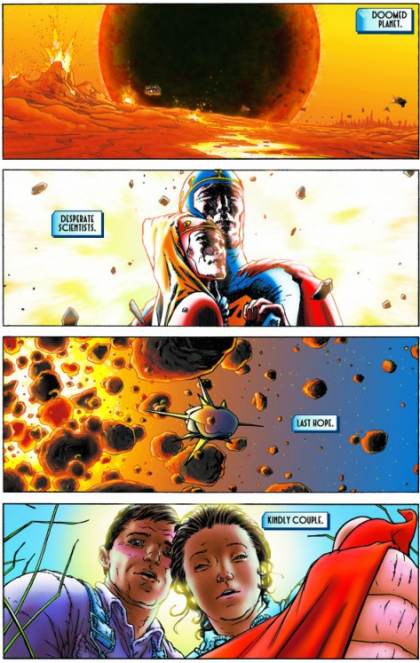
Oh, and if you want to know how to elegantly tell an origin story without letting it taking over an issue, Grant Morrison’s four panel recap that started off his masterly All-Star Superman is the way to go. Perfect comics work.

Four panels. Eight Words. Seventy Years Of Back-story.

*One last thing. The heads up/impetus/desperate steal of an idea at the end of a dry creative day for this one came from long time X&HTeam-mate, Rob May. His new geek-friendly website Cake And Lies is very much worth your time. And as he says here, there are prizes to be won.  

Lyrics That Make You Want To Listen To Instrumentals

I’ve been listening to The Icicle Works again lately – Ian McNab’s epic bombast suits my mood, especially here under the grey dome of a typical late spring bank holiday.

Their breakout single “Love Is A Wonderful Colour” is wonderful, widescreen bellow-along stuff, but the opening line almost knocks you out of the spell the band are trying to create.

“My friend and I were talking one evening, beside some burning wood…”

That, I guess, would be a bonfire. I’d listened to the song for years, but only recently glommed on to how clumsy that opening line is. Now, of course, it’s all I can hear. Great.

This fumbled attempt at mystery and atmosphere, while at the same time trying to keep the metre and rhyme of the song in check can lead to some unexpectedly hilarious or outright bizarre lyrical choices. Take, for example, one of my favourites, Thin Lizzy’s “Jailbreak”. Phil Lynott asserts:

“Tonight there’s going to be a jailbreak, somewhere in this town…”

I’d start with the jail.

Comedian Russell Howard pointed this one out, and I have to hold back from yelling “try the jail!” whenever I hear the song. The song also contains a prime example of Lynott’s way with the ladies:

“Searchlight on my trail
Tonight’s the night all systems fail
Hey you, good lookin’ female
Come here!”

You can’t resist, can you? This is the man who allegedly coined the come-on line “Got any Irish in you? Would you like some?” You have to at least admire the swagger and testosterone in the couplet above, and the wink in it is almost visible.

Sometimes, all you need is one syllable to make a line scan, and the temptation is to jam one in and damn the consequences. That’s all that I can think was going through Paul McCartney’s mind when he wrote the opening verse of “Live And Let Die”. It starts off with a philosophical flourish:

“When you were young, and your heart was an open book, you used to say live and let live…”

All good so far. But then we get a sentence that doesn’t seem to know when to finish.

“But in this everchanging world in which we live in…”

CLANG. Brakes on. A binful of prepositions, and all of a sudden Sir Paul is tripping over his own feet. Makes me give in and cry.

Readership, you all know of my love and admiration for R.E.M. but even the saintly Michael Stipe gets it wrong every so often. Famously, the band’s first album Murmur was titled after Michael’s less than clear vocal delivery. Sometimes, it might be better if he mumbled a bit more. The lovely Leaving New York contains the line

“…leaving was never my proud…”

which I would dearly love someone to explain to me. It doesn’t even rhyme properly with the next line of the chorus. In a song that has a strong personal meaning for TLC and I, that line sticks out like a gangrenous thumb.

Of course, the king of rotten lyrics is Simon Le Bon of Duran Duran. He seems to be quite happy to sling together any old word salad as long as it matches the tune. My personal favourite is from “Wild Boys”, where our Simon loses the plot and the ability to string a sentence together all at once:

“You got sirens for a welcome
There’s bloodstain for your pain
And your telephone been ringing while
You’re dancing in the rain
Wild boys wonder where is glory
Where is all you angels
Now the figureheads have fell
And lovers war with arrows over secrets they could tell…”

There’s plenty more where that came from. Although I’d disagree with the school of thought that claims the line “You’re about as easy as a nuclear war” is one of the worst ever. It has the right level of over-the-top silliness that suits the Dran in their heyday.

We could go on and on, but I don’t want to turn this into a simple “crap lyrics” post. It’s the lines that almost work that are the most fun. Besides which quoting out of context does every songwriter here a disservice. There is one that always makes me smile, though, and I want to conclude with Sade. I am happy to say she taught me something about American geography when she sang:

“Coast to coast, LA to Chicago…”

The Windy City is, as any fule with access to Google Maps no, 800 miles inland. I guess “LA to New Jersey” didn’t have the glamourous cosmopolitan ring Sade was after.

The End Of Recorded Music: Bill Drummond And The17

Let’s begin with a few words from artist musician and cultural rabble-rouser Bill Drummond.

Drummond has always been about flipping the switch on baked-in ideas about art and music, but this is something else. Performance for the sake of performance, completely dissolving the boundaries between musician and audience, to the point where they become one and the same entity.

In his explanation of the concept found here Bill mentions influences as disparate as Yoko Ono and Steve Reich. I’d add the experiments David Byrne carried out in Brooklyn, turning an old warehouse into a musical instrument. I’m also thinking about Jem Finer’s Longplayer, a software instrument designed to play by itself for a thousand years without ever repeating. Or his Score For A Hole In The Ground, a tuned series of metal bowls that play a random melody when water is dripped onto them from above, hidden in a forest in Kent.

I find conceptual music deeply fascinating and satisfying, and the idea of a piece of music mutating and evolving beyond the reach of it’s composer is an amazing idea. The17 aren’t quite there yet – they are still organised by Drummond, and sing libretti that he has written. But this will change, I’m certain. And Drummond has stated his intention to set it free on his 60th birthday in 2013.

There is something so freeing and fresh in these ideas. I find it more and more difficult to connect with modern chart music, which has become shamelessly blatant in the way it cribs older songs, or have the sound and lyrical content of skipping rhymes. Yes, yes, I know, old git thinks music ain’t worrit used to be. Which is a rubbish argument, because there’s a lot of great new music out there. And let’s not lose the image of me bouncing up and down on the sofa cackling at Eurovision a couple of weeks back. I’m still not convinced about Drummond’s argument that all music has been heard to death, either. But a radical stance is the first move towards new way of thinking, and Bill has always been an innovator.

You could argue that performance by and for a small group is as ancient as gatherings around campfires. But then sometimes we need to see where we’ve been to understand where we’re going. I love the Spotify model of complete access to a vast range of music. I love discovering new and old music alike. (an example: this absolutely gorgeous version of Leonard Cohen’s Suzanne by… well, you’ll be surprised. Pleasantly.) The17 ties into that process of discovery and distills it down to a very pure, clear extract. A perfect circle, welcoming and enclosed all at once. Music for the initiated, performed in an open church.

The next The17 performance will be in Portugal on June 17th. For more details, or if you’re interested in participating, check the website.

On a slight deviation, Bill Drummond is the unheard voice in our conversations about the M25 Spin, following chats with Gimpo and Iain Sinclair. Dom is in contact with him, and it’s a dear wish of mine to be able to chat to Bill about the Spin, The17 and his other projects. We remain hopeful, and will update you as news becomes available.

The End Of The World, Continued

NewImage

It’s a big old world out there, and everyone has their own ideas about how it’s going to end. It would be silly of me to suggest that the Christians have the whole Empty Earth thing wrapped up. And anyway, the concept of The Rapture bothers me. I think the whole idea of a chosen few being whisked away to safety leaving all the non-believers behind is incredibly selfish. There’s an element of that in all religions, of course. Our way is the right way, and the rest of you can (quite literally) go to hell. It also gives a whole new spin on the idea of Christian family values.

Every culture has a view on the apocalypse. The Abrahamic tradition (your Jews, Christians and Islamics) tend to view it as the end of all things. God ringing down the curtain as punishment, or rebooting creation as it’s started going a bit funny and his spreadsheet package has frozen. Buddhist and Hindu philosophy tends to think cyclically. As one age ends, another begins. It’s almost a seasonal thing, the endless cycle of death and rebirth. I can sympathise with this. Every time I think I’ve wrought the End Times on the weeds in my garden, back they come, regular as the new Golden Age.

Most religions seem to agree that we are living, if not in the End Times, then at the corrupted end of a cycle. Hindus call it Kali Yuga. The thinking goes that as we and our world go through time, we devolve from divine beings that know nothing of sin, into the sort of base creatures that can happily watch the X-Factor. According to Buddha, our life spans are also attached to this cycle. In the past, people lived for 80,000 years and were endowed with beauty, grace and strength. Over time, as we took on more worldly habits (organised religion, frozen stuffed crust pizza, Sky Sports) our life span and the gifts that go with it started to decline. Eventually, as the cycle comes to an end, we will live for ten years, become sexually active at five, and hunt each other for sport. Once only a few of us are left to repent that we ever thought Eastenders was any good, we will somehow regain virtue and become again divine. See, much more sensible than this Rapture nonsense.

I’m intrigued by the idea that most religions think that we are living in a time that is significantly more corrupt and evil than any that has gone before. I’ve heard that argument before. From my nans, mostly. Things were so much better when they were kids. There was Hovis for everyone, and there was none of this war stuff, you know apart from the war.

This hearkening back to a mythical Golden Age, and dire warnings for our future if we don’t behave, has been going on for longer than you think. Sumerian cave writings have been found that gloomily document a society grown weak, venal and corrupt – a society that, the grumpy writer predicts, will soon collapse into rubble. These writings, surely the first example of a Daliy Mail editorial, have been conservatively dated to around 2800BC. Which goes to show. If we really are living in Kali Yuga, we have been doing so for a veeeeery long time.

Boom Bang A Bang: How Twitter Saved Eurovision (for me, anyway)

So, here we are again. The day after Eurovision. We’re all feeling a little grainy, a little dull around the edges, perhaps a trifle embarrassed at how much time we spent on Twitter last night.

Twitter has transformed Eurovision for me. It turns the show into a community pastime. I wouldn’t be caught dead at a Eurovision party, but I’m more than happy to sit at home, drink copiously and rant on the webs about the silly minutiae of Moldovan headwear or the relationship status of the Azerbaijani pair. And I know full well that there are hundreds, thousands of people out there all doing the same. I’ve bitched about the show in the past, but I simply couldn’t resist, despite fair warning from Twitterpal Selcaby:

(I missed out a couple. I was cooking dinner at the time.)

It can seem that the whole thing devolves into a scrum where everyone is shouting at the telly at once, and you do sometimes wonder whether the songs are getting the fair judgement that they deserve. But then there were some genuine clunkers and deranged decisions at the Dusseldorf Arena that needed commentary. And more and more celebs seemed to be joining in this year. Charlie Brooker, Chris Addison and Caitlin Moran all added a welcome dose of acid to the event.

Eurovision has become, despite (or perhaps because of) the obviously partisan voting a genuinely exciting and unpredictable contest. I was certain, to the point of nearly putting money down, that the Hungarian entry would romp away with the prize. She never got out of the bottom eight.

Ireland’s blatant attempt to make sure that they didn’t winning by fielding sugared-up quiffbots Jedward looked as if it could backfire, and at one point midway through voting they were looking dangerous. Well, as dangerous as a pair of ADHD-twitchy bubbleheads in red leather can look, anyway. Which just goes to show that Eurovision is as much about the performance as the song, and a dose of surrealism can actually catch you some mileage.

As for the UK, well, at least we’d moved away from the talent-show method of picking an act, and for that managed the best result we’ve had in years. Untouched by partisan voting (six points? THANKS, Ireland) we stayed resolutely mid-table, but with none of the embarrassment of the nul points years. The song was a bit of a clunker, but the back-to-business approach worked. It’s something to build on for Azerbaijan. A proper, honest-to-goodness pop band doing a proper, honest-to-goodness pop song, with none of the amateurism that’s marred our recent entries.

In short, this was the year when I learned to relax and enjoy Eurovision. Saturday night saw TLC and I both curled on the sofa, hammering away on laptops and cackling like loons. It was my FA Cup final, with an end result that had a certain poetry and ironic charm. Especially when the winners couldn’t stay in tune for their second performance.