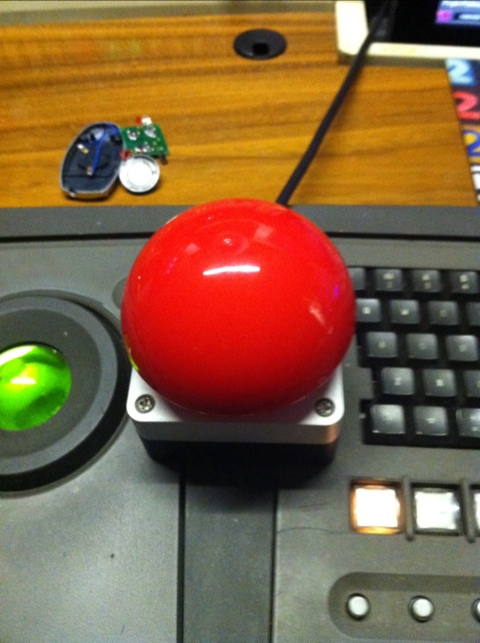
My Twittersphere already know about The Big Red Button, and the time has come to share it with you. I use it to start and stop my scanner in an instant. It’s much quicker and easier than clicking a mouse, and infinitely more satisfying.
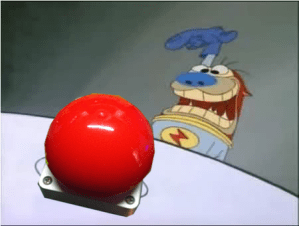
You can use it to help give money to Comic Relief. Go on, give it a click. You know you want to. Be like Stimpy. Give in to the urge.
Battle: Los Angeles is a war movie. Let’s get that out of the way right now. The SF trappings are there to pull in the core audience of 16-25 year old males who will happily sit through it in the same way that they’d sit through a walkthrough of Crysis 2 on YouTube. But it’s really an excuse to have US military, modern US military with their grenade lobbing rifles and laser sights and night vision wage war against an enemy with which they can actually get their fight on. There is no fear of accidental civilian deaths or any of the horrible tangled messiness that modern warfare against an enemy that remains undefined and hard to find has become.
SF has always provided this kind of unambiguous thrill. As the audience becomes less and less excepting of the traditional war movie (which after all served primarily as propaganda against countries that have now been friends and colleagues for over fifty years) there’s still a need for shootybangbang excitement against a villainous horde. If you can make that villain completely fictional, and of a different species to the hero, then all to the good.
The aliens in Battle: Los Angeles are faceless, emotionless avatars, existing only to shoot and to be shot at. They spindle around in a backward-leg walk, and fire guns that have been grafted onto their arms. They couldn’t surrender if they wanted to, or were given the chance.
There’s little sign of pain or any kind of emotion when M-16 slugs tear through them (or, in one memorable sequenced, skewered on a bayonet and then torn apart by M-16 slugs). They make that default monster noise that’s becoming as over-used as the Wilhelm Scream, and then they fall over. As such, they’re simply the latest in a long line of invaders that runs all the way back to War Of The Worlds. Think the swarming hordes of James Cameron’s Aliens, mirrored helmets topping a drooling tooth-filled maw. The creatures of Independence Day, blankeyed and mouthless. Notice too, that the writers haven’t even bothered to give the enemy proper names. They are simply called by their function. Alien. Invader. Enemy. Monster.
Creatures from the Doctor Who universe have names, at least. Of their species, anyway. On the whole, they still follow the same idea of being interchangable, indistinguishable. Daleks and Sontarans differ from the Hollywood Horde ideal in that underneath the expressionless masks they wear, something hideous lurks. The Cybermen take this one step further – they were humanoid once, and chose to lock all that away behind a blank carapace. There’s a little more depth there, but their intentions remain the same. They are set on conquest and colonisation.
The Stormtroopers of the Star Wars Universe have the same purpose. Spookily, under their helmets, they all look the same. They’re clones, and therefore again one step away from the human. They’re constructs, manufactured and therefore easily expendable. And again, they have a collective name rather than anything that would allow us to see them as individuals, to give us the chance to empathise.
The one flipside to this idea that I’ve been able to find comes in, of all places, from the first Austin Powers movie. A running gag showed the home lives of some of Dr. Evil’s henchmen after they were killed by the International Man Of Mystery. Giving a faceless hench a wife, a family, friends and a social life is unthinkable in most of the cases I’ve talked about. We’re not supposed to care about them. They are obstacles to be removed without thought or consequence.
As @JaesonX pointed out to me on Twitter, SF invasion pics are starting to shrug off the old cliches. District 9 takes a much more complex and nuanced approach to the theme of first contact, a situation that’s unlikely to begin with the two sides shooting at each other. Gareth Edwards’ Monsters tells us that we’re just unlikely to be able to figure out what they want here in the first place. Both films end, not in full-scale conflict, but a grudging, uncomfortable co-existence, marred with sporadic violence. This can be tracked back to shows like Alien Nation, where the visitors arrive not as aggressors, but refugees. This reflects the fluid nature of national identity, racism and touches on the way people view their territory and the people that come into them in ways that the basic war movie simply doesn’t have the tools to address.
There will always be a place for war movies. But we live in a complicated world, and it’s sometimes difficult to figure out who the bad guys should be. I’m holding out for the first war movie that pits the USA against it’s own banking system. That’s a fight with some life in it.
I am the commander of an invasion force. We have travelled across the stars to parasitise a small, blue planet somewhere on the Western Spiral Rim of the Milky Way. Specifically, my comrades and I have come for its water. There’s a lot of it. This “Earth” (such a foolish name for a world whose surface area is 70% water) is a rich prize.
Because I am not stupid, and because I understand that a) tactically, high ground gives you a major advantage and b) there is no higher ground than low orbit, I begin my assault by making a note of all the major gathering points of the indigenous population. Usefully, these are lit up at night.
Then I start throwing rocks at those population centres. They don’t need to be massive. Just big enough not to burn up on their way through the atmosphere. Something the size of a skyscraper, tiny in terms of the masses of rock and metal that swing around the sun in tandem with the blue world, would have a pretty appreciable effect on a major urban conurbation when it’s travelling at several miles per second. I don’t even need to be that accurate. Shockwaves and airborne debris would do most of the work. Then it’s a simple mopping-up operation.
Or, if I’d rather start a harvest of the water without causing genocide, I could land my forces in the middle of the Atlantic and Pacific, and set up seaborne facilities that would be difficult to detect until it was too late. I could have a defence grid in place before the aboriginals have a chance to organise a meaningful response. Maybe I’m already at it. You’ve heard of the Bermuda Triangle, right?
The one thing I would unquestioningly not do is land a ground force on coastal zones of high population without immediate air support, and then force them to fight inland in order to start a refuelling and harvesting operation from the sewers. The sewers, for fate’s sake. This would afford me the barest trickle of the resources that are clearly available. You know, all the blue stuff I can see from orbit? The stuff I came hundreds of light years to get at? Why would I fight an expensive and potentially ruinous land war against natives who, quite rightly, are going to be pretty honked off at what I’m up to? Like I said, I’m not stupid.
I am the commander of an invasion force, and I laugh at your Aaron Eckhart, just before I throw an asteroid at him.
Yesterday I touched on how Radiohead had developed their own distribution and marketing after parting ways with their record company. You no longer need to be a big famous rock band to do that. These days, it’s as easy as signing up for Bandcamp.
Bandcamp is a bit of a paradigm shifter. It’s a quick and easy way for musicians to get their work out to an audience, with a good-looking home page featuring your own custom artwork and full previews. For a user like me, browsability and preview options are key, and Bandcamp has all this covered. Most interestingly, the pricing is set so that the minimum the artist is prepared to charge is always the default, but you can pay more if you think the music’s worth it. File options run the gamut from MP3 to massive lossless formats. It’s a great way of discovering new music at a pleasingly affordable price point, and compensating the artists appropriately.
My latest Bandcamp download is from Stepdad, who specialise in sunny, quirky synth-pop. They have the bounce and charm of early Depeche Mode before they discovered rubber leisureware. There’s nothing particularly original or innovative at play, but it’ll make you smile and jig about, and most days that’s all that you need. You can pick up the Ordinaire EP for under a quid. That has to be worth a punt, surely.
It’s not just the little guys that use Bandcamp. Longtime X&HT Crush Amanda Palmer has released her latest album on the platform after leaving her old label Roadrunner in 2008 – a process that she extensively documented on her blog and on stage, pleading to be released from her contract after it became clear that they were simply not interested in promoting her. Amanda Palmer Goes Down Under, a mix of live and studio recordings based around her regular trips to Oz and New Zealand, shows off her punk cabaret stylings beautifully. It contains odes on a mix of subjects, including one on the horror of Vegemite, and the joy and wonder of intimate female hairstyling in the hilarious Map Of Tasmania.
You can pick up the album for 69c, but there are a ton of other options, including vinyl, artwork packages and, for $5000, An Evening With Amanda Palmer where she will come to your gaff and perform. I’m not sure if anyone’s taken her up on the option yet, but I’m sure we’ll hear all about it when it happens.
Readership, I urge you to visit Bandcamp and have a sniff around. There’s a huge range of music to explore. The preview options make it a no-risk endeavour. Who knows, your new favourite band could be waiting there for you.
Music week continues on X&HT as I look at the new record by my favourite band, R.E.M. Mentioning this has led to responses as varied as “Oh, are they still going?” through to “…pukies”. I can see I’ve got my work cut out with this one.
Say you’re waiting on a bus or a train. It’s dead time, so to ease the boredom you grab your smartphone to check the latest post on your favourite site – this one, of course. You get a nice strong 3G signal, and hit the bookmark.
Instead of that familiar, beautifully designed opening page, you get a warning from your mobile provider, telling you that the site you’re trying to reach is only suitable for over-18s, and that you need to go through an age verification process. You’re then taken to another page which, although it has livery from your provider, seems to be from another website entirely. And this page is asking you for your credit card details.
It’s an obvious and rather lame attempt at phishing. You’re not any kind of idiot (you’re a member of The Readership, after all) so you spot it as that instantly, and sadly inform the webmaster that his site has been hacked.
Except it’s not a scam. Well, not in the true textbook sense of the word, anyhoo. The scenario above happened yesterday to O2 customers across the country, as a age verification process was extensively rolled out. It only affects their 3G and GPRS networks, and it’s really, really stupid.
The reason for the credit card charge (£1, following which you’re refunded £2.50 as a one time payment) is to ensure that the person attempting to access “adult” material is over 18. You have to be over 18 to own a credit card. QED. But you also have to be 18 to set up a Pay Monthly account, and surely it would be simpler to set up a password controlled block in the website accessible only to the bill-payer. And the over-enthusiastic filter O2 have put in place means that PAYG customers are being blocked from sites they have perfectly legitimate reasons to visit. It’s just nonsense.
What on earth was going through the O2 mind (you know, the one that’s currently TV advertised with a very badly disguised version of Mr. Tumnus in place)? Did no-one think that suddenly switching on a filter without fair warning that would direct their customers to a site asking for credit card details might not be taken as entirely genuine? O2 claim that the company in question, Bango, have many years experience and are a trusted partner. Fine. I’ve never heard of them, and have no reason to trust them on O2’s say-so.
More worryingly, O2 have yet to explain what Bango (the name that doesn’t fill me with trust, it has to be said) do with your credit card details after the verification transaction. And, for that matter, how long your payment stays in Bango’s account before you get your £2.50 refund. I call shenanigans on this. It all feels a bit suspect, a bit slippery. Why a quid, for example? PayPal do a similar thing to ensure the card you’re linking to their system is legitaimate, but they do it with payments or 3 or 4p. Stick a couple of hundred thousand pounds of your customers cash in a high interest account for a couple of days, and there’s a decent profit to be made.
It’s the mealy-mouthed, box-ticking nature of the exercise that really makes my teeth itch. The block only operates on O2’s mobile internet services, meaning that your child can easily access all the adult content they want as soon as they hop onto a wi-fi signal. That, of course, is outside O2’s remit. They’ve done their job, and been seen to be compliant with a self-regulatory agreement with no legal basis.
O2 have really dropped the ball on this one. If they wanted to worry, bother and honk off a fat chunk of their customer base in short order, then they’ve found the perfect way of doing it. The process assumes a blithe ignorance of internet safety 101, and contravenes advice that they give on their own website. The O2 forums are full of seething customers that had no idea that O2 were about to drop this on them.
I’m absolutely furious. At one point yesterday morning, I was convinced that X&HT had been hacked, compromised and retasked as a phishing site. All because some hand-wringing twonk at O2 doesn’t want to take responsibility when a 15 year old accesses questionable material on their network.
Here’s an idea. If you don’t have a credit card, you can age verify at any O2 store with photo ID. I suggest that every aggrieved customer who feels a bit uncomfortable at giving out their credit card details to a third party for access to the sites they’ve always been able to access with no trouble before does exactly that. If that happens en masse, we’ll clog up the stores and cut into O2’s profits a bit. Direct action, taking a page from the UK Uncut playbook. That’ll send a message that they can’t ignore.
As Libya is on the verge of shrugging off the chains of the most comic-book of the villainous Middle Eastern dictators, I thought it would be fun to look at some slightly more fictional varieties of Gaddafi et al. With his elite guard of female killers and penchant for a fancy costume and ranting speeches, I reckon he’d fit in nicely amongst this lot.
It’s looking more and more likely that Libya will be the latest of the domino nations to shrug off an oppressive regime, and hopefully find a better alternative. The power of social networking will be heavily cited as a prime factor in the destabilisation of hitherto unbudgeable despots like Mubarak and Gaddafi. Or, if you’re Malcolm Gladwell, nothing whatever to do with it.
"A moving, heartfelt tale about the dark side of colonialism, and the barriers to true love."
The producers and cast of most recent TV SF shows are at pains to point out that their programme isn’t actually science fiction at all. They tie themselves in semantic knots to make sure we don’t think that their show is anything to do with that woo-woo spacy stuff. This is as true as ever when we look at the press for the BBC’s new drama, Outcasts.
Set designer James North has said “This is futuristic drama with the focus on pioneering humans who, out of necessity, just happen to be living on a planet that isn’t Earth.” Showrunner Ben Richards elaborates, making it clear that the new world of Carpathia is “… an alien planet without scary monsters. Little green men and fearsome creatures isn’t what Outcasts is about at all.”
Which to my mind is a bit of a shame. A first contact show might be more interesting than the programme we’ve ended up with, a frontier drama with a simple message. We can’t ever make a fresh start, because wherever we go, we have to take ourselves along. It’s not a new theme for an SF show. Look at Battlestar Galactica. It’s clear Ben and James have.
When a producer, writer or actor disassociates themselves from SF, they’re really backing away from the furniture. Look out for phrases like “flying saucers,” “space aliens” “ray guns,” or indeed Ben’s own “little green men.” And of course, the dreaded “sci-fi”. But at the same time they’re happy to use the tropes and themes that have been part of the genre since Wells and Verne started marking out the territory.
I guess it’s the G-word that’s the problem. Somehow the idea that SF is either kid’s stuff or entertainment for the socially inept is still a belief that informs the way films and books are marketed and sold. For “genre” read “ghetto”, and if you can make a semantic little wiggle that ensures you don’t get stacked up in the racks at the back where all the pimply, friendless people go, then so be it. This is especially important for the literary types. It’s taken the best part of thirty years for Margaret Atwood to “out” herself as an SF writer. Jeanette Winterston still has problems with the terms, although her novel The Stone Gods is set on another planet in the future.
It seems crazy to me. You wouldn’t set a story in Arizona in the 1860’s, populate it with cowboys, chases on horsebacks and a climactic shootout and say “oh, but it’s not a Western.* It’s a ridiculous stance, and hopefully one that’s on the way out. Michael Chabon’s alternative history The Yiddish Policeman’s Union won a Pulitzer Prize, and Justin Cronin’s apocalyptic vampire story The Passage is a genuine hit on all levels. There’s a misunderstanding about the people that enjoy SF, fantasy and horror that seems at least 30 years out of date. It makes the attempts of creators like Ben Richards all the more silly. Why would you cut yourself off from an big potential audience that can prove itself to be loyal and supportive to the right show?
The thing is, at a deep core level, Ben and James are right. Strip away the silver foil and spandex, and SF transcends it’s often low-budget set dressing. (Not an accusation I can level at Outcasts, by the way. It looks great.) SF acts as a mirror on the times in which it was created. It becomes a pretty relevant document of the hopes and fears of the generation that made and consumed it.
In the 50’s, it was all about the fear of infiltration by a foreign power and nuclear destruction. I Married A Stalin From Outer Space. Invasion Of The Atomic Leech-Women.
In the 60’s, SF began to explore the inner spaces of the mind, and the implications of massive shifts in societal influence. The first inter-racial kiss on TV was on Emergency Ward 10 in 1964, but it’s the second one that everyone remembers – on the Star Trek episode “Plato’s Stepchildren.”
In the 70s, things went dark and creepy as the promise of the Age Of Aquarius melted away, and we were left with three day weeks, Vesta curries and The Generation Game. Sapphire And Steel was un-nerving and bleak. TV’s eternal optimist Gerry Anderson went live action, and in UFO and Space: 1999 crafted shows that were in equal measure silly and almost unbearably harsh. The latter show starts with the moon being blasted out of orbit, effectively ending all life on Earth and dooming the inhabitants of Moonbase Alpha to a nomadic life. Even Doctor Who went steampunk and gothy, and featured sequences that are still carved in my psyche today.
SF’s role as social and political commentary is often overlooked, which is a pity but in some ways a major strength. The deep stuff is in disguise, the way a concerned mum will sneak veggies into a pasta sauce for her fussy kid, giving the viewer something to chew on after the end credits have rolled. But ultimately, it doesn’t matter. Ben Richards can claim all he wants that his show isn’t SF. When the first shot has a spaceship gathering speed towards a strange new world, we all know what we’re looking at. What he’s trying to make clear is that there’s meat on the bones, that his show has substance and depth. Personally, I think audiences nowadays are sophisticated enough to make up their own minds about whether a show is worth watching or not without caring about the genre.
I’ll leave the last word to Jeanette Winterson, who I unfairly sneered at earlier. She nails the argument on her website, thusly:
People say to me, ‘so is the Stone Gods science fiction?’ Well, it is fiction, and it has science in it, and it is set (mostly) in the future, but the labels are meaningless. I can’t see the point of labelling a book like a pre-packed supermarket meal. There are books worth reading and books not worth reading. That’s all.
(The quotes from James North and Ben Richards come via a Daily Mail piece on January 29th – an article I picked up via Ansible, I hasten to add.)




 EXCUSES AND HALF TRUTHS