Castaway: Outcasts and other science fiction deniers

NewImage
"A moving, heartfelt tale about the dark side of colonialism, and the barriers to true love."

The producers and cast of most recent TV SF shows are at pains to point out that their programme isn’t actually science fiction at all. They tie themselves in semantic knots to make sure we don’t think that their show is anything to do with that woo-woo spacy stuff. This is as true as ever when we look at the press for the BBC’s new drama, Outcasts.

Set designer James North has said “This is futuristic drama with the focus on pioneering humans who, out of necessity, just happen to be living on a planet that isn’t Earth.” Showrunner Ben Richards elaborates, making it clear that the new world of Carpathia is “… an alien planet without scary monsters. Little green men and fearsome creatures isn’t what Outcasts is about at all.”

Which to my mind is a bit of a shame. A first contact show might be more interesting than the programme we’ve ended up with, a frontier drama with a simple message. We can’t ever make a fresh start, because wherever we go, we have to take ourselves along. It’s not a new theme for an SF show. Look at Battlestar Galactica. It’s clear Ben and James have.

When a producer, writer or actor disassociates themselves from SF, they’re really backing away from the furniture. Look out for phrases like “flying saucers,” “space aliens” “ray guns,” or indeed Ben’s own “little green men.” And of course, the dreaded “sci-fi”. But at the same time they’re happy to use the tropes and themes that have been part of the genre since Wells and Verne started marking out the territory.

I guess it’s the G-word that’s the problem. Somehow the idea that SF is either kid’s stuff or entertainment for the socially inept is still a belief that informs the way films and books are marketed and sold. For “genre” read “ghetto”, and if you can make a semantic little wiggle that ensures you don’t get stacked up in the racks at the back where all the pimply, friendless people go, then so be it. This is especially important for the literary types. It’s taken the best part of thirty years for Margaret Atwood to “out” herself as an SF writer. Jeanette Winterston still has problems with the terms, although her novel The Stone Gods is set on another planet in the future.


It seems crazy to me. You wouldn’t set a story in Arizona in the 1860’s, populate it with cowboys, chases on horsebacks and a climactic shootout and say “oh, but it’s not a Western.* It’s a ridiculous stance, and hopefully one that’s on the way out. Michael Chabon’s alternative history The Yiddish Policeman’s Union won a Pulitzer Prize, and Justin Cronin’s apocalyptic vampire story The Passage is a genuine hit on all levels. There’s a misunderstanding about the people that enjoy SF, fantasy and horror that seems at least 30 years out of date. It makes the attempts of creators like Ben Richards all the more silly. Why would you cut yourself off from an big potential audience that can prove itself to be loyal and supportive to the right show?

The thing is, at a deep core level, Ben and James are right. Strip away the silver foil and spandex, and SF transcends it’s often low-budget set dressing. (Not an accusation I can level at Outcasts, by the way. It looks great.) SF acts as a mirror on the times in which it was created. It becomes a pretty relevant document of the hopes and fears of the generation that made and consumed it.

In the 50’s, it was all about the fear of infiltration by a foreign power and nuclear destruction. I Married A Stalin From Outer Space. Invasion Of The Atomic Leech-Women.

In the 60’s, SF began to explore the inner spaces of the mind, and the implications of massive shifts in societal influence. The first inter-racial kiss on TV was on Emergency Ward 10 in 1964, but it’s the second one that everyone remembers – on the Star Trek episode “Plato’s Stepchildren.”

In the 70s, things went dark and creepy as the promise of the Age Of Aquarius melted away, and we were left with three day weeks, Vesta curries and The Generation Game. Sapphire And Steel was un-nerving and bleak. TV’s eternal optimist Gerry Anderson went live action, and in UFO and Space: 1999 crafted shows that were in equal measure silly and almost unbearably harsh. The latter show starts with the moon being blasted out of orbit, effectively ending all life on Earth and dooming the inhabitants of Moonbase Alpha to a nomadic life. Even Doctor Who went steampunk and gothy, and featured sequences that are still carved in my psyche today.

SF’s role as social and political commentary is often overlooked, which is a pity but in some ways a major strength. The deep stuff is in disguise, the way a concerned mum will sneak veggies into a pasta sauce for her fussy kid, giving the viewer something to chew on after the end credits have rolled. But ultimately, it doesn’t matter. Ben Richards can claim all he wants that his show isn’t SF. When the first shot has a spaceship gathering speed towards a strange new world, we all know what we’re looking at. What he’s trying to make clear is that there’s meat on the bones, that his show has substance and depth. Personally, I think audiences nowadays are sophisticated enough to make up their own minds about whether a show is worth watching or not without caring about the genre.

I’ll leave the last word to Jeanette Winterson, who I unfairly sneered at earlier. She nails the argument on her website, thusly:

People say to me, ‘so is the Stone Gods science fiction?’ Well, it is fiction, and it has science in it, and it is set (mostly) in the future, but the labels are meaningless. I can’t see the point of labelling a book like a pre-packed supermarket meal. There are books worth reading and books not worth reading. That’s all.

(The quotes from James North and Ben Richards come via a Daily Mail piece on January 29th – an article I picked up via Ansible, I hasten to add.)

*Unless you’re Cormac Macarthy, I guess.

There’s A Light

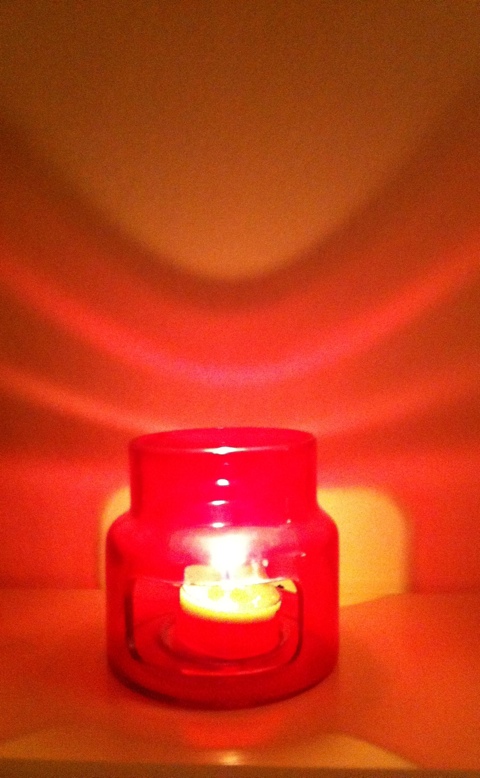
There’s beauty everywhere, if you’re open to it. Even the simplest of things, a tealight out of a big bag, a cheap plastic lamp and a bare wall, can bring about a moment of quiet wonder. Casting a glow even in the darkest of times. On a foggy morning like today, it seems even more welcoming.

A Tangled Web, or some random thoughts on animation

I noted yesterday that Tangled is likely to be the last of the “Disney Princess” films. This still seems like a bit of an odd decision, considering how popular the girls are as a brand. They have their own clothing, doll and even comic ranges, and new direct-to-disc movies seem to roll out on a regular basis. It’s funny to see how Tinkerbell seems to have been folded into the gang. She’s an uncomfortable fit. A bit too feisty for the rest of the girls. It’s apparently to do with appealing to boys. Note that Disney didn’t say anything about quitting the fairy-tale genre. That Jack fella’s got some stories to tell.

When pictured together, the Princesses have a disturbing similarity. As their images are tweaked and refined, they are slowly nudged into templates that look very familiar. The eyes get bigger, the mouth smaller, the head shape more overtly heart-shaped. Granted, Mulan and Jasmine don’t quite fit the mould, but it’s starting to become difficult to tell Cinderella apart from Sleeping Beauty, Belle from Ariel*.

NewImage.jpg

Rapunzel’s the most extreme version thus far of the look. It’s a very anime approach. Her eyes take up half her head and her mouth almost disappears to compensate. There’s a lot of the japanimation heroine in Rapunzel. Her hair becomes prop, weapon and maguffin. Anime is full of characters with ridiculously long hair, that seems to have a life of its own (and also seems to randomly change length based on what the character is up to at the time).

NewImage.jpg

The thing is, of course, that the influence goes both ways. The father of modern manga, Osamu Tezuka, was famously influenced by early Disney, with characters like Astro Boy given the big eyes and childish features that he found so appealing in Mickey Mouse and his friends. We could say that by making Rapunzel look so anime, the designers are simply acknowledging, however subconsciously, the history and influences that have placed The House Of Mouse at the heart of world animation.

We can look to Europe too. It fascinates me how we are happy to have cartoony characters as long as the backgrounds and settings are rendered realistically. Tangled again is a prime example of this idea, with gorgeously rendered scenery playing up against massively stylised heroes and villains. It’s an example of the style that French bande desinee artists have made their own. Think of Tintin, with all those beautiful, exquisitely researched landscapes backing our blank-eyed hero. Or Asterix, if you want to go more cartoony. There’s nothing to say that Disney was at all influenced by the French school, but the comparisons are there to be had.

NewImage.jpg

The Europeans are also big on their anthropomorphic animals. The biggest selling comic album in France right now is Blacksad, a noirish detective tale. The main character just happens to be a panther, with a snappy line in suits. Again, Disney made their name with animals that wear clothes, walk on two legs and talk. Which came first – the mouse or the marsupilami? It’s a knotted mess of influence and cross-fertilisation. And it’s not helped by the fact that, contrary to common practice in modern animation, the two animal sidekicks in Tangled don’t talk. They react in human ways, but in dumbshow. Even more messily, the horse Maximus is presented as half cop, half jock and half dog. He chases down Flynn by smell, and reacts very favourably to Rapunzel scratching him behind the ears. It’s yet another knot in the net.

NewImage.jpg

It’s worth sticking around to watch the end credits, which are illustrated with character designs (by the brilliant Shiyoon Kim) in a lovely, scratchy inky style that has more than a nodding relationship to the work of one of my favourites, St. Trinian’s creator Ronald Searle. I’ve always seen nods to Searle’s style in some of my favourite Disney’s, and the linework in the Tangled end credits hearkens back to some of those classic mid-60s films. 101 Dalmations and The Aristocats are prime examples of this looser, freer form. It’s great to see this little tribute to past triumphs, and I was quietly amused to see how much more busty Rapunzel is in these early sketches. I didn’t think Disney did cleavage.

Dammit, this film has got me thinking about cartooning again in a big way. In a kind of unfocussed, scattershot manner, for which I apologise (how else could it be when talking around a film with a title like that?). But the fun in watching a film as rich this rich reference and tribute comes from seeing the images spark and fire off connections, however randomly. Tangled provides a dense web in which it’s a pleasure to get tied up.


*yes, alright, apart from the tail…

The Chain Of Life

I gave my bike a little dose of love yesterday. A good dose of lube, a bit of a wash down and de-rust, a fresh tube on the back tyre. The poor old thing gets dreadfully neglected for the amount of abuse it gets, and it’s quarterly wash and brush up is quite literally the least that I can do*.

I try not to make it look too shiny though. I lock up at Reading Station when I’m at work, and a bit of protective colouration goes a long way to making sure that the thieves keep their mitts off my wheels. Hence, although I often swoon over the gorgeous machines at AW Cycles on the Henley Road, I know in my heart that I couldn’t use them. I’m not a competitive or leisure cyclist. My four-year-old Ridgeback Motion is a mode of transport, simple as that.

You notice things on a bike that simply pass most other people by. The state of the roads, for example. Last year’s brutal cold snap took place not long after a fairly major resurfacing project in Reading – a surface that simply hasn’t held up. The side roads, in particular are drastically potholed and cracked. My Ridgy has no suspension. You feel everything. I bounce around on the saddle so much that it makes the bell on my handlebar ring*.

IMG 1000000824
Our friend here is not in the bike lane. For obvious reasons.

Which wouldn’t be so much of a problem if we had a decent and consistent cycle lane policy. The bike lanes around here are badly-thought out, and have a tendency to merge you into traffic or simply disappear just when you least expect it. Or, in the case of the lanes around the Vastern Road rail bridge, they abruptly cut off with whacking great stop signs. Pedestrians grumble about cyclists on the pavement – in this case I simply have no option.

Ah, pedestrians. They walk in your bike lane. They wander out in front of you. They run out in front of you. They never look where they’re going. I’ve noticed this more and more over the past couple of years. I suspect, with absolutely no evidence whatsoever, that it’s connected to the fact that so many people are plugged into iPods and other devices when they’re out and about. With a soundtrack in your head, you become invulnerable.

They’ll still look out for cars. The mass displacement of half a ton of steel bering down on you must trigger some latent impulse to at least look around before you step out on to the road. If you’re on a bike, you’ve got no chance. If they’re texting while they’re walking, the temptation would be to plow into them anyway. I know riders that do that just to prove a point.

The problem is that when I’m off my bike, I’m guilty of exactly the same crimes that I’ve just bitched about. I dreamily amble around, letting stories and characters flit through my head, barely hearing the scream of brakes and curses from behind me. In Amsterdam, a true cyclists city, TLC and I both nearly ended up in someone’s front forks. I really thought I knew better, but it seems that as soon as I’m off the saddle, my spatial awareness goes to pot. I’m as bad as everyone else, bitching at cyclists on the pavement when I’m on foot, at pedestrians in my way when I’m on two wheels.

Some things never change. Pedestrians hate cyclists. Cyclists hate drivers. Drivers hate cyclists. Cyclists hate pedestrians. The chain of life continues, unending as the loop round my deraillieurs.

*The more waggish members of the Readership who might postulate that I’m not talking about my bicycle here are filthy minded reprobates – and that’s probably why you’re here. Fair do’s. Carry on.

.

Friday Fotos: A Day Among Ghosts

I took a day to plot and scheme with the mysterious docoBanksy yesterday. Usually we meet and cavort in Soho, but I fancied a change, so we met in Islington, before heading to Spitalfields and Brick Lane. It was a cold, cold day. Fun was had. Beer was drunk, including a pint of crude in the infamous Ten Bells. It’s been tidied up a lot, but there’s still a strange air about the place. An edge, sharp as a butcher’s blade. Or maybe I was just letting my imagination get away with me.

Anyway, here are some photos of the day. The area’s renowned for the street art which graces many of its walls and dead spaces, which will always get me pulling out a camera.

(edited, to include the fact that I was actually in Spitalfields, not Shoreditch. Maybe it’s because I’m no longer a London-errrr…)

The Sunday Lao Tzu: Quiet Time

“Silence is a source of great strength.”


When I write, I like to be in a quiet place, physically and spiritually. On a day off, if I’m working on a blog post or getting some word count down, there will be no music on, and no sound to be heard apart from the soft tick of fingers on keyboard. It’s a simple fact that I’m not much of a multi-tasker, and I’m very easily distracted. It’s better for me just to switch off and work.

I find quiet time to be an important source of inspiration, too. I like to walk, wandering like a flaneur with no real sense of destination or purpose, content to see where the road leads. This will often put me in a contemplative mood. That’s the moment where ideas often arrive, or solutions to a narrative problem solve themselves. On occasion, a character has simply popped into my head and started talking. Because I’m quiet, I’m able to listen to them. Rory Armstrong introduced herself to me in this way. If I’d had headphones on, it’s likely that she would have been drowned out.

Being quiet, and open to the world around us, I think we’re much more likely to find inspiration and strength in everyday life. Sometimes, all you have to do is shut up for a minute and listen.

The Daily Grind

Commuting is horrible. Yes, I know, that one’s up there with gems of wisdom like “oranges are not the only fruit” or “poking oneself in the eye with a stick is a bad idea”, but it’s a truism that somehow packs some weight. I think we treat commuting as a task that we simply don’t think about. Getting to and from work is just something that has to happen. It becomes blank time, a zero point that we don’t think about unless it becomes more difficult than usual. I think that if we properly considered the time, effort and money that goes into the simple act of getting in and out of the workplace, then there would be a lot more people simply rethinking their lives and walking away.

If a train breaks down or if there’s a tube strike, then we are confronted with the true, mind-clawing horror that we have to deal with at the start and end of every day of our working lives. It becomes work on top of work, a trial to be completed before we can get on with all the other crap we have to sort out.

Otherwise, it’s a journey that’s erased as soon as it’s over. There are days when I have walked into my suite and stopped dead, realising that I have no recollection of the steps I took to get there. The bike ride to the station, the train journey, the tube, walk or bike ride to Soho – all gone. Dropped out of short term memory like veg peelings into a bin. Scraped off the brain and composted without a second thought.

I’ve often talked about the virtues of my morning commute as valuable writing time, and that’s still true. But time spent on the netbook has a second, and almost as important benefit. It kills time, compressing the half-hour spent on the fast train from Reading into an eye-blink. On the odd occasions where the batteries on my devices have drained, and I have nothing to read, that 30 minutes stretches out to something like three days. It drags interminably, and I begrudge every wasted moment.

And I consider myself lucky. My shift pattern means that I have to do this trip fourteen times in any given fortnight. An ordinary 9-to-fiver has to do it twenty times. And if you’re driving, or if you have to stand on a bus or a train, that really is time in which you can’t do anything else. The very thought of it fills me with the fear. It feels more like a punishment then a task that we willingly impose on ourselves. It’s not surprising that we wipe it as soon as it’s done.

The Sunday Lao Tzu: Three Things

“I have just three things to teach: simplicity, patience, compassion. These three are your greatest treasures.”

I think I’m at my happiest when I’m doing simple things. Reading, writing, cooking. A life lived quietly and without fuss. Today’s teaching strikes me as not just true, but directly applicable to the way I live my life. Simplicity, patience and compassion are all interconnected, and when you start to live with these three things in mind, then you are on your way towards a more contented existence.

I have always been a patient person, to the point where it becomes something of a kink. My favourite part of Christmas is the anticipation. Waiting to see how the dinner will turn out, what gifts are under the tree. As I tend to know what TLC has bought me beforehand (with the exception of The Pot, which came as a genuine, delightful surprise) the wait until I can get my mitts on the new loveliness becomes part of the pleasure of the whole experience. It’s an exquisite torture. See, told you. Kinky.

But patience also comes out of care and preparation. It’s pointless rushing a loaf of bread while it’s proving, or a slow-cooked stew while it bubbles fragrantly on the stove top. Is it a coincidence that my favourite meals are the ones that take a bit of time to prepare and cook, filling the house with delicious smells, allowing the expectancy of the meal to become part of the whole experience? I don’t think so. And of course, the food I like tends to be simple, hearty, rustic fare. I’m not a big fan of fussy over-done stuff. Although Heston Blumenthal always makes me laugh.

Compassion is a no-brainer. If you don’t live a life filled with understanding and empathy towards everyone else, if you lose your patience, then your time on the planet becomes much more complicated. People can be vain, stupid and cruel. That doesn’t mean you have to be. For the most part, getting angry with an obstacle of any kind doesn’t help matters. In fact, it can frequently make things worse. Basil Fawlty thrashing his broken down car with a tree branch is an image that springs to mind. I’ve never seen the boys at Kwik-Ft do that. Treating the people around you with a little patience, understanding and humour works wonders. Call it a charm offensive if you like, but it works a hell of a lot better than yelling and screaming.

Now, I know this is all making me sound like some sort of annoying zen guru, answering questions with yet more questions or gnomic statements, floating smugly through life. That’s not the case. The idiot in the modded Peugeot who cut me up on the way into work yesterday got the finger and a robust curse. I get angry and pissed off. I rush stuff and grumble about it. But I try to remember that simplicity, patience and compassion do work, and that sometimes all you need to do to solve a problem is to take a breath, step back and look at it differently. Sometimes, the answer really can be simpler than you think.

New Culinary Definitions: SMOZZ

Smozz is the stuff added to food to make it extra perfect. Vinegar on chips. Parmesan. Ketchup. Sweet chili sauce. It’s an embellishment. A grace note, but one without which a meal can be perfectly fine, yet not …quite …there.

Smozz is dependent on the tastes and proclivities of the individual. Most people like a dollop of ketchup with their chips, which to me is a culinary crime. Mayo, on the other hand, is a must. Those crazy Dutch really hit on something there.
Smozz is not just a savoury addition. Sweet smozz can include marshmallows on hot chocolate, or a snappy, plasticy Flake shoved at a jaunty angle into an ice cream. A grating of chocolate on your cappuccino is the very essence of smozz.

Origin: the word was first seen on a bill at an Italian restaurant, where TLC and I had ordered a small garlic bread with extra mozzarella. Garlic bread does not need a blanket of sizzling, string-melty cheese on top, but it certainly doesn’t hurt. The bread was itemised on the bill as s.mozz. A new culinary term was born.

The Sunday Lao Tzu: starting small

(In the attempt to keep the blog fresh as I make the attempt to give you something new every day, I have decided to theme my Sunday posts arounds the teachings of Lao Tzu, the father of Taoism. Expect the Sunday X&HT to be a bit more philosophical, if not necessarily spiritual).

“All difficult things have their origin in that which is easy, and great things in that which is small.”

I don’t do new Year Resolutions, for the same reason that I no longer keep diaries. They always seem like a good idea, and I start off strongly, entering whole-heartedly into the agreement with myself to be a better person, to journal my every move. I have a stack of notebooks that have entries through the first week of January, an apologetic second burst somewhere in mid-February (when I was a teenager these usually coincided with Valentine’s Day, and consisted of bursts of woeful spite and, if things had been going really badly, love poems) then nothing. Rueful, shameful blank pages. Most of my resolutions have started and ended this way, and I view it as a sign of finally growing up that I stopped making unrealistic pledges that would be quickly abandoned.

I’ve realised that I was going about things in the wrong way. Rather than launching with both feet into a project and losing interest in the face of the hard and sustained effort that was required, I would have been better starting gently, easing into the task. This was a lesson that Lao Tzu teaches, but that Nanowrimo allowed me to apply to real life. By doing something every day, the task soon becomes a habit, then a part of your daily routine. No matter how little, the daily bit is the important bit. (Sidebar: yes, I know Nanowrimo is a 1667 word a day challenge, and that doesn’t sound like a little thing. By by breaking that task down into further 500 word chunks, it’s surprising how quickly you make your daily, weekly and monthly goals.)

The Habit is something that I hope to achieve with the PostaDay exercise. The point where I feel twitchy if there’s a danger of not posting is the point where I know I have accomplished something important.

When your objective stops being a chore, and becomes a daily pleasure, then you have succeeded in your goal.