Being offline for a morning (not my fault by the look of it, the cable modem’s flashing where it shouldn’t, and the Virgin Media tech support line is permanently busy) does tend to concentrate the mind on all the other chores I should be doing rather than farting around on the web. But it also tends to concentrate one’s thoughts on the inherent fragility of the online existence.
Take Spotify, as an example. This brilliant music streaming service is being held up by many (including me) as the first step towards a radical new business model for the music business. Pay a tenner a month, and eight million tracks are yours. Up until the point where a workman with a jack-hammer chops a cable in half, killing internet connection. All of a sudden you’re paying for… nothing. Better hope the hard drive you stashed all your music on before eBaying all your CDs still boots.
Actually, let’s think this through. Say, like me, you use Google for a lot of your services, upload text to Google Docs, have online storage with any number of companies. Online banking. Chatting to friends in foreign countries. Online gaming, online shopping. Perhaps even running a business. If you couldn’t get at any of that stuff, then you’re stuffed.
This is, of course, exactly what the government’s proposing to do to alleged file-sharers, as part of their brave new digital strategy thought up in a couple of days flat and sketched out on a napkin by Peter Mandelson, completely superseding the moderate, carefully considered Digital Britain survey on which Labour spent months and millions. If one member of a household is “found guilty” of “excessive file-sharing” (these points are in quote marks as there’s no guidelines as to what either of these terms mean in reality. There’s no mention of any particular up/download limit after which filesharing becomes excessive, and certainly no mention of fair legal process or right to appeal) the whole household suffers.
There’s a school of thought that the Internet should become listed as an essential service, which it already is here at X&HTowers. This becomes more relevant when you consider that the Government is already moving some of it’s services and information onto a purely online basis. I now have to administrate Sick Puppy Films Ltd. through the Companies House website, as they charge me to submit my accounts on paper. This is only set to increase, and it becomes a matter of ever-growing horror and disbelief to me that there is consideration to throttle a vital conduit of services and information on shaky legal and ethical grounds.
See, even now I’m putting off sorting out the flat tyres on my bike in favour of ranting about the internet.
Ooh, look, the modem’s playing nice again. Gotta go. I have YouTubing to catch up on.
I would like to think that you know my feelings towards freedom of speech and information by now, o Readership. So it should come as no surprise that my reaction to the announcement that BBC Question Time has allowed Nick Griffin of the BNP to appear on the show is one of delight and relief.
It’s about time that he was given a chance to air his views and opinions in public, so that the people that elected him and Richard Barnbrook into office as MEPs earlier in the year can see exactly what it was they voted for.
The BNP have, by dint of claiming the role of outsider or maverick, been able to control the image they provide to the public, letting very little of what they say in closed meetings and rallies get out into the open air. They know that if that were to happen, the stink of their unfiltered outpourings would get people’s attention in the worst way.
Freedom of information is all about freedom to correct information. The BNP are desperate not to be portrayed in the media as racists, despite the clear statements to the contrary in their manifesto. The EDF would like to be seen as protectors of an ill-defined “British way of life”, choosing to ignore the hundreds of years of multi-culturalism and tolerance that give a much truer picture of England’s history and heritage than these clowns would have you believe. Unlike most of Europe, this country has no history of mainstream representation of far-right political parties. We choose to treat racists with the respect they deserve. The respect you give to any ranting nutter.
I’m really happy that that Griffin is about to get his say, because it’s likely to open a lot of people’s eyes as to the truly toxic nature of his views. Frankly, I don’t think the producers of Question Time have gone far enough. I’d have a member of the EDF on there as well. Preferably in a balaclava. That’d kill two birds with one stone.
When I was growing up, a popular refuge/meeting place/night out was the cinema that lived on Hoe Street in Walthamstow. It started off as a Granada, before becoming in short order a Cannon, an ABC and finally an EMD. It was a home from home during some of the toughest years of my adolescence, a place where I could be myself.
It helped that it was a proper, booming DecoGothic pile of a place, with a double-tongued swoop of a staircase up to the mezzanine level, and famous red and gold Moorish architecture, the work of Theodore ‘Komis’ Komisarjevsky, the man credited with bringing Chekhovian theatre to England. It was a palace of dreams and nightmares, a place where I fell in love with the films of John Carpenter, American wine gums and, for a while at least, a girl called Tracy Gilbert.
In 2003, after a disastrous stint as a Bollywood-only cinema, it was bought at twice market price by the controversial United Church of The Kingdom of God. They immediately shut it and declared their intention to turn it into a church. This move, which rendered the London Borough of Waltham Forest the only one in London without a working cinema, provoked an immediate and ferocious backlash, which spiralled up from a bunch of passionate local activists to the attention of the deputy Prime Minister at the time. The campaign worked. The cinema remained, unusable as a church, with owners unwilling to reinstate it to it’s former glory.
This year, the church reapplied for permission to retask the building. They have clearly been doing some work behind the scenes, as there are prominent members of Waltham Forest Council backing their scheme.
Fortunately, the original group of protesters, the McGuffins, have not been quiet either. Over the past few months they have been making it clear exactly what is at stake, and what Walthamstow will lose if the UCKG get their way. There is an enormous groundswell of opinion that it makes huge financial and cultural sense to restore this beautiful grade II* listed building to it’s original purpose, and get people watching films in Walthamstow again. Alfred Hitchcock used the cinema as a kid, and if it’s good enough for him…
So. To action. Waltham Forest Council are taking objections to the UCKG’s scheme until this Friday the 25th September, which is shockingly short notice, I know, but to my shame I only found out about the plans today, and then purely by chance. The time to act, unfortunately, is now.
We may be making progress. The Mandelson-backed shift in the government’s policy towards file-sharing (cut people off from the internet on a record company’s say-so) has attracted enough negative attention that the members of the Open Rights Group have snagged a meeting with his staff on Monday to put their point (internet access is too important to cut off on a record company’s say-so) across. This is because people who care about freedom of speech and expression, people like you and me, Readership, are willing to raise their voices to say no thanks, actually, this is not the sort of thing I voted you into office to do. Actually, remind me. Who voted you into office?
Aaaanyway. A couple of linkies for you. First and foremost, to the ORG petition on the issue. 3000 sigs so far, and they’re aiming to get 5 grand for Monday. Stick your moniker on this one, it’s important.
And I’m gonna repost a great piece on NRRF which makes all the right noises while simultaneously making a politician after a few column inches look like a complete knob. This HAS to be a good thing.
Reviews should be objective. It’s never a good sign for a pundit to write a piece on a film when it’s known that he or she was involved in it’s creation. There’s no sense of distance, and every chance of bias.
Here is my review of Blood + Roses, a film which gives me a prominent colourist credit, and for which I put together an EPK.
Blood + Roses is a film about a girl who cannot help but get involved with bad boys.
At the beginning of the film we meet Jane, who is stuck in a loveless relationship with Martin, a cold, controlling bastard played with misogynistic glee by Kane John Scott. Jane, frail and wounded, has nightmares of something awful that has happened to her in the recent past. Something that she can’t quite remember, and that Martin is in no hurry to help her recall. Something that they have driven to an isolated cottage in the country to try and put behind them.
Once there, things don’t seem to be improving for Jane. Martin is unsympathetic, selfish. Then she meets, and is seduced by the ultimate tall, dark stranger – Seth, a vampire. As Jane begins to change, her memories of what has happened begin to return, and her frailty is shed in favour of something more primal. Physically and mentally, her strength returns. As it does so, Jane begins to thirst. Not just for blood, but for revenge.
Blood + Roses is an attempt to tweak some of the more romantic aspects of the vampire mythos, to tease out some dark truths about the nature of attraction and desire. Jane may be stuck in a loveless marriage, but she knows what she’s getting into with Seth. She embraces her new life with relish, and an almost unseemly haste, considering the consequences.
Jane is played by Marysia Kay with a touching fragility in the early stages of film, before her transformation. After, she becomes stronger, sleeker, more feline, graceful yet deadly. She portrays this change nicely, and as a vet of the BritHorror scene, I would have been surprised if she hadn’t. This is, after all, an actress who specialises in portraying strong women – sometimes strong enough to pull their hapless victims in two!
Seth, the third point in the triangle, is played with louche charm by Benjamin Green. Seth appears worldly and urbane, but at the same time he is very much the predator of the piece. He simply walks into Martin and Jane’s life and takes what he wants, without a wasted thought to the consequences. Jane is quick to embrace his attitude – any escape from the airless trap that her life has become with Martin would seem to be acceptable, even the loss of her soul.
Blood + Roses is a film to muse over, something that needs a little time to sink in and percolate. It’s careful to play with the mythos just enough – the “v word” is never mentioned, and in this film they can be seen in mirrors. An interesting move, perhaps to bring home the point that the life Seth offers is a dark mirror of the one Jane is so keen to leave. The life of a vampire is, in it’s way, as constrained as her marriage to Martin. She will never see the sun again, eat real food be able to have children. Her time with Martin may have stripped away most of her humanity, but accepting Seth’s bloody bargain means turning her back on what’s left of it.
The isolated location of Blood + Roses works in it’s favour. Most of the action takes place in the confines of the small cottage Martin and Jane have rented. The camera stays tightly framed on the actors, trapping them in dark corners, unable to escape their fate. The cinematography is lush and rich, though, and colour is used to surreal effect in a couple of dream sequences. Kudos to DoP Richard J. Wood and director Simon Aitken for resisting the temptation to desaturate the colour palette and give the pictures a mud wash. This is a good-looking film, even if it was shot in nasty HD video.
The film really comes to life when it’s focussed in on the vampires. The chemistry between Seth and Jane comes across beautifully, to the point where I was disappointed when they weren’t on screen. By contrast, I felt too much time was spent on the plot cooked up by Martin and his doctor friend Ted, and their crime against Jane. This wasn’t helped by the dry reading given by Adam Bambrough, which made the pair come across as buffoonish rather than truly evil. A shame, because on the whole I thought the script, by Simon’s long-time writing partner Ben Woodiwiss, worked well. And the guy can write a mean vampire.
On the whole, then, I found Blood + Roses an entertaining take on a couple of standard horror tropes. It doesn’t wallow in grue or histrionic performances, preferring instead a low-key approach that builds slowly towards the finale. Here, at last, my gorehound tendency was satisfied in an ending that riffed nicely on classical and Elizabethan revenge tragedy. It’s something a bit different, and I wish it well.
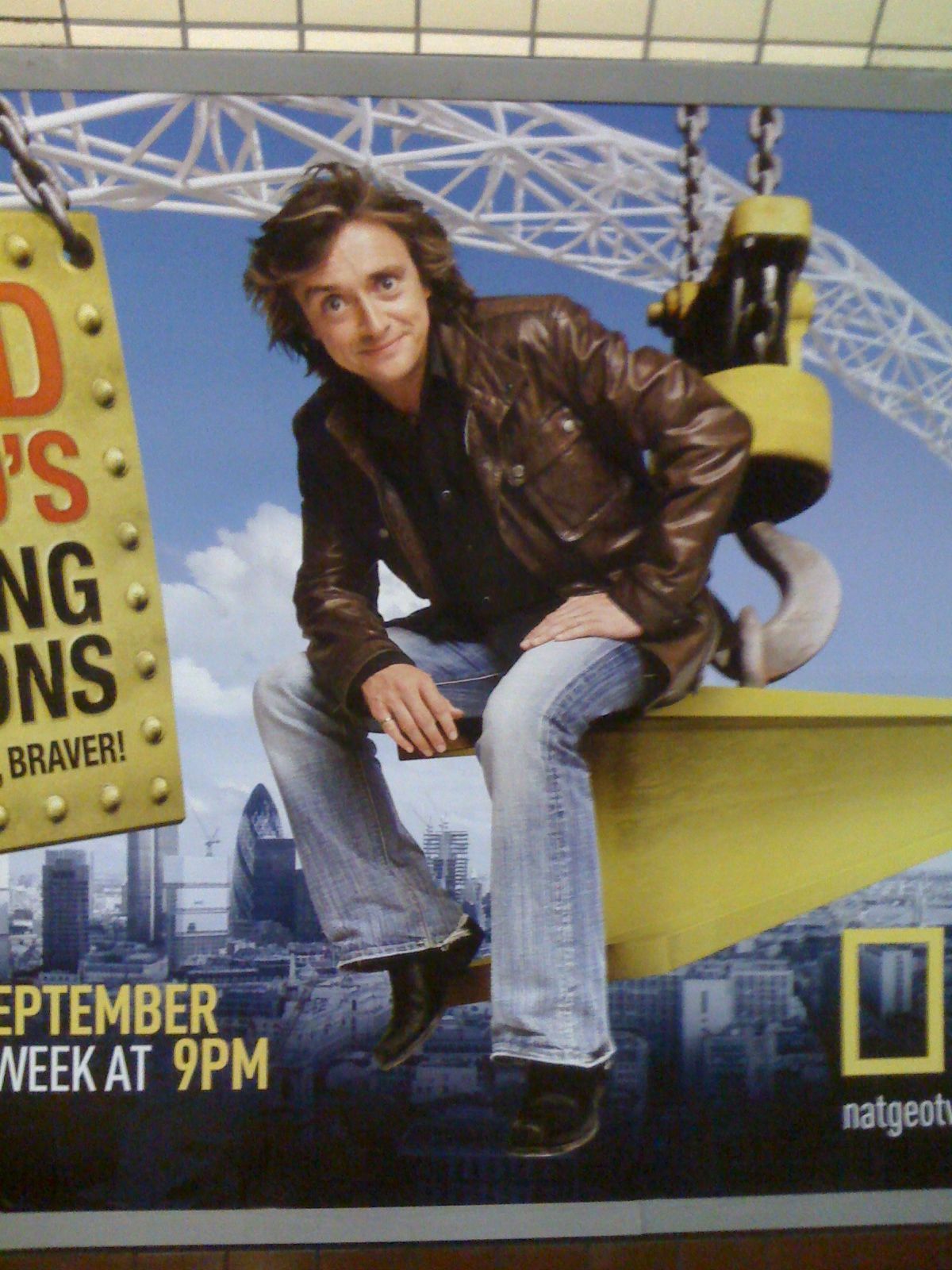
Or another entry in an occasional series where Rob over-reacts to an advertising hoarding…
Dear Gods, this is un-nerving. Who put the rodent in the leather jacket? I mean, look at that scrunched up muzzle. Those wittle feet in their tiny clompy bootkins.
But it’s the hungry look in those eyes that really freaks me out. Like it’s just spotted something tasty.
Clever little thing. It knows how this game works. Play it cute. Go doe-eyed. Wait for your prey’s defences to drop. Maybe it will come in to pet, to give you a skritchy-scratch behind the ears.
And then BANG. Go for the throat. Worry out the jugular with those sharp little claws. Bleed out your prey before it has a chance to think about what’s happened. Go for the eyes as it hits the deck. Chittering in triumph as you feed.
It’s a big day for UK indie film-maker Simon Aitken. Blood + Roses, his first feature, has it’s cast, crew and press screenings tonight. I’m really excited, and can’t wait to see it on the big screen at last. It’s been a long, hard two year fight to get the film to this position, and it shows the sort of tenacity and single-minded drive that Simon has in spades that he’s done it with no money, and certainly no help from government or lottery-funded grants. It’s a tremendous achievement, and I’m proud to be associated with it.
First of all, some news that has retained it’s power to shock over the past week or so. Lord Mandelson, ignoring the eight months of work that has gone into the report on Digital Britain, has decided that penalties for persistent file-sharers should include shutting off their internet connection.
This move is so wildly flawed that I’m not even sure where to begin. Let’s start with the fact that it was announced soon after Mandelson was wined and dined at a holiday villa in Corfu by David Geffen and Steven Spielberg. No conflict of interest there then. No openings for accusations of government policy being swayed by the interests of big business.
Let’s continue by noting the opposition to the plan from privacy campaigners, ISPs, the artists that this bill is allegedly supposed to protect, and Labour Party MPs. Included in these dissenting voices is Tom Watson, until recently the man in charge of the government’s internet policy.
Let’s further note that these new proposals could fall foul of the law. Simon Davies of Privacy International has said:
“This proposal fundamentally reverses the onus of proof. It establishes systemic accusation. It is fraught with technical impossibility, it invites circumvention and creates a major online conflict between rights holders and users. And these are fundamental rights that are being violated.”
Larry Whitty, chairman of Consumer Focus, further makes the point:
“Cutting people off the internet for allegedly infringing copyright is disproportionate, and to do so without giving consumers the right to challenge the evidence against them undermines fundamental rights to a fair trial.”
Digital Britain contains largely sensible and pragmatic approaches to the problem of file-sharing, and to all intents and purposes has been ridden over roughshod by business interests who see dropping profits, and can only attempt to combat the threat by criminalising their customer base. Despite the fact that a lot of the research they tout to strengthen their case is based on numbers that are not just wrong, but appear to have been made up.
This post on No Rock And Roll Fun counters Mandelson’s arguments and demolishes them point by point. To my mind, what we have here is an opportunistic landgrab that’s been heavily influenced by external interests, ill-thought out, rushed through and potentially illegal. So pretty much par for the course for media and internet legislation from this government, then.
Another piece of flawed legislation pertaining to new media was the 1984 Video Recordings Act, AKA The Video Nasty Act. Famously, it empowered the BBFC to apply certification to home entertainment, and banned a ton of cheap and dirty horrors that are now beginning to return to UK shelves. The Act is old, and really no longer fit for purpose. In recent years it has caused independent film-makers all kinds of problems. You have to pay the BBFC for every minute of content that goes onto a DVD if you want it to be certificated, and therefore legal to sell in the UK. All the extras, any little shorts, even text and audio commentaries. All of this can run into thousands of pounds of unwarranted expense, and act as a fairly major deterrent to getting your film onto disc and legally into the UK market.
Imagine the shock and surprise in the UK indiefilm community then, when it was ruled that the Act was rushed through so quickly that it was never properly enacted. It’s not law. Which means that for a giddy few months, we are free to make and market unrated films without any fear of prosecution, or without the financial burden hanging over us from the BBFC. This bit from The Times tells the story, although the headline is hardly what I’d call unbiased journalism. The Melon Farmers have a bit more of an objective view.
Of course, the danger is that the government now has a chance to strengthen the bill, and clamp down even harder on a market that is one of the most censored and constrain in Europe. There is a chance for fundamental reform, and as per usual it’s up to us to make our voice heard.
Finally, another ray of good news, which could become a fundamental switch in the way we consume media, or at least music. Despite all logic and reason, Apple approved the Spotify iPhone App, and it went live on Monday. This is astonishing news. The App means that with a 3G or Wi-Fi connection, millions of tracks become available instantly. You can create playlists of your favourites that can be accessed offline, when you’re on the tube, for example, and it seems to work pretty flawlessly. No more worries about filling your hard disc. There are terabytes of music at your fingertips.
It costs, of course, and this is where things get interesting. The app won’t work without a £10/month subscription, although the desktop app that’s been doing grand service for me over the past few months has a free, ad-supported version. But this is a brilliant move, and paves the way to a subscription-based service where money starts going back into the industry, to the artists, and piracy becomes less of a problem. Research has shown that consumers are more than willing to pay a fair price for their music, and 33p a day seems pretty darn fair to me.
There are caveats, of course. Classical buffs will find their choices a bit variable, and as I’ve mentioned before, there are questions about royalty payments to artists. But let’s try and be positive. There have been concerns about Spotify’s ability to monetise the service, and that question has been answered by the flood of people signing up for Premium. We may be seeing the birth of the answer to the music industry’s woes. And if that gets them off our back legislatively speaking, then I’ll be happy.
Well, who’da thunk it. Code Grey will be screening at the 29th Cambridge Film Festival, as part of the Best of the Cambridge Super 8 Festival strand. It’s on the 25th of September at 1:30 in the afternoon. Here’s the whole programme.
This is an unexpected pleasure, and obviously very good news. I’m tempted to go down and show a bit of support, not the least because the rest of the programme looks downright intriguing. I’m especially interested to see how the documentary films work out.
Also, a browse through the schedule as a whole shows a lot of good stuff being screened, including the new Shane Meadows, Dominic Murphy’s excellent White Lightnin’, and some FrightFest alumni, including Pontypool and Hierro.
On the subject of Pontypool, the BBC World Service has released an audio version of the film on the iPlayer. This is not quite as weird as it sounds, as the film is set in a radio station, and is about the viral qualities of language. Get your headphones out for this one, people…
Saturday dawned, sunny with clear blue skies. A blessing, after three twelve hour days at work in the dark, staring at a screen.
No sun for me. I would be spending the day voluntarily sitting in a dark room, staring at a screen. Saturday was Frightfest day.
I met Leading Man Clive and Blood ‘n’ Roses Aitken in the one decent pub in Leicester Square. They were breakfasting. I had already eaten, so fortified myself with a pint of crude. It’s good for you, right? Besides, I didn’t want any more coffee. Twitchy in a horror movie crowd is not a good look.
To the Empire, the big new venue for Frightfest. We grabbed wrist bands, perused the retail opportunities around the main concourse (The Cinema Store had a decent selection of goodies, but I contented myself with a Frightfest teeshirt) and all too soon it was time to go in for the first movie.
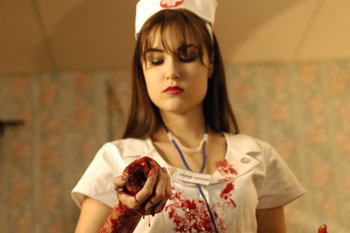
SMASH CUT is a loving tribute to the work of Hershell Gordon Lewis, The Wizard Of Gore. It wears it’s influences lightly and isn’t afraid to make fun of itself. The story of a director who starts harvesting murder victims for props for his movie, it’s light on it’s feet, funny, sharp and impassioned about the state of the industry. It features a lot of genre names in cameo and supporting roles, including Hershell himself, who was clearly having a ball. It was a great casting move to include porn star Sasha Grey, who gives a fairly solid performance as the investigative journalist tracking down the psycho director. There’s a fine horror tradition of giving strong female roles to porn actresses, and it’s carried off with aplomb here.
I loved it. It will never win any Oscars, but for fans of the genre it’s well worth the time. Director Lee Demarbre and star David Hess introduced the film and gave a hilarious Q&A afterwards, which also addressed the central dilemma at the heart of the film. A love story to cheap and cheesy 16mm film-making, it’s shot on video. I’m never convinced by the arguments given for shooting on HD versus film, and just think it always looks a bit cheap. I’m biased, I know, but I simply don’t see HD as the only choice for the lo-to-no budget film-maker.
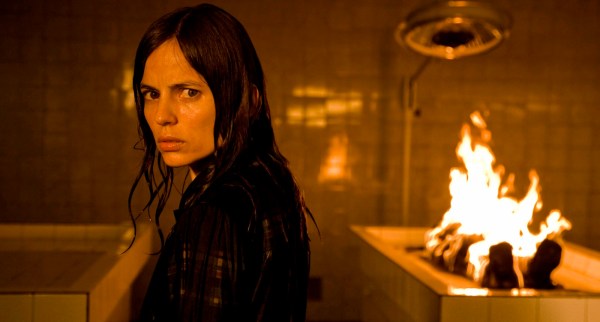
Aaaaanyway. Twenty minutes later, we were back in our seats for HIERRO, a Spanish horror that’s clearly going for the same creepy ghost child feel as The Orpanage and The Devil’s Backbone. It doesn’t, sadly, feeling leaden and plodding. Rather than building a mood and putting us on edge, director Gabe Ibáñez seems content to make a good looking frame, and ensure that his lead actress, the lovely Elena Anaya, always looks stunning even at the height of her despair.
Elena plays Maria, who lost her son on a ferry trip to the island of La Hierro, on the southernmost tip of the Spanish territories. Crazed with grief, she returns to the island when a child’s body is found, only to then believe that the child is still alive.
It’s a shame that it doesn’t work. The performances are fine, the last plot twist is clever, and Gabe Ibáñez can compose a beautiful looking shot. But the funereal pace and lack of shocks just do for it, in the end, and I found myself unable to care for Maria or her plight.
Another short break, which led Aitken to indulge in the Pick ‘n’ Mix counter as we didn’t have time to get anything proper to eat, and back in for MILLENIUM, aka THE GIRL WITH THE DRAGON TATTOO. This, we were told, was something of a departure. Not strictly speaking a horror film at all, it contains enough horror tropes to make it suitable for we merry band of hardcore Frighters. “Trust us on this one,” we were urged. “It’s great.”
And it is. I can’t say I’m a huge fan of detective stories, but this was utterly absorbing. A twisty, clever tale of the decades-spanning work of a serial killer and the journalist and hacker who team up to stop him, it features one of the best new characters of the decade, and if there’s any justice, Bizarre magazine’s new muse, the heavily tattooed and pierced Lisbeth Salander. Vicious, antisocial, but stridently moral and incorruptible, she is no victim despite her harsh upbringing. Her revenge on the guardian who abuses her is jaw-droppingly cruel – but he deserves everything that happens to him, and she had the whole cinema cheering.
Already a massive hit in Europe, you need to search this one out when it hits the UK early next year. There are two other films in the trilogy, which are out in Scandinavia in September and November. Time for me to start brushing up on my Swedish…
Yet another short break (you can see where I’m going with this, can’t you?) which gave us just enough time to dash out and inhale a Burger King. It was getting on for seven o’clock at this point, and we’d all had to skip lunch. Pick ‘n’ Mix, Simon opined, is no substitute.
I was excited now, as the next film up was the new one from one of my horror heroes, Dario Argento. A return to his slasher roots, to the point where it was simply named after the genre: GIALLO.
These days, it’s unusual for me to watch a film through my fingers. I like to think I’m pretty hardcore. Giallo was a rare exception. I was in a knot throughout.
It’s utterly, mind-buggeringly, squirm-inducingly awful. It would be laughable without the name of a master attached. The dialouge is rotten. The performances veer from flat to scenery-chewing without ever hitting decent. The effects are no better than the ones in Smash Cut, and they were supposed to be laughable. I spent the first reel hoping against hope that it would improve, and realised by the end of the second that there was no hope for it. I very nearly walked out, but I was so utterly mesmerised by the slow-motion car-crash unspooling in front of me that I was rooted to my seat.
It’s interesting to note that Argento’s most recent mainstream interview, a three-page spread in this month’s Bizarre, fails to mention Giallo at all. There are strong rumours that he has completely disassociated himself from it, that it was taken out of his hands, even that Emmanuelle Seigner, the lead actress, was on drugs throughout. Can’t properly comment on that one as it’s pure speculation, but it would explain the dreadfully flat performance. I’m not a believer in the so-bad-it’s-good school of film appreciation, but it honestly has laugh-out-loud moments. If it’s a spoof, it’s a work of utter genius. If it’s not, then I’ve just witnessed one of my favourite directors piss what’s left of his reputation away.
After that we all needed a drink, so I got them in while we waited for the next film of the night. I had tried and failed to get tix for Pontypool, a clever spin on infection horror, but I was assured that I would not be disappointed by my second choice.
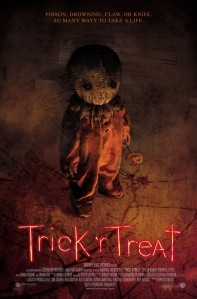
And so it proved to be. TRICK ‘R TREAT is a loving tribute to the horror anthologies of the eighties. It’s chock full of invention, wit, charm, proper scares and features the most genuinely inventive new horror character in years, the Halloween sprite Sam. It’s being hailed as the highlight of the festival, and rightly so, as it’s genuinely, properly entertaining. Quite honestly, it’s a film I could take Clare to, feeling sure she’d enjoy it.
So, it’s a shoo in for Halloween screenings, right? Warner Bros must be all over this one like a rash, right? A proper, honest horror hit in the making, right?
Wrong. Trick ‘R Treat was made in 2007, and has been shelved ever since. It’s finally getting a DVD release this year, which is totally bogus for a film that really comes to life in front of a cinema audience. For this film to be sat on, when formulaic retreads and remakes get the nod is frankly sickening. Michael Dougherty, the director, was there, and made an impassioned plea for people to get behind this film and push for it. He has support from none other than John Landis, at Frightfest for the re-release of An American Werewolf in London, and who made his feelings about Warner’s actions very clear indeed, with a bellowed “Fuck ’em!”
Supporting this criminally overlooked film is the least I can do. It’s available for pre-order now – go snag a copy. Better, if you get the chance to see this film on the big screen, do it. It’s brilliant. It’s just the most deeply satisfying horror I’ve seen in a long time.
The last film of the night, Vampire Girl vs. Frankenstein Girl, started late, and was shaping up to be good, sugared-up gory fun, but something made me check the train schedules, which was just as well. The 3:30am train I was counting on wasn’t running, which meant an abrupt exit, hasty apologetic texts to Simon and Clive, and a dash across town to catch the last train home. A shame, as I enjoy the anime-brought-to-life of films like Tokyo Gore Police. The twenty minutes I saw came across like Grange Hill on meth. This is not necessarily a bad thing.
(The clip below is NOT SAFE FOR ANYBODY)
And that was me done. I was drained after just one day, so Gods know how Clive does it year after year. I can see why he does it though. It’s a great way to get a real snapshot of what’s going on in the horror and fantasy field, as well as seeing rare and interesting movies that you simply wouldn’t see otherwise.
My one problem was with the density of programming. It’s great that they cram so many films into the day, but it does mean if you want to network or kick back with your mates, you’ll probably have to miss something, and if you’re on a day pass that’s just not the best use of your time.
Still, that’s a minor grumble against a day that was otherwise well worth the money.
Frightfest – very nearly the best fun you can have with lots of people in the dark.




 Well, who’da thunk it. Code Grey will be screening at the 29th Cambridge Film Festival, as part of the Best of the Cambridge Super 8 Festival strand. It’s on the 25th of September at 1:30 in the afternoon.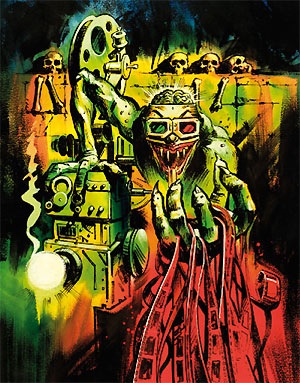

 EXCUSES AND HALF TRUTHS