The Women: Genre And Gender

NewImage

Horror, SF and fantasy, according to common knowledge, are not female friendly genres. Bad enough that the prototypical image of the genre fan is the sweaty overweight dysfunctional geek – that’s hardly representative. By making that image male, the picture is distorted even further away from the true. As a regular visitor to Frightfest, I’m happy to confirm the large number of women that attend that are just as vocal in their enjoyment of the movies as the men. The authors of the two biggest fantasy franchises on the planet are women – JK Rowling and Stephenie Meyer. Common knowledge is, as is usually the case, bass ackwards from the truth.

However, the depiction of women in SF, fantasy and horror needs a refresh. There are still far too many victims out there, female analogues waiting to be rescued or assaulted. When kickass women do appear, they’re frequently Buffy clones or, in the case of Hitgirl, children. It’s either that or the avenging angel of I Spit On Your Grave or Ms. 45. The wronged as killing machine, using their femininity as a weapon or a cloak from which to strike out at their abusers. It’s an old, tired tale.

I’ve seen a couple of movies lately that change that sorry state of affairs. Both films feature strong, uncompromising central performances from their lead actors, and both explicitly reject the myth of the female as victim in genre films.

Pedro Almadovar’s The Skin I Live In has a cool, controlled surface. Underneath that, lunacy boils and writhes. I need to be careful here. The central conceit on which the plot pivots is not one that should be easily spoiled, and it’s one that threatens to derail my whole argument before I even get started (feel free to give me a kicking in the comments).The film is part Pygmalion, part Frankenstein, part Eyes Without A Face. It tells a common genre tale – the mad scientist attempting to cheat God and death by resurrecting a lost love. Antonio Banderas is suitably driven and remorseless as the plastic surgeon, rebuilding a burn victim in the image of his dead wife. But all is not as it seems with the beautiful Vera. Played by Elena Amaya (pictured left) with a mix of vulnerability and shocking power, she seems at first barely human. A mannequin, meek before her master’s demands. As we discover her past, and all she has lost at the hands of Banderas, Vera shrugs off the weakness, becoming something fierce and strong. Her own creation, transcending the scientist’s plans, remade by sheer force of will. She ends the film as her own woman.

Lucky Mckee’s The Woman, which had it’s UK premiere at Frightfest, tells a similar tale, then rebuilds it from the bones up. A feral woman is discovered and captured by a suburban lawyer, who plans to “civilise” her. He locks her in an outhouse, hoses her off and dresses her in clothes with easy release fastenings. It’s clear what his intentions are from the beginning. Yet the Woman of the title, played with ferocious magnetism by Pollyanna Mackintosh, is no victim. She will never succumb to him, and is content to wait as the lawyer’s family collapses under the weight of revelation that her arrival sparks. Her release, and her revenge, are inevitable. Part monster, part hero, the Woman is never less than the mistress of her own destiny.

Frightfest was a bit of a showcase for this cliche-busting approach this year, with films like Susan Jacobson’s The Holding (with yet another fine central performance from Keirston Wareing) showing how genre doesn’t have to mean generic when it comes to gender. This is a good start, but we shouldn’t be complacent. Although I started this post in a bullish mood about equality in the realm of the fantastick, we’ve had a summer where DC Comics’ big relaunch was marred by the realisation that there were hardly any female creators on board, and a call from author Juliet Mckenna to promote equality in genre writing. There’s a way to go before we can get the balance right, but as Juliet points out, SF, fantasy and horror have always questioned unthinking prejudice and the status quo. Films like The Woman and The Holding are encouraging indeed, pointing the way to new, strong voices and bold, uncompromising stories.

The Sunday Spiritual: Together In The Dark

NewImage

One last thing, before I let Frightfest go for another year. Many people would balk at the prospect of spending five days in a cinema watching horror films. I’ll admit, I’ve only ever done a single full day, and that very nearly wiped me out.

But of course, Frightfest is not just about the films. Because it’s impossible to watch everything on offer, you simply have to take a break, get a drink, have a chat. There are seminars, Q&As, quizzes and plenty of opportunities to meet up with film-makers and like-minded fans. If anything, the extra-curricular activity is as much the point to Frightfest as the movies. It’s the community that’s built up around the love of the genre that makes this festival so special. The fabled Sleepy Queue, when the hardcore stake their claim on the weekend seats, usually forms in the early hours of the morning before the tickets go on sale. That has to tell you something about the attraction of Frightfest.

I will always try to make the effort to see at least a couple of films with the Frightfest crowd. Seeing horror with a bunch of people that love and appreciate the genre with all it’s foibles and eccentricities always makes for a more interesting experience. Seeing a good horror film with the Frightfest crowd is a genuine pleasure that I don’t think you get from any other type of film. Going to the cinema is, like any other communal experience, a heightened state of mind. I believe you get more out of a film when you see it on a big screen with a like-minded audience. At Frightfest, that feeling is amped up still further. It’s not just about the film. It’s about the audience, the gathering, the congregation. Together in the dark, loving the ride.

Frightfest part 2: Attack Of The Leading Man

As promised, we are subject to a takeover from the mighty (and mightily-bearded) Clive Ashenden, who went above and beyond when I called out for contributions for the X&HT coverage of Frightfest. Over to you, oh my Leading Man…
On Thursday 25th August hundreds of genre pilgrims descended on the Empire Leicester Square for the annual celebration of all that is best in Horror cinema: Film4 Frightfest.

On Monday 29th August after 5 days, 36 films, and numerous short films, trailers, Q&As, interviews, and special events; they staggered back out into the moonless night, pale and red-eyed, and babbling tales of eldritch things and widescreen terrors.

And your humble correspondent was amongst them. A little personal history before we plunge into the dark meat: This is Frightfest’s twelfth year and my tenth as a weekend passholder. In 2005 my horror short “Snatching Time” (co-written by X&HT’s own Rob Wickings) was screened before “Broken”.

Last year the teaser trailer I wrote and directed for “Habeas Corpus” – the horror anthology movie on which (together with Rob, Brendan Lonergan, Simon Aitken [“Blood+Roses”], and Paul Davis [“Beware The Moon”]) I am attached to direct one of the stories – was screened before “Primal”. So I have a long standing connection and love of the biggest and best horror film festival in the UK, as both a filmmaker and horror fan.

Due to the dual screen format of the festival, it wasn’t physically possible to see all of the films shown.  But I managed to catch 24 films, and I’m going to highlight the ten best. So gentle readers, if you feel ready to enter some very dark places, take my clawed hand and I’ll be your guide to the best of Frightfest 2011.

Continue reading Frightfest part 2: Attack Of The Leading Man

Five Horror Films You’ll Never See In A Horror Festival

An interesting discussion on the Frightfest forums about the nature of the genre – and more specifically, when is a horror film not a horror film – led me into a bit of a muse last night. Frightfest was one of the first venues in the country to show The Girl With The Dragon Tattoo. A strange but somehow logical place to show a film about a woman-hating serial killer. The curators have frequently shown movies that stretch the bounds of what you or I would call horror.

Which films, I thought, would be out of bounds to most horror festivals? I’ve come up with a list of five films that I reckon really wouldn’t fit the bill. You might not agree, but that’s part of the exercise. I’d love to know if you think I’m wrong, or which films you’d put on instead.

Continue reading Five Horror Films You’ll Never See In A Horror Festival

The Invisible Genre: How The BBC ignored SF on World Book Day

NewImage

World Book Day is a celebration of all things literary, a chance to put your hand up and say, “Hell yes, I’m a reader. Give me a book and I’ll read the living stuff right out of it!” It’s an important event that brings together writers and readers worldwide and unites them under a common, quarto-shaped banner.

But there’s a problem. Author Stephen Hunt watched the BBC’s coverage of the day, and noticed that there was something missing. Something big.

Apart from a brief mention of Philip Pullman’s Northern Lights as a YA crossover, SF, fantasy and horror were not represented. No Pratchett. No Rankin. No Tolkein or Lewis. No Iain M. Banks, no JK Rowling. No China Mieville or Joe Abercrombie. No Clive Barker, no Christopher Priest. Genres that between them take between 20 and 30% of the UK book market were roundly ignored.

I wish I could say I was shocked or surprised. The publishing world is more than happy to make money from the fantastic end of the market, but they’re not so keen on promoting it. You’ll hardly ever see SF or fantasy on the front-of-house deals at your local Waterstones unless your name happens to be Rowling or Meyer. As Hunt points out, it’s pure and simple snobbery. What’s more, it’s damaging.

The publishing industry always depicts the book as a gateway to a world of imagination, to a place of limitless possibility, of endless adventure. At the same time, the act of picking up and reading a novel is considered to be an act that is good for you, in the same way as running twice a week or eating a high-fibre cereal for breakfast. It’s an educational action, a pathway to moral improvement and good citizenship. In some ways, you can be defined by what, and how much, you read.

The perception amongst most mainstream critics is reading SF, fantasy and horror is not an improving activity. That these books are of low character, of dubious morality. That somehow you will put the book down, and not gain the insights into the world and it’s people that you would if you’d only pick up something by Margaret Atwood. Or Jeanette Winterson. Or Kazuo Ishigura. Something without spaceships or aliens, clones or creatures grown from genetic experiments gone wrong.

You can see where I’m going with this, can’t you? All the above authors have written SF. They simply choose not to identify the books as such for fear of hurting their profits.

It’s the same skewed thinking that forces Iain Banks to flag his Culture novels as written by Iain M. Banks. As if they were somehow written by a different person. He at least is pushing the envelope, however gently. His latest “mainstream” novel, Transition, was an SF book in all but name, and contains references to a culture that may be … well, The Culture. But the book is packaged and marketed in a very different way to his SF excursions. The back cover blurb calls it a “fable”.

Stephen describes SF, fantasy and horror as a “gateway drug” to the world of literature. I agree. What’s more, that’s proven to be true by one of the growth markets in the publishing sector – the young adult or YA book. This new stream is stuffed full of fantastik stories – and I’m not just talking about Potter or Twilight knockoffs. Cory Doctorow’s agit-punk books such as Little Brother and For The Win are politically driven and yet still filled with action and drama. Scott Westerfield’s Uglies postulates a world where it’s a crime to be ugly – a pointed and direct comment at the sort of world in which kids struggle with their self-image every day. YA is where a lot of the interesting stuff is happening right now.

Should I be bothered by the fact that the BBC ignored the fantastik? It’s fair to say that a lot of people do buy, read and enjoy genre fiction, and it seems to tick along quite happily without mainstream critical attention.

But a lot of truly great books, head and shoulders above the latest “contemporary” efforts in terms of literary merit, plot, character and inventiveness are marginalised purely because of their subject matter. It’s a stigma that prevents deserving authors from reaching their full potential readership. This is simply not on, and needs to be addressed.

It”s a real shame that genres need to be compartmentalised, but it’s a fact of the industry. However, the playing field should be fair. A good book is a good book regardless of where or when it’s set, irrespective of the species of the main character.

What next? Well, Stephen’s set up a Facebook page, and there’s a petition to sign. If you love SF, fantasy and horror and feel that it didn’t get a fair chance in the BBC’s coverage of World Book Day, you know what to do.

Blood + Roses: Treat Yourself To Some Grown-up Horror!

The big news this weekend for music fans is the sudden appearance of the new Radiohead album, The King Of Limbs, which I’m happily downloading as I write. But if you like horror, then there’s another reason to celebrate.
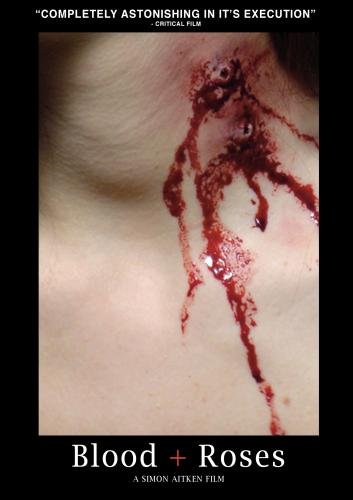
Simon Aitken’s smart, grown-up vampire film Blood + Roses is finally, finally available to buy from Amazon. OK, yes, I have a deep connection to the film. I have a big fat colourist credit, and edited the behind the scenes documentary Love Like Blood. But I believe in the film. I think it’s a clever update on the mythology and iconography of the vampire trope. It’s well written, and has a sterling brace of leading performances from Benjamin Green and TV’s own Marysia Kay (she’s on Take Me Out tonight on ITV1). Those in the know are already calling Blood + Roses “Twilight For Grown-ups”. I’m really pleased that you all have the chance to enjoy a film that I’ve been banging on about for the last couple of years. Do yourself a favour, and snag a copy of Blood + Roses, Readership. You know it makes sense.

A flag of convenience: turning pirates into customers

I’m thinking out loud here, so please do indulge me.


Adrian Faulkner tells a story on his excellent blog about a work colleague with a newly acquired e-reader, and his attitude to the cost of content for the device. In short, he thinks e-books are overpriced, and has taken to torrenting. Adrian recoils at this, and I agree. But at the same time…

I’m in the same position as his workmate John. I received a Kindle as a birthday gift, and love it to bits. But I was immediately struck by the disparity of pricing on the online store. Like most people with a new Kindle, I zealously hit the free or dirt cheap options, grabbing the complete works of Dostoyevsky and Dickens for less than I’d pay the lovelies at AMT Coffee for my morning cup of joe. But there were also Penguin editions of the same works that cost exactly the same as the paperback editions. There will, granted, be differences in translation, and of course e-books are liable to VAT, but apart from that I can’t see how that justifies a 700% difference in price point.

Modern authors also exhibit this disparity. Stephen King’s Under The Dome is a whopping £16.99 in the Kindle Store. You’ll pay half that for the paperback. I love Stephen King, but I’m caught in a bad place here. I don’t want to lug a breezeblock sized brick of paper around with me. That was a prime factor in buying an e-reader in the first place. At the same time, I’m buggered if I’m paying the thick end of £20 for it. Thus the dilemma that John has easily solved by merrily downloading his books for free. I don’t agree with what he’s doing, but I can kind of see his point. (In my case, I shall get the book out of the library, assuaging my conscience and supporting an essential public resource at the same time).

Part of the problem is the perception of worth. John thinks e-books are worth less than a hardback book. He sees craft and manufacturing cost in the heft and weight of a fat wodge of paper. He seems unaware of the fact that the paper is simply a carrier for the important stuff, the words on the page. But it’s not surprising he’s confused. There’s no consistency of pricing. A best selling CD, book, or DVD will cost you different amounts depending on where you buy it. And frequently when you buy it. Wait a few months after release, and a lot of titles suddenly have a huge discount applied, or turn up in twofer deals. Or sometimes free on the covers of newspapers.

Here’s a challenge. Given the choice between a vanilla DVD title in a cardboard sleeve with no extras for nothing, and a “normally” priced copy of the same thing with all the extras, I will lay money that the majority of people will plump for the freebie. I’m not talking your film buff or cineaste here. I’m talking about the man in the street. The sort of person that doesn’t want a director talking over the top of their Saturday night movie. The sort of person who doesn’t care about deleted scenes because if they were any good, they’d be in the film, wouldn’t they?

Of course, these films aren’t free. They’re promotional items, and you pay for the newspaper to get them. But they have the word FREE all over them. In the same way, musicians are now expected to put tracks online for free, again as promotion for full works. And here’s the problem. There’s already confusion over an object’s perceived worth. The idea of not paying anything for your entertainment has become an encouraged, acceptable option, regardless of the intention behind giving it away.

Neil Gaiman has extolled the virtues of this approach, citing the uptick in sales after doing just that for an audiobook of American Gods. Thriller writer Stephen Leather has done the same thing, putting his early work on the Kindle store for under a quid a shot. Again, this has been highly successful. But these are established artists, able to control the pricing structure of their material. If you’re a struggling author or film-maker, the appearance of your work on a torrent or Rapidshare feed chews up your revenue stream in a moment. If the film or book is all there is, if there’s no back catalogue for which you can use that free item as a loss leader, then the strategy seems to have failed.

That sounds incredibly negative, I know, and there’s no easy answer. Once people get used to the idea of free, then it’s really tough to change their minds. It’s easier than ever to get your work out to an audience, and much more difficult to get them to pay for it. It’s completely doable, of course – look at the success Amanda Palmer has had. She completely gets the vital role in keeping her audience sweet. She works incredibly hard at connecting and communicating with her fans.

There are ways of turning negatives into positives, too. Steve Lieber’s “Die Hard in a cave” comic Underground was merrily pirated by fans on 4Chan. Instead of complaining or issuing lawsuits, Leiber went on the site, and began chatting with the fans of his work, pointing out that the book was available as a print edition. Net result: a massive spike in sales. Similarly, fantasy author J.S. Chancellor asked people who had downloaded her work to leave reviews of it on Facebook and Amazon. It worked, and again, an uptick in sales was the result.

Self-pub and self-distribution is a tricky business to get right. It takes imagination, guile and a lot of effort to make a buck in this new marketplace, and the strategies that work for one artist are more than likely not going to work for another. Persuading your public that your work has value is more than half the battle, but if you can win that battle then good times approacheth. The Johns of this world can be talked into paying for their books and movies, if you talk to them in the right way.

(EDIT: to correct the schoolboy error JS Chancellor pointed out in the comments.)

I Run To Death, And Death Meets Me As Fast: X&HT Watched The Seventh Victim

NewImage

The crossing where the dark roads of horror and film noir meet is a place of fertile earth, where nightmares are easily grown. The ground, after all, is fertilised with a hefty dose of bone and blood. There are a ton of great films out there that take typically noir traits, and give them a shivery twist. Think of classics like Alan Parker’s Angel Heart, Jonathan Demme’s The Silence Of The Lambs. David Fincher’s Se7en. Kolchak The Night Stalker. Hell, half the X-Files was horror noir. Think of a film where a hard-boiled tec takes on a case, only to find that he’s hunting down something with a little more of the night in it than he anticipated.

Back in the heydays of noir, the 1940’s, this crosspoint was wide and broad. Noir has always been black and white in both visual and moral terms, and like horror, is not overly concerned that good should always triumph over evil. Both genres cast a bleakly jaundiced eye over human relationships, and easily find and stress-test the weak points.

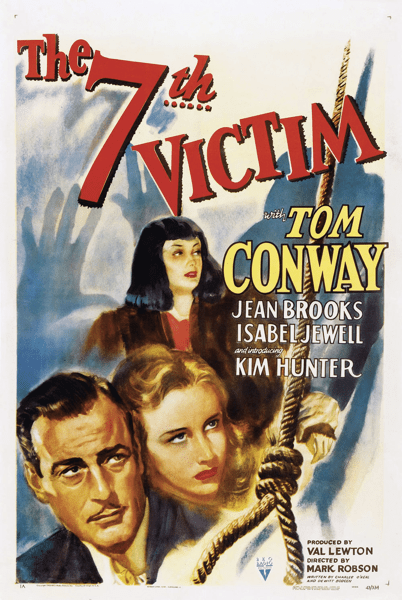
The 1943 film The Seventh Victim saw producer Val Lewton take the psychological horror that he had pioneered in the classic Cat People, and add a noirish feel. Deep shadows and slashes of light were already visual cues for hard-boiled film, and this was a look in which Lewton’s long-time cinematographer Nicolas Musuraka revelled. On The Seventh Victim, he and director Mark Robson went a step further, soaking every frame in pools of darkness.

The Seventh Victim begins as the sheltered world of our heroine, Mary, is quickly stripped away. She attends a boarding school, the fees paid by her only relative, her sister Jacqueline. Jacqueline has disappeared, and the funds have dried up. Offered the choice to stay in the school as unpaid help, Mary instead opts to travel to New York to find her sister.

Once in the Big Apple, the mystery only deepens. Jacqueline has given away the family business, and got into some very bad company. Mary is quickly snared in a web of lies and deceit, and the hunt for Jacqueline will lead her to question the motives of everyone who pledges to help her.

The Seventh Victim casts an eerie, uncomfortable spell right from the first frames. Mary is urged to leave the boarding school and not return by the headmistress’ assistant, who tells her that “you must have courage to really live in the world” – a creepy foreshadowing of future events. Jacqueline is described as a rare beauty by everyone she meets, a light in the dark city – and yet she is obsessed with death, and rents a room above the Dante Restaurant (a powerfully appropriate name) containing nothing but a noose and a chair.

The film contains sequences that are the match of The Cat People in terms of shadowy shocks. Mary and a private detective who has taken her case search the cosmetics factory that used to belong to Jacqueline, at night. The one room they haven’t entered is barred by a black rectangle of shadow at the end of a dark corridor. Both Mary and the detective recoil at the sight of it. They are right to do so. There is death in that room for one of them.

The final fifteen minutes, in which Jacqueline wanders the streets after being cursed by the Satanists who have swallowed her life and shattered her sanity, are as powerful as any horror of the era. Vulnerable and alone, Jacqueline is threatened by shadows that turn out to be harmless, only to have new real, threats loom out of the darkness. Trapped by her own crumbling will, Jacqueline’s escape route is clear to us all, yet still a punch in the gut when it happens. Mary starts to hope for the future, unaware that her sister has already closed the door firmly on it. It’s an astonishingly bleak ending.

Noir doesn’t often get this creepy, horror doesn’t often have this atmosphere. Fans of both genres should find much to admire in The Seventh Victim, even if it’s a little too cold-hearted to love.

Leading Man Clive put me up to this, but then he knows my proclivities better than most. It proudly appears under the banner of the annual Film Noir Preservation Blogathon, raising funds to get classic and wrongly forgotten movies back into shape so they can thrill and chill a brand new audience. Readership, I urge you to support this worthy cause, which as I’m sure you can imagine is pretty near to my heart.

You can donate using Paypal by simply clicking on the lovely lady under the lamp-post below. Be gentle though. She may look like a kitten, but this cat has claws.

My 15 Favourite Horror Things

This is all Simon Aitken’s fault. He tagged me in a Facebook post, as part of an ongoing meme which seems appropriate for this, The Most Wonderful Time Of The Year. In short, he challenged me and his friends to list our top 15 horror films, and give a reason why we like them so much. His list is here, and I can’t argue with any of his choices.

As I started thinking about my list, I realised that some of my favourite horror moments weren’t films at all. So, as it’s me, and I believe in doing things a little differently, what comes next is a countdown of my favourite horror things. I hope you’ll find some surprises. In no particular order, then…

Continue reading My 15 Favourite Horror Things

Big News about Habeas Corpus

Readership, I have been keeping things from you. This is obviously a betrayal of the trust we have built up over the years, and I can only apologise. But I had very good reason. And the time has finally come when I can talk a little about what’s been happening with a project that’s about to take up quite a bit of my time and attention.

Today, I want to talk about Habeas Corpus, the anthology horror I’m making with a lot of my friends and fellow travellers. We’ve all been working hard on the film. My previous announcement that the scripts were just about locked was a bit … well, previous really. Leading Man Clive has come into his own here, making sure that we’re delivering nothing but our best work. The final draft of livedeadgirls is one of my best. Very different to how I originally thought of it, but that’s a good thing. Less angsty. More … horrible.

Obviously, we want to let people know what we’re up to. With that in mind, Team Corpus came up with a super special surprise that we showed at Frightfest, one of the premiere horror festivals on the planet, in London’s glamourous Leicester Square. It’s a 90 second thing, a little standalone teaser that was shot over a long weekend at the end of July. It stars one of our directors, Paul Davis, and in a bit of a casting coup, scream queen and face of British horror Emily Booth. This is a really big deal for us, and it’s great that as horror fans we got to launch our biggest project in front of an audience that’s as committed and passionate about the scene as we are.

You wanna see it, right? Well, here you go.


The reception so far has been really positive, and we’re hoping that Frightfest weekend will give us the kick the project needs to get it properly rolling. For the meantime, you can read more about the project on Dread Central, and here’s a rather nice review of the teaser from Brendon Connolly at Bleeding Cool.

And please, join the Facebook group. Your support will help us to make something that we can all show with pride.

I’ll tell you more about the events of the weekend as it wears on. For now, keep the faith, Readership.