As Libya is on the verge of shrugging off the chains of the most comic-book of the villainous Middle Eastern dictators, I thought it would be fun to look at some slightly more fictional varieties of Gaddafi et al. With his elite guard of female killers and penchant for a fancy costume and ranting speeches, I reckon he’d fit in nicely amongst this lot.
It’s looking more and more likely that Libya will be the latest of the domino nations to shrug off an oppressive regime, and hopefully find a better alternative. The power of social networking will be heavily cited as a prime factor in the destabilisation of hitherto unbudgeable despots like Mubarak and Gaddafi. Or, if you’re Malcolm Gladwell, nothing whatever to do with it.
A busy day in the kitchen yesterday. A fresh loaf, a blueberry cake, and hell, I’m in the kitchen anyway, I might as well go the whole hog and make a fish pie.
This is more or less Nigel Slater’s famous recipe, and I’ve been making it for long enough that I can quote it from memory. It’s a messy job, there’s no doubt about it, but I’ve tweaked it enough that it’s reasonably straightforward. Even if it wasn’t, fish pie would be worth the fuss.
I start with about half a pound of fish in my big saute pan. Enough milk to cover goes in, with a bay leaf if you’ve got one and some peppercorns. Bring it to a simmer, and cook until the fish is about done. Should take about ten minutes. While that’s bubbling, chop a couple of big leeks and some mushrooms (enough to give you a couple of big handfuls of dice) and a stick of celery. I also put four fist sized potatoes in the steamer to cook, as they are, in their skins.
Fish done. Fish comes out of pan, and put somewhere to stay warm. If you’re a big ole cheaty-head like me, you’ve used a fish pie mix that’s skinless, boneless and already chunked up. If not, the skin and bones will come away easily from the cooked fish, which you should keep in chunky pieces. No mince here. Pour the fishy milk into a jug through a strainer. Keep this with the fish.
Wipe out the pan. Back on the heat with a little oil and butter, and cook the leeks and celery over a lowish heat with the lid on until the leeks are soft and bright green. Whip those out, reheat the pan and do the mushrooms, letting them soak up the oil and butter. You can do these in two pans if you like, but do them separately to stop the mushrooms going wet and sloppy, rather than flavoursome and slightly caramelised.
Once the mushrooms are nice and brown, add the leeks back in, and sprinkle over a couple of tablespoons of flour. Let this cook for a minute of so until you can’t smell the flour any more, then throw in the milk. Let this bubble until the sauce you suddenly have in the pan thickens a bit to a nice creamy texture. A big spoonful of creme fraiche, lots of salt and pepper, then stir the fish back in. If you fancy chucking in any fresh herbs, flat leaf parsley, maybe some celery leaves, hell, even basil, now’s the time. Give this another five minute love in. The sauce should be creamy and rich, not at all runny or sloppy.
While that’s doing, check your spuds. They should be done. Do what you have to do to turn them into mash. I’m not going to tell you how to do it. You’re a grown up. Be comfortable with your mash-making technique.
Pile the mixture into a baking dish. Now the spuds. I use a ricer, and squish cooked unpeeled potato straight on top. Saves on peeling, and gives a nice light result. Then cheese. People say you shouldn’t put cheese on a fish pie. Screw them. I like cheese. I used a nice strong Wyke Farm cheddar with horseradish for a little doink of heat. If you’re going to be all huffy about it, just dot some butter over your mash.
Hot oven (about 200C, Gas 6) for 15 minutes or until there are nice brown toasty peaks on your mash.
Serve to someone you love (you’re not gonna go to all that effort for someone you don’t at least fancy) with some peas and a little soft music.
One can not reflect in streaming water. Only those who know internal peace can give it to others.
There are several reasons why I choose to allow my Sunday posts to be quiet and reflective. The main reason, I think, is that I am in a quiet and reflective place at this time of the week.
All is still here. A cup of tea, steaming faintly. An empty plate, toast crumbs stippling the surface. Upstairs, the sounds of my wife preparing for the day. The light outside is cool. The sky seems a flat, gray bowl, but if I look carefully, I can see the faint colour changes of the cloud cover, slightly deeper hues shading away from the monochrome into blue. A bird flits from branch to branch on a tree outside, as busy as I am still.
For a moment, I let the day sink in, and distraction slip away.
I’m thinking out loud here, so please do indulge me.
Adrian Faulkner tells a story on his excellent blog about a work colleague with a newly acquired e-reader, and his attitude to the cost of content for the device. In short, he thinks e-books are overpriced, and has taken to torrenting. Adrian recoils at this, and I agree. But at the same time…
I’m in the same position as his workmate John. I received a Kindle as a birthday gift, and love it to bits. But I was immediately struck by the disparity of pricing on the online store. Like most people with a new Kindle, I zealously hit the free or dirt cheap options, grabbing the complete works of Dostoyevsky and Dickens for less than I’d pay the lovelies at AMT Coffee for my morning cup of joe. But there were also Penguin editions of the same works that cost exactly the same as the paperback editions. There will, granted, be differences in translation, and of course e-books are liable to VAT, but apart from that I can’t see how that justifies a 700% difference in price point.
Modern authors also exhibit this disparity. Stephen King’s Under The Dome is a whopping £16.99 in the Kindle Store. You’ll pay half that for the paperback. I love Stephen King, but I’m caught in a bad place here. I don’t want to lug a breezeblock sized brick of paper around with me. That was a prime factor in buying an e-reader in the first place. At the same time, I’m buggered if I’m paying the thick end of £20 for it. Thus the dilemma that John has easily solved by merrily downloading his books for free. I don’t agree with what he’s doing, but I can kind of see his point. (In my case, I shall get the book out of the library, assuaging my conscience and supporting an essential public resource at the same time).
Part of the problem is the perception of worth. John thinks e-books are worth less than a hardback book. He sees craft and manufacturing cost in the heft and weight of a fat wodge of paper. He seems unaware of the fact that the paper is simply a carrier for the important stuff, the words on the page. But it’s not surprising he’s confused. There’s no consistency of pricing. A best selling CD, book, or DVD will cost you different amounts depending on where you buy it. And frequently when you buy it. Wait a few months after release, and a lot of titles suddenly have a huge discount applied, or turn up in twofer deals. Or sometimes free on the covers of newspapers.
Here’s a challenge. Given the choice between a vanilla DVD title in a cardboard sleeve with no extras for nothing, and a “normally” priced copy of the same thing with all the extras, I will lay money that the majority of people will plump for the freebie. I’m not talking your film buff or cineaste here. I’m talking about the man in the street. The sort of person that doesn’t want a director talking over the top of their Saturday night movie. The sort of person who doesn’t care about deleted scenes because if they were any good, they’d be in the film, wouldn’t they?
Of course, these films aren’t free. They’re promotional items, and you pay for the newspaper to get them. But they have the word FREE all over them. In the same way, musicians are now expected to put tracks online for free, again as promotion for full works. And here’s the problem. There’s already confusion over an object’s perceived worth. The idea of not paying anything for your entertainment has become an encouraged, acceptable option, regardless of the intention behind giving it away.
Neil Gaiman has extolled the virtues of this approach, citing the uptick in sales after doing just that for an audiobook of American Gods. Thriller writer Stephen Leather has done the same thing, putting his early work on the Kindle store for under a quid a shot. Again, this has been highly successful. But these are established artists, able to control the pricing structure of their material. If you’re a struggling author or film-maker, the appearance of your work on a torrent or Rapidshare feed chews up your revenue stream in a moment. If the film or book is all there is, if there’s no back catalogue for which you can use that free item as a loss leader, then the strategy seems to have failed.
That sounds incredibly negative, I know, and there’s no easy answer. Once people get used to the idea of free, then it’s really tough to change their minds. It’s easier than ever to get your work out to an audience, and much more difficult to get them to pay for it. It’s completely doable, of course – look at the success Amanda Palmer has had. She completely gets the vital role in keeping her audience sweet. She works incredibly hard at connecting and communicating with her fans.
There are ways of turning negatives into positives, too. Steve Lieber’s “Die Hard in a cave” comic Underground was merrily pirated by fans on 4Chan. Instead of complaining or issuing lawsuits, Leiber went on the site, and began chatting with the fans of his work, pointing out that the book was available as a print edition. Net result: a massive spike in sales. Similarly, fantasy author J.S. Chancellor asked people who had downloaded her work to leave reviews of it on Facebook and Amazon. It worked, and again, an uptick in sales was the result.
Self-pub and self-distribution is a tricky business to get right. It takes imagination, guile and a lot of effort to make a buck in this new marketplace, and the strategies that work for one artist are more than likely not going to work for another. Persuading your public that your work has value is more than half the battle, but if you can win that battle then good times approacheth. The Johns of this world can be talked into paying for their books and movies, if you talk to them in the right way.
(EDIT: to correct the schoolboy error JS Chancellor pointed out in the comments.)
The crossing where the dark roads of horror and film noir meet is a place of fertile earth, where nightmares are easily grown. The ground, after all, is fertilised with a hefty dose of bone and blood. There are a ton of great films out there that take typically noir traits, and give them a shivery twist. Think of classics like Alan Parker’s Angel Heart, Jonathan Demme’s The Silence Of The Lambs. David Fincher’s Se7en. Kolchak The Night Stalker. Hell, half the X-Files was horror noir. Think of a film where a hard-boiled tec takes on a case, only to find that he’s hunting down something with a little more of the night in it than he anticipated.
Back in the heydays of noir, the 1940’s, this crosspoint was wide and broad. Noir has always been black and white in both visual and moral terms, and like horror, is not overly concerned that good should always triumph over evil. Both genres cast a bleakly jaundiced eye over human relationships, and easily find and stress-test the weak points.
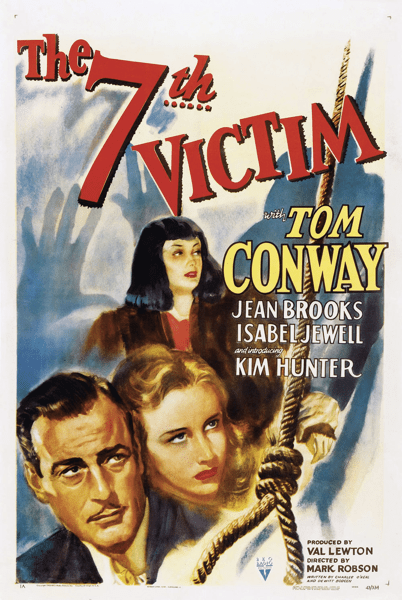
The 1943 film The Seventh Victim saw producer Val Lewton take the psychological horror that he had pioneered in the classic Cat People, and add a noirish feel. Deep shadows and slashes of light were already visual cues for hard-boiled film, and this was a look in which Lewton’s long-time cinematographer Nicolas Musuraka revelled. On The Seventh Victim, he and director Mark Robson went a step further, soaking every frame in pools of darkness.
The Seventh Victim begins as the sheltered world of our heroine, Mary, is quickly stripped away. She attends a boarding school, the fees paid by her only relative, her sister Jacqueline. Jacqueline has disappeared, and the funds have dried up. Offered the choice to stay in the school as unpaid help, Mary instead opts to travel to New York to find her sister.
Once in the Big Apple, the mystery only deepens. Jacqueline has given away the family business, and got into some very bad company. Mary is quickly snared in a web of lies and deceit, and the hunt for Jacqueline will lead her to question the motives of everyone who pledges to help her.
The Seventh Victim casts an eerie, uncomfortable spell right from the first frames. Mary is urged to leave the boarding school and not return by the headmistress’ assistant, who tells her that “you must have courage to really live in the world” – a creepy foreshadowing of future events. Jacqueline is described as a rare beauty by everyone she meets, a light in the dark city – and yet she is obsessed with death, and rents a room above the Dante Restaurant (a powerfully appropriate name) containing nothing but a noose and a chair.
The film contains sequences that are the match of The Cat People in terms of shadowy shocks. Mary and a private detective who has taken her case search the cosmetics factory that used to belong to Jacqueline, at night. The one room they haven’t entered is barred by a black rectangle of shadow at the end of a dark corridor. Both Mary and the detective recoil at the sight of it. They are right to do so. There is death in that room for one of them.
The final fifteen minutes, in which Jacqueline wanders the streets after being cursed by the Satanists who have swallowed her life and shattered her sanity, are as powerful as any horror of the era. Vulnerable and alone, Jacqueline is threatened by shadows that turn out to be harmless, only to have new real, threats loom out of the darkness. Trapped by her own crumbling will, Jacqueline’s escape route is clear to us all, yet still a punch in the gut when it happens. Mary starts to hope for the future, unaware that her sister has already closed the door firmly on it. It’s an astonishingly bleak ending.
Noir doesn’t often get this creepy, horror doesn’t often have this atmosphere. Fans of both genres should find much to admire in The Seventh Victim, even if it’s a little too cold-hearted to love.
Leading Man Clive put me up to this, but then he knows my proclivities better than most. It proudly appears under the banner of the annual Film Noir Preservation Blogathon, raising funds to get classic and wrongly forgotten movies back into shape so they can thrill and chill a brand new audience. Readership, I urge you to support this worthy cause, which as I’m sure you can imagine is pretty near to my heart.
You can donate using Paypal by simply clicking on the lovely lady under the lamp-post below. Be gentle though. She may look like a kitten, but this cat has claws.
This is not a review. This will not be fair, or balanced, or even particularly well informed. It will be full of spoilers. I’m not here to measure the virtues against the flaws.
I’m here to talk about the idea behind Never Let Me Go, why it patently, clearly doesn’t work and how dressing up a core SF trope in literary clothes is a dirty trick.
The story, as brought to us by the chronicler of the English mind Kazuo Ishiguro, is set in an England where cloning for body parts is legal and accepted. Of course, we’re not told that all at once. Instead, we’re introduced to the student body of Hailsham, a secluded boarding school. They are your usual bunch of artsy upper-middle class wet sponges, who flop about making doe eyes at each other, without the faintest idea in their heads that something is remiss here even when teachers keep bursting into tears and rushing out of the classrooms. They are educated, sent out into sheltered accommodation, and when the time is right, harvested. All of which they accept with a stoic, bovine acquiescence. There’s no sense that they can escape their fate, that they can find a life outside their defined role.
The idea of a society that would openly sanction or even allow organ harvesting is intriguing, and leads me to wonder what that world would look like. It would be a very different place.. The very idea that we would tolerate bags of spare parts that looked like Keira Knightley wandering the streets is one that takes a bit of a stretch. We’re squeamish at the best of times. We allow factory farming because it is convenient, cheap, and above all out of sight. The butcher’s counters at Tesco tend not to have attached abattoirs. Let’s face it, if scientists came up with a talking cow, the numbers of vegetarians would spike overnight
At the end of the story, Hailsham is revealed to be a failed experiment – an attempt to show that clones have souls. It’s never made clear why the school was closed. Was it that, like Philip K. Dick’s replicants, the Hailsham kids don’t show emotions, but rough approximations, fakes, large-scale autonomic reflexes that just happen to look like fear or love? Or, more likely, that the clones are indeed human, and that we don’t care? That if the program were to be shut down then the crisis that forced us into the position of creating the clones in the first place could reoccur, putting society back to square one? All of these questions are never addressed, which is a shame, because the society in which Hailsham exists deserves a second look. Never Let Me Go seems to depict us reverted to a slaver’s past, a time when we could quite easily look on certain creeds and colours as resources, as tools. But we never see this world beyond the narrow focus of the Hailsham kids, and they’re all too drippy to give a toss about.
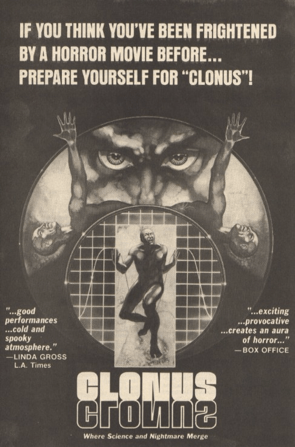
None of this is new, of course. The nature of humanity is a core concept in SF. One of the formative books of the genre, Mary Shelley’s Frankenstein, deals with that very issue. Philip K. Dick’s Do Androids Dream Of Electric Sheep brings us Roy Batty, rebelling against his nature and destiny to find his humanity despite the cruellest of barriers – a shortened life span. The Clonus Horror, a 1979 SF movie takes the whole idea of clones and organ harvesting and gives it a pulpy spin. Michael Bay’s 2005 clunker The Island takes the same tack, mirroring the Clonus story so closely that it led to a lawsuit and an out-of-court settlement. Both films pitch the clone factory as a conspiracy that, once revealed, brings the whole edifice down. Never Let Me Go doesn’t bother with that kind of closure. The characters simply shrug and carry on, plodding onto the killing floor with uncomplaining docility.
The primary disconnect for me comes from the idea that the clones need to have feelings and emotions in the first place. Surely if we have the technology to create something like that, it would be far more cost effective to make them obviously non-human. It’s just the organs we want, after all. Build something with a rudimentary brainstem, or the capacity for self-awareness of your average squirrel, make it mobile enough that it can feed and water itself without the ability to run away, and there you go, job done. If you can sort out a resealable zipper so you can pop out the organs you need, so be it. A farm animal, effectively.
Or, if we absolutely positively have to have intelligent, self-aware bipeds, we could quite easily condition them to embrace their position in life, so that they see their eventual sacrifice as a good thing. I’m thinking the way the lower classes in Huxley’s Brave New World are so happy with their lot that the idea of rising above their station fills them with nausea. I’m thinking the Ameglian Major Cow from The Hitch-Hiker’s Guide To The Galaxy, so happy with it’s fate that it cheerfully points out the best cuts to potential diners. The one problem I always had with Duncan Jones’ masterful Moon was that Sam had to have memories of his “past life”. Why would he not simply be conditioned to be happy where he was, even to the point of tidying himself away at the end of his “shift?”
I can deal with Never Let Me Go, just, barely, if I look on it as a kind of satire both on factory farming and a very British kind of stoic resignation to one’s fate. Otherwise, it’s simply too ridiculous a concept to take seriously. The idea hangs together if you treat it as a life-extending plot committed by the rich and powerful that will be busted and brought down by our clone heroes. But Ishiguru ties a Swiftian-style Modest Proposal to a very English love triangle, and it’s simply too unwieldy a prospect to float. The fact that it’s been sold to the public as a love story from the writer of The Remains Of The Day is dangerously close to misrepresentation. It’s a bleak account of a particularly nasty kind of dystopia that doesn’t even have the guts to give the audience a dose of closure.
Needless to say, I won’t be seeing this one. I think a rewatch of The Island might be in order. There’s a film that knows it’s stupid.
“Love is of all passions the strongest, for it attacks simultaneously the head, the heart and the senses.”
Love is not supposed to be easy. It’s not a universal cure-all, a panacea for the ages. Love will not give you a happy ending. Love does not mean that everything is going to be all right.
At the same time, love is not a disease, an infection, a shot through the heart. We could say it’s a form of madness, a consensual delusion. But if love is not returned, or rejected, or ignored, then the pain is very real, and as sharp and deadly as any blade.
It is impossible to write dispassionately about love – which is kind of the point. We all need companionship, the feeling that we are valued and treasured for the things that we are. We all need comfort and passion, support and shelter, finding in another person those things that we lack, or that we need.
Love is, simply put, the moment when you find someone and know, without doubt or equivocation, that you are supposed to spend the rest of your life with them. Through hardship and heartbreak, through joy and delight, in sunshine and rain. If you can, then love has served its purpose. If you can’t, then there can only be pain. That primal, simple truth has been subsumed in a backwash of sentiment and retail opportunities, and it simply isn’t needed. If you love someone, and they love you back, then they don’t need a token of your appreciation once a year. They know.
But it’s always worth telling them, just to be certain.
Blimey, it comes round quick. It’s year three for the Beeranauts at the Battersea Beer Festival, a hastily assembled crew gathered for an evening session, as we weren’t organised enough to pull it together for a full day.
The South West train service from Reading is slow, but direct to Clapham Junction (un-nervingly, the station announcements were running backwards in my carriage. If I were to believe them I was heading further away from Clapham with every stop). From there, a short hike up Lavender Hill brings me to the Battersea Arts Centre, brutish in concrete cladding.
In the Great Hall, it’s a different matter. A huge oaken hall with a pipe organ at one end, the very best of Victorian municipal architecture, and improved no end by two long counters housing hundreds of beer barrels. I walk straight in, but it’s already busy, roaringly so, barrel-belly tight, and I was lucky to dodge the queue that must have started forming immediately behind me. Charmer Ciaran wasn’t so lucky. He was in a one-in, one-out shuffle forward that took him and The Lovely Chloe an hour to negotiate.
Joining the Beeranauts (for the purposes of this gathering the rollcall is Rev Sherlock, Cranford Sam and new addition John The Oilman) I was informed of the first problem. Some popular and interesting ales had already vanished, a victim of the tickers on the first night. Tickers are the twitchers of the beer world. They will come to a festival with a list to try, and will drain a popular barrel like piranhas on a cow carcass. This is not good. Tellingly, the one beer I really wanted to try, Entire Stout, which had just won Champion Ale at a big CAMRA show in Manchester, was the only one of the five Hopback beers in the catalogue that wasn’t on offer.
This makes it sound like there was a crisis in supply, which is errant nonsense, of course. There was, as ever, an embarrassment of choice. All it meant was that we abandoned all pretence of discernment in our picks, and went for the beers with the waggiest tails.
I’ve found that I tend to drink in the same way at festivals. I start light and hoppy, before moving onto juicy IPAs, building up towards dark, rich stouts and porters. A palate cleanser of hoppiness at the end, perhaps a cider or perry, and I am replete.
I must make mention of the food at the BBF, run by a small concern that serve up proper grub for a small lay out. Their Hunter’s Stew, a thick concoction of sauerkraut and all the finest smoked meats that Eastern Europe has to offer is particularly good, although their meatballs with olives over rice also do the job nicely. I bought a plateful just to be polite. I didn’t think I was hungry. I scarfed the lot in land speed record time. A godsend for the hungry drinker.
We had a wander round the cider room, which seemed a lot friendlier and fuller than last year. No twats in hats, but the demographic was noticably younger and more female. The Lovely Chloe recommended a Welsh cider, which was delish. Uncharacteristically, I forgot to note it down. Forget I mentioned it.
Beer of the night? I’m going to go for Powerhouse Porter, a rich, dark, fruit-and-nut bar confection from Sambrooks, who are local to Battersea. It divided the Beeranauts. Cranford Sam and I loved it. John couldn’t finish his half. I was a gent, and helped him out.
As ever, the Battersea Beer Festival was a buzzy, beery treat, well-organised, friendly and well-stocked. It’s worth getting there a little early if you’re planning to go, because it does fill up fast for the evening session. I always find it worth the trip, and always come home with a new beer to rave about.
"A moving, heartfelt tale about the dark side of colonialism, and the barriers to true love."
The producers and cast of most recent TV SF shows are at pains to point out that their programme isn’t actually science fiction at all. They tie themselves in semantic knots to make sure we don’t think that their show is anything to do with that woo-woo spacy stuff. This is as true as ever when we look at the press for the BBC’s new drama, Outcasts.
Set designer James North has said “This is futuristic drama with the focus on pioneering humans who, out of necessity, just happen to be living on a planet that isn’t Earth.” Showrunner Ben Richards elaborates, making it clear that the new world of Carpathia is “… an alien planet without scary monsters. Little green men and fearsome creatures isn’t what Outcasts is about at all.”
Which to my mind is a bit of a shame. A first contact show might be more interesting than the programme we’ve ended up with, a frontier drama with a simple message. We can’t ever make a fresh start, because wherever we go, we have to take ourselves along. It’s not a new theme for an SF show. Look at Battlestar Galactica. It’s clear Ben and James have.
When a producer, writer or actor disassociates themselves from SF, they’re really backing away from the furniture. Look out for phrases like “flying saucers,” “space aliens” “ray guns,” or indeed Ben’s own “little green men.” And of course, the dreaded “sci-fi”. But at the same time they’re happy to use the tropes and themes that have been part of the genre since Wells and Verne started marking out the territory.
I guess it’s the G-word that’s the problem. Somehow the idea that SF is either kid’s stuff or entertainment for the socially inept is still a belief that informs the way films and books are marketed and sold. For “genre” read “ghetto”, and if you can make a semantic little wiggle that ensures you don’t get stacked up in the racks at the back where all the pimply, friendless people go, then so be it. This is especially important for the literary types. It’s taken the best part of thirty years for Margaret Atwood to “out” herself as an SF writer. Jeanette Winterston still has problems with the terms, although her novel The Stone Gods is set on another planet in the future.
It seems crazy to me. You wouldn’t set a story in Arizona in the 1860’s, populate it with cowboys, chases on horsebacks and a climactic shootout and say “oh, but it’s not a Western.* It’s a ridiculous stance, and hopefully one that’s on the way out. Michael Chabon’s alternative history The Yiddish Policeman’s Union won a Pulitzer Prize, and Justin Cronin’s apocalyptic vampire story The Passage is a genuine hit on all levels. There’s a misunderstanding about the people that enjoy SF, fantasy and horror that seems at least 30 years out of date. It makes the attempts of creators like Ben Richards all the more silly. Why would you cut yourself off from an big potential audience that can prove itself to be loyal and supportive to the right show?
The thing is, at a deep core level, Ben and James are right. Strip away the silver foil and spandex, and SF transcends it’s often low-budget set dressing. (Not an accusation I can level at Outcasts, by the way. It looks great.) SF acts as a mirror on the times in which it was created. It becomes a pretty relevant document of the hopes and fears of the generation that made and consumed it.
In the 50’s, it was all about the fear of infiltration by a foreign power and nuclear destruction. I Married A Stalin From Outer Space. Invasion Of The Atomic Leech-Women.
In the 60’s, SF began to explore the inner spaces of the mind, and the implications of massive shifts in societal influence. The first inter-racial kiss on TV was on Emergency Ward 10 in 1964, but it’s the second one that everyone remembers – on the Star Trek episode “Plato’s Stepchildren.”
In the 70s, things went dark and creepy as the promise of the Age Of Aquarius melted away, and we were left with three day weeks, Vesta curries and The Generation Game. Sapphire And Steel was un-nerving and bleak. TV’s eternal optimist Gerry Anderson went live action, and in UFO and Space: 1999 crafted shows that were in equal measure silly and almost unbearably harsh. The latter show starts with the moon being blasted out of orbit, effectively ending all life on Earth and dooming the inhabitants of Moonbase Alpha to a nomadic life. Even Doctor Who went steampunk and gothy, and featured sequences that are still carved in my psyche today.
SF’s role as social and political commentary is often overlooked, which is a pity but in some ways a major strength. The deep stuff is in disguise, the way a concerned mum will sneak veggies into a pasta sauce for her fussy kid, giving the viewer something to chew on after the end credits have rolled. But ultimately, it doesn’t matter. Ben Richards can claim all he wants that his show isn’t SF. When the first shot has a spaceship gathering speed towards a strange new world, we all know what we’re looking at. What he’s trying to make clear is that there’s meat on the bones, that his show has substance and depth. Personally, I think audiences nowadays are sophisticated enough to make up their own minds about whether a show is worth watching or not without caring about the genre.
I’ll leave the last word to Jeanette Winterson, who I unfairly sneered at earlier. She nails the argument on her website, thusly:
People say to me, ‘so is the Stone Gods science fiction?’ Well, it is fiction, and it has science in it, and it is set (mostly) in the future, but the labels are meaningless. I can’t see the point of labelling a book like a pre-packed supermarket meal. There are books worth reading and books not worth reading. That’s all.
(The quotes from James North and Ben Richards come via a Daily Mail piece on January 29th – an article I picked up via Ansible, I hasten to add.)




 EXCUSES AND HALF TRUTHS