It is perhaps the BBC’s biggest money-spinner, generating millions of pounds in revenue. You can buy books, a monthly magazine, toys and games and even cakes emblazoned with the images of the hosts. It’s enormously popular, boasting a loyal and worldwide fanbase.
It’s Top Gear, and I hate it. It’s a prime example of safe Sunday programming that just plods on and on and on doing the same old stuff week after week. It’s turned into a smug, bloated cliche. It’s not even interesting enough for satirists and comedians to have a pop at it now. It just sits there, taking up a chunk of primetime scheduling, getting in the way and stinking up the joint. It’s like Last Of The Summer Wine for petrolheads. Songs of Praise for the sort of person that buys every new Clapton compilation, regardless of how many versions of the same songs they own.
We spent the weekend with TLC’s side of the family, parked in a row of 5 caravans beside a pretty fishing lake in the Warwickshire countryside. It was an excuse to chill, relax, kick back, doze out, laze around, flop about and generally be at one with nature. There were children, dogs and balls to throw at both.
Oh, and we ate and drank like champions, which isn’t too tricky when you have five barbies, assorted gas grills and fridges groaning with beer and wine. As you can see from the map, there’s a brewery just down the way, which due to circumstances beyond our control I didn’t get to visit. I was assured by the sore-headed gentlemen of the group that it was very good, and well worth a visit.
It was as close to idyllic as I’d seen in a while, and yet another example of Britain’s countryside at it’s best. There was no power or facilities other than the ones we brought with us. And yet we had a great time. I didn’t even mind blowing up the air bed with a manual foot pump.
I’d do it again in an instant – although probably not in a tent. That’s a bit too close to nature. But caravans and camper vans are great, and anyone who thinks otherwise, or grumbles at being stuck behind one on the motorway has clearly never had a fun time on a lake. Their loss.
It’s taken me a while, so my apologies for being late to the party. But I think I’ve finally figured it out. I’ve realised that the Twilight Saga is a work of utter genius.
Now, I understand your misgivings, Readership. Lord knows, I shared them for long enough. A visit to the third and most recent instalment of the series, Eclipse (documented with neat charm by the wise and lovely WDW here) was tantamount to torture for me. I was the only male of voting age in the cinema. The smirk from the attendant on taking my ticket should have been warning enough. The phrase “enjoy the film” have never been uttered with less sincerity.
We left the cinema with screaming headaches and jaws agape. In the pub afterwards (because trying to make sense of the film sober at that point was a task equal to knitting with live squids) we worked round and round the problem, before coming to the conclusion that many many people had arrived at way before us.
The Twilight films are utter shit. They don’t work as romance, as horror, as drama. They don’t properly work as films. They’re prime examples of a money-grab, where a franchise with a popular following is flung onto the screen with little care and attention. The fans will go and see it regardless, as long as there’s plenty of close-ups of the stars smouldering. Or topless. Preferably both.
I travelled home, swearing that this would be the last time I went to see a film on a dare, or under the assumption that it would be entertainingly bad.
And then, gods help me, I started thinking about it some more. Admittedly, I hadn’t stopped drinking. This probably contributed to my relaxed state of mind. And it led to an epiphany. I realised the essential point to the Twilight films.
The reason that the drama is so wooden, the acting so minimal, is that we are supposed to see through it. The Twilight films are Brechtian, concealing a deeper truth behind the faux-“thrills” on screen. The actors are not playing roles, they’re archetypes. They’re symbols. They may as well (and probably should) be carrying around placards stating their intentions. We’re not supposed to believe that the Cullens are actually vampires, for heaven’s sake. That’s why all the vampiric tropes have been stripped away. No fangs. No fear of daylight.
No. The Twilight films are about greed, and how desire for a single object can destroy a carefully balanced system. It’s a treatise on economics, and a telling satire on our culture and the focus on wanting what the other guy has.
Consider. There are two families living in an isolated location, who have come to a fragile piece after centuries of enmity. They stay away from each other, and the balance is maintained.
Then an object enters this system, that the scions of both families decide that they want. It could be a car. It could be a nice jacket. In the case of the Twilight saga, it happens to be a girl. It really doesn’t matter. Bella Swan is not a character in the accepted sense of the word. She’s the equivalent of Helen of Troy. She exists simply to be fought over. In true cinematic terms, she’s a maguffin. She’s the thing that everyone in the film is chasing after for their own purposes, and therefore helps to move things along. The boys, Haircut and Six-Pack, want her without really knowing why. There certainly seems to be no sexual attraction visible. Kisses are exchanged to drive the other guy mad, not as an expression of desire.
Meanwhile the villains of the piece, Redhead and CreepyGirl, want her as a weakness they can use to exploit the others. If they can have her, or at least prevent Haircut and Six-Pack from having her, then they have won. Possession of the Object of Desire is all. Everything else is subsumed into that simple, primal urge. All focus is on the fragile, Pantene-haired creature whose expression never changes.
It would be easy to compare her porcelain features to a mask, which would then strengthen the arguments towards Twilight becoming a modern form of Greek tragedy. But this would be a mistake. There is real heart and emotion at the core of Greek drama. No. what we have here is more akin to a cool scientific procedure. Elements are set adrift in a hermetically sealed environment (very little takes place outside Forks, and the forests that close it off from the world outside) to interact weakly with each other. The words “love”, “need”, and “desire” are used but there is never any sense that the elements using them understand their meaning. The only term that makes any sense in this context is “want”. Everyone wants Bella, but they wouldn’t know what to do with her if they got her. Having her is not the point. It’s the wanting that matters.
It’s this understanding of the illogical and destructive power of greed that makes the Twilight Saga such a clever and rewarding piece of art. It’s completely fascinating, and I’m saddened that it’s taken me this long to cotton onto the ideas that make the film tick. Fancy me thinking it was just a godawful soul-less teen franchise. I really should know better.
I can’t wait to see what happens in Breaking Dawn…
My post on fandom a couple of weeks ago was very much coloured by the fact that I’m not part of a fan community. I thought that this would give me an objective outside view of the world. All it really did was provide a barricade behind which I could lob brickbats and snarks without fear of blowback. That’s unfair to a lot of people, and nudges me dangerously close to the kind of snobbish commentary that drives me to fizzing spasms of rage when it’s directed at something I happen to like.
I’ve decided to offer a right to reply to a friend and writer who is deeply involved in fandom. WDW runs a very well respected blog on one of the more interesting A-listers on the scene, Jake Gyllenhaal. She knows the highs and lows of being a fan, and I’m delighted to offer her a slot on X&HT in order to set me straight.
TLC and I are big on parks and gardens. We’re paid up members of the National Trust, and like to support the work that they and organisations like them do for the great British countryside.
One of our days out on our recent holiday to Norfolk was a visit to Sandringham, the Christmas retreat of the Royal Family. This was, as you’d expect, stunning. It goes to show what you can do with a decent budget, and it’s the first time that I’ve seen a point to the Civil List. It’s not the cheapest of days out, but it’s one with plenty to see and do, making it reasonable value for money.
We were there on a breezy, overcast day. That didn’t matter.
I’m not big on torrenting music. With a SpotifyUnlimited account I can listen to pretty much anything that tickles my fancy, and MySpace or Last.FM are still worthy tools for checking out any recommendations that come my way. And of course, if I come across any mixtapes on my wanderings, I’ll snaffle them up too. The process of discovery is part of the fun.
Here are some of my favourite finds from the past couple of weeks.
The new Nine Inch Nails side project How To Destroy Angels has posted an EP on their site. If you like the idea of NIN with sweet female vocals, you’ll like this, s’all I’m saying.
90’s singer/songwriter Jane Siberry has decided to go the free/pay-it-forward route with her entire back catalogue. Her earlier albums are especially worth a listen, and it’s fascinating to track the changes she’s gone through over the years. Still touring, still writing, still got it.
I’m not the biggest fan of La Roux. I find her work derivative, and her voice scrapes my nerve endings like cheese wire on glass. But her Jamacian vacation with remixers Major Lazer takes the material into strange, dubby new territory and has me bouncing around like the dancers in the ‘Pon The Floor video.
Omar Rodruiguez Lopez of The Mars Volta is constantly spraying out interesting psych-proggy weirdness, and has begun collaborating with John Frusciante. The last two albums documenting this collaboration are available for free, or donation to arts charities. The earlier of the two albums is especially good for zoning out to on a long train ride.
Finally, I’d like to recommend Zoe Keating’s new album, Into The Trees. Her cello-driven, darkly cinematic soundscapes are a must, and will come into their own this autumn. On downloads alone the album is already top 20 in the Billboard classical charts, and deserves to break big everywhere. The download will set you back $8, which is hardly a piggy-bank shatterer. Give it a go.
A little squib that was written and didn’t make the cut for The Campaign For Real Fear. It addresses the way we all spend so much time looking at ourselves these days – and what if one day we look and something else is looking back. It’s a common enough horror meme, I guess, but by mixing it up with ideas of infection, invasion and zombification, hopefully I’ve come up with something fresh.
Note: a horror story. Which is why it’s tucked behind a More tag.
While I was away, I was taking video of some of our adventures in Norfolk, and I’d like to share some of them with you, oh Readership.
First up, a record of a day spent at Pensthorpe Nature Reserve. It’s best known as the home of BBC Springwatch, but it’s a cracking day out at any time of year. We were lucky and timed our visit with the arrival of the 2010 batch of chicks. This led to an amusing standoff between us and a particularly protective goose on a narrow stretch of path. The goose won, that’s all I’m saying.
Nice plumage
We were also lucky enough to spot Packham and Humble in the wild!
Replace "Ron Paul" with "Fabio Capello", and you have a large majority of British male Twitterers
Fandom is an ugly, messy, partisan, tribal business. Pledging allegiance to a team, sport, film, TV show, actor or band is tantamount to drawing a magic circle around oneself, and becoming involved in the fan network wrapped about your chosen totem of desire can invoke all kinds of trouble.
I’m no football fan, as readers of my most recent posts should now be well aware. But I know fandom in all it’s perverse glory, and observers of human behaviour have a petri dish seething with activity to enjoy. I’ve become interested in the way the fans, most specifically the England fans, are acting during the World Cup – or rather, how they’re being told to behave and how they’re taking that advice.
The flags are everywhere. That simple red cross on white has become a unifying banner under which lesser tribes can unite for a few weeks. Notice how a lot of the England flags in the stadiums of South Africa will have local team names emblazoned across the middle (I saw a Reading one the other day, which gave me a bright shock of recognition) making the point that there are many tribes gathering under the one flag. Old enemies will set aside their grievances for a while in order to do all they can to aid the common good. It all starts to look almost medieval – the face paint, the battle horns, the war-chants. It’s the old SF saw of war being subsumed into sport, with corporations as the only true winner. Makes me want to watch Rollerball again. (The good one. The James Caan one.)
And then there’s the whole ENGLAND EXPECTS bit. Churchill, Shakespeare and Blake all have their finest words and phrases mashed up as rancid headline fodder. Wayne Rooney is wrapped in a flag and plastered over the front page of the Sun on the day of the England-Algeria game. The headline declares “OUR FINEST HOUR.” The fans are given to EXPECT GREAT THINGS, despite the overwhelming evidence to the contrary. The sad fact that our team has not lived up to expectations for forty-four years is glossed-over, hand-waved away. This time, it’ll be different.
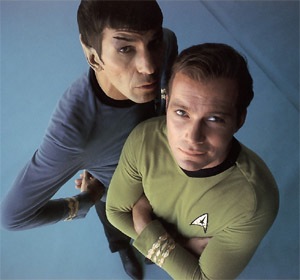
Which is, to my mind, a lot like the Star Trek franchise. Endlessly fussed and fossicked over, each new iteration and re-invention held up as the one, the return to greatness, forget all that other rubbish, remember 1966, here we go, make it so. The fans dress like their idols, wear all the shirts, put on the face-paint (admittedly, for Star Trek fans this is a bit more complex than two red slashes on a white ground) and, somewhere in the back of their minds, get ready for disappointment.
Ah, the '66 kit. CLASSIC.
I guess the JJ Abrams Star Trek reboot is then akin to England winning the World Cup. People didn’t quite know how to react when it turned out to be quite good. It was almost a shock to be confronted with something that didn’t look tired and old. Delight was mixed in with genuine surprise.
We can therefore compare the reaction to England’s performance against Algeria to a crowd who, instead of seeing the Abrams Trek, were confronted with an episode of season three of Voyager. Lame, uncertain, confused and above all BORING.
Rooney’s reaction to the boos that rang out around the pitch at the end of the nil-nil draw say a lot about the England Expects attitude, and how easy it is for an exalted figure to face the wrath of his foes. England Expects cuts both ways. We are couched to see our team as conquering heroes, incapable of defeat. When we are instead presented with a fumbling and inadequate display, we are unlikely to be in the mood to listen to excuses about climate, the kind of ball that’s being used, or the distractions of thousands of trumpets honking in B-flat. These are all actually perfectly legitimate reasons for poor performance, and for all they get paid, the England players are not superhuman. However they have been led to expect unwavering and above all uncritical support, especially during international matches. The press, the management, the PR, all geared towards making them feel unbeatable. They are not here to empathise with fans who have sacrificed an awful lot to be with their team in South Africa this summer. As far as the team is concerned, the fans are simply there, as they are always there, and their role in the game is to cheer. If they don’t – well, things start to fall apart.
The discovery that the object of your adoration is not only human, but not a very nice human is one that most fans will encounter at some point. Whether it be a brusque refusal for an autograph, or acting counter to the way the fan thinks that you should, the actors, sportspersons and musicians on which so much adulation is stacked are in constant danger of royally pissing off a chunk of their following. When they do, they seem surprised and a little hurt. It simply isn’t done for the fans to show disappointment. This comes out of a profound misunderstanding of the whole relationship. The fans do not know the star. The star cannot know the fans. They are involved in a parasitic relationship, fulfilling a need rather than entering into any kind of deeper understanding of each other. Not that either side would encourage it. That would defeat the object of the agreement. The gods need their worshippers as much as the worshippers need their gods.
Aaaany excuse.
The internet has, of course, intensified the whole scenario. Fans can now talk to each other, organising and gathering into communities as rich and diverse as their focus is narrow and intense. Many tribes and viewpoints under one banner, each putting aside their individual differences. For a while, at least, until someone says something they shouldn’t and the battle lines get drawn up. Occasionally the object of devotion will appear. This would be akin to royalty strolling into a tavern for a tankard with the proles. It’s all very exciting, but doesn’t feel llke a genuine gesture of kinship. It’s like drinking with the Prince Of Wales. It would get real uncomfortable real fast. It’s a rare celebrity that has the ability to communicate with their fans directly and without corporate bullshit. Amanda Palmer springs to mind, and probably Wil Wheaton (although he’s carved out a name for hisself above and beyond the whole Star Trek thing, becoming a bona fide geek celeb). But these guys use the connection as much as it uses them, building a fan base and therefore cashflow out of this open relationship. Amanda especially works ferociously hard at this, building a career out of guerilla gigs and selling her records online.
The mainstream, and footballers in particular, don’t do it at all. They have no need. The huge online footie communities rage and conspire as usual, but have the ability to vent their frustrations in a direct and vocal means at their objects of devotion, every Saturday at grounds around the country. Football chants are the most immediate and to-the-minute way for fans to communicate how they feel straight at the players, at full volume. Any gaffe, affair or poor run of play will be met with incisive commentary and vicious humour. You simply won’t get any of that on the Twilight boards. Whether the footballers get a lot of what’s being said is another question.
Fandom, then, is an abusive relationship in which both sides are using each other, lashing out and making up in equal part, yelling at each other without really understanding what the other side has to say. At the same time it’s a focus for kinship, friendship, creativity and community. The boards are places where you can be unafraid of your likes, your urges. They are places where you can discover that you are not only not alone, but there are thousands if not millions of people around the world who think like you, like the same bands, and have the same picture on their wall or as a computer desktop. Fandom is, was, and always shall be, regardless of the figure that is praised.
I’ve used a lot of phrases like “worship”, “devotion” and “idol”, and it’s deliberate. The parallels between religion and fandom are strong. They both focus on unknowable, fantastic creatures who move in rarified circles beyond and above those of the people that follow them. They promise much, and rarely deliver. But no matter how badly or indifferently they are treated, the fans will always be there, always loyal, always devoted.
Up until England get knocked out tomorrow, anyway…
(And look, while we’re on the subject. The phrase Come On, England has a comma in it. Otherwise, it’s an exhortation to ejaculate on a field in Kent. It’s the LANGUAGE, people! Let’s use it like we know it!)
I’ve heard a lot about “The World Cup” over the last few weeks, and it sounds like a bit of a hoot, so I thought I’d give it a go last night, especially as our national team were playing. They seem like a fine bunch of lads according to the papers, upstanding, moral and intelligent.
And do you, know, I enjoyed it. It’s a much more subtle game than I had anticipated, and it took me a while to figure out the gameplay and scoring. Here’s my understanding of it – please do let me know if I’ve got anything wrong.
There are two teams of ten men, and two stewards or “goal keepers”, whose job is to tend to a wooden frame with a net strung across it. The purpose of the game is to get a ball close to the net without it going in – if there is a danger of this happening, then the “goal keepers” are on hand to save the day. These two gentlemen, resplendent in purple and yellow, did sterling service, and the unqualified disaster of the ball touching the net remained unfulfilled.
To make the job more difficult for the players, the ball itself seems to be under some form of radio control, perhaps directed by the flag-wielding opposition lined up around the arena. Certainly, the players seemed to have problems in controlling the ball, and seemed to be forever tripping over it or missing it entirely.
The game ended in a perfect nothing to nothing score, with which everyone must have been very pleased. The game seems to be an enactment of the quest for nirvana, or nothingness, a struggle that ends with a greater understanding of the void in which we all must toil. The ongoing musical accompaniment by a troupe of trumpeters added a further meditative air to proceedings.
It was, on the whole, a most relaxing and thoughtful way to spend a couple of hours. It makes a refreshing change from the game it most resembled, “foot ball”, with much less emphasis on the Western bias towards competitiveness and “winning”.






 EXCUSES AND HALF TRUTHS
