A Fiendishly Good War Comic

Wartime horror is one of those subgenres that’s never really taken off. War itself is horrific enough. You don’t need to overegg the pudding with something supernatural.
SF can get away with the setting, as it’s an excuse for cool dieselpunk gadgets and Nazi robots and that.
There’s been a bit of an upsurge in films about Nazi zombies lately, but really they’re just the walking dead in an emotive costume.

I’m kind of disappointed that there’s been so little material on Nazi vampires. I can’t think of anything in the realms of film apart from Michael Mann’s discodelic The Keep (oh, those lasers…). Angel and True Blood have both had WW2 vignettes.*

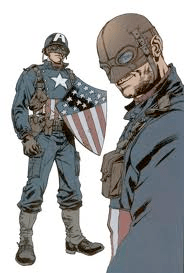
But it’s comics that have brought us the best examples of an admittedly niche trope. Some fine recent examples include the current run of American Vampire, and a lovely, creepy Captain America strip by Ed Brubaker and the sorely missed Gene Colan, that you can read in full here.
But for the definitive WW2 vampire story, look no further than my beloved 2000AD, and Fiends Of The Eastern Front. Drawn by one of the most celebrated artists on the British scene, Carlos Ezquerra, and written by one of it’s most under-rated scribes, Gerry Finley-Day, FOTEF is a stark, uncompromising and gloriously pulpy bit of horror.
The comic is set during the Russian campaign of 1942, and takes the form of a diary written by a German trooper, Hans Schmitt. His regiment becomes host to a group of Romanian partisans led by the charismatic Captain Constanta. They seem unstoppable in battle, and fight by night, spending the day asleep.
You’ve guessed it. They’re Transylvanian, and Schmitt discovers their bloody secret. Of course, none of his comrades believe him, and Constanta gives him a not-so-friendly warning. When the tide of the war turns, and Romania changes sides, Schmitt and his regiment face a new and remorseless enemy who are quite literally after their blood.
2000AD is unfairly tagged as the Judge Dredd comic, when it has published a wide range of solid genre work over the years. Their horror is particularly good (and probably worth a post all to itself), and I would hold up FOTEF as one of the AD’s finest hours.

Ezquerra’s stark black and white art is dripping with atmosphere and a sweaty, febrile dread. Findley-Day’s script is stripped to the bone, as tight and inevitable as a hangman’s noose. Bookended with a scene set in a Berlin bunker twenty years later that provides a neat final twist, FOTEF is a deeply satisfying read that motors along breathlessly. As a treatise on the way allegiances can all too quickly shift, and how trust be be so easily compromised, it has few equals in the comics field.
Finley-Day is best known as Tharg’s future war specialist, creating both Rogue Trooper and The VC’s. But FOTEF’s roots can be traced to his work with Battle and Action in the mid-70s. He was already known for creating sympathetic German heroes, and his work had a sharply political and cinematic edge. Rat Pack, an earlier collaboration with Ezquerra, is a neat take on The Dirty Dozen, and I can’t help but be reminded of Peckinpah’s Cross Of Iron when reading Hermann Of Hammer Force. Not least because Ezquerra’s heroes look a bit like James Coburn…
Fiends Of The Eastern Front was revamped (sorry) for modern audiences in the early norties by David Bishop, and those stories, dropping Constanta and his bloodsucking crew into real life battles, are a lot of fun. But the original is the best, and Gerry Finley-Day deserves recognition for a solidly original work of horror fiction. War, with Constanta at your heels, can indeed be hell.

Revolution Books have a nice new edition of Fiends Of The Eastern Front for your viewing pleasure, which include the original tale and David Bishop and Colin MacNeil’s reboot. Highly recommended.

*As expected, I has UPDATES from X&HTeam-mates. Ben Woodiwiss issues a Uwe Boll warning, and reminds me of Bloodrayne 3, which features more vampNazis than you can shake a stake at! Trailer here. Caution: not safe for anyone.

Meanwhile, Leading Man Clive has pointed me at this:

http://www.youtube.com/watch?v=cEI9BLZ6460

Looks like you have to go to the Germans for your Nazi Vampires…

The Mutant Question: X-Men First Class, prejudice and revenge

We humans are a venal, fickle bunch. We’re fine with superheroes as long as they’reaccidental (bitten, exposed to gamma radiation, struck in the face by toxic sludge); gifted by otherworldly outsiders (aliens or magical beings, or indeed aliens posing as magical beings); or if they’re otherworldly outsiders (aliens from a stricken red-sunned world, gods of thunder, Amazonians). If you’re unlucky enough to be born with your power, then we will fear and despise you. Talk about a mixed message.

(spoilers after the cut)

Continue reading The Mutant Question: X-Men First Class, prejudice and revenge

Justified: an interview with Bill Drummond

I was looking for an exit strategy all morning. Maybe I was ill in bed. Maybe an unexpected client attend had dropped on me. There had to be something. I was halfway through a sixty-hour crunch week at work, and the last thing I needed was the added stress of a filmed interview with an ex-member of the KLF.

Thing was, I’d made a promise. And this interview was a big deal. Bill Drummond, art-provocateur and Justified Ancient Of Mu-Mu, was the last interview we needed to get perspective on Gimpo and the whole M25 Spin. It didn’t matter how tired I was, or how many rings I’d have to jump through to square a four-hour lunch break with work. We’d chased Drummond for years, and for me to bow out at the key moment because I was a bit tired wasn’t going to play. Dom would forgive me, but I’d never be able to forgive myself.

Continue reading Justified: an interview with Bill Drummond

Rules Of Engagement: Easy A and the laws of Highschool-land

NewImage

The Laws Of Highschool-Land are clear and sharply defined. As a citizen of the state, there are certain people you must be friends with, certain things you must wear, certain actions you must carry out, certain things you must say. As long as you stick to those rules, then you will be safe and content, and nothing will ever happen.

Which is why those rules are designed to be broken.

Continue reading Rules Of Engagement: Easy A and the laws of Highschool-land

Who’s that Girl? Lisbeth Salander, remakes and makeovers

The David Fincher remake of Neils Arden Oplev’s The Girl With The Dragon Tattoo is looking worse by the minute. I know it’s an exercise in foolishness to judge a film on the strength of a couple of trailers and a poster. But Sony Pictures have sent out these images to garner a first reaction to the film. So here’s mine.

(NSFW after the cut. There is an exposed nipple. It is pierced. Be afraid.)

Continue reading Who’s that Girl? Lisbeth Salander, remakes and makeovers

Cut: Censorship,The BBFC and Human Centipede 2

In a move that’s boggled the minds of UK horror fans, the BBFC have refused to certificate the sequel to Tom Six’s The Human Centipede, Human Centipede 2: Full Sequence. 2009’s Jap horror Grotesque was the last film to join this rarified club of films too awful for the sensitive British public to see.

Continue reading Cut: Censorship,The BBFC and Human Centipede 2

The Minor Fall, The Major Lift: 5 Soundtracks That Transcend Their Movies

These are good times for film soundtracks. Reputable dance acts are now willing to work with a director and come up with music that complements and adds to the visuals, rather than simply licensing a couple of songs to play over the end credits. Instead of a duff compilation or an orchestral suite, soundtrack albums are becoming sharp experimental works with a proper narrative flow.

The big beat boys of the nineties make music that has always had a cinematic edge, and the addition of an orchestral edge to the bounce really opens out the sound. Basement Jaxx’s work on Attack The Block adds theremin to the mix, accentuating the sci-fi. The Chemical Brothers created a jagged, jittery soundscape for Hanna that seems to have influenced Joe Wright’s cutting style.

Then of course, there’s the epic score to Tron: Legacy, which has frankly raised the bar for electronic soundtrack work. The scale and sweep of Daft Punk’s work made the album one of my favourites of last year.

A decent soundtrack album can be a sheer joy, mixing great songs with massive instrumentals and moments of mood and drama. Some don’t work at album length. I’m thinking specifically of John Carpenter’s Assault On Precinct 13, which is simply the same cues played over and over again at different track lengths. Or, sadly, Clint Mansell’s music to Moon, which I love to bits, but is stretched uncomfortably thinly over 75 minutes. The final ten-minute piece Welcome To Lunar Industries (Three Years) gives you everything you need. Tellingly, it’s the one track not available on Spotify.

There are certain soundtrack albums that have managed to find an identity above and beyond their origins, becoming works of art in their own right. Here are my top five. I’m sure there are more. I’m sure you’ll let me know.

Continue reading The Minor Fall, The Major Lift: 5 Soundtracks That Transcend Their Movies

Out Of The Woods: X&HT Watched Hanna

20110519-173058.jpgA girl and her father live in a cottage in the middle of a forest. It’s a simple existence. They hunt, and read together, and every so often the father will leap out of the undergrowth and try to beat the girl up. He warns her that she needs to be ready for attack even when asleep, and she assures him that she will be in several languages.

The girl decides she is ready to leave the forest. So the father digs up a military transponder. Once she flicks the switch on it, the world and all it’s dangers will come to her.

She flicks the switch, and the wolves come running.

Joe Wright, director of so-so adaptations of literary classics, has decided to radically change direction with Hanna, his first film based on an original story. It’s an up-tempo thriller with an SF twist, backed with a killer soundtrack from the Chemical Brothers (the best I’ve heard since Daft Punk’s Tron: Legacy monster). It boasts a couple of great central performances from Saiorse Ronan and Cate Blanchett and a nice story idea.

But it doesn’t hold together. The script is full of plot holes and dangling threads. Tom Hollander’s monstrous assassin is a bundle of cliches tied up in an ill-fitting Tacchini tracksuit. The nice bunch of middle-class hippies that offer Hanna a different definition of “family” to any she has hitherto known simply vanish at the end of act two, never to be seen again.

While watching, I kept coming back to the transponder, the literal flick of the switch that starts the movie going. Why would Hanna’s father insist that if she was going into the world, it would be as a warrior at bay? I waited for the reason, the revelation of the long game that he had been playing. The revenge play, the public exposure of the terrible plot.

It never came. There was no point to bringing Marisa, evil step-mother and big bad wolf in one power-suited package, back into the picture. It seemed to be an unnecessary sacrifice of everything that father and daughter had shared in the forest. It started to seem uncomfortably like a fit of pique.

As a movie, Hanna is dressed up nice and plays pretty. There are some sterling action sequences, some fun camerawork, and it’s not, at least, part of a franchise. But the lazy comparisons with the work of Luc Besson do both parties a disservice. Hanna is not Nikita meets Leon. It doesn’t have Besson’s bite and fire. Worse, it has a hamfisted way with visual metaphor (count the eyes on posters as Eric arrives in Germany. We get it. He’s being watched) and a final line and shot that you can see coming a mile off.

Summary: Not quite a wasted opportunity, but nowhere near as clever or groundbreaking as it believes itself to be. What a shame.

In Defence: Michael Bay’s “The Island”

the_island.jpg

The Island was Michael Bay’s last film before he disappeared into the creative black hole of the Transformers films. It had a difficult shoot, an advertising campaign from which Bay disassociated himself, and a public response that varied between lukewarm and actively hostile. He rushed it out in less than a year to get the jump on a mooted remake of Logan’s Run, and the experience and reaction to it nearly broke him. He retreated to a sweet franchise deal with a baked-in non-judgemental audience, where it didn’t matter what the critics said.

That’s a pity, because The Island has a lot to recommend it. The basic pitch is clear – Logan’s Run meets the Clonus Horror. A post-apocalyptic colony, isolated after an ecological disaster are gradually revealed to be clones, grown as organ donors for rich clients. The island of the title, allegedly the one uncontaminated place on the planet, is a mirage. It allows the evil scientists running the place to whisk away their bags of meat with no questions asked. Everyone in the colony wants to go to The Island, but being picked for the privilege means death. When two clones discover the truth about the world and their place in it and escape,  the running, chasing and shooting at which Bay excels can begin.

However, up until that point it barely feels like a Michael Bay film at all, and you can see why he and the studios were so concerned about the Logan’s Run reboot. The opening section of The Island is a solid rip-off of the early parts of the kitsch 70s classic, with a Nike-futurist twist. The surfaces are all glass, polished concrete and ribbed fabrics. The clones waft about serenely in form-fitting tracksuits, and the dome comes across less like a living space and more like a mall. The similarities between the lottery for The Island and the black crystal marking you for Sanctuary are clear. The idea of a friend moving on to a better place and leaving everyone behind, never to be seen again, and for that sudden loss to be an expected and normal event is the dark place at the heart of both films, and they both reap benefits from it.

In fact, there are quite literally dark places in both films. Evil scientist Merrick’s offices are clad in dark stone and underlit through patterned glass. The computer that controls life in Logan’s dome sits in a vast, dim, cathedral-like space, the status panels glowing like stained glass. Bay and his design team seem to be drawn back to the design cues and plot beats of Logan’s Run – Merrick’s private army are dressed like Sandmen, and are relentless in their pursuit of the two runners, Lincoln and Jordan.

Famously, Bay was drawn to The Island because of the script and its exploration of how much value we put on life. He’s never subtle, but the way in which the clones are treated more like prized and pampered cattle than people still packs a punch. The moment that drew him to the project has a shocking power that’s not matched by anything else in his back catalogue. A pregnant clone is “taken to The Island,” giving birth only to see her baby taken away before she is put to sleep. The newborn is given to her client duplicate, who shows no concern for the surrogate. This is the point of the movie. The clones have been sold to the public that use them as unthinking, unfeeling creatures. Jordan and Lincoln’s escape puts that fiction under threat.

The world outside the dome is a hard, cruel place with some harsh lessons for the childlike clones. Jordan and Lincoln are both confronted by their doubles, who are shown as vain and duplicitous – quite literally two-faced. Ultimately, it’s the clones, sheltered from the world, that come across as the characters with the most humanity. There’s nothing particularly original about the story or it’s themes, but compared to Bay’s other films The Island is Shakespearean in depth and scope.

It’s a real shame that Bay, one of Hollywood’s purest visual stylists, has retreated from scripts with a bit of resonance and interest to spend the last five years directing Shia LaBeouf shouting “Optimus!” into a bleached-teal sky. The Island is no masterpiece, but it’s interesting enough to be worth your time.