Windows In SF

No, not the Microsoft version, and you’d like to hope that the systems on board the Enterprise and the like are not based on an underpinning that’s liable to blue-screen on you halfway through a transporter cycle, or need to download an important security update before you can fire those photon torpedoes.

I'm not sure that's the best way to clean windows...

Windows in SF tend towards the panoramic. They are great floor to window room-width panes, around which your crew can gather to goggle in wonder at each new wonder they encounter on their impossible mission to the gates of forever. More recent iterations of The Big Window have embedded graphics. Just in case you weren’t sure about the exact designation of the Klingon Warbirds moving into battle configuration in front of you, handy pop-up windows, scrolling text boxes and spinning wire-frame models tell you more than you needed to know.

In reality, of course, the sort of panoramic window that you’d see on the bridge of the Enterprise or the command deck of an Imperial Destroyer could never happen. That much glass, under atmospheric pressure on the inside and the constant risk of micrometeorite impact from the outside, would be far too dangerous to install. On the International Space Station and the Shuttle, windows are tiny, quadruple-glazed portholes of thick crystal. You want a peek outside? That’s what video cameras are for.

The guy in red doesn't realise he's up for window-cleaning duty yet...

Which is why most “windows” in SF are actually really big projectors. They have zoom functions. They can hook into communication circuits, so that looming close-up of the approaching enemy warlord demanding your immediate surrender and the handover of fifty of your most fragrant ensigns can be really threatening. You can even show that things have gone really badly wrong by having the screen just show that fuzzy analogue static that is somehow still a signifier of lost signal even after ten years of fizz-free digital telly.

I’m a fan of The Big Window in Danny Boyle’s Sunshine, which started this whole SF decor riff in the first place. That window is a way for the crew to have a look at the approaching sun in all it’s fearful magnificence, and it’s tunable to filter out all but 3% of the light. This, for once, does just seem to be a portal, albeit one with some really smart sunblock. But it fulfills all of the rules I outlined earlier – it’s a Really Big Window, probably twenty feet square, and at one point the whole crew do gather around it to gawp in wonderment at Mercury passing across the surface of the sun. It’s a lovely moment, and sums up for me the important thing about SF set design. It should always be there to help the story along. Let’s face it, that bit of the film wouldn’t have had the emotional impact if the crew of the Icarus II had been crowded around a foot-square porthole.

We're gonna need a bigger tube of Factor 50.

One word you should never hear in an SF movie? “Budge up a bit, let me have a look.”

The Man Who Draws The Movies

As I think we’ve seen, set design in science fiction follows particular rules and tends towards particular looks. It does not, in general, have the jury-rigged aesthetic that you’d see on actual spacecraft, or long term habitations like the ISS. Which is fair enough. No-one really wants to see high drama carried out in the sort of cramped compartments astronauts have to survive in for months at a time. No, spacecraft in Hollywood are roomy affairs, filled with high-ceilinged, dramatically lit rooms that bizarrely are connected by low, dark corridors.

I put the blame for the look of Hollywood spacecraft squarely onto one man’s shoulders. He’s been a seminal influence on fantastic (as in cinema of the…, although his work is never less than brilliant) set design since the seventies, and was pivotal in creating the look of some of the greatest films of the genre.

I’m talking about Ron Cobb, of course.

His career began at UCLA in the early seventies. Working alongside a fledgeling director by the name of John Carpenter, Ron’s first piece of design was on Carpenter’s first film, Dark Star. Although the clean lines of Star Trek were still in evidence in the ship design, the tiny bridge room he put together was a clever way of working within a budget that was not so much tight as gonad-squeezing. All three astronauts are crammed into a tiny set, but by placing them face-to-face and stacked along the frame, he allowed Carpenter to build in long dialogue takes without needing to intercut. His work on Dark Star is smart and sharp, and makes a student film look much, much more expensive.

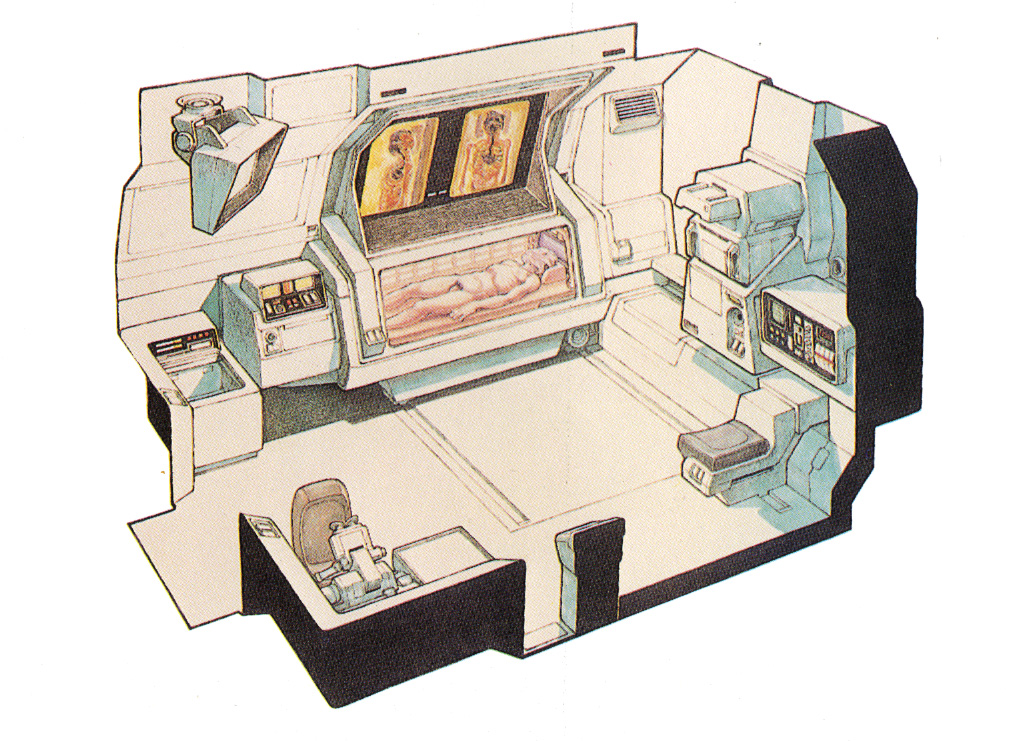
The work for which he’s best known would come with his collaboration with Ridley Scott on Alien. Taking a cue from Jodorowsky’s aborted Dune project, Scott assembled some of the best known SF illustrators of the day for their takes on the gigantic space tug Nostromo, the alien craft they discover, and the creature they bring back with them.

Cobb interiors. The second image is from Walt Simonson's fantastic adaptation of the film. Equally influential.

Cobb’s drawings of the interior of the Nostromo were a part of my childhood. One of my most prized possessions as a boy was a book on the making of Alien. This had a wealth of pre-production drawings from the likes of Cobb, Chris Foss and of course HR Giger. I wish I could tell you what happened to that book. It somehow managed to disappear during one of the many moves my family made while I was a teenager. I was drawn especially to Cobb’s boxy, solid interiors, and used to pore over the details, obsessing for hours over how he had managed to do so much with such apparent ease.

It was thanks to him that I started to draw, filling notebooks with carefully drafted approximations of his work. He helped me figure out perspective, shading and modelling. Even now, my choice of art materials skews towards the technical. Sharpies, Rotrings and markers rather than pastels, oils and charcoal. Tie that into my enduring love of comics, and the discovery that actually I’m not a bad cartoonist, and my path has been set artistically ever since. I’m a black line boy.

Ron is still working, of course, and it’s great to see his mantle taken up by other, equally talented film designers like Nigel Phelps. But I see his influence in comics and graphic work of all hues and persuasions as well. His boxy vehicle designs are very much echoed in current production line models like the Kia Soul, the Scion and most obviously to my mind, the Nissan Cube with it’s asymmetrical wrap-around window. The modern MRI scanner owes more than a tip of the hat to his medbay drawings for the Nostromo. It seems we all live in Ron Cobb’s world now.

If only I could remember what I’d done with that Alien artbook…

(once again, a tip of the hat to John Eaves and his excellent website, from whence a lot of these images have been ganked.)

The Chair In SF

The humble chair. A little spot designed for rest and relaxation, right? An item of furniture for you to take the weight off your feet, to switch off a bit.
Not in SF, it isn’t. In our favourite genre, the chair becomes a place of action.

Consider The Captain’s Chair in Star Trek. In The Original Series, it is a slab-sided, poorly padded lump of alloy on a swivel. Kirk spends a minuscule amount of time on it, and for the most part he perches on the edge of the seat cushion. Mainly because if he tried sitting back the rotten thing would dig a hole in his lower back. It wasn’t surprising he couldn’t wait to get out of it. It seemed to be a focal point for James T. to bark at Scotty through the communicator whilst leering at leggy ensigns.

It’s interesting to note that The Captain’s Chair becomes more comfortable the less outwardly aggressive it’s occupant. In the later seasons of Star Trek – The Next Generation, The Chair is better described as The Recliner. I swear, the thing has a footstool. I’m also certain there are opening shots in some of the later episodes where Picard can be spotted having a sneaky snooze.

Standards are slipping at Starfleet

SF chairs are not static objects. They do things. They move about. They are multi-purpose. They are dramatic objects. They are not designed for settling into with a mug of cocoa and a thick paperback.

A lot of them are on gimbals or tracks and whizz backwards and forwards with exciting whines and buzzes. They frequently incorporate communication devices, video equipment or in some cases, something more destructive.

pewpewpewneeeowwwkaboooom

Let’s do the Star Wars thing. I’m thinking specifically of the gun emplacements on the Millenium Falcon. These are fantastic. They’re ceiling-mounted. They have headsets, cool video screens and OH DID I MENTION THE GUNS?? I wanted one of these so badly when I was a kid. Oh, who am I kidding? I want one now.

Clearly I’m not alone. The gun emplacement bit in The End Of Time, the last Tennant Doctor Who episode, is a clear homage to the Falcon gunfight. Behind the scenes footage shows Bernard Cribbins having a whale of a time behind the sights of the lasers. I want to see the out-takes where he goes “pewpewpew” and makes exploding noises through his cheeks.

To confuse matters even further, let’s look to The Matrix. The gateways to the virtual world on the Nebuchennezar are accessed through couch-mounted plugs and circuits. You take a seat to dial into the Matrix. Let me just reiterate that. In the Matrix, chairs can be doors.

In Iain M. Bank’s Use Of Weapons the chair becomes something more potent. I would argue that the events of the book revolve around the sourcing of materials and construction of a simple white chair. This might seem a bit of a strange thing to say when talking about a novel that chronicles the adventures of an interplanetary mercenary. And it’s a difficult thing to properly talk about without ruining the big wallop at the end of the story. I recommend reading the book, but if you must, there’s a spoiler below.

The chair is made out of the bones of the main character’s sister, complete with a cushion fashioned from her skin. Iain Banks’ SF is not cheerful. Although it is somewhat chairful. Sorry.

After all that, I need a sit down. Someone send me over an armchair…

The Door in SF

You thought I was kidding, didn’t you?

Ron Cobb does the business. That’s the kind of door we’re talking about…

image courtesy of John Eaves. Check out his chunk of posts on Ron Cobb here.

Let’s consider the humble doorway, and how it has become a character in and of itself in SF. In every other genre I can think of, they are simple objects. They open. They close, occasionally with a slam. In a prison context, they are symbols of incarceration, although to be frank characters tend to talk about the walls more, and they are the object that will have the graffiti and the gate-bar scratches, counting off the days until freedom comes.

SF doors are infinitely more complex. They are desperately over-engineered for the job at hand. And at the same time they barely fulfil the essential design requisites that you and I would consider the door would need. They rarely have handles, for example. You have to punch a code or say a password or, memorably in Jeunet’s Alien:Resurrection, huff your cheesy breath into a detector.

And that’s before the darn things will even open for you. Then you get the best efforts of a team of props men as they slide back on tracks or drop through the floor or iris open like a lens. In Star Trek: DS9 the doors were built like cogs, and they rolled out of the way in a way that was far too complex for the end result. Lights will frequently blink and flash. In Peter Hyam’s Outland, they had useful red or green fluorescents to let you know if they were locked or not.

And then of course, they always make noise. Helpful bleeps and chimes to let you know that they’re about to do that fancy three-way split. The hiss of hydraulics. The unzipping sound that accompanied Captain Kirk as he marched down the corridors of the Enterprise (those corridors were always too fancy for my liking, although I’ve always had a thing for the Jeffries Tube). And I have to mention the doors on the Heart Of Gold in the Hitch-hiker’s Guide To The Galaxy, that were programmed to take pleasure in opening and closing, and did so with an almost orgasmic sigh.

Of course, there are always exceptions. The doors in the reboot of Battlestar Galactica are heavy, unwieldy things, but at least they have a handle and they are pulled open and closed. However, as they’re all designed to isolate an area in the event of a leak, they still have valves and wheels and an excess of handles and cranks. Opening a door still takes up a disproportionate amount of screen time and effort.

I’ve not really talked about the more esoteric kind of SF door yet. The Stargates, for one, have devolved over the years from being a 2001-esque gateway across galactic space, complete with warp effects and the wailings of a heavenly choir, to the kind of thing that O’Neill and crew hop through when they fancy a walk in the Canadian woods. Then we have the organic portals of the living craft of Lexx and Farscape. These worry me. I’m not sure a door should drip and ooze. Or to that point, just vanish on you just at the point when you need them the most.

But of course, my all-time favourite SF door? Well, there’s no contest, really.

And don’t tell me you wouldn’t do the same with a door that did that. I want one for my garage.

The Joy Of Corridor

2A30A56D-F5B7-4D17-89F9-6CCA1E1E8DF0.jpg

Like most things in my life, it all boils down to Star Wars.

There are certain kinds of films that I really go for, and will happily sit and watch again and again. Danny Boyle’s Sunshine is one of them, and in a short introduction before it’s screening last night on FilmFour, he nailed one reason why. They all seem to be of a particular type, a genre with a history and a meme-set that is easily tracked. I love films of the genre sub-species he described as “A Ship. A Crew. A Signal.”

These are the horror-tinged bottle films, where most of the action takes place on a dark, monolithic spacecraft, within the confines of which BAD THINGS HAPPEN once The Crew pick up and foolishly answer The Signal. This Signal is usually a misinterpreted message to STAY THE FRAK AWAY. From then on in there will be running and screaming and dying and mostly a single survivor.

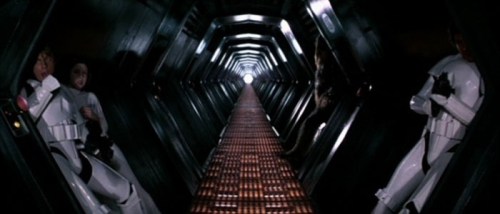
But mostly, there will be corridors. Hundreds of them, stretching for miles. They will be encrusted in vents, ducts, computery bits, extraneous ribbing, tons of stencilling and detailing in a limited palette of sans-serif fonts. There will be steam. Oh my word, there will be steam. I often wonder whether ships like the Nostromo and the Event Horizon are powered by a coal-fired boiler rather than a nuclear reactor.

The camera will start the film drifting in a dreamy manner down these corridors, and end it whizzing down them as the final character either has to get to a door before a timer runs out, or because something insectoid with too many teeth is chasing them. Frequently, both of these things are happening at once. There will be a whooping alert sound. It’s the same one in all of these films. There will also be a calm female voice doing the countdown. I think Winona Ryder has the monopoly on that one.

Sunshine has some great corridors. The set took over the entirety of Three Mills Studio in East London when the film was shot in 2006, and the detailing is exquisite. I’m happy to report that there’s also little attempt to score points off the meme. Although the ship is on it’s way to the sun, the corridors are dark and claustrophobic. The feel is heavy and industrial. Like most of these ships, the Icarus II is a submarine in space, a tiny metal bubble of life in an environment that’s almost instantly lethal.

I spent years in my youth drawing corridors like the ones you see in films like Sunshine and Alien. Once the technical drawing classes I took in junior high school taught me the rudiments of perspective, I was away. I can still draft a pretty good blocky spaceship in three-point, or an infinitely expansive throughway liberally coated in technological cruft. I love them. They are places where adventure happens, where there is high drama, monsters coming out of the walls and lots of those spinning orange lights they have on the roofs of ambulances.

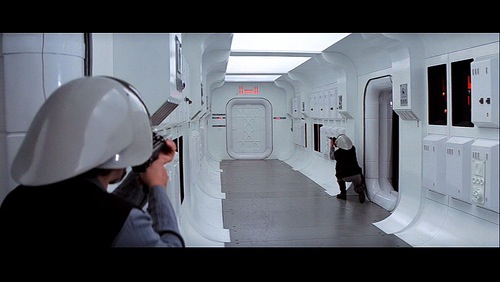
I said at the beginning that I blamed this on Star Wars. Think about it. Two minutes into the film, after all that tedious nonsense with the yellow letters and the big triangle that goes on for miles, we are inside the Tantive IV, and we see… well, THIS.

09259B08-6F16-4BD1-A2F9-ABA546B3E02D.jpg

This, and the later scenes in the Death Star are something that should not be shown to an impressionable ten-year-old who’s already a little too lost in his own imagination for his own good. Especially the bits in the prison block.

For further reading, I cannot recommend Martin Anderson’s post on Den Of Geek highly enough. If you think I’m wibbling on un-necessarily, just wait and see what he’s got.

Coming up: doors in SF.

Satan’s Schoolgirls

girl silhouette.jpgI should mention this, shouldn’t I? The observant amongst you, Readership, will have noticed the ranty banner at the top of the page. Let’s reiterate the message. For the first time, the entire text of my first novel, the St. Trinian’s meets Lord of The Flies mashup Satan’s Schoolgirls is available, gratis, free and without charge. Click on the link, or here, to send a PDF copy flying to your downloads folder.

Would you like a copy in ePub, or as a Kindle file? That’s in the works, as is the ultimate aim – a paperback version. This will be print on demand, most likely through the lovely people at Createspace, and is – well, imminent. For the meantime, enjoy the story. Please, give me feedback. I’d love to know at which point you feel it all went horribly wrong.

Done A Mix

431F8AD0-9E43-445C-8C75-929D090185D0.jpgYesterday, the popular link-forwarding site Reddit was asked to generate a list of songs to get you out of bed and moving on a Monday morning. The response was – shall we say enthusiastic? As I had some spare time, I decided to plug those results into Spotify, and ended up with a mix that will last you through most of the day.

It’s here, and it’s collaborative, so if there’s anything you think should be added, go right ahead. Usual Spotify caveats apply – no Beatles, but then that’s true of digital media in general. No Led Zep either, as far as I can tell. I’ve tried to keep the list to one song per artist, and I should stress these are not my choices, so don’t be raggin’ on me about the Phil Collins, mmmmkay? However, in general I think it’s a great list, and will work for any day you need to get your lazy ass out of bed and getting the day by the short hairs.

(If anyone doesn’t have Spotify yet, and would like an invite, hit me up in the comments. I have plenty to spare, and it’s a service that’s worth a look.)

Food For Thought

I love flicking through cookery books. I’m a complete sucker for them, always have been. I’m a curious cook (that is, someone that enjoys playing and investigating in the kitchen, not someone that’s a bit odd when he puts on an apron (although that accusation has also been quite fairly laid in front of me. That does not necessarily mean I have to eat it)). I believe in reading round the subject. Post-austerity cookery books of the 50’s are especially good value, their garish colour schemes never quite disguising the fact that the lovingly photographed spam fritter is just that, and therefore in-flippin-edible.

I enjoy cookery books that bring something more than recipes to the table. My enthusiasm for Nigel Slater knows no bounds, and it’s not just because his relaxed and improvisational way with a meal perfectly suits my own. He brings so much of himself to the page that the process of cooking becomes more… conversational, I suppose. Plus, he has a way of slipping dirty jokes and innuendo into the recipes, in a way that just adds a certain naughty charm to proceedings. Anyone that doesn’t believe that cooking is all about sex should try reading some of his dessert ideas.

Anthony Bourdain’s Kitchen Confidential is another book that I go back to time and again for inspiration, although it doesn’t actually contain any recipes at all. Rather, it’s the passion and the attitude that he slathers across the page that I sometimes crave. Part autobiography, part cautionary tale (it is thanks to Bourdain that I will never order fish in a restaurant on a Monday), part business plan, part manifesto – all great. He writes crime books too, with the same elan and skill. The book was transferred to a lacklustre TV show, that failed in my mind because there wasn’t half enough Bourdain in it. His greedy enthusiasm for everything edible renders the book almost lickably good.

However, if cornered, my favourite food book comes from the mighty, and sadly missed, Keith Floyd. He was the first TV chef I took seriously, and certainly the one that inspired me to cook with a glass in hand. One for the pot, one for me. His American Pie is an extraordinary travelogue. Floyd tears across the States in a big red Caddy with a crazy blonde PA in tow telling a story that is in equal parts crazed, elegiac, evocative and drop-the-book funny. It’s a bonus that it just happens to have an addendum filled with some extraordinarily good recipes. I will admit to not being brave enough to try to make chitlins or collard greens his way (offal and I have never seen eye to orifice) but his small section on the great American slumgullion has informed my cooking from it’s formative stages. Again, it’s that slightly experimental approach. I like all these ingredients. Let’s chuck ’em all in a pan together, and see what comes out. It’s worked so far. Well, I haven’t poisoned anyone yet…

I’ve found a couple of pieces online recently that have nourished me in a similar way. Roger Ebert, the famed movie critic, has posted a wonderful piece on his recollections of food. It’s a piece that’s Proustian in it’s detail, and heartbreaking in it’s central conceit – following a series of operations, Ebert can no longer eat or drink. The memory of food is all he has left. Although there is a wonderful moment where he talks the doctors into putting some coke into his IV…

Then there’s this, from Stuart Ian Burns, AKA Feeling Listless. Slipped into the middle of his musings on frozen pizza and Costco steak, there’s a moment where he talks about a Pan du Chocolat he ate …well, half-ate, at the Musee d’Orsay Café in Paris. It’s beautiful and frankly … heartbreaking.

There’s plenty more food for the soul out there. Any suggestions?

The White Event

X&HTowers, busy as everWell, Reading really caught the brunt of the cold weather this time around. X&HTowers is blanketed under about a foot of cold crisp white stuff, and looks more festive than Santa’s new socks. I’ve been really lucky with shift patterns over the festive season, and am happy to report that The Big Freeze, as most unimaginative news outlets are calling it, coincided with three days off. Yes, OK, I have to work this weekend, but I don’t have to work now, which pleases me greatly.

2010 is, I think, the year when Working From Home becomes much more important, especially if the country continues to be caught out by EWEs (Extreme Weather Events, Ⓒ Rob Wickings if no-one’s snagged that term yet). It’s like taking a duvet day without the guilt, or the chance of getting caught out by the boss. With the prelavence of netbooks and smartphones it’s now so easy to Work From Home that you can do it from a cafe. Or if you prefer, the pub. Why pay for all those expensive business premises when you can just bitch about your colleagues and play soduko in the nearest Barstucks? It’s been coming for a while, and all it takes is one more EWE, one company where no-one bothers to come in, business continues as usual and the clients don’t notice and … well, I reckon it’s time to start investing in multi-purpose public spaces. Wave of the future, I’m telling you. Make ’em weatherproof and give ’em free wi-fi and creche facilities, and you’re rocking. Why close libraries, when you could turn them into something like that?

Happy Feet
Happy Feet

I wish I had the option. Sadly, my work still requires a physical presence, which means braving public transport and the train services. I have a bicycle. Buggered if I’m going to use it in this weather. I can walk to Reading Station if I need to, which I have to frequently as buses and taxis evaporate in Reading as soon as the weather takes a turn for the rotten. If you need a workout, nothing beats walking uphill in a snowstorm. It’s that heel-toe action that you have to adopt to prevent the comedy prat-fall and inadvertent face-first snow angel action. It works muscles that you’d forgotten you had. Muscles that have taken the opportunity to remind you of their presence by complaining loudly.

The House Elf Takes The Strain

The end result of all this has been that I have taken great pleasure in spending the last couple of days with my butt in a chair, laptopping. I have been working hard on a New year treat for you all, which is the first step in what I am calling The Year Rob Makes Contact. I have great hopes for this year, despite all the evidence so far that it’s going to be rubbish. Come on, we’re only a week in. Give the new guy a chance.

In the mean time, here’s a little something. Below is a PDF to a short piece called The Body Politic. It’s excerpted from a longer piece, Under Glass, which I SWEAR will never see the light of day. It was a badly-misjudged piece of erotic writing, and it makes my toes curl in all the wrong ways. Not pretty. The bit I’m sharing has a few merits, though. It’s here as a PDF. I’d appreciate it if you can let me know if you have any problems either reading it, or dumping it onto your hard drive. My reasons for this will become clear soon enough.

Click the arrow to download THE BODY POLITIC

branches_download.png

There Is A Light That Never Goes Out

Stay warm, everyone.