Freedom And Liberation In Mad Max: Fury Road

A guest post this week! The fact it appears in a week when I have very little in the bank for a Swipe is entirely coincidental.

I am honored and delighted to welcome my pal Ryan Morris to the ranks of X&HTeammates. He has gracefully allowed me to host his piece, first published in 2019 by Jump Cut Archive, on… well, look at the title and you should get the idea. With Furiosa rumbling over the horizon this month, now is an excellent time to dig into the first part of the story (chronologically speaking, the second part but hey, you know, movies).

Aaaanyway. This is a deep dive but worth the oxygen debt. Settle back and let Ryan lead us down the path to freedom.


Geographically, Mad Max: Fury Road ends exactly where it begins. After a short prologue detailing the descent of the world and of humanity, we find ourselves deep within the Citadel, held and run by the tyrannical Immortan Joe. We watch as Max is brought there, used as a blood bank for the War Boy Nux, strapped to the front of a fired-up car and sent after Furiosa to bring back Joe’s five Wives. We follow their chaotic journey to the Green Place, grieve at their loss of hope, then witness their last-ditch effort to reclaim the once traumatic environment of the Citadel and re-identify it as a home of liberation. It’s a frantic, brutal, cyclical journey.

The Citadel opens George Miller’s film as a place of violence and hopelessness, an environment that leaves physical wounds upon the body – Max is brought there and immediately scarred with markings that dehumanizingly list his blood type, while Furiosa is introduced to us through a shot of the symbol Joe has branded on the back of her neck before we’re given the reveal of her mechanical left arm, an enigma to the violence of her past. Both elements to these characters will be important later, as we look at the ways Fury Road finds freedom for its characters, and binds it to a specific idea of liberation depending on the character you examine: for Max, it is liberation of the self; for Furiosa, liberation of the past; for Nux, liberation of the mind; for the Wives, liberation of the body. Miller’s film may open and close in the same physical environment but the same cannot be said for the people who occupy his story.

Before we begin, it’s worth looking at the other central themes that occupy Fury Road, as many of them will resurface once we take a deeper dive into the individual characters of the film and the way Miller takes them on the path to freedom via liberation. Most notably, Fury Road concerns itself with survival, specifically in a harsh, post-apocalyptic world. More than simply surviving the events of the film, though, Miller’s script imbeds the concept of survival deep into his characters – survival is all Max cares about, Furiosa concerns herself with the survival of others and Nux has little interest in survival in order to appease the leader he worships. Redemption and revenge also arise throughout the film, as well as the concept of home, again in a variety of ways – the Wives are looking for a new safe home, Furiosa is trying to return to her old home, and Max’s has been long destroyed.

Max Rockatansky opens the film with a narration, through which he refers to his world as “fire and blood” and deems himself “reduced to a single instinct”, survival. His narration grants us flashes into his past, scattered memories of family and friends he was unable to protect or save. He is, unmistakably, haunted by them. The shame of Max’ past overwhelms him and his sense of self, the figure we see at the beginning of the film is without home and without soul. Existing in the wasteland is all Max longs for and all he achieves, the most fundamental element of humanity – survival – is also the most rudimentary. We all need to survive, but we all choose to do so much more. Not Max.


It’s important to remember that, at this stage in the film, not even Max’s own blood belongs to him. Further into the film, when Max meets Furiosa and reluctantly joins her mission to free Joe’s Wives, he is queried as to his identity and his story, but he refuses to answer. Furiosa asks for his name during a pivotal scene and is met with little more than a blank stare and a snappy shake of the head. I don’t deserve a name, we can read through Tom Hardy’s brilliantly expressive eyes. A man haunted by those he failed to save does not warrant saving. To have a name is to have belonging, our first names identify us while our surnames come coupled with our history. Initially, Max wants neither.

Across Fury Road, Max comes to see that this world, though still unavoidably bleak and decayed, has opportunity for him. Those he failed to protect in the past will always haunt him, but when faced with the chance to correct the wrongs of his former self – the self he no longer identifies with – he begins to understand how he can avoid making the same mistakes. We’re introduced to Max in the Citadel as a blood bank for the Immortan’s army, but by the film’s resolution we find him using that branding to save the life of the woman who saved his sense of self – in doing so, he reclaims the identity he’s been hiding from others and, most notably, himself. Our last sighting of Max is of him disappearing into the crowds beneath the Citadel, refusing the spotlight and walking away from acknowledgement, but his nod of the head towards Furiosa – surviving because Max’ blood runs through her veins – is of stark contrast to the head shake he dismisses her with earlier. Liberated from the nameless persona Max bound to himself, we get the sense that the idea of family (a key component in our understanding of the self) is perhaps not all that lost to him anymore.

Similarly to Max, Furiosa’s growth across the film comes through our understanding of her past. While Max is granted the opportunity to talk us through his immediate history at the film’s opening, Furiosa has no such luxury, meaning we must piece her narrative thus far together ourselves. We know from Miller’s rich sense of world-building that women aren’t exactly heralded as worthy in this new and broken world, so we can perhaps ascertain that in order to achieve her high-ranking status Furiosa had to embody the traits of men and perhaps even look down on the other, “lesser” women of the Citadel. Why is the freedom of Joe’s Wives so important to her? In the Citadel, Furiosa has security, she has power and she has trust – that mechanical arm didn’t make itself. Abandoning this safety to grant the freedom of others in such a harsh world is an act of overwhelming selflessness, one we arguably don’t understand until later in the film when Furiosa reunites with the Vuvalini.

Redemption is the sole word on Furiosa’s lips when Max asks her what she wants, and it’s the sole word that convinces her to have faith in Max’s final plan to return to the Citadel. But what exactly does Furiosa need to redeem? We find out through her time with the Vuvalini that she was stolen from her home as a child, raised in the Citadel without any family and forced into the life she presently leads. There’s a sense of shame in Charlize Theron’s voice when Furiosa discusses her past without specificity, an unspoken side to her character that craves redemption without revealing what led her to require such an atonement. Has she brought misfortune or pain to others? To other women? Or was the mere act of passivity too much for her in the end, to allow Joe’s ruling to bring so much suffering for others? It’s hard to know for sure, but Furiosa is hell bent on fixing it.


Through saving Joe’s wives, and reuniting with and rehoming the surviving members of the Vuvalini, Furiosa finds her past actions (or inactions) redeemed, her bravery and ferocity leading to her physically ripping the face from Immortan Joe’s skull, ridding the identity of her enemy from the people she intends to rescue. Furiosa’s liberation almost comes at the expense of her own life too, with Max’s blood restoring her vitality in the film’s final moments. Where this act can be seen as a reclamation of identity for Max – the role he was assigned becomes the role he chooses – for Furiosa it feels more akin to a poetic sense of justice. When Furiosa first arrived at the Citadel, following her violent kidnapping, she lost the one person with whom she shared blood – her mother, kidnapped alongside her – three days later, leaving her alone and vulnerable to the world and the men who ruled it. In returning to the Citadel at the end of Fury Road with Max’s blood coursing through her body, her sense of family is restored and her past is relived in a more hopeful way, freeing her from its violence.

Continuing on from Max and Furiosa, Nux’s arc across Fury Road also begins prior to the start of the film. We meet Nux ill and drained, Max’s blood being pumped into him to keep him alive. He’s a War Boy, a slave to a religion. His purpose is to please his master, Immortan Joe, and die a glorious and historic death in order to be granted access into an afterlife, into Valhalla. Referred to as a half-life, Nux believes his sole purpose is to die so he can reach the next stage of his existence. He’s riddled with tumours and entirely unhinged, both his body and especially his mind are essentially poisoned. Giving chase with Max hooked to the front of his car, determined to bring back Joe’s Wives and win the acknowledgement of his God, Nux takes a leap of faith.

And he misses. He falls. In front of his ruler, he fails. Overcome with shame and fear – everything in his mind now tells him he’s destined to be cast aside, never awaited in Valhalla, living a worthless life – he cowers in the rig and is found by Capable, one of Joe’s Wives. Through his failure, he finds companionship. Through companionship he finds love, and through love he finds acceptance. Except, it isn’t a self-validating kind of acceptance, it doesn’t liberate his past or his identity in the ways the film uses Max and Furiosa. Rather, Nux’s freedom comes with accepting that his world and his beliefs are falsified, fabricated by his own ruler in order to use him as a blind soldier willing to die for a prize he’ll never see. His mind is a lie.

Coupled with his own rediscovered sense of purpose, Nux slowly joins the side that fights for freedom. In his final moments, Nux sacrifices himself by crashing the rig into a rock wall, allowing his newfound allies to survive while he closes off the pathway to the army chasing them. He dies on the battlefield, witnessed and loved by the one most important to him, in a historic death that changes the world. Nux achieves all he sets out to do but, with his mind now liberated from the toxins fed to him by a false God, he’s able to fight for the right people. Maybe an afterlife greeted him after the rig crashed through that violent terrain, or maybe his world went black and his time in it was up – the beauty in Nux’s ending is that it no longer matters. Whichever the outcome, Nux dies free, but most importantly he dies a hero – and that’s all he ever wanted.

Finally, we have Joe’s five wives: The Splendid Angharad, Capable, Toast the Knowing, Cheedo the Fragile and The Dag. Used and abused by Joe in the Citadel, exploited as little more than prized possessions and breeding stock, it would be very easy for the Wives to fall flat as characters, to feel like little more than cargo that Furiosa is escorting. But Miller binds a very simple yet powerful statement to the five women – “We are not things” – that prevents this from happening. We gather that, as breeding slaves, the Wives have little to no power in the Citadel, be it physically, emotionally or intellectually. Their bodies belong to Joe, and their minds don’t matter, as long as they’re pure and beautiful and as long as they’re his.


Across Fury Road, we witness Joe’s Wives liberate themselves from that very identity through the reclamation of their bodies. At their first pit stop, they use bolt cutters to forcibly remove the violent-looking chastity belts Joe forced them to wear and shower in water pumped from the rig, cleansing themselves of the environment they formerly belonged to. We know from an earlier scene that Joe uses water to manipulate the downtrodden citizens of his Citadel, pumping it up from the ground and claiming ownership of it. The act of using this water, that Joe himself would have pumped up, to rid the remnants of his Citadel from their skin is one of many ways the Wives free themselves – and, in that, their bodies – from Joe’s control. Later, when Joe has a clear shot at victory, Angharad hangs from the rig’s door and uses her pregnant body as a shield to prevent Joe from firing his gun. In both circumstances, the Wives use their bodies against Joe – at first symbolically, and then physically.

Returning to the Citadel feels like the very last thing the Wives would want to accomplish in this film, and yet it still rings entirely like a victory when they do. When we meet them, the Wives are the property of men in a hostile environment, but when Fury Road circles back to this location for its final sequence the circumstances could not be any more changed. Capable, Toast the Knowing, The Dag and Cheedo the Fragile return to the Citadel in the company of women, rising up on a platform and liberated from the male possession. That the film ends with them being physically lifted up to the highs of the Citadel by the sick War Pups is no coincidence, as the four women have altered their state from property to power. Their return is heralded, and as they look out from the platform rising to where we first met their former owner, their bodies now stand independent and free.

And so, we end back at the Citadel, the very place in which we began. There is an unmistakeable sense of irony to the cyclical way Mad Max: Fury Road ends, in which all the characters who fight to leave the Citadel end up returning to it and all the characters who want to return there end up dead in their attempts to do so. Here, we’ve looked at the ways Miller allows his characters’ motives and purposes to double back on themselves, to return to an earlier state but with a shift in perspective: Max reclaims his former identity but with reinvigorated hope, while Nux returns to the idea of sacrifice but for the opposing faction. Irony there may be, but it’s an irony that comes coupled with a sense of liberation for all involved.

Fury Road’s climactic return to its opening locale visually represents the nature of its own themes, a perfect circle that begins in one shade but finishes as another. All of the core characters in Miller’s film are released from their burdens, if not entirely then we at least get a sense that their new journeys are now in a place from which they can begin. Freed from the chains holding them back – be it physical (the Wives), mental (Furiosa, Nux) or maybe even both (Max) – Fury Road finds a changed, liberated perspective for its characters. The world may be poisoned and the future might look grim, but there’s no situation you can’t free yourself from if you have the power to do it, Miller argues. Self-discovery, redemption, understanding and empowerment await. Liberation awaits.


In Here Life Is Beautiful

‘Come and have a dance.’

Your response to that demand (and it is a demand, not a question or request) depends entirely on who says it. From your beloved? No option but to comply. It’s likely one of Your Songs has hit the decks. You need to throw shapes with them, right now.

If a drunken relative puts out a hand, you have more swerve room. It’s within your rights to fake the flare-up of an old sports injury or the development of a new twinge—say from the strenuous shape-pulling you’ve just thrown with your beloved—as an excuse to cry off. It’s also a good cue to make for the bar and grab a glass of something to ease the imaginary pain.

Exceptions to the rule? If your mum or gran make the demand, get over yourself and get back on deck. It’s the least you can do after what you put them through as a child.

If a large sweaty bloke in pancake makeup and a corset who you’ve never met before invites you up, well, what do you do? More specifically, what did I do when it happened to me last week?

Continue reading In Here Life Is Beautiful

One Shot: X&HT Watched The Fighter

Boxing movies, like most dance films, like most music films, are rags to riches tales. They tend to be “true stories” – as much as any Hollywood biopic can have any claim to veracity. They will be set in dirt-poor urban neighbourhoods, where everyone gathers outside stoops and porches when they’re not in the local bar starting fights and getting in trouble with the waitresses.

They will focus on the last shot at stardom, the fight or talent contest or rap battle that our hero or heroine absolutely cannot lose. Most importantly, they talk about how the family is the key to success, while at the same time pointing out what a bunch of monsters the family of the main character is.

The Fighter succeeds by taking all these elements and cranking them up to distortion point. It’s the tale of Micky Ward, a stepping-stone boxer used by better prospects to get up the ladder to the lucrative title bouts. Played by Mark Wahlberg as a doughy, sad-eyed lump of protein, Micky is a no-hoper, a never-gonna.

He’s crippled, not by lack of talent or fighting spirit, but by his family. Ma Ward is a manipulative harridan, seeing insult and disrespect in every stray comment. His sisters are a bunch of lemon-sucking, frizz-haired monstrosities. A Greek chorus of harpies. His brother Dicky, mentor, trainer, that guy that knocked down Sugar Ray Leonard that one time, is a manic, eye-bugging crack addict. Any one of these would be enough to send a normal person off down the street screaming. All three in one house give you a fairly close idea of the inside of a lower circle of hell.

In these kind of films, the main character always needs a love interest to help find the confidence and belief in themselves that will give them the chance to escape the traps that their live have become and live their dreams. Frequently they’re from the other side of the tracks, and it’s no different here.

Things are so low-rent in this world that Charlene, played with perky toughness by the delightful Amy Adams, stands out by having gone to college. She’s a dropout, but by sporting an education she’s some sort of interloper to the Wards, who view any outside influence with the kind of swivel-eyed suspicion that really deserves to be backed by a banjo and a hooting jug. She’s a threat to the family unit, and they make their displeasure clear.

Later in the film the ladies Ward will start a seven-to-one street catfight with the lovely Ms. Adams, as she is not only no better than she oughta be, but also indulges in lesbian threesomes, according to reliable scuttlebutt. Sadly, these speculated threesomes are never pictured, which I’m guessing means they didn’t happen. A boy can dream, I suppose.

So, there’s the inevitable schism. Dicky goes to jail, which gives Micky the excuse to break away from the Wards, and what a surprise, start winning fights. There are montages. Lots of montages. Training montages. Fight montages. Dicky in jail getting clean montages. Which is fair enough, and very much on model. Rags-to-riches tales need montages, because the process of going from rags to riches inevitably takes years and we are an impatient bunch that need to see progress fast. The dancer will slip and trip, but in a couple of lap dissolves we’ll see her pirouette across the studio floor. The rapper will frown over a blank sheet of paper, but we’ll soon see it fill with rhymes.

Dickie reappears with new teeth but the same old attitude, expecting to pick up where he left off, leading to yet more schisms and fights. Lockers get punched. I feel sorry for lockers in these kind of films. They come under all kinds of abuse.

Finally, Mickey decides that even those his family are a bunch of raving nutballs, he needs them. Or at least, the insight that Dickie has on his fighting. This again is textbook stuff, a reunion leading to the final triumph of the protagonist. Does he triumph? Well, this is the story of a fighter that won the WBU crown in 2000. There should be no surprises here.

And that’s the point, Readership. The Fighter is a film about the fight, not the victory. The important thing is not the conquest, but the battle to get there. Rags-to-riches tales make this point clearly. They end at the moment of triumph, dissolving away to a final series of cards telling us what happened next. But it’s not important. It’s all done by the time the boxer raises his hands into the flashbulbs of the cameras, or the moment that the dancer or the singer takes her bow in the blast of the spotlight. After that, we know the story. We can take over now.

One last thing. Cleverly, director David O. Russell runs footage of the real Micky and Dicky over the end credits. There’s been a lot of honking in the review columns about how broadly Christian Bale plays the manic Micky. Accusations of over-acting, of method gone mad, have been levelled at him. Watching the footage of the real Pride Of Lowell, you quickly realise that Bale calmed down his performance. The real Micky, a motormouth attention vampire, would drive you nuts in five minutes flat.

The Mirror Crack’d From Side To Side: X&HT Watched BLACK SWAN

NewImage.jpg

Black Swan is the first great horror movie of 2011. Darren Aronofsky has taken the beloved movie trope of the doomed ballerina, and created something new, sumptuous and berserk out of it. It references Polanski’s Repulsion, the moody, lush quality of Dario Argento’s Suspiria, and most boldly, the work of David Cronenberg. The body horror may be going on in her head, but for poor Nina Sayers, the changes that happen as she struggles with the dual roles of the White and Black Swan are all too real.

It’s a simple story. Nina is a ballerina plucked from obscurity in the corps to dance a career-defining role as the Swan Queen in Swan Lake. She is precise, technically perfect. But passionless, controlled. Her quest to embrace the sensuality and darkness at the heart of the role, the evil twin, the Black Swan, leads her down the path to madness.

It’s a film about duality, and Aronovsky makes that clear from the start. The film is jammed full with mirrors, obscured windows, and all sorts of other reflective surfaces that offer up warped views of the world. We often see two or more versions of Nina in the frame. As her sanity starts to fray, those mirror images start to show something other than reality. Her reflection no longer maps to her, taking on it’s own life. When that happens, she is free to release herself from her old existence, taking on the mantle of the Black Swan both mentally and physically.

Like the tortured, driven characters in much of Cronenberg’s work, and indeed in Aronovsky’s own extraordinary debut Pi, Natalie Portman plays Nina as fragile, unworldly yet driven to succeed at all costs, even if that cost is mental and physical transformation. When Thomas, the exploitative and abusive head of the corps (played with sleazy physicality by Vincent Cassel), demands that she become the Black Swan, that is exactly what she does. It’s a tour de force, and Portman is on record as throwing herself into the role, training for ten months before shooting started. She makes a convincing prima ballerina, and worryingly, an even more convincing psychotic.

The film works beautifully at blurring the boundaries between the real and Nina’s mirror world, undoing murders and seductions in the blink of an eye, showing us flashes and warped reflections of her unravelling mind. The atmosphere throughout is unsettling. There are a few shockhits, but for the most part Aronofsky keeps the mood low-key, and his audience on edge. It’s a brave, bold and scary film. For once, I’m behind the Oscar hype. This one deserves to fly.


(WDW isn’t so much of a fan, for reasons that I can totally get behind. Her contrasting review is up on MovieBrit.)

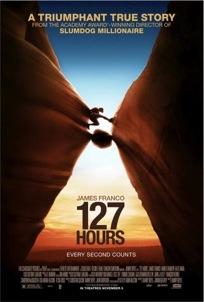
Start Choppin’: X&HT Reviews 127 Hours

it took me ages to figure out that the pic here is
an hourglass...

Bottle
films are notoriously hard to carry off. Putting all of your action
in one cramped, isolated place, with a limited cast of characters
could be the recipe for a tense, claustrophobic thriller. Rodrigo
Cortés’ sweatily effective Buried springs to mind as the most
extreme recent example.

If you’re going to hem in your
actor to that kind of degree, then you’d better be sure that you’ve
got someone bloody good in front of the camera. Ryan Reynolds is
brilliant in Buried, and I’d have been interested to see him cast
as Aron Ralston in Danny Boyle’s 127 Hours. He has the proper sense
of physicality and goofy charm for the role. Instead, the face that
we see in a hole in the rock is James Franco. It’s a testament to
Franco’s skills as an actor, and of Boyle’s as a director, that
we’re convinced from the get-go of his capability, energy, skill
and knowledge of the desert that very nearly kills him.

We all know the story by now.
Aron Ralson, crag-hopper, mountain biker, all-round super-confident
hardbody makes a split second mistake while out on a weekend jaunt
in the deserts near Moab, Utah and ends up in a crevasse, his hand
mashed between the rock wall and a huge piece of
chalkstone.

His story, and what he has to do
to get back to civilisation, is the stuff of legend. In fact, there
were times when I found myself scoffing at the preposterous nature
of his escape. “There’s no way he could rappel down that cliff,” I
chuckled at one point. “He’s half-starved, desperately dehydrated
and quite possibly in shock. What do the writers take me for?”
Aron’s story is mind-boggling because you have to keep telling
yourself that all this actually happened, that he did free himself
from a predicament that would have 99.99% of us forming an
attractively spooky display of bleached bones in a cave somewhere.
He survived, and continues to do the things he used to, only now
with a rather cool looking climbing tool replacing his left hand.
Very post-human.

The trick to keeping a bottle
film interesting is to keep your viewpoint fluid. In Buried, the
director does this by exploring every nook and cranny of the set,
and cleverly by changing the size of the coffin to enable his
camera to get into places where there simply shouldn’t be room. in
127 Hours, Danny Boyle takes a different approach, and a lot of the
film isn’t in the canyon where Ralston is trapped at all.

With the use of flashbacks,
hallucinatory episodes and gorgeous tracking shots over the desert
terrain, I felt like I was on a guided tour of the trapped
climber’s interior geography. It’s cleverly done, and although you
lose something of the isolation and claustrophobia that he must
have felt, the end result is a dazzling, eye-popping feast. The
cinematography is wonderful, and every format from yummy 35mm to
grainy 2003-era DV is thrown into the mix. Kudos to Enrique Chediak
and Anthony Dod Mantle especially for the beautiful macro work,
slipping cameras into water bottles, the guts of cameras and
tracking the path of ants and insects through the cave.

Danny Boyle is one of the few
directors out there that loves colour, and uses it to it’s full
advantage on the big screen. I’m tired of the limited palettes that
are the thing in film these days, and heartily sick of the dreaded
cyan/orange cliche that makes modern films look underlit and boring
to watch. 127 Hours is a hard dose of pure sunshine after all that
drabness, and I felt like Aron, dipping my toe in blissful relief
into warmth and light, if only for a little while.

As for THAT moment: well, I’m a
horror film fan, so I’ve seen significantly worse. It’s nicely
done, and everyone around me seemed to be squirming. I loved the
way the arm breaks were accompanied by an almost subliminal flash
of light. As I watched, though, I realised that no matter how much
gore or screechy sound effects Boyle threw at us, there would be no
way of conveying more than a hundredth of what Aron Ralston went
through that day, in his cave, alone and close to death.

127 Hours is a worthy testament
to an astonishing feat of human endurance, but it doesn’t come near
to showing us what it must have been like. That’s a good thing.
It’s a remarkably positive movie, filled with light and colour and
life, and a happy ending. As a lesson in what we can survive and
achieve, 127 Hours is a triumph.

X&HT Reviews: Season Of The Witch

My esteemed colleague WDW and I seem to have made it a habit that, if we go to see a film together, it’s usually as a dare to watch something truly dreadful. Our last adventure, a trip to see Twilight: Eclipse exceeded all our expectations.

When we settled down in front of Season Of The Witch, a medieval action-horror boasting a Rotten Tomatoes score of 3%, we had no thought that it was going to be anything more than turgid nonsense, with light relief coming from seeing how unconvincing Nic Cage’s hair extensions were going to be.

Readership, we were labouring under a misapprehension, one that desperately needs clearing up. Season Of The Witch will never be a great film, but if you enjoy derring-do, sword-play and ye olde adventuring then you could do a lot worse.

The story concerns Nic Cage and his wig returning from the Crusades as a deserter, along with his best mate Ron Perlman and his giant forehead. They are talked/blackmailed into escorting a witch across country to an isolated monastery, whose monks will take away her powers and cure the land of the pestilence sweeping across it. It’s a dangerous cargo story, a kind of olde worde Wages Of Fear, and the package they carry turns out to be neither the innocent girl that our heroes initially see, nor the witch that the monk accompanying them believes.

At 97 minutes there’s no flab or dull patches. The film gallops from wild-eyed battle to preposterous encounter. There are swordfights, wolves, demons, and a sweatily tense bridge-crossing sequence. There’s a decent performance from Nathan off of Misfits, and Claire Foy as the witch does a fine job of flitting between innocence and evil. Nic Cage does his trademark flip-out, and Dominic Sena directs the whole thing with an eye to the gothic and grotesque.

Yes, ok, the dialogue is pretty dreadful (although there are a couple of great lines that WDW and I quoted back and forth to each other in the pub afterwards) but then you show me a medieval actioner where the lines are anything more than groanworthy.

Short conclusion – we walked out feeling utterly bemused by the rotten reviews this film has been getting. It’s a lot of fun and solidly old-fashioned in it’s approach in giving you thrills and jolts in equal measure. It’s likely to get knocked around at the box office, facing as it does the one-two punch of 127 Hours and The King’s Speech in it’s opening weekend. That’s a shame, because if you’re in the mood for scary action (admission: I’m ALWAYS in the mood for scary action) this fits the bill admirably.

WDW and I wanted to see a bad film this weekend. We failed dismally.

(Check out her take on the film here.)

PoPcorn

Early CGI tests were not promising.

I have a review of Prince of Persia: the Sands of Time up at MovieBrit, in which I am not entirely complimentary. Not at all complimentary, in fact. As WDW, who runs the site, is a massive Gyllenhaalic, it’s good of her to run it uncut (although she couldn’t resist the temptation to adorn it with lots of pics of the man with his shirt off. I guess that’s what you call editorial input). Anyhow, go read. It’s one of your five-a-day of snark, bile, angst, over-reaction and humbug.

The fun starts here.

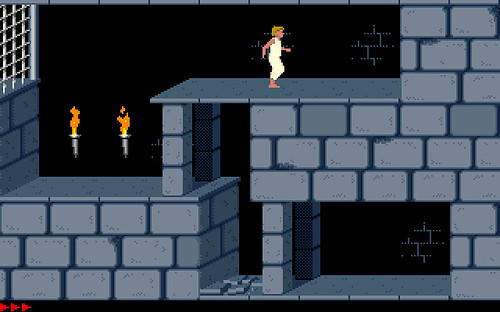
More fun here – a reminder of why Prince of Persia was the most frustrating game I’ve ever played!

Blood + Roses – a review

officialposter.jpg

Reviews should be objective. It’s never a good sign for a pundit to write a piece on a film when it’s known that he or she was involved in it’s creation. There’s no sense of distance, and every chance of bias.

Here is my review of Blood + Roses, a film which gives me a prominent colourist credit, and for which I put together an EPK.

Blood + Roses is a film about a girl who cannot help but get involved with bad boys.

At the beginning of the film we meet Jane, who is stuck in a loveless relationship with Martin, a cold, controlling bastard played with misogynistic glee by Kane John Scott. Jane, frail and wounded, has nightmares of something awful that has happened to her in the recent past. Something that she can’t quite remember, and that Martin is in no hurry to help her recall. Something that they have driven to an isolated cottage in the country to try and put behind them.

Once there, things don’t seem to be improving for Jane. Martin is unsympathetic, selfish. Then she meets, and is seduced by the ultimate tall, dark stranger – Seth, a vampire. As Jane begins to change, her memories of what has happened begin to return, and her frailty is shed in favour of something more primal. Physically and mentally, her strength returns. As it does so, Jane begins to thirst. Not just for blood, but for revenge.

Blood + Roses is an attempt to tweak some of the more romantic aspects of the vampire mythos, to tease out some dark truths about the nature of attraction and desire. Jane may be stuck in a loveless marriage, but she knows what she’s getting into with Seth. She embraces her new life with relish, and an almost unseemly haste, considering the consequences.

Jane is played by Marysia Kay with a touching fragility in the early stages of film, before her transformation. After, she becomes stronger, sleeker, more feline, graceful yet deadly. She portrays this change nicely, and as a vet of the BritHorror scene, I would have been surprised if she hadn’t. This is, after all, an actress who specialises in portraying strong women – sometimes strong enough to pull their hapless victims in two!

Seth, the third point in the triangle, is played with louche charm by Benjamin Green. Seth appears worldly and urbane, but at the same time he is very much the predator of the piece. He simply walks into Martin and Jane’s life and takes what he wants, without a wasted thought to the consequences. Jane is quick to embrace his attitude – any escape from the airless trap that her life has become with Martin would seem to be acceptable, even the loss of her soul.

Blood + Roses is a film to muse over, something that needs a little time to sink in and percolate. It’s careful to play with the mythos just enough – the “v word” is never mentioned, and in this film they can be seen in mirrors. An interesting move, perhaps to bring home the point that the life Seth offers is a dark mirror of the one Jane is so keen to leave. The life of a vampire is, in it’s way, as constrained as her marriage to Martin. She will never see the sun again, eat real food be able to have children. Her time with Martin may have stripped away most of her humanity, but accepting Seth’s bloody bargain means turning her back on what’s left of it.

The isolated location of Blood + Roses works in it’s favour. Most of the action takes place in the confines of the small cottage Martin and Jane have rented. The camera stays tightly framed on the actors, trapping them in dark corners, unable to escape their fate. The cinematography is lush and rich, though, and colour is used to surreal effect in a couple of dream sequences. Kudos to DoP Richard J. Wood and director Simon Aitken for resisting the temptation to desaturate the colour palette and give the pictures a mud wash. This is a good-looking film, even if it was shot in nasty HD video.

The film really comes to life when it’s focussed in on the vampires. The chemistry between Seth and Jane comes across beautifully, to the point where I was disappointed when they weren’t on screen. By contrast, I felt too much time was spent on the plot cooked up by Martin and his doctor friend Ted, and their crime against Jane. This wasn’t helped by the dry reading given by Adam Bambrough, which made the pair come across as buffoonish rather than truly evil. A shame, because on the whole I thought the script, by Simon’s long-time writing partner Ben Woodiwiss, worked well. And the guy can write a mean vampire.

On the whole, then, I found Blood + Roses an entertaining take on a couple of standard horror tropes. It doesn’t wallow in grue or histrionic performances, preferring instead a low-key approach that builds slowly towards the finale. Here, at last, my gorehound tendency was satisfied in an ending that riffed nicely on classical and Elizabethan revenge tragedy. It’s something a bit different, and I wish it well.

But then I would say that, wouldn’t I?